This conversation is the second in a series produced in collaboration with Experimental Foundation. Established in 2022, the Experimental Fellowship supports practice-led, research-based architectural projects that foreground experimentation as both method and ethos.
Federica Zambeletti / KOOZ Both teams approach soil from different but deeply rooted trajectories. Since these practices emerge from very different contexts, I’d like to begin by grounding the conversation in place. What does it mean for Grunt to work with soil in Ukraine today — socially, materially, and within the conditions the country is facing?
Anna Pomazanna/Grunt In contemporary Ukrainian practice, earth construction is almost absent. You might still find some vernacular techniques in rural areas, but in professional practice, even when earth appears in project proposals, it rarely makes it to implementation. This is due to gaps in building codes, difficulties sourcing materials, and the lack of skilled labour. We experienced these issues ourselves during the first stage of building the pavilion.
Historically, however, earth-based construction was widespread in Ukraine, as in many parts of the world. Unfired clay and soil appeared in different forms: traditional Ukrainian houses combined clay with plant fibres — straw, hemp — and often a timber frame. During Soviet industrialisation, some collective building traditions survived in villages, but they were gradually replaced by industrially produced materials — mainly concrete — which were standardised and cheap.
So when we started working with soil, it became clear that we were dealing with something that needs to be reintroduced into Ukrainian construction culture.
"When we started working with soil, it became clear that we were dealing with something that needs to be reintroduced into Ukrainian construction culture."
Mykhailo Shevchenko/Grunt I would add that this is a big question many of our colleagues are also exploring: which materials could support a greener reconstruction in Ukraine? We are returning to traditional materials — timber, plant fibres, clay — and experimenting with them. Reconstruction often prioritises speed, and that urgency can push these materials aside. For us, it’s important not to repeat past mistakes, but to imagine a different material culture for rebuilding. In that sense, we are, in some way, pioneering this work in Ukraine.
"Which materials could support a greener reconstruction in Ukraine?"
KOOZ Anna, you mentioned that one limitation to using earth today is not only building codes but also the shortage of skilled labour. Another issue your research addresses directly is soil contamination. Could you expand on this? What is the current state of soils in Ukraine, and what have you been able to identify through your research?
AP Our research began by reviewing reports that were produced not by architects but by environmentalists, soil scientists, and geologists. There is extensive data — collected through field studies, GIS mapping, and satellite imagery — on pollution levels in Ukraine, especially in the eastern and southern regions where most military activity has taken place. These studies were initially focused on agriculture, since Ukraine relies heavily on its fertile soils.
But we asked ourselves: if we turn to regenerative materials and hope to use excavated soils from the local environment to rebuild cities in the South and East of Ukraine, what happens when those soils are contaminated? This is where the work of geologists and soil scientists became crucial. We collaborated directly with two soil scientists — Oleksandr Bonchkovkyi and Zlata Sydorenko— who helped us apply field-study methodologies to analyse soil samples and identify pollutants. We focused mainly on heavy metals such as cadmium and arsenic.
It is important to say that this issue extends far beyond war-related contamination. Ukrainian soil scientists have long studied pollution from pesticides, agriculture, and, in cities, from industry and traffic. In the end, when we talk about war pollution, we are still dealing with specific elements — often the same heavy metals that also appear in industrial or agricultural contamination. So the topic resonates with many other contexts around the world, not only with the war in Ukraine.
"If we turn to regenerative materials and hope to use excavated soils from the local environment to rebuild cities in the South and East of Ukraine, what happens when those soils are contaminated?"
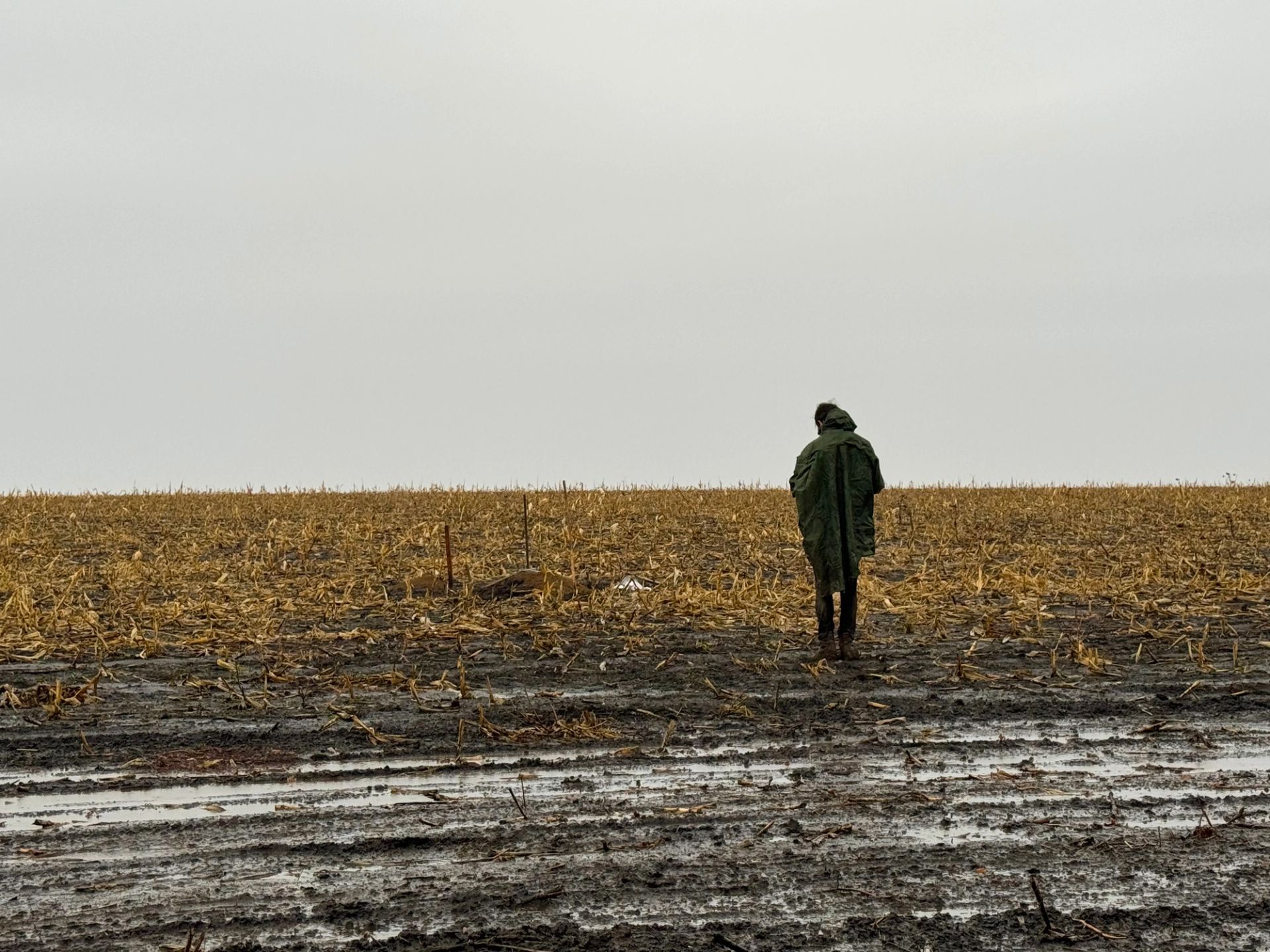
Gathering the soil samples in the field close to Fedorivka village, Kharkiv region, Ukraine. Field research of Grunt. Photo © Anna Pomazanna
KOOZ The repercussions of the Vietnam War are still visible in the landscape, and soils remain contaminated in many areas. Given that you’ve spoken about vernacular knowledge and the continued use of rammed earth, how did these practices change during or after the war? And what is the situation today when working with these soils?
Ha Nguyen/Situated Regionalism In Vietnam, rammed-earth and earth–plaster construction — often combined with bamboo structures — has a history of more than a thousand years, especially in the northern mountainous regions. During the war, most bombing occurred in the South, so the soils traditionally used for rammed-earth construction in the North were not directly affected. As a result, these vernacular techniques continued, and the way they are practiced has not fundamentally changed.
Today, however, we face different pressures. One major issue is sand mining. Because of rapid construction across the country, sand has become scarce, and illegal mining has severely damaged riverbanks and nearby villages. This has pushed us to look again at soil-based materials as an alternative.
At the same time, the Vietnamese government has announced an ambitious goal of reaching net-zero by 2050. It isn’t yet written into law, but there is now an official recommendation that 40% of the materials used in public construction should come from earth or from industrial by-products. Interestingly, most existing soil research in Vietnam does not come from architects but from agricultural and fertilisation studies, so the material is still underexplored within architecture. In that sense, we are among the first firms to research soil in a contemporary architectural way — experimenting with compressed earth blocks and other techniques.
"Most existing soil research in Vietnam does not come from architects but from agricultural and fertilisation studies, so the material is still underexplored within architecture. In that sense, we are among the first firms to research soil in a contemporary architectural way."
Hojung Kim/Situated Regionalism Building on what Ha said, there have been studies since the 1990s by Vietnamese researchers mapping where Agent Orange contamination occurred across the country. There are diagrams and maps that show the spread quite precisely. What is important, however, is that the main concern is not Agent Orange itself — its chemical compounds break down relatively quickly — but the dioxin TCDD, which is far more persistent and much harder to measure. To analyse dioxin properly, the soil needs to be fully exposed to sunlight, and most studies only test the topsoil. There is still little research on the deeper “health” of the soil.
For our project, we began with data from seven regions. We initially focused on northern Vietnam because many of our projects are based there, but we expanded the study to include the South and the islands in order to understand different geographical conditions. We were able to collect soil from five of the seven sites; the remaining two were inaccessible due to typhoon and rainy-season conditions, which made it impossible to dry the samples in time.
We conducted laboratory tests to analyse the proportions of silt, sand, and sulfate in each sample. So far, we haven't found anything dramatically unexpected. However, one of our sites is in Nhơn Trạch, not far from a former military base. Early studies indicate that this area was sprayed with Agent Orange in the 1970s and 80s, so we are particularly interested in whether any trace remains today.
Our sampling process was rigorous — we took soil from depths of one to three metres to ensure the most accurate results. When we return from our trip to Berlin, we’ll also test a dried sample from Nhơn Trạch–Dong Nai to see whether we can detect any dioxin residues.
KOOZ Anna, Mykhailo, I’d like to understand how you’ve been approaching this from a design perspective. You’ve mentioned that much of the scientific knowledge comes from soil scientists, yet you are now exploring how to actually work with these soils: how to encapsulate contaminated material, how to dilute it, and how to imagine its use in construction. How does the scientific analysis inform the ways you build or speculate with soil? And which contaminants are you dealing with? I imagine they are quite different from those found in Vietnam.
AP In our case, the main contaminants are heavy metals — primarily cadmium and arsenic. Hearing about the chemical behaviour of Agent Orange in Vietnam has been fascinating, because the treatment strategies are completely different. With heavy metals, we are dealing with pollutants that do not break down; they persist and accumulate. That led us to look closely at the chemical properties of clay.
Clay can act as a filtration and absorption material. In soil-washing facilities, for example, contaminated soils are washed so that pollutants accumulate in the clay fraction, while the cleaned sand and gravel can be reused — for instance, in road construction. Because clay is so effective at binding heavy metals, we began studying research on clay and earthen construction in more detail.
A key reference for us was the work of researchers at BAM — the Institute for Materials Research and Testing in Berlin — particularly Dr. Ute Kalbe. Her studies on historical earthen buildings showed that structures built from polluted material (for example, near industrial sites) or exposed to pollutants over time (such as smoke from ovens or kilns) often absorbed contaminants into the walls. In earthen structures, the pollutants tend not to migrate extensively. Heavy metals remain bound within the clay matrix. Organic pollutants, by contrast, off-gas over time, which poses greater health risks.
For heavy metals, this containment capacity of clay became central to our strategy. We began developing an approach based on encapsulation: stabilising contaminated soil within the building structure, then covering it with several layers of clean material. We are aware that many users may feel skeptical or even fearful about living in buildings that contain contaminated material. But our research into legislative “limit values” — in Ukraine and internationally — helped us understand where the real risks lie.
Most limit values come from landfill regulations, where the crucial question is whether contaminants could leach into groundwater. The highest environmental risks arise when polluted material is placed directly into the soil through landfilling, not when it is immobilised inside a building. That led us to propose that buildings could actually serve as safer long-term encapsulation environments, preventing exposure for both humans and ecosystems. This is counterintuitive — almost an anti-modernist position, given the modernist ideal of the sterile, sealed interior and the notion that “waste” belongs outside. But this provocation pushed us to rethink how built and natural environments are intertwined, and how construction might participate in cycles of contamination and care rather than simply exporting its burdens elsewhere.
"In earthen structures, the pollutants tend not to migrate extensively. Heavy metals remain bound within the clay matrix. Organic pollutants, by contrast, off-gas over time, which poses greater health risks."
MS Working with contaminated material forces us to rethink construction from the ground up. As architects, we are used to certain standard systems — typologies that are so widespread we barely question them. But the moment you introduce a wall that contains contaminated soil, everything becomes thinkable again. You have to reconsider how the element is used, the conditions it will be exposed to, how people will interact with it, and what might happen if it is damaged.
It also forces us to think carefully about end-of-life scenarios: how the building will eventually be dismantled, how the material can be safely handled, and whether it can be reused. You can’t simply substitute this material into an existing construction logic. You have to redesign the whole process around it.
In that sense, working with contaminated soil doesn’t only change how we use this particular material; it pushes us to reconsider how we build altogether — how we assemble, maintain, and deconstruct our buildings across their entire lifecycle.
"In that sense, working with contaminated soil doesn’t only change how we use this particular material; it pushes us to reconsider how we build altogether — how we assemble, maintain, and deconstruct our buildings across their entire lifecycle."
HK I have a question for the Grunt team: in the areas where you conducted your experiments, how high were the contamination levels? Are we talking about a significant amount?
AP In our samples, the cadmium levels were only about one-and-a-half to two times higher than the Ukrainian limit values. When we compared them with German regulations, the numbers were roughly similar — cadmium thresholds in both countries are close.
For arsenic, the situation was a bit different. Ukrainian regulations are stricter, and in two of our samples we were slightly above the national limit. But when we compared those same results to German limit values, we were actually below their thresholds. So this raises the broader question of what is considered “acceptable” contamination, which varies significantly from country to country and depends on how the soil will be used.
In any case, we were not dealing with extreme pollution — nothing like the cases where contamination exceeds the limits by 20 times or more. In that sense, we were “lucky”: the material was not hazardous enough to endanger us or anyone working in the Bauhaus Earth Workshop. At the same time, the results gave us a useful opportunity to study how these limit values are defined and applied.
"This raises the broader question of what is considered “acceptable” contamination, which varies significantly from country to country and depends on how the soil will be used."
HK And how broad was your sampling? Ukraine is a very large country, so I’m curious: were your soil samples taken from one specific region, or are you collecting from multiple areas across Ukraine?
AP Our samples all came from the Kharkiv region. We had very limited time, and because it’s on the opposite side of the country from where we live — and very close to the front line — the trip had to be fast and quite risky. So we focused only on this region and collected two samples from sites where we knew the type of contamination in advance. One was from the crash site of a military helicopter; the other was from an area where multiple rocket launchers had been stationed.
MS For us, it was important to take samples specifically from de-occupied territories, where contamination was certain. But it’s also crucial to remember that contamination migrates over time, and concentrations can vary widely even within the same region. We were only able to collect two samples on this trip, but in the future it will be essential to investigate other sites and other regions across Ukraine.
Even with this limited set, the process gave us valuable experience: how contamination behaves, how it shifts over time, and how to work with geological data from previous tests. We could already see that the situation is unstable, and that understanding these changes is an important part of the research moving forward.
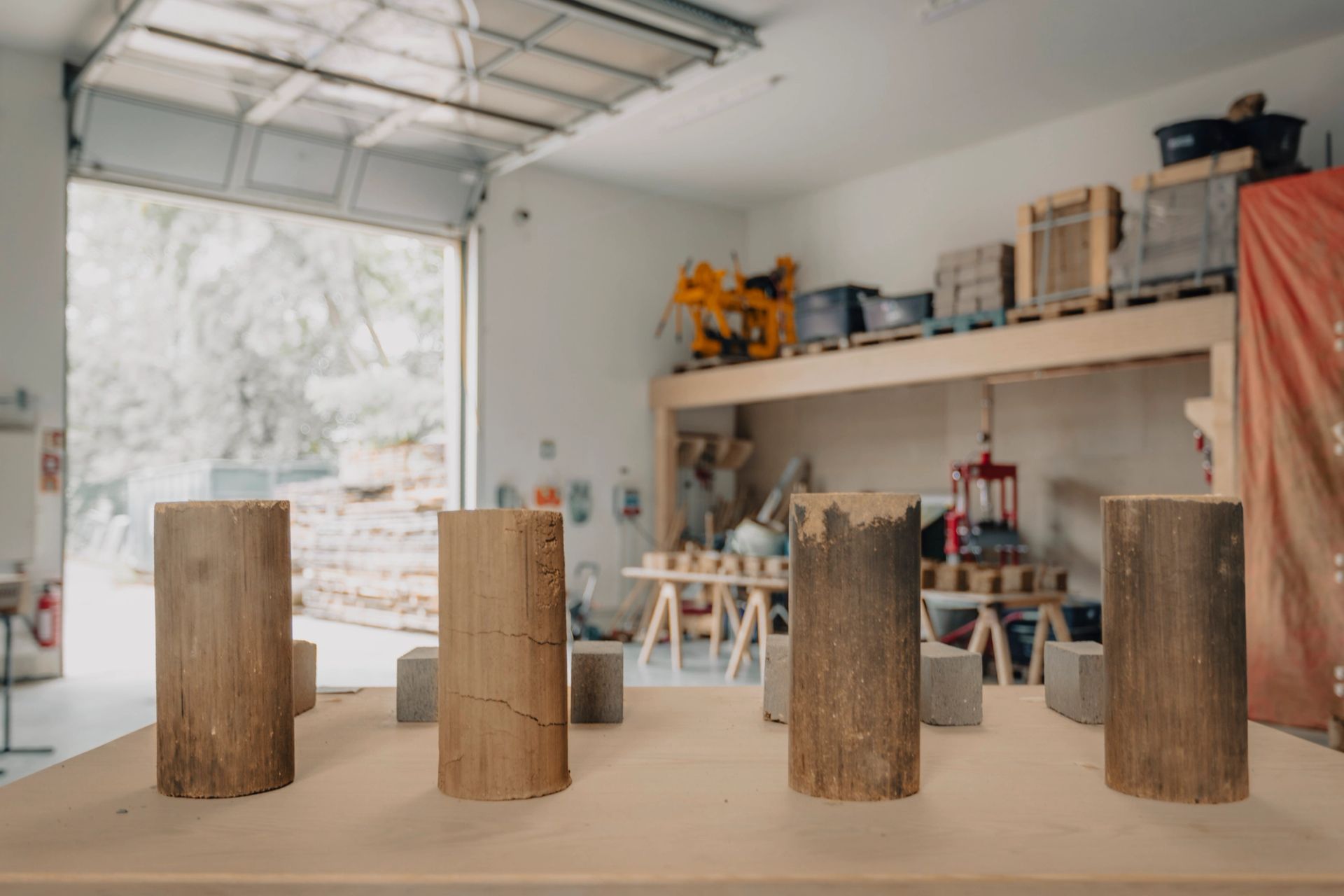
Material samples to identify different levels of contamination at Bauhaus Earth Workshop. Research of Grunt. Photo © Raquel Gómez Delgado
KOOZ Speaking of limit values — and how they vary across different geographies — I’m curious how this affects the actual production of construction materials. You’ve been working with compressed earth blocks (CEB) and developing a prototype, but how feasible is it to apply this process elsewhere if every country or region has its own contamination thresholds? How do you approach creating a “recipe” for producing these blocks when the regulatory frameworks differ so much?
MS It always has to begin with testing. You must work with the soil you have, which means first understanding its level of contamination and then its composition — how much sand, how much clay, and what other particles are present. Only after those tests can you determine how the material should be used.
For example, the soils we collected from the Kharkiv region were extremely clay-rich: one sample had about 85% clay, the other around 80%. Knowing this, we understood that to make CEBs we would need to add sand. Geological maps then become very useful, because they allow you to locate nearby sources of complementary materials — in our case, areas with much higher sand content that could be combined with our clay.
Another approach is simply to work with the soil as it is, without adjusting its composition. In that case, you would shift to a different technique: instead of CEBs, you might use the material for plaster, or as part of a light-earth mixture. In other words, the “recipe” depends entirely on the local tests and on choosing the construction method that fits that specific soil.
"You must work with the soil you have, which means first understanding its level of contamination and then its composition — how much sand, how much clay, and what other particles are present."
AP To add to the question of pollution levels: although we are developing practical and experimental frameworks for working with contaminated soil, we will eventually need to define our own limit values. It’s unrealistic to say that “anything goes” — not every level of contamination can or should be incorporated into construction materials.
Our premise is that we are taking soil that is too dangerous to leave in the open environment — too risky to enter natural cycles, to become part of food chains, or to leach into groundwater — and relocating it into a controlled, encapsulated form. So while such soil may not be suitable for agriculture, it may still be suitable for construction. But there will always be a threshold beyond which the contamination is too high, even for industrial typologies.
Our task, then, is to work within existing conditions and to identify what constitutes an “acceptable” level for construction, while also pushing the boundaries of what can be done with polluted natural materials.
"Our task, then, is to work within existing conditions and to identify what constitutes an “acceptable” level for construction, while also pushing the boundaries of what can be done with polluted natural materials."
KOOZ I’m also interested in where your research stands now and where it is heading. You’re simultaneously working on practical applications — actually building — and engaging with questions of legislation. How does this work in practice? What is the process for reviewing or, since this hasn’t really been done before, defining new limit values for using contaminated soil in construction? And what kind of timeframe does this involve?
AP This is very much a long-term project. At the beginning of the Fellowship, the Experimental Jury told us it could easily become a lifelong research trajectory — and I can see why. Our next step, for example, is to commission professional leaching tests to understand what contaminants are released under percolation. In some European countries, these certified procedures take six to twelve months. So if a single testing cycle can take up to a year, you can imagine how long it takes to repeat the tests, adjust the technology, and eventually translate the results into policy.
So yes, the long-term goal — developing new limit values and influencing legislation — will take many years. But there are also shorter-term opportunities through experimental construction. It’s one thing to create widely accepted standards; it’s another to build real prototypes that demonstrate feasibility, allow for real-life testing, and help with social acceptance. So our work moves on two parallel tracks: the long-term legislative and scientific process, and the short-term strategy of building, testing, and showing that these methods can work.
"It’s one thing to create widely accepted standards; it’s another to build real prototypes that demonstrate feasibility, allow for real-life testing, and help with social acceptance."
KOOZ It’s fascinating — and encouraging — to think of a lifetime dedicated to soil, especially if we consider how the construction industry needs to redirect itself. Since you’ve now completed your first year of the Fellowship, I’d like to turn to Hojung and Ha. How do you plan to approach the upcoming year? Will your focus be primarily on practice and material experimentation, or do you also foresee engaging with the legislative dimension of soil use in construction?
HN Recently, almost all of our projects are outside the city — either in suburban areas or in mountainous, hilly regions. In these contexts, we approach every project with the assumption that soil must be part of the construction. And if a client refuses this premise, we actually decline the commission. It’s a radical position, but for us it’s essential: we want to revive traditional knowledge and translate it into a contemporary material practice.
Many forms of know-how have been lost in Vietnam, and several natural resources — stone, sand, even certain types of clay — are now either depleted or restricted because extraction has caused serious damage to the landscape. By contrast, Vietnam’s soil conditions are incredibly rich and full of potential. We believe soil should be developed in a more thoughtful, future-oriented way, especially if we want to reduce environmental damage and decrease the dependency on destructive materials.
Cost is also a key issue. One of our goals is to demonstrate that soil-based construction can be economically comparable to conventional materials — and, ultimately, that it is the more sustainable option. In the next phase of the Fellowship, our priority is to prove this in practice: to show that soil can stand as an equal alternative in terms of performance and cost, while also carrying cultural value and opening up a different developmental path for Vietnam.
HK Our choices have been very intentional. For example, we avoid using plaster finishes because we want the blocks themselves — and the craft of making them — to remain visible. This also reflects the potential for low-skilled labour to take part in the process. The modules can be produced directly on site, which eliminates the need for transportation and makes the system far more accessible and scalable.
KOOZ Ha, you spoke earlier about the richness of Vietnamese soil. This raises a fundamental question: rich soils are also carbon sinks — crucial for agriculture, for biodiversity, and for absorbing CO₂. Ecosystemically, they need to remain in the ground.
On one hand, soil is a generative medium that produces life; on the other, you are transforming it into construction material. Some might argue that using fertile soil in buildings could be as damaging as sealing land with cement, given that soil takes thousands of years to form. So how do you navigate this tension? Are you attentive to how “rich” a soil is, and whether it should ever be used for building? And does this mean that perhaps we should only work with contaminated soils — materials that can no longer function ecologically and therefore need to be regenerated through alternative uses?
HN In Vietnam, the problem of fertilisers is significant. Our country is among those that depend most significantly on agriculture, and the overuse of chemical fertilisers has severely affected many soils. As I mentioned, when we recently tested samples from different sites, two of them had unexpectedly high sand percentages. We later discovered this was due to long-term fertiliser use, which had altered the soil structure.
In terms of producing CEBs, our ecological studies show that planting certain species can later provide fibres that help absorb toxins in the soil. These fibres can then be mixed into the earth, and together with natural biopolymers they create a kind of protective “skin.” This layer can help stabilise contaminated soil and prevent pollutants from spreading into the wider environment.
We also pay close attention to climate. Vietnam’s climate — its humidity, heavy rains, and heat — is very specific. Soil performs extremely well in these conditions. It regulates humidity, responds naturally to thermal changes, and is well-suited to tropical environments. Historically, Vietnamese engineers have used earth even in reinforced-concrete buildings — during the colonial period, for instance, earth and fibres were used in the ceilings and slabs, at a time when modern materials were not yet widely available. We learned a great deal from studying those techniques.
All of this reinforces our understanding that soil is not only an ecological material but also one deeply adapted to our climate and construction culture.
"Soil is not only an ecological material but also one deeply adapted to our climate and construction culture."
AP The pavilion we built and lived with was not made from contaminated soil. For us, it was important to place something in public space that demonstrated the reliability of earth as a construction material — something that could show people that soil is strong, durable, and viable for reconstruction. We couldn’t take the risk of using polluted material in a public setting in the centre of the city. So instead, we used soil from the waste stream of a nearby excavation project.
Even though that soil wasn’t contaminated, it was still meaningful to work with excavated material — soil that had already been displaced by another construction project. This aligns with other material research practices, such as the work of BC Materials in Brussels with Léém, which also focuses on utilising waste streams.
For us, there are two parallel commitments: Working with contaminated soil when removing it from natural cycles is beneficial for the environment — when it is too dangerous to remain part of agriculture, ecosystems, or groundwater flows. And also working with soil from construction waste streams, especially given the enormous amount of excavation that will occur during Ukraine’s reconstruction. This provides abundant material without taking fertile soil away from nature — soil that should remain in place to support life and store carbon.
Both paths are essential if we want to use soil responsibly, without depriving ecosystems of what they need.
MS For us, it’s also essential to work with unstabilised mixtures. We want the material to be able to return to nature at the end of its life. This ties back to how we organise the entire project. As Anna mentioned, we deliberately work with soil that would otherwise be sent to a landfill site and stored there indefinitely. There is an enormous amount of excavated soil in Ukraine that is not contaminated yet still unused — often mixed with other soils or simply discarded.
Knowing this, our aim is to ensure that the material we produce is fully reusable. We keep this in mind at every stage and think carefully about the broader processes behind construction — processes that are often overlooked but are actually vital. By working with unstabilised earth and waste-stream soils, we hope to create cycles where the material can be returned, reused, or reintegrated rather than becoming permanent waste.
KOOZ You’ve both spoken about building on vernacular knowledge, and that raises an important question: how do you plan to document this research so that it remains accessible to others? The work you’re doing through the Fellowship — and through your built experiments — could be valuable for practitioners in very different contexts. How do you envision sharing these methods and findings so that others can engage with the topic and carry the research forward within their own systems and geographies?
MS We’re currently presenting our work in the Lviv Mobility Center, (October 16 – December 4), and today we’re hosting another event that walks through the entire project — from the initial research to the construction phase. Sharing the work is a central part of the Fellowship’s Creative Commons licence, and of the project more broadly.
We’re also developing our website as a platform to publish the methods, findings, and documentation. Because this is an experimental technology and not yet widespread, it feels especially important to make the knowledge accessible. In conversations with Ukrainian architects and scientists, we’ve realised that many people are trying to explore similar questions. Making our research public can help connect these efforts and support others who want to continue or apply the work in different contexts.
AP We really value exchanges like this. Sharing knowledge with the public is essential, but equally important for us is contributing to academic and professional discourse. Even though academia can sometimes feel like a separate or exclusive sphere, we want the results of our Fellowship to enter that space as well.
Since this is a long-term, potentially lifelong project, it shouldn’t depend on just a few enthusiasts. It’s stronger when many people participate. That’s why publishing academic articles — and making them open-access — is a priority for us. Our public exhibition also reflects this approach: it includes contributions from 15 students whose projects are now part of the research.
In this way, the work circulates not only among the general public but also among professionals who can build on it, adapt it, and push the field forward.
"Sharing knowledge with the public is essential, but equally important for us is contributing to academic and professional discourse."
KOOZ I remember attending a soil conference last year — three full days with soil scientists who were completely immersed in their field. Later, I found myself surrounded by construction experts speaking an entirely different language. It made me realise how much knowledge sits within science, often inaccessible simply because the terminology and modes of communication are so different from those used in architecture.Every time we bridge these worlds, it feels like we have to “translate” the same ideas into two parallel languages — not just literal languages, but disciplinary ones. I’m curious as to how you navigate that need to constantly rewrite and reframe information so it can be understood across different fields.
AP At the same time, each moment of “translation” forces us to test our own hypotheses. Every time we rewrite something for a different audience, we have to ask ourselves again: Does this actually make sense?
In that way, the repetition becomes productive. Each iteration of communication requires us to confront the reality of what we’re proposing and to verify that our approach holds up — not only scientifically, but also architecturally and socially.
"At the same time, each moment of “translation” forces us to test our own hypotheses. Every time we rewrite something for a different audience, we have to ask ourselves again: Does this actually make sense?"
HN For us, archiving is one of the most important parts of the work. In Vietnam, we have very little historical documentation — not only in architecture, but in general. Our written language has shifted over time, from Chinese characters to a Latin-based script, and in that transition, a great deal of knowledge was lost. Much of our vernacular building culture was never written down; it survived because people practiced it, spoke about it, and passed it on orally. But very little exists in any permanent form.
That’s why this project is also about building an archive — not just of our own methods, but of a way of working with material that has almost no written history in Vietnam. Recently, we had a conversation in Vietnam about what “research” even means in architecture. We rely heavily on scientific knowledge from other fields, but we also believe that architects produce knowledge through doing — through drawing, building, testing. That knowledge also deserves to be recorded.
So archiving becomes a tool: for us, for future architects, for researchers in ecology or material studies. Through documentation we can capture information about the sites, the materials, the processes. And that archive may help others see possibilities that are not yet visible — another way of expanding the knowledge that architecture can offer.
"Much of our vernacular building culture was never written down; it survived because people practiced it, spoke about it, and passed it on orally. But very little exists in any permanent form."
HK For us, the key is not to rely solely on expert knowledge, but to actively bridge the gap between disciplines. One way we’re doing this is by developing what we’re calling a Soil Atlas. This platform is important because it doesn’t only document how materials are physically made; it also brings in the conceptual, historical, and socio-cultural dimensions behind them.
This morning we had a really interesting conversation about the idea of material literacy — how materials can carry cultural and ecological narratives within them. We’re trying to embed that perspective into the objects we create, so that the material itself reflects not only its technical properties but also the cultural ecology it comes from. Our hope is that this becomes a meaningful resource for others as well.
KOOZ That’s a wonderful way to end. Thank you for sharing your research and practice with us.
About
Experimental Foundation is a Berlin-based non-profit organisation founded by architect Prof. Regine Leibinger in 2022. It supports projects that aim to redefine the field of architecture by challenging how and with what we build. Committed to sustainability beyond the technical, Experimental focuses on spatial quality and aesthetics. It provides emerging talents with financial and organisational support, creating space for experimentation and the development of unconventional questions and project ideas. The Experimental Fellowship at Bauhaus Earth has promoted seven fellows over the last three years. Building up the fellowship program with further partners, in July 2025 two postdoc Experimental Fellows at Harvard GSD are supported for one year; Experimental will launch its next Open Call with a new partner shortly thereafter, in early 2026.
BIOS
Grunt (UKR: ґрунт) investigates the potential of regenerative reconstruction in Ukraine using earth sourced from contaminated soils by industrial, agricultural and wartime sources. Their aim is to address war-related environmental pollution, making its remediation an integral part of reconstruction and engaging architects in the effort. Central to the project is promoting multidisciplinary cooperation networks and developing guidelines that can be applied to other post war contexts worldwide.
Anna Pomazanna is an architect and educator. After completing her Master’s at TU Berlin, she worked as project architect and competition team leader at Kleihues+Kleihues in Berlin. In 2022, she returned to Ukraine to teach at the Kharkiv School of Architecture, where she developed a course on architectural typologies. Her work focuses on biobased materials, particularly earth construction in the context of Ukraine’s recovery. She is a co-founder of the NGO Materia Lab.
Mykhailo Shevchenko is an architect, product designer and educator. Since 2018, his work has focused on material research, circular design and open-source practices. He teaches at the Kharkiv School of Architecture and leads the annual ‘First Aid Spatial Kit’ workshop. In 2023, he became Head of the Office for Shaping the Built Environment at the Department of Architecture and Spatial Development of the Lviv City Council. He is a co-founder of Materia Lab, an NGO focused on circular practices, local materials, reuse and recycling.
Situated Regionalism explores the role of unfired brick construction across Vietnam’s seven ecological zones, from upland forests to coastal wetlands. The project engages with the country’s diverse geology and Indigenous building traditions while addressing challenges linked to colonial infrastructure, war-related contamination, and rapid industrialization. The fellowship unfolds between Vietnam and Berlin, combining fieldwork, prototyping, and digital research to advance regenerative earthen construction rooted in local knowledge and ecological sensitivity.
Ha Nguyen is an architect and co-founder of arb architects, MM Lab, Vietnam. Her work combines computational methods with local crafts to develop ecological and community-based design strategies. She affirms Indigenous knowledge and spatial autonomy while experimenting with material innovation. In 2024, she received the Moira Gemmill Prize for Emerging Architecture.
Hojung Kim is an Assistant Professor at the University of Tennessee and co-founder of MM Lab. His research examines how centralized manufacturing systems displace Indigenous techniques and degrade ecosystems. He frames material production as a site of ecological resistance and cultural resilience, connecting local practices to broader architectural debates.
Federica Zambeletti is the founder and managing director of KoozArch. She is an architect, researcher and digital curator whose interests lie at the intersection between art, architecture and regenerative practices. In 2015 Federica founded KoozArch with the ambition of creating a space where to research, explore and discuss architecture beyond the limits of its built form. Parallel to her work at KoozArch, Federica is Architect at the architecture studio UNA and researcher at the non-profit agency for change UNLESS where she is project manager of the research "Antarctic Resolution". Federica is an Architectural Association School of Architecture in London alumni.