Shumi Bose/KOOZ Well, let me start by thanking you for inviting me to Assemble’s legendary communal lunch table — today cooked by Irgel! As this is an intimate conversation over some stew, I wanted to depart from a more formal output: the recent monograph on Assemble by renowned critic Aaron Betsky, published by Thames and Hudson. How did it feel to look back over Assemble’s first decade in practice?
Anthony Engi Meacock It was interesting; we were approached by Aaron, whereas a lot of architects initiate the retrospective monograph about their own work. I think it’s actually a very hard thing to do.
Mary Anderson I quite enjoyed it. Since the book came out, as well as the talks around its launch, I liked that you were able to take a book that someone else had written about you and use it to reflect on yourself. It's a useful thing!
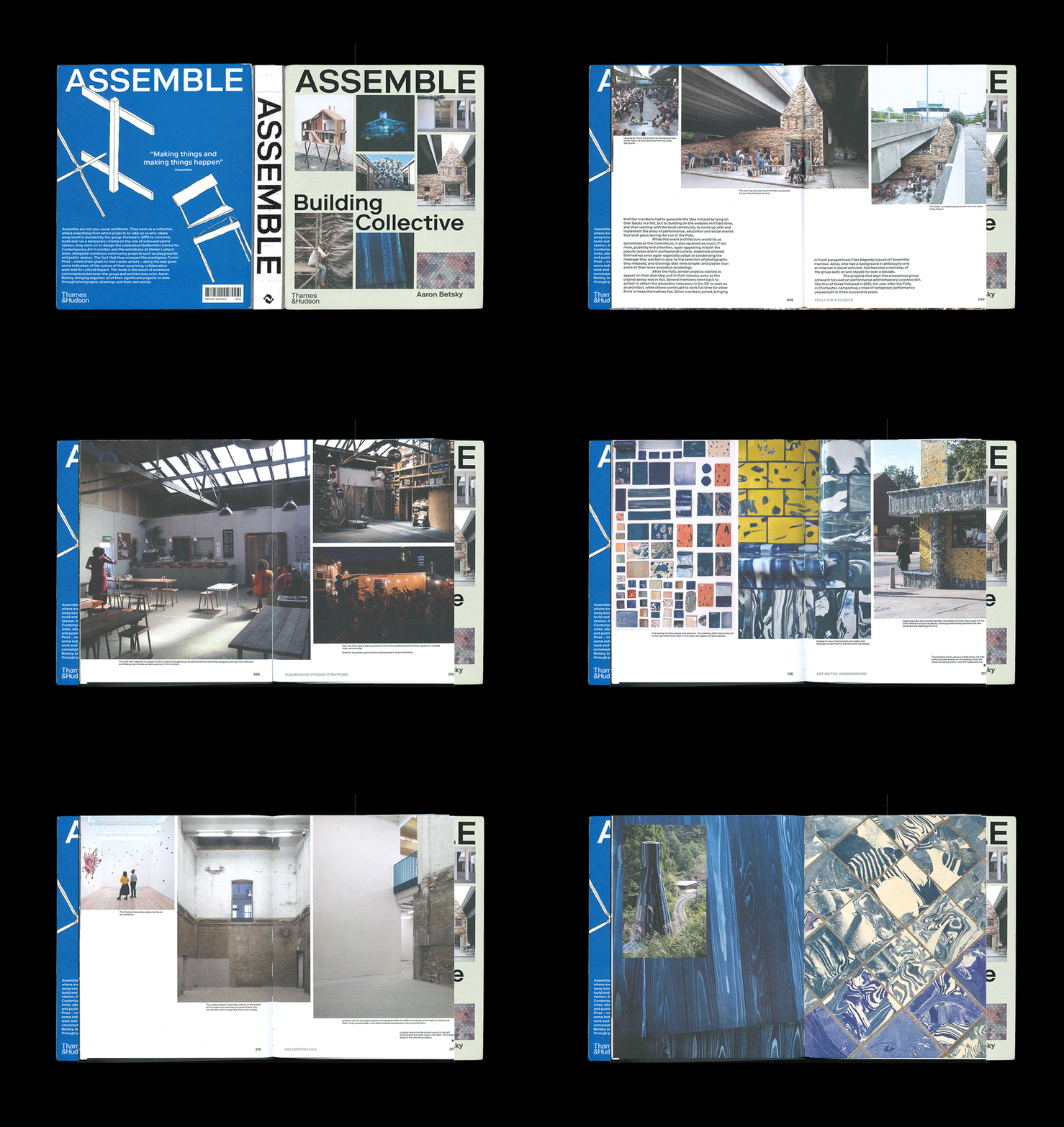
'Assemble: Building Collective', edited by Aaron Betsky, celebrates the Turner Prize-winning architecture collective
KOOZ The popular legend of Assemble is of an organic group of friends who fell into a convivial form of practice. As the book gives us a factual timeline, let’s talk about the undocumented ways in which the practice has changed shape. The first time I encountered Assemble was at an event called ‘Rip it Up’, shortly after your Cineroleum project in 2010 —
AEM That was the first talk we ever did. In fact our name only crystallised there.
Maria Lisogorskaya Yeah, I don’t think we were even ‘Assemble’ before that —
AEM I guess I was there from the beginning. I was studying architecture at Cambridge… maybe 22 or 23 years old? We finished our undergraduate degrees and were largely working in London. It was a set of very loose conversations — the earliest one was at a birthday party — about the dullness of junior practice, especially in the middle of a recession. We wondered if it would be possible to make or do something — not to start a company, but just to make work.
KOOZ … To make work instead of having a job, as such?
AEM No, no — we were thinking of it almost as a hobby, or rather something that was enjoyable in and of itself. The Cineroleum project was really beautiful, how that thing came about. We discussed different scenarios — from refurbishing someone’s parents’ house to building a folly. Slowly, our conversations morphed into an idea for something in London. I think it was Lewis who suggested looking at petrol stations, because loads of them were closing down — one really near him in Stockwell. “This petrol station site has been empty for a while, shall we … ?” It seemed for a moment like everything was up for grabs. We’d have regular meetings at the pub, with slightly different people at each one and the project slowly evolved.
What I can't remember is the moment where that project definitely became the Cineroleum. There were ideas around performance, we thought that would be interesting. Theatre was probably over-ambitious, but film seemed nice. That's how our friend Amica Dall got involved; she ran a little film festival in Cambridge.
KOOZ Maria, do you remember moments where things crystallised?
ML I came in through Lewis Jones, who was actually my college “son” — he was a year below me at King's College; there is a “parent” system in which freshers or new students get two student guides from the year above. So at university, I had done a couple of projects together with Lewis and Paloma Gormley — founder of PRACTICE architecture and now co-director at Material Cultures. That’s when he mentioned, “Come and join this project. We're thinking about doing something.”
KOOZ What were you doing at the time?
ML I was working for Asif Khan. I had been to Rotterdam, and then I came back to London; after starting work, I wanted to do something more hands-on… so Lewis told me about this group and that's how I joined up. I just remember being on site, making things…
KOOZ But this was still nebulous, you didn’t know that this was going to be a group practice at this point.
ML No way, no. Not for a long while, actually! Some went back to their studies, other people left…
AEM There was a chat in the lobby of the Cineroleum, with the curtains down. We were thinking about what was next, should we look for other projects…. Some of us were working at muf architecture/art, who were looking at the Olympic redevelopment and legacy plans for East London. So Liza Fior had kindly suggested a few sites in Barking, which she thought might be interesting for us to look at. One of those eventually became the site for Folly for a Flyover.
ML It was actually the Barbican Centre that got in touch with us — they asked whether we wanted our project to be a satellite for their animation exhibition. But they didn't have any money; they connected us to Create London, an organisation supporting socially inclusive art and architecture projects.
KOOZ So the Barbican asked whether you — as a group of multi-skilled, but informally organised people — want to be a satellite for their exhibition?
ML Yeah — that's when we had to become a company, to get the funding from CREATE.
AEM Even then, it felt like there may or may not be a future, but the focus at the time was entirely on producing the Folly.
ML That was also when we applied for our first paid job, and when a few people decided to try and carry on working as a group. Our first paid project was New Addington, commissioned by Finn Williams, who obviously took a massive gamble on us. We didn’t have anything real before, as a practice. We had a couple of articles in The Guardian since the Cineroleum project, but they were open to us applying to do that project.
KOOZ What was it like having such enthusiastic press early on?
AEM Some strange things happened. Like that weird invitation from Calvin Klein —
ML We came up with a proposal, but it was way too ambitious.
AEM We proposed a floating greenhouse on the Thames that would be reused and redistributed across various community gardens. There were a few of these unexpected conversations happening…
KOOZ The Cineroleum was built in a rather democratic manner, if not as explicitly as community-facing as Folly for a Flyover, New Addington or many of the projects that came afterwards. Your work seemed to emerge with a sense of civic generosity: was that baked in at the beginning — or was it more about finding fun projects before developing an ethos?
AEM I think that's fair — the ideas that were embedded in our approach probably came from our education and being taught by figures that instilled certain ethical underpinnings. But the civic aspects were always implicit rather than explicit. With the Cineroleum, the idea of being public was important — the spectacle of things like hoisting the curtain and hosting performance in the city.
"With the Cineroleum, the idea of being public was important — the spectacle of things like hoisting the curtain and hosting performance in the city."
ML To start with, Cineroleum was just about making something together with other people — but it was a ticketed cinema where you had to pay, so the idea of publicness was not fully thought out. With Folly, it definitely felt like, how can we make this accessible? Especially in that community at the time, there was not much going on, so we wanted to keep it open.
AEM You know, Cineroleum was only open for ten nights — and we had one illegal screening. So the attention was amazing but very unexpected. I guess it was also a really visible location. On the first weekend, we had just about sold out before the screening. By the second of four weekends, word had gotten out, and it sold out in two hours. For some reason, my mobile number was the contact and my phone was ringing off the hook for weeks, not having thought through that process. By the final week, we sold out in about five minutes. So things gained momentum. I also think, accidentally, it's the thing that made it a bit legendary — because it was so brief. We could have run it for a long time, but that probably made the hype more intense.
KOOZ Let’s switch from that deep history to some of the more recent members of Assemble. Mary, when did you find out about the practice and what led you in?
Mary Anderson Probably when I was applying for uni — it felt like there were quite a few pop-up projects, almost like a new genre. There were probably some lectures at Cambridge that mentioned Assemble. Then, when I left university, I did a project with Practice Architecture, a self-build house — I worked on it for a couple of years on, and then went to do different things, including working at other practices and completing my MA at the RCA.
KOOZ Kaye, when did you decide that you want to work at Assemble? Were you at school, or was it before that?
Kaye Song Quite early, during my undergraduate education. We were taught by Rod Heyes, whom I think also taught some of Assemble —
AEM He didn't teach us, but we talked to him a lot. When we were doing the Goldsmiths project, we felt we needed a sort of mentor for some of the more pragmatic stuff. He was one of the people who would help us to write specs and give us guidance about how to prepare stage three reports, so that we weren't completely in the dark about how to do that type of stuff.
KS Well, our brief in the final year was workspace, and we were brought over to Sugarhouse Studios. So Assemble has always been on a bit of a pedestal for me, I was so excited to get a job here. For me, it was like the only other place that I wanted to work in London, and that was five years ago. I think it felt really relatable as well, a sense that you could kind of learn how to do things yourself. Two days a week, I now run my own studio, Flimsy Works — in the same spirit, but much smaller. So it felt really empowering, as a young person — more so than the more established practices producing sophisticated, large-scale stuff; this felt so much more appealing.
"It felt really empowering, as a young person — more so than the more established practices producing sophisticated, large-scale stuff; this felt so much more appealing."
AEM The timing of our work was quite serendipitous, I guess. The combination of the recession meant loads of things were on hold. Luckily, there was funding around for the Olympics and people wanted London to look its best. There was also a kind of swagger around a number of young London practices, in hindsight: Practice, The Decorators, Something & Sons; we also had our champions and precedents, like muf and EXYZT.
KOOZ I'm thinking of my students; rather than feeling able to act on ideas without waiting around, we often assume the need to map our trajectories through stints of anonymous work in large offices, and endless courses of study. It is exhilarating to know people who didn't necessarily stick to that.
AEM Some of my friends were working on small-scale music festivals, building stages at events like Secret Garden Party, so I was doing a bit of that in the back.
ML Yes, and Louis Schulz was involved in building sound systems...
AEM People who came from other fields were doing exciting things. There's definitely a parallel world where Assemble could have gone on to be more like stage-set builders. We were getting invitations about events and venues.
ML One thing that was really cool during the Cineroleum project was all of the people on site, the friends and connections we brought in to help. There was Flint, who helped with all the hanging of the curtains. Helen Marten — herself a very well known artist — was another friend who came to make some stuff. There was Henry Stringer who came to help us with the vacuum-former, who now has his own practice. That moment was just a gathering of really great people. Leslie's mum came and gave some food.
AEM Samera Scott did the outfits —
KOOZ I do recall how heartening it was to see that as young designers, you could still actually just make something, put work out there in a way that doesn't betray everything you stand for and yet allows you to have a good time. That was the lesson — that these possibilities exist
KSYes, that was the appeal for me too.
KOOZ Anna, what’s the project you’re working on — the one that is nearly finished, is it your own or one for Assemble?
Anna Russell That’s an Assemble project. It's a community center for an evangelical church. The site was initially a dairy for the Becontree estate, but it has been lots of things: a fireworks shop, then the back building was a print shop. Giles has been to one of the services — they have a big rock band. They're spending a lot of money on their AV system. A big part of the planning requirement was that we could not let much sound out. They have to shut their ventilation chimneys for the 40 minute period when they play live music, but they can't go beyond that, because the space will overheat.
KOOZ One question you must get asked is about the different ways of running the office; as I understand it, you’ve experimented with different structures.
Alice Edgerley We do get asked about that! And yes, we’ve had a number of iterations.
ML At the beginning, there was a period where we didn't really have much sense of organisation. Lewis put himself forward to be office manager — well, we asked him to do it, but it didn't work for too long. He did set up HR reviews, and I remember that Amica tried to keep the timesheets: she had a really horrible app that everyone ignored until there were penalties, like you wouldn’t get lunch or something. We hired someone to take on the finances — someone who didn't really have much experience with finances but enjoyed the book-keeping. He wasn't working on projects, he just sent the invoices out, so we didn’t have to do that. But then we hired a finance and office manager, Joe Bibby, who was with us for two years — before we hired Karim.
AE But in the early days, when we started working on projects, there really was no management system; it was more like everyone was freelancing.
"In the early days, when we started working on projects, there really was no management system."
ML We made decisions all together, really, before we hired Karim. I can't remember how we handled resourcing.
AEM It was done by a show of hands, of who's interested in what.
MLWeirdly, there were rarely any debates, very rare contentions. Once Adam and I both wanted to give a talk, for example, and we just flipped a coin about who went to do it.
KOOZ If the first iteration of Assemble was a loose group of friends who knew each other personally, I'm guessing there was a lot of trust.
ML At first, we had a freelance system where everyone got the same day rate, but it wasn't that many projects, nor that many people. We tried a new payment system with a 50% Assemble tax, where people get paid partly from their project and partly from the general pot. But that became really unequal. Some people got paid a lot more; we realised that when we shared everyone's pay, there was a massive disparity.
AEM That was the end of the 50% system.
ML Exactly. So then we decided on a new system, which we call the UBI, like the Universal Basic Income. Everyone got paid the same and all work counted as Assemble projects; only teaching was outside of that. I remember teaching to earn some extra money.
AEM It started as more of a UBI idea in a political sense, and then it became an actual salary, rather than a survival wage. I think somebody else compared it to a strip club, where you get a basic income and then you can earn more on your own terms.
ML We then moved to the new site, and Sugarhouse Studios got a lot bigger. We had all these new tenants, and so Audrey took on the management of the tenants. That's when we created the forum, which was made up of four people as rotating members in management.
KOOZ Okay, so it wasn't always the same bunch of people running the village.
ML But it just didn't work. So that expanded into dedicated groups: to address new work, the projects team; HR, Finances and general operations; the Estates team for Sugarhouse, then documentation and comms. That's how we ran for a few years, and it morphed into reps from each of those groups, meeting once a week. We restructured again when the Assemble team changed; quite a few people left and lots of new people joined. It felt important that it was not just the long term members in that management group; we wanted to break it up and spread the load. Also, so that more people could feel like they could participate in and shape those decisions. Now we've got a business development team with Mary and Giles, looking at new work, comms and the archive, and we've got housekeeping — making sure it's possible to work, plus the finance team, then HR and resourcing, which is mostly me.
KOOZ Would you have wanted these things to be taught at architecture school?
AEM I don't you’d take it in, is the problem. I think a lot of this stuff only becomes interesting when it's essential for you to exist.
Anna Russell Well, I've just done my Part 3 (professional qualification) and when there were the lectures on finance and why you should do your time sheets and cash flow, I understood that more than many of my peers — partly because I’m working here. Maybe it would be nice to have known a bit about that before. But then, can you really learn that?
KOOZ Even the term business development is quite an amazing departure from what you might have studied at architecture school — did you ever think you would be interested in this?
MA I think I'm drawn to it because it's sort of like storytelling. All my school subjects were in the Humanities — and that's also why I like Assemble, because it feels somehow connected to the Humanities as a way of doing architecture. With business development, you're trying to tell a story to more people who aren't necessarily architects. I find that very appealing, to try not to be full of jargon or intellectual arenas.
"With business development, you're trying to tell a story to more people who aren't necessarily architects. I find that very appealing."
KOOZ Irgel, perhaps you could tell me a bit about how you came into things.
Irgel Enkhsaikhan Sure. I think I'm the only person at this particular table who didn't go to Cambridge. I was studying architecture at Westminster. If you went to Cambridge, Assemble was probably on your periphery, but it wasn’t as present in the vocabulary at Westminster. Really, in my first year, I was only mildly conscious of the practice at the time.
KOOZ So how did you find yourself in this family, if not via the stream of Cambridge graduates?
IE I used to work with Rural Urban Framework, with Joshua Bolchover. I was working on what was described as design-as-research, so it's like propositional research. Actually part of it was really good, because you really had to be on the ground to be able to make connections with NGOs, and reach people who were living in the communities that you were researching, a lot of it was people management. I just finished that job, I moved back to London mid-Covid, and I applied for the job.
KOOZ How much time do people generally have to do their own independent projects? Does everything get brought into Assemble? I was thinking in particular of the project for Frieze London in 2025 — was that a commission from Frieze?
ML A while ago, there was a point where everything was an Assemble project, as a collective. Then we shifted to something called the Assemble Work Policy; that was basically about questioning what should be an Assemble project and what is not. Quite a lot of us work part time, some people now have kids and families, so things are quite different from what they were. So if there's an opportunity that they want to pursue, people are encouraged to talk about it. It's just about transparency, about whether something makes sense, if they want to do it through Assemble, or a situation where someone has been approached personally.
KOOZ A friend and I once wrote a poem based on the Pied Piper of Hamlyn, about OMA and the practices it has spawned: BIG, JDS, REX and many more. Have fold started to emerge with their own practices from Assemble’s roster of members over the years?
AEM Yes, definitely; people have spun out to do different things. Fran does a lot of things, but they are one of two people who run House of Annetta, a charity that emerged from a project that we were doing. Lewis left through doing the Granby Workshop; now he does his own thing — including the research practice Matter At Hand, and a PhD into ceramics that was informed by Granby. James and Amica have collaborated with Giles at Assemble on the first two publications as part of an emerging organisation looking at rural issues called Common Treasures, and Joe and Adam set up a small practice called Jam.
IE There’s also Harry, with ReCollective. They started off by basically dismantling film sets, and then building up a material stock. Ideally they try to put it into community projects, but they do whatever they can to save things from going into landfills.
KOOZ Did that come out of an Assemble project too?
IE Maybe somehow, because Harry worked at LUMA Arles, and he found that quite informative.
AEM I think a bunch of people from that project became ReCollective, an activist network based in London’s Park Royal for the time being. They've been given a free site to develop their work on reusable material systems, close the large developments that are taking place in that part of London — somewhat similar to how ROTOR used to operate.
KOOZ Some of you have worked at stalwart Feminist practice muf, who have always kept a “family tree” of workers past and present on their website. Do you have one too?
AEOh yes, Mary and Giles are looking at that at the moment.
KOOZ Then this is just another chapter in an ongoing story. Thank you so much for your time and especially for lunch.
Bios
Mary Anderson is a partner at Assemble, working across the fields of art, architecture and set design. Her work centres on how these practices can inform one another through craft, story-telling and low-carbon construction. In the last two years, Mary has been part of the interdisciplinary team creating Dreamachine, a touring immersive art installation that she continues to develop for a worldwide audience.
Alice Edgerley is a founding partner of Assemble. Their work focuses on bridging the gap between the public and the processes of making spaces. Alice is leading Assemble’s participation on a major recently-awarded project to revamp the Timespan cultural hub in Helmsdale, Scotland with emerging practice Office Corr Higgins.
Anthony Engi Meacock is an architectural designer, educator and founding partner of Assemble. Anthony trained as an architectural designer and as a carpenter, with a keen interest in hands-on work and craftsmanship. He has been a unit leader at the Architectural Association, London School of Architecture and University of Westminster in London and lectured internationally.
Irgel Enkhsaikhan is a designer and partner at Assemble, with an interest in exploring the social impact of architecture in complex urban conditions. His focus on shaping environments that promote social equity and resilience informs a body of work spanning workspace design, masterplanning, the public realm, wayfinding, the residential and cultural sectors, as well as art commissions.
Maria Lisogorskaya is an architect, artist and co-founding member of Assemble. In both her collective and evolving individual art practice, Maria engages with people, places and materials at different scales: object making, spatial design and organisational strategy. Maria was Assemble Visiting Professor of Masters Architecture in EPFL Switzerland 2020-2022 and has previously led Masters of Architecture studios at Central Saint Martins in London, and at Vienna TU.
Anna Russell is architectural designer, artist and partner at Assemble. Her practice focuses on the sociopolitical impact of architecture and its role in shaping the way we live through drawing, model-making, textiles and film. Anna has lectured at several events and schools including the Oslo Triennale, Norway; KU Leuven Belgium and Kunstuniversität Linz, Austria.
Kaye Song makes spaces and takes pictures. She designs practical spaces as well as art installations that explore the forces that shape our built and natural environments, and uses photography to research landscapes. In addition to being a partner at Assemble, she founded and directs Flimsy Works, a studio that uses design and construction to connect communities to the natural environment. In 2025, she was awarded the Arts Foundation Future Award in Design, granted to the most promising artists and creatives in the UK.
Shumi Bose is chief editor at KoozArch. She is an educator, curator and editor in the field of architecture and architectural history. She is a Senior Lecturer in architectural history at Central Saint Martins and also teaches at the Royal College of Art, the Architectural Association and the School of Architecture at Syracuse University in London. She has curated exhibitions at the Venice Biennale of Architecture, the Victoria and Albert Museum and the Royal Institute of British Architects. In 2020 she founded Holdspace, a digital platform for extracurricular discussions in architectural education, and currently serves as trustee for the Architecture Foundation.