Federica Zambeletti / KOOZ Susanne, welcome. Let me start by saying that as an architect, I never understood the fear of post-occupancy studies; I think your film attests to the beauty of letting a place play out and seeing how people inhabit it — especially in this case, on the ground. The title "The Floor All Around Me” suggests this idea of an enveloping surface, which is interesting and potentially a little destabilizing. Can we start with the title and what it means for you?
Susanne Bürner Thank you very much, Federica. The title actually stems from a K-pop song — because 80% of the dancers are rehearsing to K-pop. I looked into their music, and discovered this lyric, which I found very suitable. It conveys this immersive feeling that you get in the 1970s housing estate of Mériadeck, in Bordeaux. It's a city within a city, built across two split levels and populated with a lot of towers. There’s the pedestrian area on the upper level and below, cars; human and vehicular traffic is separated. The protagonists of the film choose to practice where they do precisely because the architecture offers glazed, vertical surfaces that act like mirrors, often extending from the floor. I agree that the idea of the floor being all around could have a claustrophobic, destabilising feel to it; at the same time, it could also feel comfortable, like an interior envelope or womb. It can be read in both ways, and I like that ambiguity.
KOOZ I love this notion of the enveloping womb — not an instant association with a 1970s concrete housing block. Reflecting on your location in Mériadeck, what drew you there — and what does it mean to draw our attention to buildings like this? Across Europe, concrete monsters like this are being demolished, yet you depict a more poetic aspect of the appropriation of public space. Can you expand on that?
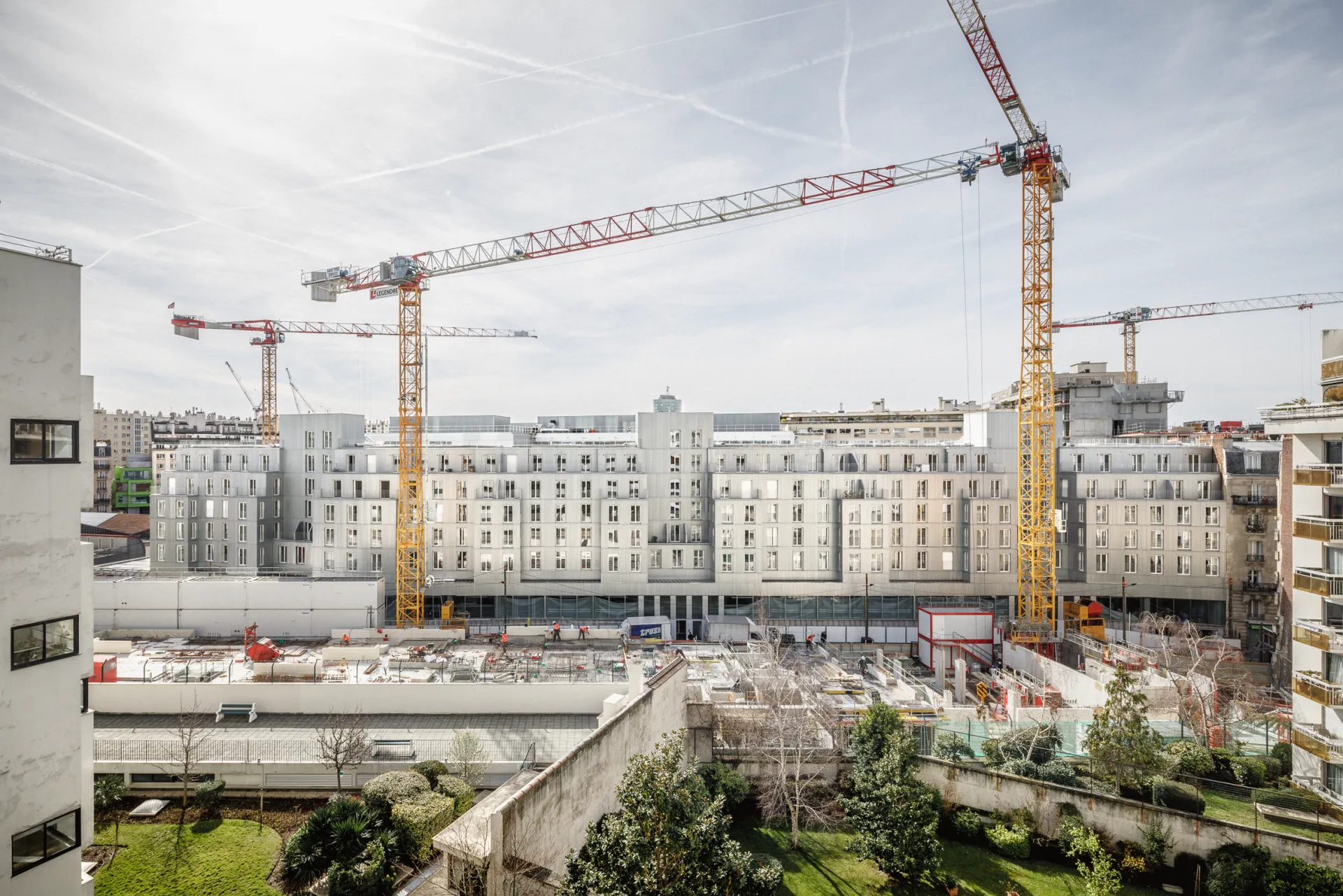
SB Yeah, I must say that I'm very much drawn to architecture that conveys a utopian vision of how we might live together. Firstly, as a visual artist, I'm interested in these visionary ideas. Then personally, I like to walk through the architecture and experience the physical sensation of the buildings themselves — what does that feel like, and how does it make you feel? What kinds of routes open up; where is one drawn to or not; how is one directed through the space? I also like being exposed to a sort of parkour, let’s say; it interests me very much because just as art, architecture doesn’t exist without the interaction of people. In terms of Mériadeck, or this type of 1970s architecture in general, it has been viewed with much ambivalence. There are people who love it or hate it. In Mériadeck I talked to people who live there, and they really love it; it's very central, it has all the amenities you could want; it even has a tennis court and a shopping mall, all integrated. What they complain about is that it is not well maintained; it needs renovation, there are broken tiles and on — and then there is the politics. There is another building that I like in Berlin, called Die Schlange or Schlangenbader Straße estate; politicians publicly refer to it as an architectural sin. But again, people enjoy living there; there's a documentary that shows how heartbroken the residents were when they had to move out. Now, luckily, there's a new awareness and appreciation for this kind of architecture, as well as the fact that it's much more ecological to keep such buildings rather than demolishing them. Back in Bordeaux, for instance, there's a housing estate in Grand Parc that was partially and famously redesigned by Lacaton + Vassal, by adding to the existing housing blocks. They added balconies and expanded the apartments, which gives the living space a more airy, contemporary feel. So I think that these kinds of buildings, even though they're seen ambivalently, have a lot of potential; they also create identity for the people living there.
KOOZ It's interesting that you mention identity; there is also a political dimension potentially to the film that counters the idea of the ‘concrete monsters’ — these are spaces that are inhabited, that have transformed over time. When one looks at these buildings, one finds a strong sense of rhythm and repetition embedded in the architecture; there is also the rhythm and repetition of those appropriating the space. Could you maybe talk about the tools that you use to connect the different rhythms of people, the city, and the buildings themselves?.
SB Yes; the music is another element in what you describe. The score is by Eliav Brand, a composer of new music, which makes a very strong artistic statement in itself. What you describe as the political dimension of the film can be read in the fact that the focus rests on different elements, which shifts within the film. Sometimes the architecture is more prominent; sometimes it’s the life within, which is not only human. There are also shifts in power; for example, I do not think that the intention of the architects included the idea that their buildings would be used for K-pop choreography. Yet the fact that the use exceeds the expectations gives agency back to everybody who uses it. Perhaps weakening the power of the architecture itself, it is given back to the people inhabiting the space, and I think this is beautiful to see.
"The fact that the use exceeds the expectations gives agency back to everybody who uses it. Perhaps weakening the power of the architecture itself, it is given back to the people inhabiting the space, and I think this is beautiful to see."
This is the difference between a non-place and a lively place: people go there. In fact, it's not only the inhabitants who do activities there. I talked to girls who had travelled there from the outskirts of Bordeaux to dance in Mériadeck. They come from the neighborhoods, precisely because they can find the ideal setting for what they want to do. I also talked to the parkour community, who told me that they found out about Mériadeck via an app or on social media, highlighting great opportunities for doing parkour there. I think these dimensions are very important to consider when it comes to the appreciation and value of the project.
KOOZ Speaking of the audio: in listening to the film, one understands how sound transcends certain specific architectures. We're in the estate — at least on one floor of it — but we can also hear the city. How does thinking about the sound of the city maybe help us to comprehend it?
SB I also work in photography — that is to say, non-moving photographic images, in various forms, which neither move nor have sound. It’s very special to have that in cinema, and I am very interested in how sound can draw and focus our attention on different elements; it can also be a tool for manipulation; just watch a scene with sound and without. There’s a particular scene in Blow Up, the movie by Antonioni, to which I wanted to refer in another work — so I revisited the film. In my memory, the park scene was so stormy and windy, but when I watched it again, the trees were not moving so much; it's all in the sound. For me, sound is a tool to shift attention: perhaps to isolate, to listen to one particular element over another or to step back, giving a more abstract sense of the cityscape.
"Sound is a tool to shift attention: perhaps to isolate, to listen to one particular element over another or to step back, giving a more abstract sense of the cityscape."
FZ Let’s give the audience a chance to share any prompts or questions —
Audience Thank you very much for your film. I'm wondering about editing because I think it's a very important part of the film. While the film title refers to the floor, I was wondering about the editing device of the curtain that you used between images, going up and down. Can you share more about this?
SB Yes. While the film is documentary, the curtain suggests a certain fictional element; it’s as if the events of the film were staged for us. It also pushed the image of the stage as “the floor”, referring to the theatre and staging in the round. It’s also a device to propose a simultaneity of short scenes; within this one place, all these little activities are happening at the same time. Reality and its abstraction can bring in fictional aspects to what is an everyday activity.
Audience How long did it take to make the film?
SB I produced this work during an artist residency in Bordeaux; that was originally scheduled for one month, but as it took place during COVID, we shortened it to two weeks. Actually, in the beginning, I had not planned to make a film. I took photographs; I had briefly visited the neighborhood before, but I had not seen it so activated in this way. I was overwhelmed and wanted to do something about it. Of course, I asked everybody whether they were okay with me filming, but generally they were not that interested in what I was doing. They were focused on their activity. Rather it came out in parallel: me working on my film; the K-Pop dancers working on their choreography.
KOOZ Susanne, thank you so much for sharing your insights.
SB Thank you, Federica; it was a wonderful honour.
BIOS
Susanne Bürner explores the psychological dimensions of photographic images, directing the viewer’s attention to questions of presence and absence, as well as to the projection of the viewer herself. In her mainly non-narrative films, the idea of the animate (of things having a life of their own) is underlined by specifically composed abstract sound. Biology as a science of life runs parallel in her work, while architecture plays another key role as the human attempt of structuring space and society, thus as a method of ordering life. Bürner is co-founder of Monroe Books, a Berlin-based publishing platform for artist books.
Federica Zambeletti is the founder and managing director of KoozArch. She is an architect, researcher and digital curator whose interests lie at the intersection between art, architecture and regenerative practices. In 2015 Federica founded KoozArch with the ambition of creating a space where to research, explore and discuss architecture beyond the limits of its built form. Federica is an Architectural Association School of Architecture in London alumni.
ABOUT
The St. Moritz Art Film Festival (SMAFF) is an annual international event held in the Swiss Engadin Valley that explores the intersection of contemporary moving images, visual art, and audiovisual culture. Founded by Stefano Rabolli Pansera, SMAFF investigates how cinematic and moving-image languages can challenge dominant narratives, addressing contemporary philosophical questions, and experiments with alternative storytelling. Each yearly edition is anchored to a specific thematic inquiry fostering cross-disciplinary dialogue between emerging creators, established artists, filmmakers, curators, and collectors.