Federica Zambeletti/KOOZ I want to start with Obel's theme of system hacking, which asks how architecture can intervene in the systems that shape society and the environment. Which systems are most urgent for architects to directly engage with today?
Teddy Cruz We have often written that in conditions of crisis, we as architects cannot wait for the client or the brief; for the programme, or even the budget. We co-produce the brief with communities on the margins; those who are struggling in the context of the migration and climate crisis. Engaging those communities has opened up an interesting approach to design civic, economic and political processes, where the architect has a central role to co-produce the city. That implies imagining a new approach to economic development and climate adaptation, and new housing paradigms that emerge from the bottom up, connected to those struggles. In the absence of public investment, it's really about designing a new approach to development.
Fonna Forman I think that our practice really illuminates the collaborative possibilities of the architect working in and with communities while also reaching out to other domains of knowledge and action. Our practice is a collaboration between an architect and a political theorist. Since before Teddy and I met, I've been investigating the challenges faced by communities at the frontlines of many global crises. Before one ever puts pen to paper on a project, or begins the design process, there's a deep research phase: a phase of learning, both from communities experiencing challenges on the ground or in the field, but also from others engaging those communities to recognise ecological and societal challenges. Part of this process involves understanding the vectors of injustice that so often define and situate these challenges; it requires deep investigation of the historical dynamics in a particular site, and the vectors of disparity conditioning the moment.
TC We are deeply embedded in and committed to a particular geography of conflict; namely this border region between the U.S. and Mexico at San Diego, Tijuana. A lot of our work has oriented itself towards a bottom-up approach, grounded within these cross-border dynamics. At the same time, our practice is interested in intervening, not only in engaging the bottom up, but also pushing against the top down to transform public policy. A lot of activists and architects committed to these conditions operate from the bottom up, but remain dissatisfied with the institutions that have perpetuated this marginalisation, this crisis. We are a bit different because we do believe in institutions, and in the role of the architect in building new institutions — or at least making them accountable. We believe in our practice as a translational and curatorial practice; with our partners, we interpret the incredible energy of communities building their own environments in the absence of public support. We carry these actions up to knock on the doors of institutions and transform public policy. I think that more architects need to intervene in that interface between the top-down and the bottom-up, which is really absent at this moment.
"We believe in our practice as a translational and curatorial practice; with our partners, we interpret the incredible energy of communities building their own environments in the absence of public support."
KOOZ You raise the notion of mitigation through institutions, which speaks to your work in repositioning the university as part of a wider civic infrastructure. Could you reflect on what led you to identify the university as an important partner for the projects that you have been doing on the San Diego Tijuana border.
FF The first motivation was obviously an ethical one, given our proximity to this site of intense conflict. This is part of a systems hack as well: we wanted to figure out how to mobilise the research capacities and social capital of the university, to become a resource for community partners on both sides of the border. So we really had to tackle the conventions of engagement within the university, structured around models of applied research or humanitarian assistance. You create your tools in the lab or the studio; you ‘descend’ into the community to test them out, and then ‘ascend’ back to the academy and publish research papers: a model very prevalent in the realm of public health. The other model — not without value — is the humanitarian or charitable version, where the university actually invests resources in community activities and capacities. We think both of those models are valid. But what we really wanted to do was tip that conventional ‘descending and ascending’ model onto a horizontal plane, where the university researchers and designers like us can partner with communities equitably, to both improve quality of life in communities and change the way the university understands its research and teaching mission. That's been a huge cultural agenda of ours, right from the start. Teddy and I have worked in a variety of institutions, from universities to non-profit organisations and even municipal governments; we led a civic design lab in partnership with the mayor of San Diego. We've found that the university has given us the most agility to do the kind of work we want to do. We’ve achieved that by creating an entity within the university that manages its own budgets, decides its own agendas, and that is not beholden to the agenda of a particular dean or a vice chancellor. In short, we're thinking about how to hack institutional protocols around community engagement.
"We're thinking about how to hack institutional protocols around community engagement."
TC This is part of what I mentioned earlier: adapting the role of the architect, the designer, the curator, to infiltrate, to encroach into institutional protocols. To advance our research-based work at the border, we decided to intervene into our own public university’s programmatic and economic structures. As part of the University of California, this institution has a specific mandate as a ‘land grant institution. This might be foreign to readers but under the federal Morrill Act, the state received land to endow its public university campuses, with the mandate that the university connects to its local communities — increasing capacities, mobilizing knowledge and research. Programmes like this are being eroded, as public universities become incrementally more privatised, but it has a long history. We took it as a way of making the university accountable to this very proximate border region. We wanted to allow for the possibility that a student could work in a campus-based lab in the morning and be in Tijuana — just twenty minutes away — in the afternoon, engaging some of the most precarious and marginalised communities in the world. It's about linking theory and practice, as a place-based agenda. The question was how to mobilise the Community Stations. I think of them as a distributed university, connected to the idea that the university no longer holds all the knowledge. There is an urgency to address the world’s problems collaboratively and rethink preexisting silos of knowledge, not only within the university but also in collaboration with communities. So the Community Stations model is about the co-production of knowledge in order to rethink the border region as a site of interdependence, as well as the co-production of the city at large. The community stations began as a collaborative form of education: a circulatory system linking university research with community priorities. This includes the hidden value of activists on the ground — they may not have a diploma, but they do hold an incredible degree of political, economic and cultural knowledge — who come into the university to help us rethink our research priorities. Gradually, Fonna and I realised that this was an opportunity for architecture to ‘hack the system’ by requesting the university to mobilise its economic and programmatic power as leverage, enabling our community partners to develop their own neighbourhood-scale infrastructure. The establishment of community stations then grew into a physical project of co-development between public university and communities to create public space and housing together: that public space is where education and research is co-produced with community activists. In other words, we co-design, fund and build the spaces first and then we activate them with cultural programming, co-curated with our community partners. The project therefore effectively links physical and programmatic agendas at the same time.
KOOZ What you were describing is something that has reciprocity in the way that you co-produce, putting institutional and community actors on the same level. How do you protect precarious sites from extractive intentions? How do you design a system that is mutually generous?
FF That's such a great question. There is really no concept of co-production in traditional university research ecology; it's a category that we’ve had to create. Typically, a grant opportunity opens; the grant requires that the researcher engage a community. The researcher will scurry around to find a community partner, and discuss the possibilities; sometimes the grant comes through, sometimes it doesn't. The community, however, remains on the edge. They're not deeply integrated in terms of identifying challenges through the voices of those experiencing them, nor in the design of the approaches to solve them.
We recognised the value of establishing deep, long-term partnerships with specific communities a long time ago, — so that when an opportunity emerges, the trust, the mutual recognition, all of the work together already exists. We believe deeply in trust, and in collaboration. Critically, the norm in academia, particularly in the natural sciences, is that the researcher should remain ‘above’ or detached from the subject of analysis. Yet building trust over time enables you to be deeply engaged and even to work through genuine friction. It's not always harmonious when the researcher and the community leader come together; sometimes our ideas about challenges and opportunities can conflict. We come from entirely different cultures of knowledge, different histories and experiences. It's not a simple surrender to anthropological observation; rather, this work involves being and staying on the ground, getting through that rough terrain where everybody learns. Genuine co-production is about give and take; a tug, a pull and a push. Together, you move through the process of creating valuable things together.
"Building trust over time enables you to be deeply engaged and even to work through genuine friction."
TC This speaks to so many domains that have remained peripheral to our role as designers and as architects. To elaborate on Fonna’s point, how do we design trust? That process could demystify and address a lot of the real threats, specifically the extractive processes enacted by top-down institutions that dip in and out of the struggle. Who is going to accompany those communities in those sites of precarity and risk? Building trust begins by being there for the long haul with those actors and their communities; it's about presence. This programme is not about the academic dropping in to perform research, write a paper or book, and then unplugging themselves. The community stations are not only place-based; they are embedded in marginal zones where there is genuinely no development. The community stations are really about increasing collective capacities for those communities to represent themselves politically. The public university becomes a tool for visualizing the situation with the communities and producing evidence, amplifying the case for support. In other words, the programme reimagines and reorganises university research through the conditions of emergency and the issues that concern specific communities, with a view towards the redirection of resources to support the creative intelligence of communities. Going back to the fear of extraction, which I want to overturn: it’s worth noting that the community stations are not owned by the university. The neighbourhood infrastructure is owned by those communities, who manage their own modes of productivity. I’m not sure how it works in Europe, but in recent years, almost every event held at universities across the United States will begin with a land acknowledgement. You might have heard something like, ‘We recognise that we're occupying the territory of marginalised Indigenous communities’ — and of course, to name that history is very important, but it tends to remain symbolic. We need to operationalise the demand to redistribute, to direct reparations and resources to those communities, enabling them to drive their own destinies. Being present already changes everything. The community station model enables the university to redirect resources to those partners with whom we have established relationships of trust.
KOOZ To date, you have helped to establish four community stations, operating both individually and as a collective infrastructure, with each addressing a specific need. How did they evolve, and are there more in the works for the future?
FF It was a very organic process. These emerged out of long-running partnerships that evolved into aspirations for spatial collaborations. All of the communities that we've partnered with either own or have access to space: whether vacant lots, public land or spaces on public lease. The idea of building a community station together with each of them emerged through dialogue, gradually defining common interests in urban development and disparities within the border region. For many years, our projects were deeply research-based — so by the time the opportunity came to build spaces for long-term collaboration, we already had a deep sense of trust as well as a nuanced understanding of the resources and capacities that everybody brought to the table. Some of the community stations involve housing as well; I don't know how we could manage a fifth, although we talk about it all the time.
TC Fonna was previously working at the scale of global development, with the UN on issues of human rights — an institutional engagement as a political theorist — while I have been embedded in this border territory for years. We joined forces to understand the problems that are rooted in this geography of conflict, at the Tijuana-San Diego border. Right now, we are living through an unprecedented moment in terms of global hostility, the tightening of borders, the erosion of public investment, the impacts of climate change; this place is a microcosm of all those conditions.
Unlike the political rhetoric that divides us, which retreats from attempts to coordinate planetary dynamics, we believe that the border is a place of interdependence. We are committed to challenging the notion of citizenship as organised through the identitarian politics of the nation-state. Rather, belonging could be reorganised by our common interests and shared values within divided territories. In a sense, our community stations mobilise a critical pedagogy to enable processes of mutual recognition with our neighbours in Mexico, We’ve long held faith in the idea that the destinies of these two border cities — Tijuana and San Diego — are intertwined, but that story needs to be acknowledged.
"We believe that the border is a place of interdependence."
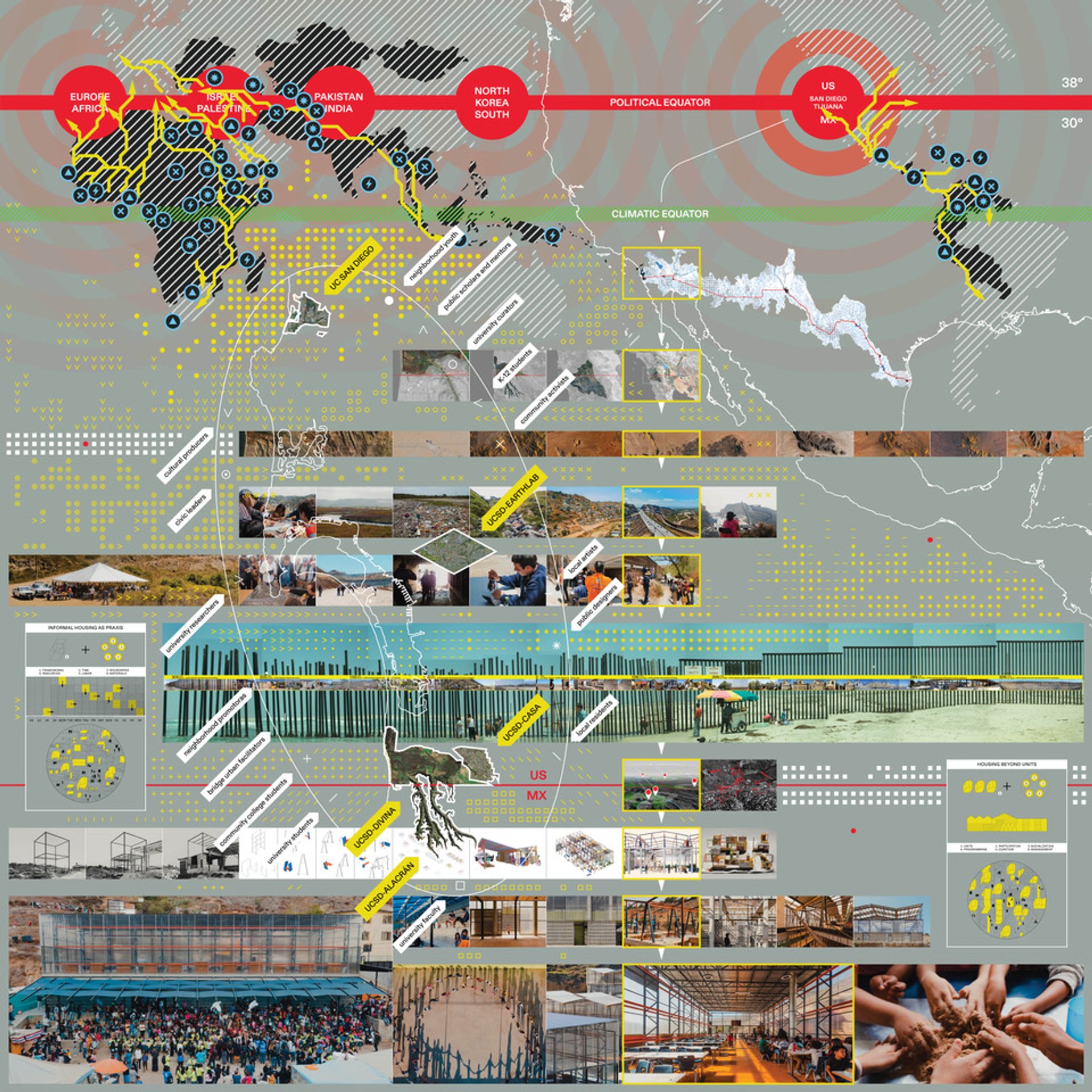
FF To put an even finer point on it: we’re really interested in cultural change in the border region, and addressing what we consider to be civic disruptions: the border walls and the splintering of communities that should be deeply invested in solving regional problems together. Water, waste, health, money: all these things flow back and forth across the border, and yet all of the planning maps in this region stop at that line. We're trying to erase the border imaginatively; the community stations that straddle this artificial separation function as bioregional observatories that allow us to circulate knowledge. Through satellites, letter writing, physical movement and all sorts of cultural activities, we're transgressing the border wall.
TC The network of public spaces also acts as an observatory for building a new culture of cross-border citizenship: one that values mutuality and recognition, where research and education is co-produced with community partners. The system responds to a very important premise: social and urban justice. Justice today must be a redistributive system, routing resources and knowledge from the centres of power towards the marginalised edges, while respecting mutual needs and opportunities. The four specific community stations developed through rooted, long-term collaborations with non-profit and grassroots organisations who have been working with us for many years. They emerge from our own research — my own on urban informality and Fonna’s work on rethinking public systems and political economies.
Of the four Community Stations, two are located in San Diego, and two in Tijuana. The UC San Diego EarthLab takes the shape of an open-air living laboratory, composed of eco technologies, green infrastructures and natural habitats that exemplify climate adaptation at the scale of the neighbourhood, so that climate-response initiatives can be led by the community. The UCSD-CASA Community Station in San Ysidro — right next to the border checkpoint — is a small-scale pilot project that links affordable housing to public space. We believe that public spaces should not be limited to functioning as sites of leisure or beautification; instead, they could be embedded with resources for the co-production of local economy, culture and education. This particular public space acts as a community theatre and an outdoor classroom, so that local organisations and residents can co-produce the programming with our researchers and students. All of that is flanked by affordable housing; it's a beautiful experiment, the first to be built with investment from the university, which then allowed our community partners to qualify for various subsidies.
USCD Alacrán has now become the largest migrant shelter in the entire Tijuana border region. In fact, that Community Station became the catalyst for the construction of an entire sanctuary neighbourhood, which includes migrant housing, classrooms, collective food hubs and a children's library. It realises the very idea that the city can be built from below, with migrant communities as partners, and it has become an exemplary model for rethinking hospitality, migration issues and building within informal settlements in Mexico.
The fourth Community Station is UCSD-Divina, also in Tijuana, oriented towards habitat restoration within the informal settlement. Because these places lack infrastructure, the station is focused on restorative practices, enabling youth in the neighbourhood to see themselves reflected in areas of erosion and destruction. It is connected to an activist nursery that propagates native plants for reforestation. The community stations also become a point of entry into bioregional research. One major project that emerged through Divina is the recuperation of several slivers of land that have not yet been squatted upon. Led by communities, we identify sites to protect and restore, and begin to think of infrastructure as an incremental system.
Cross-border dynamics come into play because Laureles Canyon canyon in Tijuana — where both the Divina and the Alacrán Community Stations are located — crashes right into the border wall. On the other side, in the United States, there is an estuary: an environmentally protected zone layered with militarisation. As the canyon region in Mexico lacks infrastructure for water and waste management, a lot of pollutants end up contaminating the estuary — which we consider to be a bi-national asset. In order to protect the estuary in the U.S., we need to invest in the canyon in Tijuana. So we have been intervening in the canyon with our Community Stations to produce incremental or micro infrastructural changes to manage water and waste, to reduce toxic impacts on the other side.
KOOZ To continue looking into the future, with climate change as an ever-pressing urgency, how would your initiatives need to adapt? Is it a matter of building more Community Stations, or rethinking how they operate?
FF About a decade ago, we began to recognise that the societal and ecological challenges we focus on here are intensifying due to the impacts of climate change. In recent years, we've seen a marked increase in migration flows north from Central and Latin America, as well as from other parts of the world. The conventional explanation is that these flows are driven by poverty, violence and political instability; but they're also intensifying because of the failure of agricultural systems south of the U.S.-Mexico border. Many places have become uninhabitable, and a UN survey found that 72% of arrivals at our southern border are agricultural workers. Clearly, there's a huge intersection between climate change and accelerating migration: we see this in Tijuana, we see it all over the world.
"There's a huge intersection between climate change and accelerating migration: we see this in Tijuana, we see it all over the world."
When migrants arrive, they tend to settle at the periphery of the city, where resources are scarce and where topsoil is the most vulnerable. In a topographical region like ours, the increase in rainfall causes everything to slide off the surface. We try to address the migration and ecological crises simultaneously, so our intentions for the sanctuary neighbourhood in Tijuana are dedicated both to dignified migrant housing and ecological restoration. In fact, it's the only migrant shelter in the region that is centrally focused on binational ecosystem protection. Climate change has become a major driver of our work over the last years; this is true not only in Tijuana but in Southeast San Diego as well. At the UCSD-CASA Community Station in San Ysidro, people are obliged to live in a place where tens of thousands of vehicles idle in border traffic every day. Young people breathe in this polluted air in their school playgrounds and in their backyards. The UCSD-EarthLab Community Station sits at the heart of the most polluted watershed in the entire Southern California region. We’re now thinking about how the spaces that we've built can become hubs for community-based ecological action. We're also working closely with state agencies on policy — again, to bring together actions from the bottom-up and the top-down.
TC The projects that have emerged here, and which we have co-produced with our partners, are complex, powerful and yet reproducible. This type of work speaks to agendas that can mobilise new forms of institutional engagement. With our partners, we are co-producing vital projects that oblige institutions to make investments that extend beyond their own boundaries. Maybe we could create a fifth Community Station but what’s really on our mind is how to layer each of these places with robust processes of critical pedagogy, bottom-up research, and the means to increase capacities.
This said, reproducibility is embedded in the logic of the Community Stations model. We have been approached by many actors across the entire U.S.-Mexico border — from places like El Paso and other major bi-national metropolitan centres — thanks to the paradigm of linking public universities, civil society and grassroots organisations. The goal is to co-produce not only a cross-border infrastructure but a new sensibility: the cross-border citizen, capable of engaging in a new type of politics organised around empathy and coexistence. Education becomes an organising axis for all of this. At the same time, each Community Station contains the DNA to rethink social housing for specific needs, and the very communities that have been most impacted by climate change can lead climate measures that can be adopted at the scale of the neighbourhood. Through the initiatives in Tijuana, the idea is that migrant shelters can act as urban catalysts to rethink the city at large as a more integral, integrative ecology of spaces that support both social and ecological restoration.
"The goal is to co-produce not only a cross-border infrastructure but a new sensibility."
Ultimately, this work simply makes the case that the ecological and hydrological systems that link these two cities need to be visualised and understood as the framework to rethink the future of the region. For example, the MEXUS research project: a map of the continental border in which the red line of the political and jurisdictional border is eliminated. Instead we visualised the eight binational watershed systems shared by the U.S. and Mexico across the entire continental border. The operative logic of those hydrological systems should really be what organises our economic and social relations; it's about a post-jurisdictional sensibility that can allow us to rethink the city.
FF The Community Stations become places of civic imagination, where we learn how to extend our capacities from the local to the regional to the global. Extending and contracting one’s horizons of concern, we can recognise that the challenges faced in an informal settlement in northern Mexico might share many of the same causes as regions around the world. Geopolitical dynamics affect the ground all over the world; this approach creates an incredible garland or network of partnerships working in cross-border contexts like ours.
KOOZ Thank you both, and thanks for bringing it back to the power of civic imagination, an extremely fitting place to conclude this inspiring exchange.
All photos courtesy of Estudio Teddy Cruz + Fonna Forman.
BIO
Teddy Cruz is a Professor of Public Culture and Urbanization in the Department of Visual Arts at the University of California, San Diego. He is known internationally for his urban research of the San Diego–Tijuana border, advancing border neighborhoods as sites of cultural production from which to rethink urban policy, affordable housing, and public space.
Fonna Forman is a Professor of Political Theory at the University of California, San Diego and Founding Director of the UCSD Center on Global Justice. Her work focuses on climate justice, borders and migration, and participatory urbanization. She serves as Co-Chair of the University of California’s Global Climate Leadership Council.
UCSD Community Stations is a research-based urban and architectural design practice at UC San Diego, led by Teddy Cruz and Fonna Forman, investigating borders and migration, informal urbanization, emergency housing, bioregional climate resilience, civic infrastructure and public culture. Cruz and Forman lead a variety of urban and environmental research agendas in the San Diego–Tijuana border region and beyond. Their work has been exhibited widely in prestigious cultural venues across the world, including the Museum of Modern Art and the Cooper Hewitt National Design Museum, New York; Das Haus der Kulturen der Welt, Berlin; M+ Hong Kong, and the 2018 Venice Architectural Biennale.
Federica Zambeletti is the founder and managing director of KoozArch. She is an architect, researcher and digital curator whose interests lie at the intersection between art, architecture and regenerative practices. In 2015 Federica founded KoozArch with the ambition of creating a space where to research, explore and discuss architecture beyond the limits of its built form. Federica is an Architectural Association School of Architecture in London alumni.
ABOUT
OBEL is a foundation that recognises and rewards architecture’s potential to act as tangible agents of change that contribute positively to social and ecological development globally. Founded in 2019, OBEL values the plurality of architecture as a practice through expanding who and what defines our built environment. Through various activities, OBEL supports influential ideas and approaches that can spearhead and seed future developments, while driving architectural discourse and education.