KOOZ/Federica Zambeletti Thank you so much for joining us. Yarema and Roman, I understand that as we speak, you’re preparing to head to Venice — presumably for the Biennale? May I ask what you’re showing?
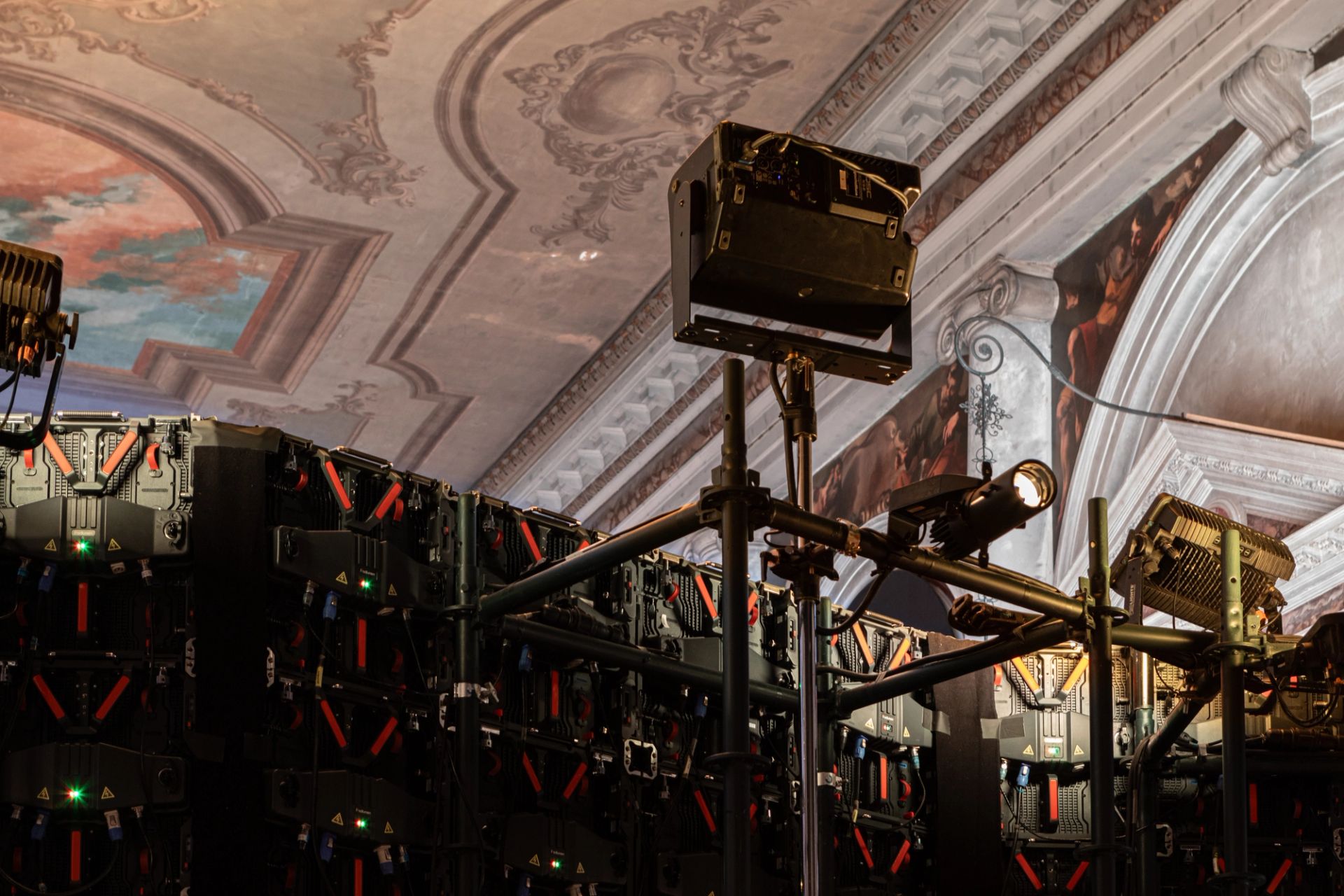
Yarema Malashchuk Yeah, it's a new commission, and we are actually still in the process of filming. It will be a multi screen installation with screens installed in different rooms, but we only really understood what we’re doing maybe yesterday, so now just have to fulfil it —
Chus Martinez Fantastic. I think stress can be a good thing; you don’t think about reality when you are stressed.
Roman KhimeiThis work is our first fictional gesture; it’s about the future, about wishful thinking — particularly as authors who continue to stay and work in Kyiv during the war. Over the last 10 years, all our work has focussed on documentary materials. But this time, for the first time, we will speculate in another mode.
YMIt feels dangerous; we are a bit scared that the work might be leading us into some strange directions — engaging with different forms of representing this connection between victim and enemy, or perpetrator, in terms of Ukrainians and Russians. We wanted to play around with this notion of the victim performing as an enemy. What if I would try to portray an occupier? Could an actor from the Ukrainian theatre cry as a Russian soldier who feels regret?
"We wanted to play around with this notion of the victim performing as an enemy. What if I would try to portray an occupier? Could an actor from the Ukrainian theatre cry as a Russian soldier who feels regret?"
CM I think you need a good conceptual frame to push against the notion of binarism in war. The only substance in the history of everything that cannot overcome binarism is war. We talk about the non-binary, but in war you need to acknowledge that people are acting against each other. This is what you are testing, but it is very difficult: war is the most binary act par excellence. It’s this Nietzschean circle. It's probably very uncomfortable to film what you’re filming, which is interesting. But now I’m starting to curate your work instead of having this conversation!
"The only substance in the history of everything that cannot overcome binarism is war."
KOOZ It’s great to hear how easily ideas spark between you, as you know each other’s work so well. Today’s conversation is partly prompted by your exhibition Pedagogies of War, at the Thyssen Bornemisza in Madrid. Perhaps we can start by exploring that tension between the works presented in Madrid and this new commission. You mentioned that this is the first time in which you launch yourselves into the speculative, beyond what seems like the necessity of the documentary form — how did that emerge?
YM Hmm, good question. We’re still not sure whether this move is the right thing to do, because as Roman mentioned, we mostly work with documentary material. The moving image is deeply rooted to questions of truth; as Godard said, cinema is truth 24 frames per second, right? We work a lot with these questions: what does it mean, the idea of truth in the contemporary moment, at a time of this overwhelming distribution of media. Now, it's not like it was back in the days of Godard; now we really cannot be sure that documentary material is 100% truthful. So we wanted to kind of speak a little bit about the representation of moving images, especially at the exhibition in Madrid and also throughout our different other works.
It's not dissimilar to what we are doing in Venice, but there we wanted to play with this wishful thinking, as Roman said; playing with the notion of Ukrainians as victims, those who've been colonised by empire and by Russians over centuries, but also as those anticipate the future — even a future that will be bright or positive,
We will still have these perpetrators speaking in documentaries [set] in the future about what they've done, sometimes hesitating, maybe not. These documentaries will be spread throughout different media platforms, talking about the same things, having the same emotions and contradictions that incite the same feeling as watching interviews of Nazis after the Second World War — or of soldiers of other armies, whether occupying or making an offensive. The idea was to take the most boring parts of the future, the most certain parts of it, and to recreate them as a series of fictional scenes. That was our goal, our aim: to work with this recreation of something of which we can be definitely sure. It's the most boring part, even though this future will naturally sound positive, as we speak from the perspective of Ukrainians who are currently dying every day from Russian aggression. The sense of near-boredom, the most predictable parts of the future: that's what we want to sort of envision and stage.
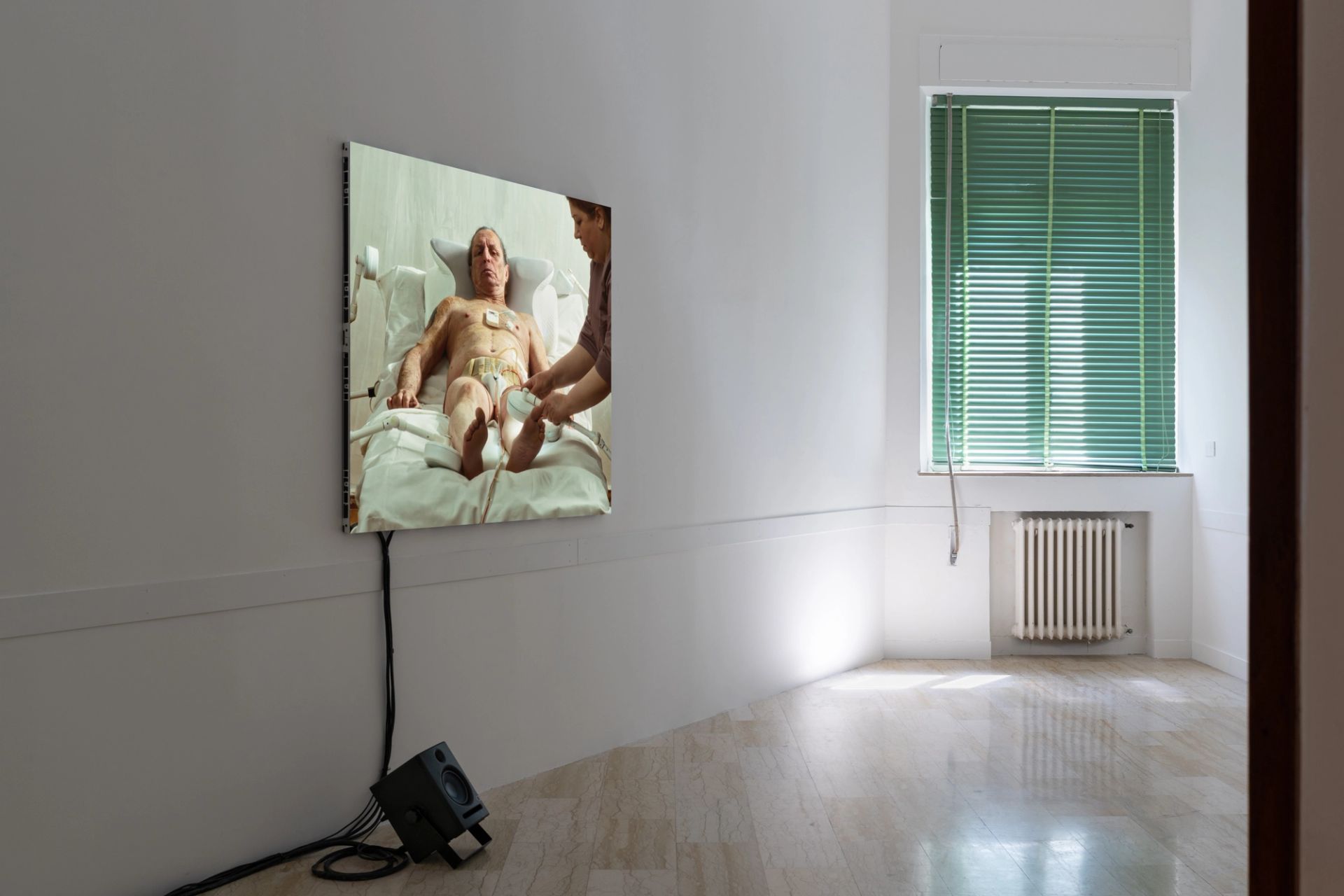
Roman Khimei and Yarema Malashchuk, Wishful Thinking, 2026 in “Canicula,” Fondazione In Between Art Film at Complesso dell’Ospedaletto, Venice, 2026. Courtesy of the artists and Fondazione In Between Art Film. Photo © Marco Cappelletti and Giuseppe Miotto / Marco Cappelletti Studio
RK I must say that when I hear Yarema now, I realise that from some perspective, this work is very much about us, about ourselves in this situation. It's important to know that before full scale war — so, ten years ago or even longer — the films that Yarema and I created usually often involved many participants and a multitude of people. Since the onset of full-scale war, we’ve somehow lost this approach. We started to react to different events: news, of course, the stream of news that is generated during wartime. With the exhibition at TBA21, we can return to this condition when we can create situations, and not only reactions to reality — a very harsh reality. Maybe we will try to continue the opportunity that we created by working on a TV show. The new work that we will present at Venice Biennale is a continuation of this mode — going beyond reactions to events, into a cultural production.
KOOZ The body obviously plays a huge role in your work. How does this new speculative chapter explore the idea of learning through the body — of corporal transmission, which is very much at the basis of the works presented in Madrid.
YM Thanks for this question. In this case, the body and this different approach to this idea of an individual who is basically presented on the screen is also important. We have different approaches to this idea of the body in the war, and they are present simultaneously. On one hand, there are Ukrainian actors, who explicitly declare that they are Ukrainian actors portraying Russian soldiers in the future. They are basically sanctioned to take part as an actor to portray someone else — as in the theatrical roles of ancient Greece. They are also those same Ukrainians or citizens of a country that is being invaded and shelled everyday. Of course, there is a certain tension, to put it mildly, between the people they are portraying and the people they really are as physical bodies, as individuals living in this country suffering from the attacks of individuals from another country. So these three sides of this triangle of relationship between three identities — the identity of a Ukrainian, the identity of an actor and that of a veteran Russian soldier in the future — this is the dynamic that we play around with. As a victim, a perpetrator, and actor: what is it to envision your enemy in the future, after you confront what you’ve done and perhaps even regret. This regret, even though it's a speculation — because we cannot say if people will regret or not — is a kind of wishful, positive thinking; that of course, in the future the Russians will lose and the war will end. Of course, those who have been recognised by the international courts as having kidnapped children, killing civilians, they will be held responsible. We can't say they will, but as Ukrainians, we may sort of presume they will. This wishful thinking is also embedded in the works.
"As a victim, a perpetrator, and actor: what is it to envision your enemy in the future, after you confront what you’ve done and perhaps even regret."
We don't want to play this situation as completely ‘non binary’; as artists, we could stay in between, trying to kind of navigate this future by saying that we are not sure what will happen. Maybe it will be this way or that; maybe those who live in Ukraine will survive, and Russia will somehow change. We don't say who will win or not win, but through the perspective created in the work, we can then construct that future, to speculate on it. It's pure speculation. And something we are still conceptualising in our heads — I don't know if it makes sense?
CM It does make sense. It's very interesting and problematic at the same time. If you were to think about it the other way around — of two Russian artists impersonating Ukrainian people, as an inverse of what you are doing — it also implies a certain logic. Russia is a bigger country, and as you have said many times, has a dominant cultural presence already, so it seems okay to portray that — but it would be very polemic if they impersonated Ukrainian people in the same way.
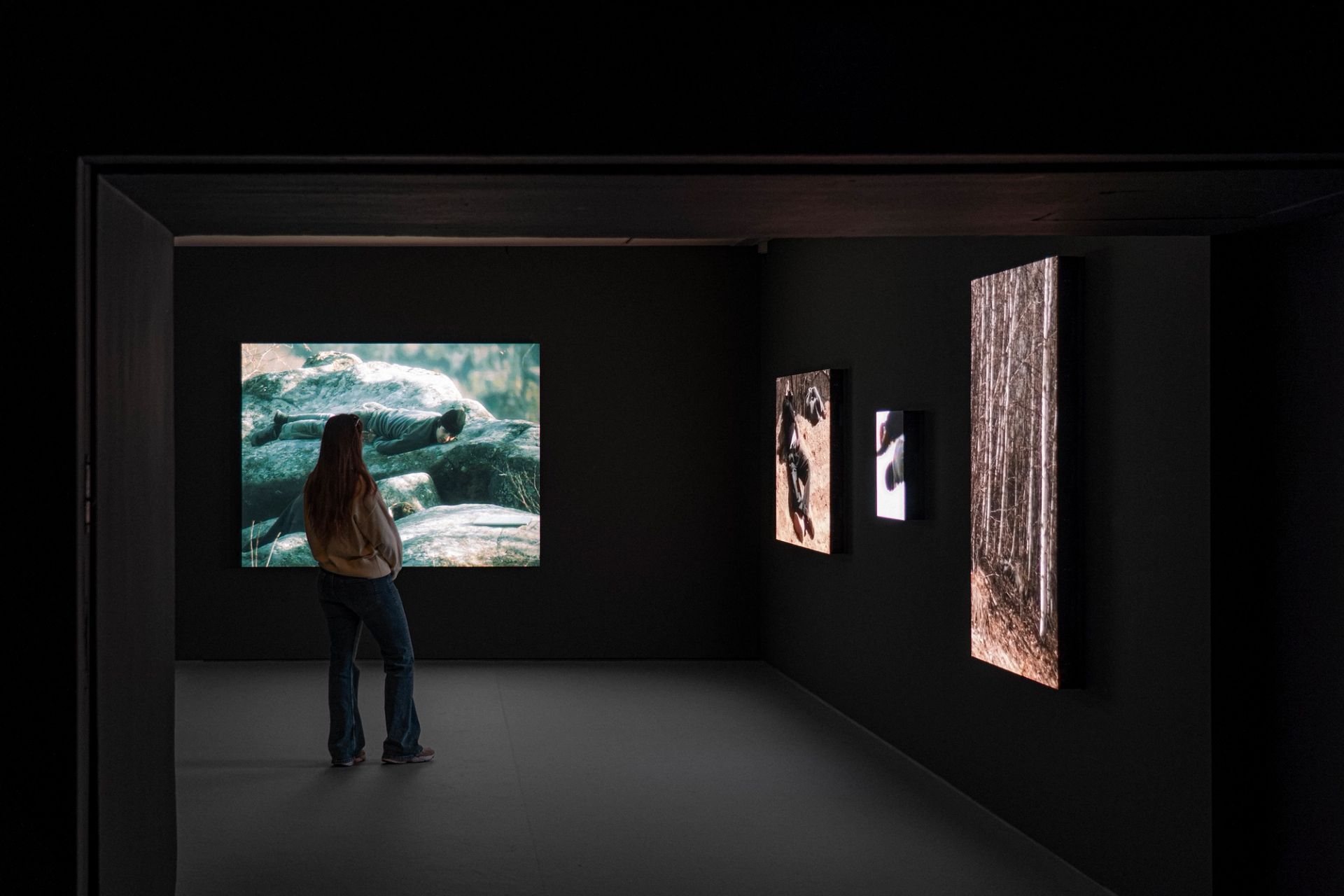
The Wanderer, Pedagogies of War, installation view. Photo by Maru Serrano.
YM In any case, they have been doing that for centuries; they have been doing it everywhere, in the theatre, in films…
CM I know, I know… and it’s also interesting that we’re not aware of that, because we are in the West. But imagine if they did the same exercise in the Russian Pavilion at Venice.. Imagine that a very good Russian artist makes a similar speculation for the sake of art — which, for me, is a really important exercise to do. An American discourse would tell us that we really cannot interpenetrate the identity of anybody, because it's appropriation. I don't think I agree with that, but it really opens a Pandora’s Box of how one can talk about certain scenarios on behalf of others, in terms of impersonating others in order to do so.
YM It's a decolonial gesture, in a way, and a pretty simple one. We take it almost as a revenge for when Russians were colonising Ukrainian culture — not to get into too much cultural diplomacy, by the way.
CM The key is also in how you frame this kind of work, perhaps unlocking it with a text. You are in that cultural dynamic, but the viewer is not necessarily there with you. For me, it's not only interesting that you impersonate the Russians, but also to speculate that perhaps the Russians could impersonate Ukrainians. If they were to do so in sincerity, they may even touch upon your pain. There are those two scenarios: one is to impersonate as an offensive, and the other one is in order to create compassion and empathy. It's an interesting exercise, because we talk all the time about empathy, but there is a strange territory between impersonation, appropriation, radical empathy and the dissolution of the boundaries. I think it's also polemic in the sense of blurring who is who. I like it and as you know it's impossible not to talk about things if you do. That's exactly what you want in such situations: you want people to talk about it.
YM Yeah, that's kind of the point. We also talk about it. We still don't have answers.
RK It comes from this almost naive desire to fulfill a certain wish; to complete the story in the future, before it happens. Maybe as Yerama said, it's part of a decolonial gesture. But the future, we understand perfectly, is imagined in an idealistic sense. What would have to happen to the so-called Russian Federation right now for its society to produce a figure like Joseph Beuys in 10 or 20 years?
CM Yeah, it's important to consider the aftermath. It's funny how usually, in the media and so on, they don't want us to think about the ‘after’, because the conflict is not resolved. That's why the ‘after’ is perpetually suspended; in talking about it, you would need to predict a winner. Yet if you suspend the binary of winner and loser, even refusing to apply these categories — as in my view, everyone is losing — then it becomes very important to talk about it, even with those personalities that are only talking about reconstruction.
Of course, Donald Trump really broke this rule in a really pornographic way, when he started showing the plans for a so-called riviera in Palestine. In some ways, this is not far from what you are doing; he radicalised it a little bit. They just put their plans out there by making that type of image, which circulated like fire because you either like it or hate it, on principle. It is an act of launching a self-fulfilling prophecy that may happen; that somebody would seize and transform a territory of culture, into a territory of capitalism. I think it's very important, in these moments where people discuss the reconstruction of a country and who would profit from it. This is the subtext while wars happen; think tanks are working on that already.
People talk about it because they know it's going to end. There is no Hundred Years War like in the past, or even the ‘Thirty Years’ War with Iran’, one bullet. You know, it's super interesting; at this time, when the war stops — meaning when the bombing stops — another conflict starts. Nobody is very interested in the second part, apart from capitalism. Capitalism is super interested in the second part, and only in the second part.
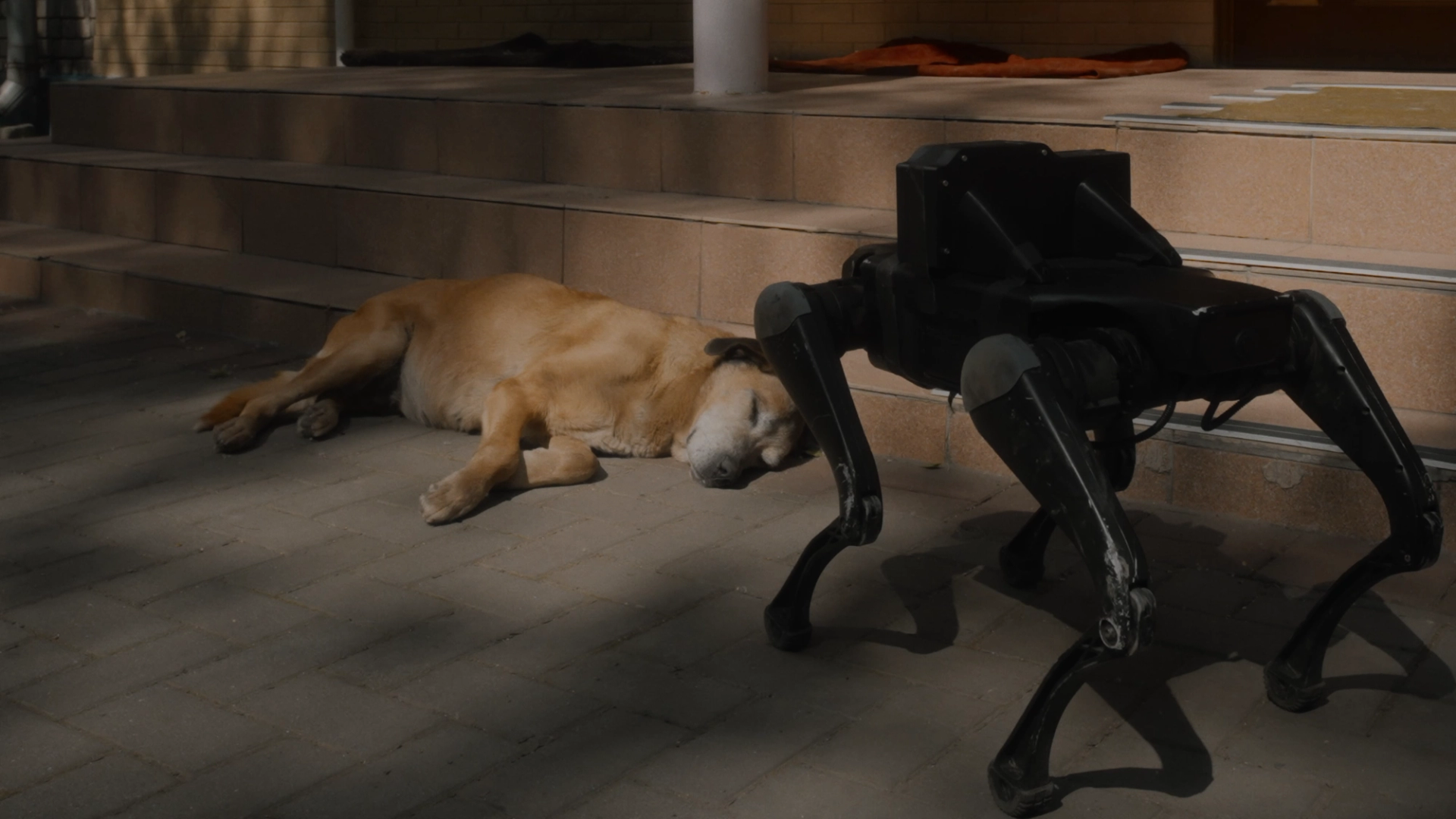
01 Yarema Malashchuk and Roman Khimei, Open World, 2025
KOOZ From a curatorial perspective, what is the importance of hosting such conversations and exchanges in cultural institutions — like the Thyssen Bornemisza in Madrid and the Venice Biennale — to what extent are these supportive or extractive? I’ve always found the Venice Biennale to be somewhat extractive as a system, presenting a plethora of ideas for six months which then vanishes in thin air. How do you position yourselves in terms of curating such topics within spaces which are more or less temporary?
CM I don't know; I stopped thinking about bad and good formats. I do think that some situations work more as assembly models — like Venice, where people come together to see and to talk. Right now, they really come for that exchange, because everyone feels that they really need to know and to be in contact with everybody else. You could say, oh, it's superficial. Many things are superficial, and yet they are super important, because people do come with a genuine interest to experience a different texture of the world, one that is distinct from what we see via the media and experience through our own exhaustion. People are really tired, so they hope for something else in Venice, and I think that's also important in institutions.
I'm a big believer of keeping the civic space active. Active and dynamic complex questions are totally possible for the audiences to take. People need those conversations to have eloquence and to really think about complex issues. It’s not that difficult. It's not even that complex. It's actually quite easy. It needs to be sustained in time, and it needs to be guided. It needs to be in company even more than it needs to be guided. You need to be there. In that sense, some works perform better than others.
I would also say that we are not in a good moment for highly conceptual, cryptic works, or rather, that’s not what I would recommend right now. We need to have works that open up to a certain eloquence. Because of social media and that way it is structured — which is not without importance — we are all radicalised in terms of moral behaviours. How to really move away from judgment and try to engage with positions that are not yours, not your interest, not your safe space? In such situations as complex, cultural conversations, maybe you are not comfortable; you are with people that don't think like you — yet, it is immensely important because of that, so that you just break a little bit and find moments where you can really think, where you can be exposed to opinions and ways of doing that are not your own. That is, for me, a fundamental practice that we need to keep doing in culture.
"We are all radicalised in terms of moral behaviours. How to really move away from judgment and try to engage with positions that are not yours, not your interest, not your safe space?"
That's also why it's a great moment to show the work of Roman and Yarema, and why I felt that Madrid was the right place. It's working really well, and it’s precisely the context that would really go for it — not least, because of the current government, the discussions currently happening in society align completely. I believe in studying the context and being very contextual in what you would offer and trying to insert the work precisely at the moment that the audience is ready to take it. So it's also about studying, scouting, analysing. I don't believe in trends or things like that; it's really about texture and how, if you really synchronise with some of the impulses and questions that are vibrant in a certain social context, then things happen and it's our responsibility to find that.
I have zero interest in showing art as such a gesture. I'm interested in making society think through art – that's our responsibility as curators. I think the language of the media is sometimes too superficial; it's about people being shown and other people reviewing what they show. This format is, for me, absolutely obsolete. We need to have those complex, uncomfortable conversations and channel those questions into the media. Otherwise, how can a regular citizen be interested in seeing a particular form of art? People are interested in particular forms of thinking; that’s why we are drawn to polarities. So that's that, we need to go where the problems lie. I'm not catering the market. I'm not interested in showing who is in fashion. Actually, I'm interested in igniting a certain debate that may help society to move forward. In that sense, what I’m doing is very close to the social media corporations. They are also interested in the conversation, in what’s going on in society; with this information, they can act algorithmically. There is always something to learn from our enemies. In this, I agree totally with Yarema and Roman.
"I'm not catering the market. I'm not interested in showing who is in fashion. Actually, I'm interested in igniting a certain debate that may help society to move forward."
KOOZ It was interesting to hear you talk about war as being a pure binary structure. To what extent can discussing the complexities of war within the space of the institution or through art actually help in dismantling this idea of the binary? Indeed, does it have to do so, or not?
CM Once war happens, it’s binary… The question is, where does that thinking lead us? Potentially that's why the exhibition in Madrid is so important, because it really ignores Russia. So, in my opinion, it is also indifference. Perhaps you can only do two things, a certain intelligent indifference or the reverse of that, as Roman and Yarema they are doing. I think you need to be indifferent, in a way, not to sense the other too much — so that your responsiveness is not geared towards the enemy. You actually respond to yourself and to your own social body. The other possibility is what you are trying to do in Venice: to actually reverse your own identity and impersonate the other. It's super important to do so, but it's also very difficult and complex. There are not many examples in the history of art of where this has been done; it's a subject to avoid. It's not that we are surrounded by a lot of examples, because it's very difficult to accomplish.
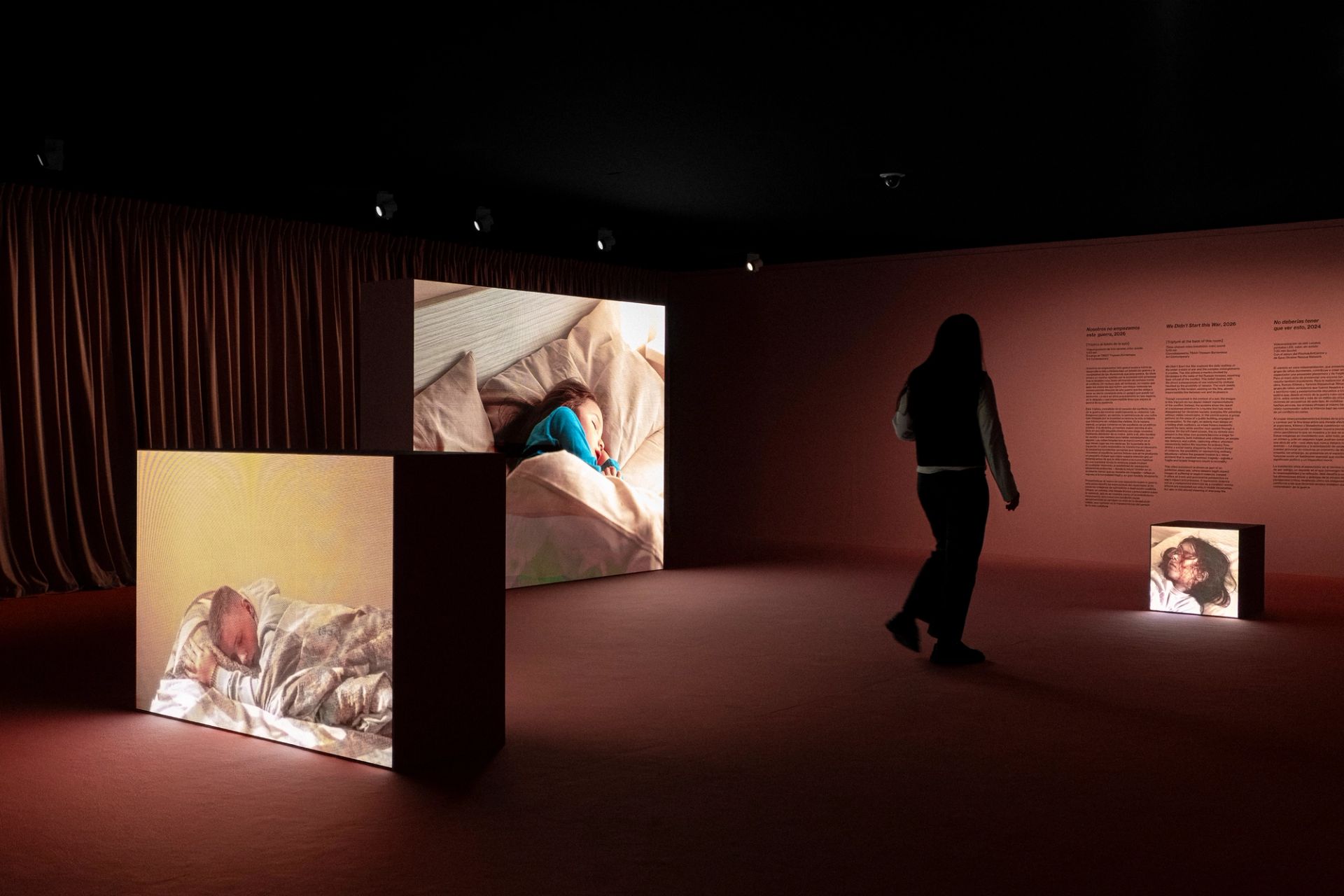
You Shouldn’t Have to See This, Pedagogies of War, installation view. Photo by Maru Serrano.
KOOZ In your work, you talk about war but violence per se is not directly shown; rather, it emerges through a peripheral gaze. I'm thinking especially of the work ‘You shouldn't have seen this’, which depicts sleeping children. Only when you read about the work does the act of extreme violence behind it become clear. What frames your view, and how does that counterpose the images of the war that proliferate through the mainstream news media?
YM It's not that we have an ethical problem with portraying the war directly. Rather, we decided to point our camera in a different direction — less mediated, therefore more accurate to the experience of living in a country at war, to put it in simple terms. This idea of not multiplying these images of war came up; for instance, we decided not to retraumatise victims like the sleeping kids, but at the same time portray them in this most vulnerable state.
We are not against those who are making interviews and trying to get first hand experiences; we’re also not saying that we are distant enough. We are still having those experiences; we’re still occupying them [the spaces of victims] through this camera, violating their presence, their privacy, but in a different way. You cannot really escape from the facts of war, but you can navigate and maybe explicitly comment on it — that was the threshold we were playing around, and the reason for the title, ‘You shouldn't have to see this’. We mean to say that these are the kinds of images that should not have been made; we should not be showing them. In that sense, it’s like the room with the children sleeping. You're walking around with this uncomfortable feeling, as you look at one image and realise that behind you, another child is sleeping; you are surrounded with intimate images, while they don't communicate anything to you. That's the zone we’re trying to navigate.
RK I must say, in addition to Yarema’s thoughts, that we are surely trying to escape from the ‘grand narrative’. We live under the weight of grand narratives; that's why we choose the peripheral gaze that you emphasise here. This peripheral gaze makes visible what direct representation often cannot — the tension, the absence, the fragmentation that exists beyond what we call ‘events’. I believe it allows violence to be felt as a continuous condition, rather than a single, contained moment.
"This peripheral gaze makes visible what direct representation often cannot — the tension, the absence, the fragmentation that exists beyond what we call ‘events’. I believe it allows violence to be felt as a continuous condition, rather than a single, contained moment."
YM To take the last word, the new commission we produced specifically for this exhibition is called ‘We didn't start this war’. This video triptych, directly, explicitly and conceptually, brings forward this idea of an avoidance of images of war — this particular narrative that war dictates you to present. This final piece is basically about that; it is made with purely conceptual intention to free ourselves as artists; as those who create images from a country at war, to free ourselves from that responsibility. Of course, we cannot do it directly but conceptually, to declare that we can film something that is not related to war, and at the same time to question whether it's possible or not; maybe even to just make that problem of representation explicit. What is expected when you think about images from Ukraine and what you see at the exhibition may not correspond. In our case, you wouldn’t see anything that could even distantly be understood as an image from Ukraine at war. You would encounter images like accidents, of things happening on the street of Kyiv and yet — from your own expectations, maybe the context of the exhibition and from all this implied previous knowledge you have received for years, now, about Ukraine — you expect the explosion. You expect the violence. You receive this violence in a sense through the work, but not in any way related to the war. It's a series of small events that can be described merely as violent acts — but accidents, right? Some unfortunate events that could happen on the streets of any city, any country, anywhere else. That's the contradiction that ends the exhibition.
"From all this implied previous knowledge you have received for years, now, about Ukraine — you expect the explosion. You expect the violence. You receive this violence in a sense through the work, but not in any way related to the war."
RK We have never before dared to employ such a level of contrast, dissonance or incompatibility between the title and the artwork. This work is somewhat like an altar, upon which we place this as a new commodity, this new value, the freedom — the freedom of boredom that we lost somehow.
KOOZ What are your reflections on this idea of pedagogy? Pedagogy really implies learning; what does that mean in the context of this exhibition? This also touches on what Chus mentioned around publics, conditioned audiences and complex questions raised within cultural spaces.
CM Well, that title was taken from reading Bertolt Brecht, so definitely, it was a polemic one. What are you learning from the war? Nothing. Nothing? Brecht was saying that what you learn is the fact that the conditions imposed by war can alter life in such a radical way. From whom are you learning? From those conditions that enable radical alteration, from the fact that life is taken to two dimensions, in a way you never thought it would be taken. This is of course something you learn. It's unstructured learning; it’s not that there are lessons that get transmitted from people to people or even from violence to people — that's not the case. Everyone mentions the title — I think this is, in itself, super important because everyone is wondering, is there something to learn that I missed? It’s exactly this structural thing: the suspension of your life makes you learn about your life. It's an unfortunate lesson, but not all lessons are fortunate. So that's how the title appears.
YM I also find it funny, as a more empirical commentary: when you see an exhibition called ‘Pedagogies of War’, you have some presumptions around what you might see. Probably you anticipate some horrible facts about what happened here or there, you may be overwhelmed by that. The creators and artists or whoever produced this show will try to inform you about certain things that you didn't know before. You will learn and you will have an experience; you will probably be aware that war is bad, but this whole logic is already so inflated. It probably does work in terms of the news. I would say that in that sense, perhaps art is not really the best place to inform people about events, per se. Rather it’s a place to reflect on certain things, so I find it funny that we have this contradiction in a title like ‘Pedagogies of War,’. In my opinion, what you see in the exhibition goes in a completely different direction than what a viewer might expect from the word ‘pedagogies’. It's even the opposite to that presumption one may have. Even I would anticipate what ‘they’ would teach me; I would expect to learn about important social events and then try, as they say on social media, to ‘go educate yourself’. That's not the case in our exhibition, I must say.
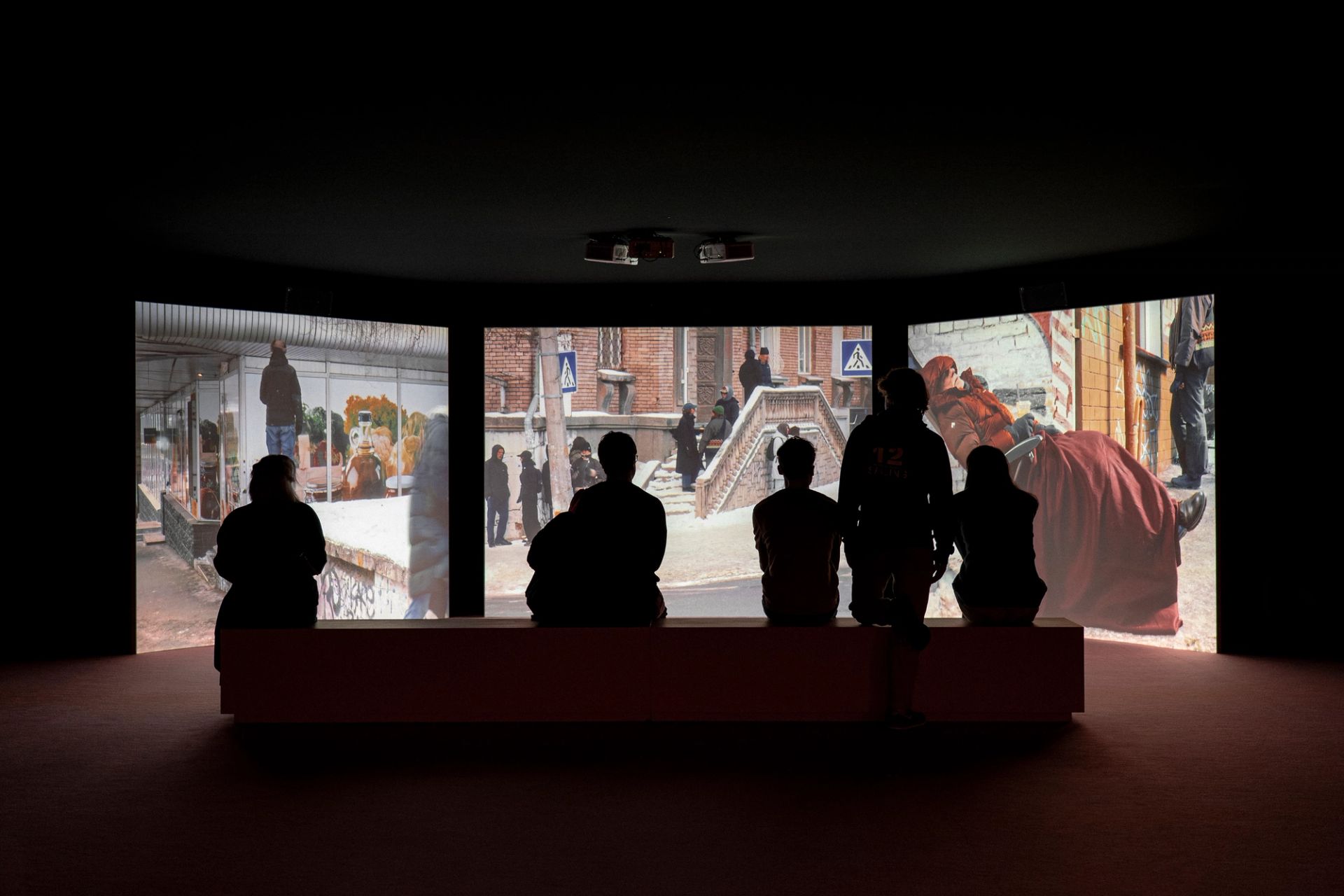
We Didn’t Start This War, Pedagogies of War, installation view. Photo by Maru Serrano.
KOOZ Coming back to Venice, I really enjoyed your description of the power of the assembly and moments like the Biennale really speak to that. What kinds of assembly are you looking forward to generating in Venice?
CM Briefly, I’ll be working on my pavilion — the Danish Pavilion with the artist Maja Malou Lyse. That one is also very polemic, but anyhow, it’s a completely different thing. It’s about pornography; I'll be a porn creator in Venice and I invite you all, of course. But I’ll let you talk about their project
KOOZ Well that sounds intriguing, to say the least!… I always find this tension between presenting such rich topics at events where people have such short but intensely powerful moments of attention and exposure. What are your expectations, and what is the value of showing your work within a space like the Venice Biennale?
YM Firstly, it's quite simple: we are glad to have this opportunity to present something we've been thinking about, in a space with a lot of people with different and interesting views on art and on the world now. I don't really go too far beyond that, in thinking about why and what it means. This work will probably live in the future in other venues, I hope, in other conditions. I don't have particularly interesting views on that — I'm just curious as to what conversations this work will prompt, hopefully a few nice ones. For me, it will be quite a lot to hear feedback from friends and creators; that's important to us and to the logic we employed. For us, it's always a challenge; there’s always some moral or ethical challenge that we address in all of our works. To find out whether it actually makes sense, whether something is capable of bringing more understanding to whatever the hell is happening in the world, and particularly within the context of the Ukrainian-Russian war… If it adds something to that conversation, I would be very pleased.
RK This time, we hope to present three different works — it's the first time that we present three video installations simultaneously. In 2017 and again in 2019 with Open Group, we participated in the Ukrainian Pavilions, as a team. We made the visuals for part of the pavilion. I'm joking here but it's a bit like Eurovision — a festival of all these countries, their national identities, codes and challenges. The work that we are preparing now — in the context of the group show ‘Canicula’ — aims to speculate; as we were saying before, it’s an attempt to fulfill a certain future. It’s an attempt to talk about this reckoning of Russian aggressions, and how this might look in the future. You probably know about returning so-called Russian representatives to the Russian Pavilion even this year, for the first time since 2022. This creates an unbelievable tension, unbelievable pressure…
YM We have to underline that this is not just about Russian artists showing works at the Biennale. This is the official Russian state that wishes to speak from their deeply imperialistic position — that is to say, to advance its postmodern-fascist way of thinking — to speak about the world, to speak about their views while they're conducting war every day. Right now, there’s an air raid and Russian jets are probably firing ballistic missiles or other missiles into Ukraine. When they speak about world issues, it feels so hypocritical and unfair, even from the perspective of the very structure of the Venice Biennale — a structure that is based on the representation of arts of every nation. I don't really have much insight into the connection between our installation and the presence of the Russian Pavilion at Venice Biennale, but there surely be some interesting encounters between these events. That's something we anticipate.
KOOZ It’s been a wonderful conversation on some difficult issues; thank you very much for your time and energy.
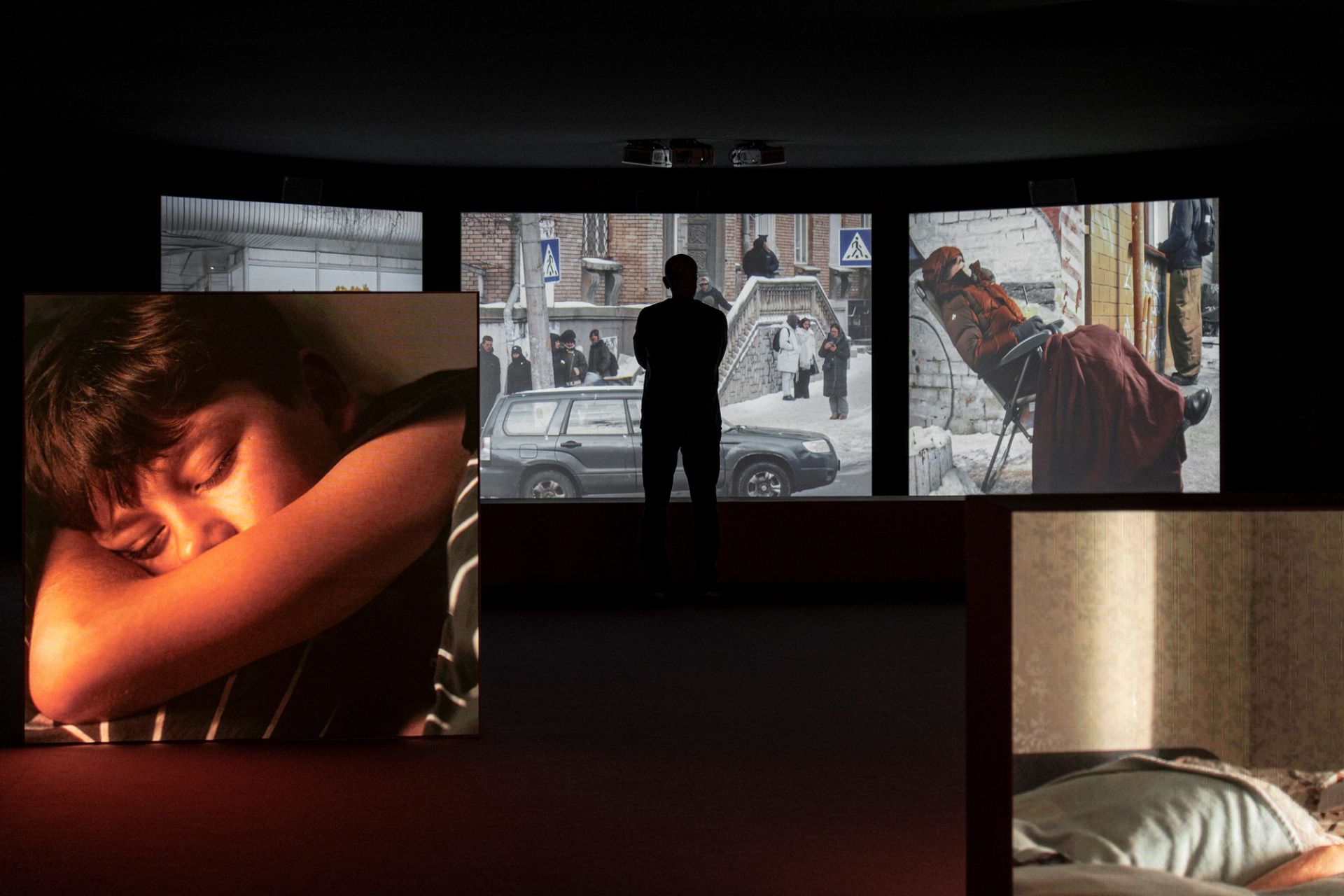
Pedagogies of War, installation view. Photo by Maru Serrano.
BIOS
Roman Khimei and Yarema Malashchuk have worked as filmmakers and visual artists since 2016, exploring the intersections between documentary and fiction to address Ukraine’s recent history and present. Their practice examines enduring post-imperial power structures and their impact on a new generation, caught between historical trauma and an uncertain future. Yarema and Roman are members of the Prykarpattian Theater, an art group that recently established the project Theater of Hopes and Expectations, which was presented at the Ukrainian Pavillion during Venice Biennale Architettura 2023. They also co-curated the group exhibition On the Periphery of the War for the Kyiv Biennial 2023.
Chus Martinez is a Spanish curator, art historian and writer. She is head of the Institute Art Gender Nature (IAGN) at FHNW Academy of Arts and Design in Basel. With a background in philosophy and art history, her career spans key roles such as Chief Curator at MACBA (Barcelona), dOCUMENTA (13), and El Museo del Barrio (New York). She was the expedition leader of ‘The Current’ and between 2020-2022 she was the artistic director of the Ocean Space in Venice, both initiated by TBA21–Academy.
Federica Sofia Zambeletti is the founder and managing director of KoozArch. She is an architect, researcher and digital curator whose interests lie at the intersection between art, architecture and regenerative practices. In 2015 Federica founded KoozArch with the ambition of creating a space where to research, explore and discuss architecture beyond the limits of its built form. Parallel to her work at KoozArch, Federica is Architect at the architecture studio UNA and researcher at the non-profit agency for change UNLESS where she is project manager of the research "Antarctic Resolution". Federica is an Architectural Association School of Architecture in London alumni.