KOOZ/Shumi Bose Lucia, Gabriel, Daniel: thank you all for being here today. Let’s start from a slight oblique; could you tell us what you've been up to, as a means to introduce yourselves?
Lucia Pietroiusti As a curator, I came through working on time-based media, public and discursive programmes and curating performance, which influenced my later practice. I've spent the last dozen or so years increasingly specialising in this intersection between art and ecology, which I like to understand in a very loose sense — maybe closer to the way that the IPS understands it.. As to my own trajectory and research in ecology, I might say that it has moved from the ontological to the epistemological to the metaphysical over time. When I started on this path, I was thinking a lot about carbon accounting, sustainability and materials. That led me to think through the prism of thinking itself, to how we change our ways of knowing, especially in relation to a more-than-human planet? This is the epistemological.
That in turn led me to developing a much greater breadth of practice: a connection to the infinite, essentially, which is really where you end up if you spend enough time in the ecological space. I’ve gone from working with experts on sustainability, to reading and interacting with anthropologists and storytellers and scholars of the history of science. Yet, right now, there are more theologians in my reading list, alongside syncretic and mystical traditions from the world over. The deeper you dive into an ecological mindset, the closer you get to things you cannot necessarily fathom in their entirety.
"The deeper you dive into an ecological mindset, the closer you get to things you cannot necessarily fathom in their entirety."
Currently, I work for the future Hartwig Museum in Amsterdam, which will open in 2028. Towards its opening, I am looking at how it might be able to function as an ecosystem, and I'm bringing an entire decade's reflections about this to it. The Museum will have living spaces, cooking spaces, exhibition and performance spaces, public spaces: a lot of different typologies of habitation and use, and we're looking at how artists, people and ideas are going to flow through it. That's what I'm working on at the moment: not the R&D of the Museum, but in what we're calling R&E, that is, research and emergence.
KOOZ Lucia, you traced a very special sequence of curiosities — from materiality to the infinite. Daniel and Gabriel, tell us about your respective journeys.
Gabriel Alonso Thank you, Lucia, that was beautiful. When thinking of my relation with the word ‘nature’ — I always remember when I was a kid and my parents put me in the car, taking me to that other place they called nature. For me, that simple experience became an important question: if I'm going to nature, where am I right now? What is this other space where I'm living that is not natural? These dichotomies and the two binomial spaces that are shaped in our structures of thinking, of living, have always been interesting to me. That was the beginning of my first questioning: what are all the interrelations and constellations and complexities of our being in the world? I then studied architecture — but I have a Freudian relationship with it; my father is an architect too. For my first paid job, I was in Berlin still studying architecture when I started working in a gallery. The first artist I worked with proposed a huge model of the city of Berlin, inhabited by four rabbits; I had to help build it and take care of the rabbits for a month. It was chaos; the model was made with carrots and broccoli, the rabbits had to eat it, they started fighting — a complete mess, and a mildly violent experience! I understood that there were other more subtle and ecological ways of speaking about the more than human, and that the artworld was a very important place to start rethinking and reshaping such new relations.From there I moved to the United States to do my Master's at Columbia University, and finally started thinking about my practice as an artist and a researcher. I studied with Felicity Scott and Mark Wasiuta; we were invited to rethink the structures of thought from Western perspectives, trying to understand those logics, and how to blur their dichotomies. I began looking at the territories of nuclear waste, investigating spaces in which contemporary materialities are really pushing the boundaries of what is natural and what is artificial, and to think of the other-than-human — not only animals or other life-forms, but also all the materials that technology and science has created. How do we relate to those substances, and how to really understand a post-natural approach to territories? I realized that when looking at viscous contemporary matter, the containers of modernity -both literally and ontologically- seemed to have lost their capacity to contain.
I came back to Madrid and together with other people, we founded the Institute for Postnatural Studies. I had my own artistic practice but I really believed that creating a platform could become my most radical artistic project; IPS was meant to become a local space, intended for artists and practitioners in Madrid to host conversations around ecology. Suddenly the pandemic hit, and everything changed drastically. That's important to mention, because the Institute emerged at a moment in which those dichotomies — as well as the cumulative fears and anxieties derived from the climate crisis — became very personal and very intimate. Most of us were at home, not knowing what was going to happen.
Of course we wondered if it was a good moment to start such a platform — then we realised it was the best moment, because people had so many questions, doubts and fears. I also understood how ecology was, for me, moving away from large, paralysing problematics into the spaces of intimacy, subjective experience, things that really affect our daily lives. We could understand ecology as this close space of relations between people, their contexts and their feelings. I guess the Institute started and continues as a platform, where we are still experimenting and learning how to create spaces for collective repair.
"We could understand ecology as this close space of relations between people, their contexts and their feelings."
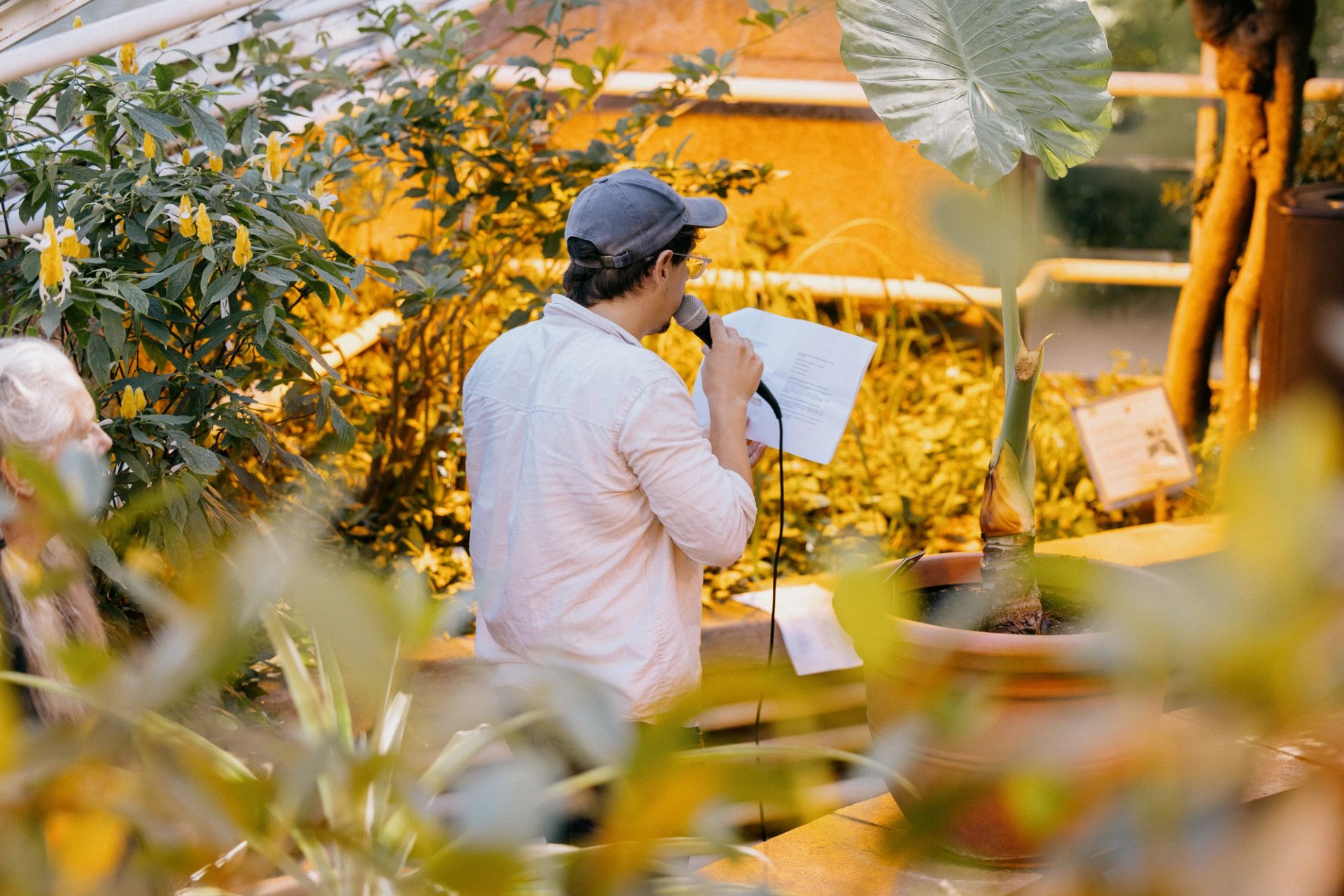
Institute for Planetary Studies, ‘HothouseFlowers’ performance and symposium, Oslo 2024. Photo: Abrakadabra
Daniel H Rey I love these unorthodox introductions. For my first job, I took over my parents' garage in Asunción, Paraguay, to sell homemade sandwiches and orange juice. But I was worried about not having a permit — even at nine years old! — so I would stop people and invite them into my house; as guests at my garage, so I could “sell” to them. I was negotiating private and public realms from a very young age. Google Street View arrived in Paraguay now and a few months ago, I found out my childhood home is now the parking lot of a Brazilian steak restaurant. I grew up across eight countries by the time I was 20, so I'm not sure where I'm from, but I like to say that I exist between soils and WiFis.
"I like to say that I exist between soils and WiFis."
Mindful that I'm a digital native, I think I embody two rather rare traits. One of them is that my entire education, both at high school in Norway and college in the UAE, has been funded by oil wealthy countries, so I have a very complex and entangled relationship with fossil fuels and education — that particular axis of power, soft power and its possibilities. Within that, and in part because of the pandemic — I ended up being among the first generation of curators in the Arab Gulf who had actually pursued a US liberal arts education in Abu Dhabi. Now my life exists in Madrid — or rather, I exist at the intersection of the multiple worlds that Madrid hosts and gathers. My practice as a curator is very much informed by the idea that departure, arrival and adaptation are the default conditions of curatorial practice. Having seen my parents sit in front of their belongings every few years — leaving things, selecting things, displaying things — made me very prone to engage in these types of exercises.
Today at IPS, my role is Curator of Programs and Networks. I think what Madrid — and this context here at IPS — enables is proposing a new configuration of worlds. There are two terms that I use a lot in my practice: firstly, I'm constantly questioning the idea that as a society, we can also be a sculpture — a social sculpture, not as in land art but rather in the sense of new relational realities. Secondly, I think a lot about this question of belonging. I hardly ever label my work with the countries where it is made; I do say that I work in Madrid and its spheres of influence, because those spheres of influence can mutate. One day Madrid’s spheres of influence could reach as far as Santiago de Chile; another day, through our work, it might be Mauritius or Uzbekistan.
I think there is something so exciting about being a curator that conducts collective efforts and consents to manifest an idea of where influence is headed, and to consider what kinds of influences we admit into our own practice too. I would insist on the fact that I feel at home between soils and Wi-Fis — I also feel at home in diasporic settings. I'll end with something I found out very recently: I was born in 1998 and I have an older sister, which means I get dragged into being a young millennial. I'm not officially Gen Z, because I have an older sister. I'm part of a‘hinge’ generation.
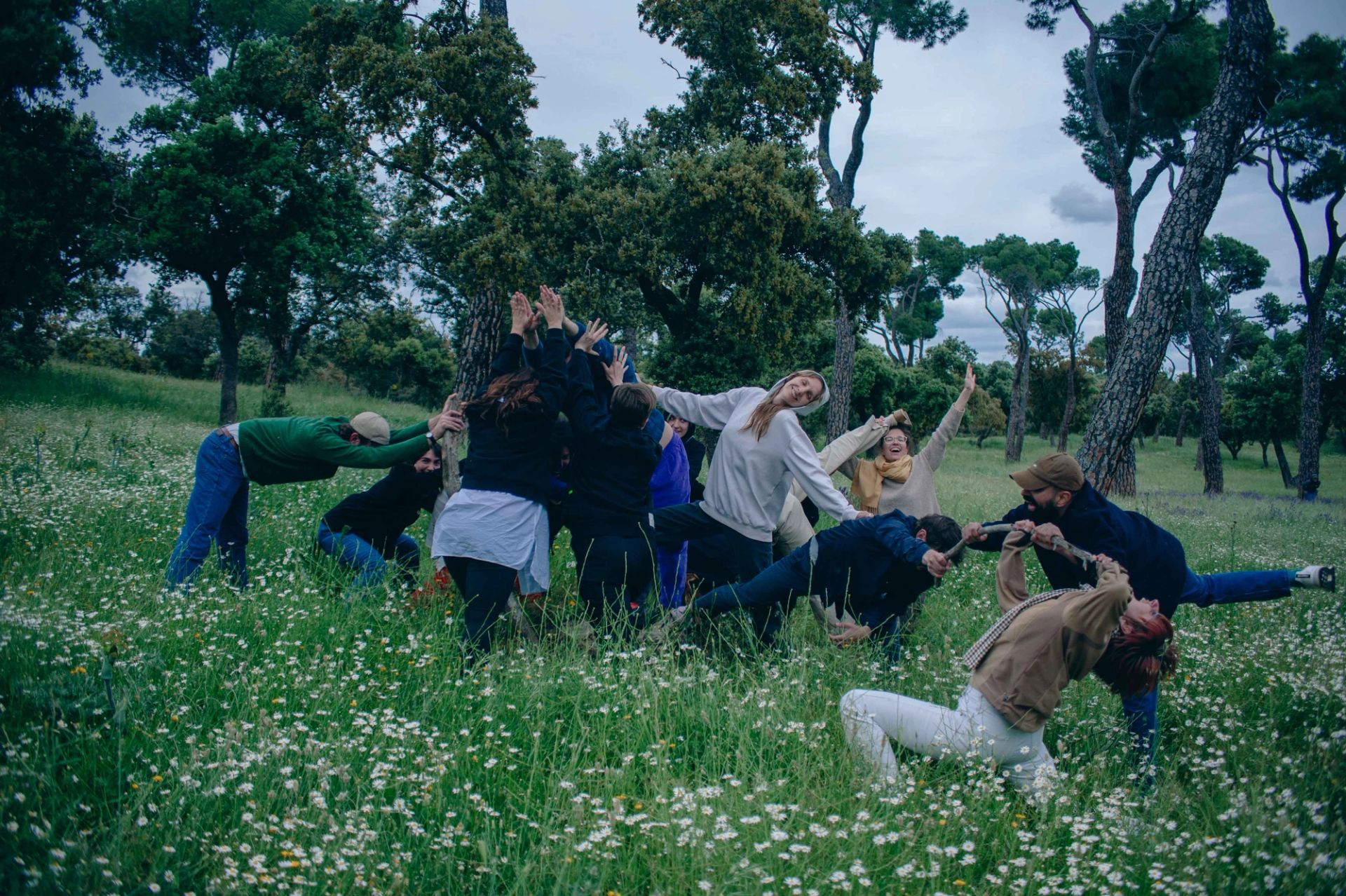
Institute for Planetary Studies, Postnatural Independent Program Workshop by Azahara Ubera in collaboration with @paisanaje, April 2024. Photo: Irene Baque
KOOZ One commonality between those beautiful introductions was the creation of the institution: Lucia, you are watching the future Hartwig Museum come up outside your window, as Head of Research and Emergence. Likewise, Gabriel talked about the foundational moment of IPS and the idea of ‘performing’ the institution. Given that you are trying to stretch the format, what is the benefit of the institution, as opposed to more informal or distributed structures?
LP I've never seen the relationship between smaller-scale organisational structures and, for lack of a better word, larger institutions as an either-or situation: they always, de facto, coexist in the world. As far as my own trajectory is concerned, I have spent an enormous amount of my professional life working within institutions. My commitment there has always been to see what kind of work (structural, parasitic, whatever) one can do from the inside to make the organisation’s boundaries more porous, to make processes more interesting and more generative, and to resist the repetition of the same. As institutions tend to institute, I find energy in experimenting with how the institutions themselves can transform in response to the ideas, projects or programmes that they host. Can the software of culture influence and change its hardware? This kind of question is particularly stimulating when the hardware seems difficult to change - as is the case in larger institutions. It’s not always easy.
"Can the software of culture influence and change its hardware?"
This probably is a good opportunity to say that for a really long time before working for the new Hartwig Museum — which lends an enormous playfulness and so much inspiration to what has almost been my life's purpose, I wrote and founded a project for Serpentine in London, called General Ecology. The project began to take shape in 2018 and it went together with a change of my job title. That’s because I insisted that in order to build a more resilient structure for the organisation, there must be humans attached to it. From Curator of Public Programmes, my role changed to Curator of General Ecology. Suddenly, “General Ecology” was a constitutive part of the organisation, by virtue of this fact. This was just one of the many strategies where, with the somewhat limited agency of a curator within an institution, you can still get to do something quite interesting with your context and with your public.
Our aims with General Ecology changed over time, but in hindsight, its ambition was to see how much of a structural adjustment could be made to an existing institution, in terms of infusing it with an ecological sense of purpose, as well as ecological ways of working, and to make these interventions at all the layers of the “stack” - from programmes to infrastructure. This is why I was so excited by IPS’s new programme and the idea of ecology as a method: this was a fundamental principle of General Ecology. The project was always about how to do ecology through ecology: so, to think about ecology as a method of thinking, a way of researching, of relating to others within an institution, of building organisations and relating institutions to each other. But also to think about ecology in a holistic sense: recognising our own being within a nested set of ecosystems, be they human, environmental, planetary or ecosystems of thought.
"The project was always about how to do ecology through ecology: so, to think about ecology as a method of thinking, a way of researching, of relating to others within an institution, of building organisations and relating institutions to each other."
Felix Guattari spoke about natural, social and psychic ecologies. I agree with him and would go as far as saying that, there are ecologies everywhere. For General Ecology, we could be looking at the specific organisation of the Gallery itself in the field of contemporary art; the park within which it is sited; the wider ecosystem of thinking and practice within which it operates; the larger environmental ecosystem, the more-than-human planet surrounding it, and so on and so on to a cosmic scale. There are nested clusters of relations, of dependence and interdependence within other clusters, and all of them are related and responding to each other.
It was with that in mind that, more recently, I started to really think about not only humans, non-humans and more-than-humans, but equally, projects and ideas themselves as having a kind of personhood. Not so much a legal personhood, but a way of being in the world that is alive, that has agency. There’s something fundamentally animist in me, which considers everything to be persons. That is to say that these things relate to one another, they have agency, they can surprise you — even ideas. While I hadn’t landed on this way of formulating it yet, it was at that level that I proposed the project. In very practical terms, the idea was to work with certain principles in mind — for instance, to always programme events about ecology and the environment, in response to virtually any circumstance or programme. If you do that often enough, you will develop a nascent community of audience members. You develop ways of doing certain things, and amongst your participants, you build a kind of a trust — much like IPS has done, building trust and community among a stellar group of speakers and teachers.
After a few years, we had produced an audience that was mirroring back an image of the institution that differed from the one that it had of itself. At that point, I could show my receipts: this is actually who we are to the outside, so let's continue to formulate it.
I do most of my research in public: I like to think while I'm speaking and while others are speaking, in the open. The project adjusted itself and also gained more traction internally as it met its public, its interlocutors and so on. There was a fairly virtuous feedback loop, for the right amount of time. Back to the question of institutions. I see my role as contributing positively and reparatively to an ecosystem that includes smaller, larger, independent and less independent institutions, and to do so in a way that is aware of the interdependencies between those.
KOOZ Your mode of making space within an institution includes coming at it with an angle of what you can stretch, push, get away with, or how far you can deviate from the given path. Daniel and Gabriel, you mentioned the shift from what was initially imagined as a social club, ballooning into a much bigger community formed in that radical intimacy of virtual contact that we experienced during the COVID lockdown. How did you then decide to call this thing an institute?
GA So I had this term ‘Postnatural’ right from the beginning. I like to go back to the moment when I was running a course called Postnature and Contemporary Creation at an independent institution in Madrid — namely Inland Campo Adentro — which had invited me to deliver a two-month seminar. We convened this group of people, but we found that we always needed more time to keep the conversation going. There was something vibrating, resonating. We realised that there was a lack of space and time to deepen into certain questions, concepts and ideas. This was seven years ago in Madrid, when thinking about ecology and art together was not so prominent here. So I invited them to my warehouse in the southern part of the city, where IPS is located now. I realised how important it was to have a place where we could all join, having a real space where those conversations could happen.
I really like what Lucia said, also as an invitation to blur these boundaries between bigger, smaller, independent or non independent institutions, because I think all of them have their own responsibilities, temporalities, possibilities, dreams, bureaucracies, struggles. It's not fair to think that there are better institutions than others because of the scale, but rather because of the possibilities that one finds in the spaces where, as Lucia was saying, one can open up to different ways of doing. The idea of having different institutions, for me, is very much understanding the ecosystem of culture, in which different types of spaces and structures will shape a healthy ecosystem; we need that diversity in order to make things differently.
When we started, we spent time thinking about this with the Institute of Queer Ecology, friends who were already taking this postnatural approach not only from biology and science, but also cultural studies and gender issues. They mentioned something beautiful that resonated a lot: the idea of performing the institution. They described how certain insects perform camouflage not by mimicry or disappearance, but rather by creating a flamboyant decoy. I have this image of a mantis becoming a huge pink orchid, its wings like the petals of a pink flower. I really resonated with that idea of a flamboyant kind of mimicry, a performativity of the institution; the spaces, desires and dreams that we have. By performing that — with excess, with these propositions, with this dreaming, with this drive and this energy — we find ourselves creating a space where we can also share ideas with other amazing people.
Lucia, I would also like to thank you for something else that you raised, something about the trust that we created with the people that joined, which somehow legitimised our attempt. It is not the name of the Institute that did so; it is the people who joined it from the beginning. As you can imagine, we felt very honored: working from a warehouse in Usera, in the outskirts of Madrid, and dreaming about an Institute for Postnatural studies, we invited people to join us and develop this virtual space, but to do so from their vulnerabilities, their fragilities, the limits of their thinking, the processes that they were going through at that moment. What we were offering was a space for sharing what they did not know, questions they were like confronting in their thinking. I think opening that space for doubting, for not knowing, for problematizing their own thinking was very important from the beginning, and very important for the Institute to start growing.
We also realised that having these conversations online doesn't mean that there is no body or presence embedded. There's something interesting about the different contexts suddenly shared on the same screen; a kind of dispersed collective metabolism of thinking. How do we think together, as a group of 35 people, with someone who just woke up, someone who is having dinner, or someone who is committing to be with us at 3am every Monday and Wednesday? What is this present that we're sharing? Creating an institution also means unlearning those methodologies of repetition and proposing new forms of relation using the tools that we have. We have these tools; let's experiment with them, let's keep imagining other forms of relation.
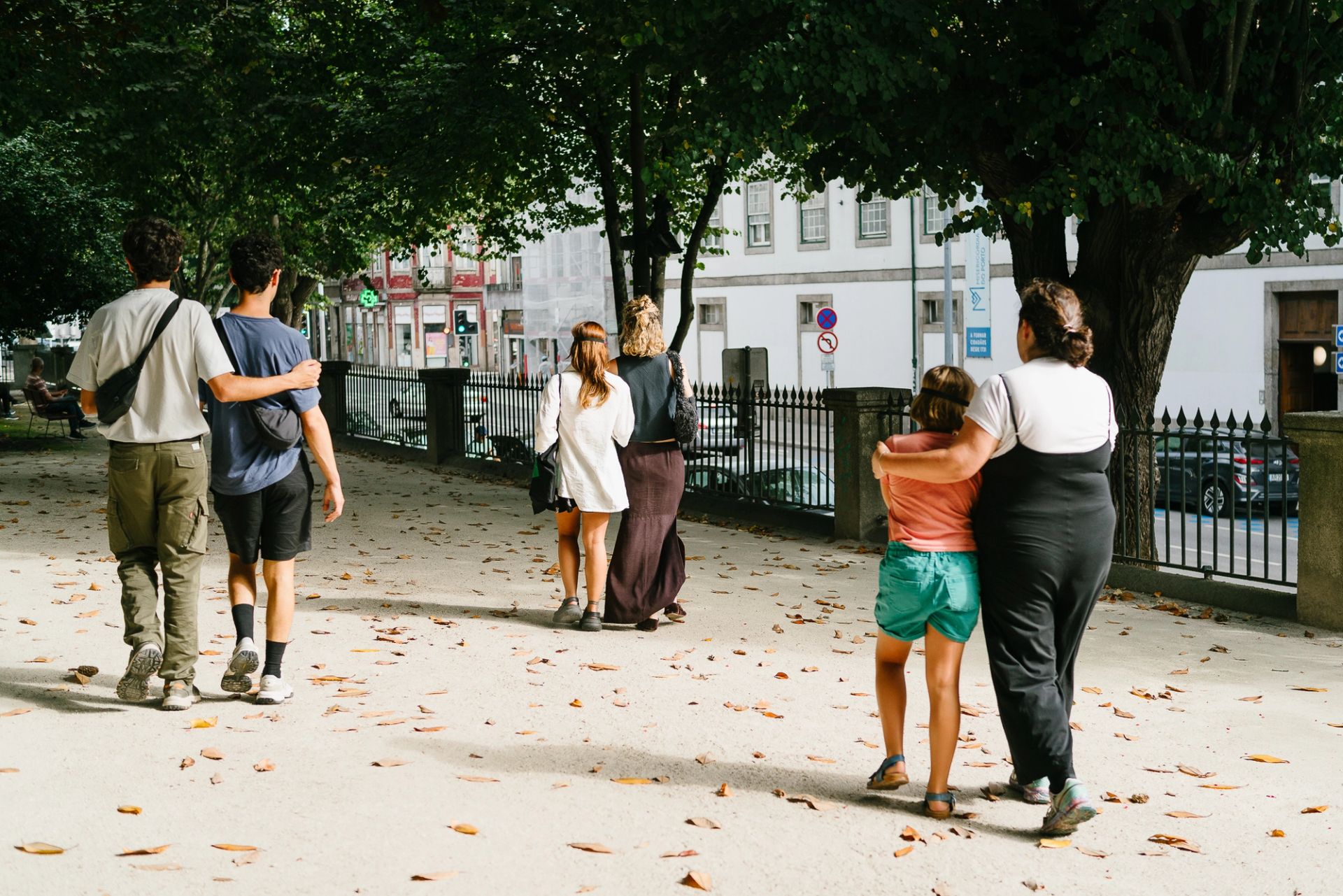
Workshop for Becoming Assembly with Coletivo Pláka. Photo: Dinis Santos, courtesy IPS
DHR.. Like effective affection, or rather affective effect. I wanted to add something about the fact that sometimes it takes having a physical address, a web address or an email address to be able to address and be addressed. That basic configuration is wacky, but also fundamental. As someone who has been following the IPS project for four years now and joined two years ago, I'm puzzled by how we often assume institutions to be declaratory, definitive or affirmative bodies. What happens when we treat and engage with the Institution as a place whose default reality is to ask questions?
I must admit, I struggle when emerging platforms, collectives, grassroots or even institutions describe themselves as being mycelium-like, tentacular or rhizomatic. Perhaps my sin here is being too anthropocentric; for me, the institution is and must feel like a hug. If I were to contribute to those images — the tentacular, the mycelial or whatever — I’d say the IPS is a hug or a hugging body. One of the main learnings I've engaged with through the team, but also one of things we want to shine brighter and lighter, is the idea that there is no point of trying to assert oneself as an institution if there is no radical engagement with the sensorial and the gestural.
I think we've confused reach with volume and loudness — and that’s setting aside the troubling primacy of visual culture and the algorithms that enable images to travel. To what extent can an institution be actually a testing ground or an experiment of the gestural, the muscular and the sensorial? Often, the very first thing I ask people is to recognise as many muscles as they can in their face before we actually engage in conversation. We forget that the first step to embody anything is to actually embody it. I worry that as speaking beings, we forget the literal muscularity, the physicality, the vibrations that enable our systems communication and observance to emerge.
"... for me, the institution is and must feel like a hug."
LP I'm so touched by this, it reminded me of something — in fact, a light criticism of institution-speak. I'm currently writing a little booklet on metaphor, and one of the misgivings I have about metaphors is how quick we are to adopt a new one — as though a figure of speech has the power to ethically redeem a world, single-handedly. That includes the ‘more-than-human’, it includes ‘quantum’ and whatever else. Eventually, when these things make their way through the institutional speech filter, you get formulations which lose all sense of rigour. For instance, if ‘quantum’ proves that things are neither one thing or another, one can read quantum as non-binary, therefore it’s about queerness, therefore that’s good. Suddenly, the term ‘quantum’ is the redemption of our moral failures; at the same time, quantum computing is on an entirely different, and often militarised, path. The real world versus the metaphor are now poles apart: what good does that do? In general, I'm quite allergic to the use and misuse of certain words, without careful consideration. ‘Care’ is one of the biggest offenders; institutions love to say that they are doing something ‘about’ care. I shy away from that word, largely because I don't intend to claim it, but neither can one assume that organisations know what they mean when they say it.
In 2023, with my colleague Filipa Ramos, we curated a show in Vienna as part of the Climate Biennale called Songs for the Changing Seasons. The idea was that in moments of rupture and crisis, moments of endings, art takes you by the hand. I always used to say to colleagues, what if you could replace the word care with things that actually mean something to you, personally, directly? For me, for example, the words ‘tenderness and attention’ hold a lot of value — they are words that mean something to me: I know them in my body, not just in my mind, or in an idea of them. It's not about obsessing about words per se, but rather playing with words that shy away as quickly as possible to get to the thing that they mean.
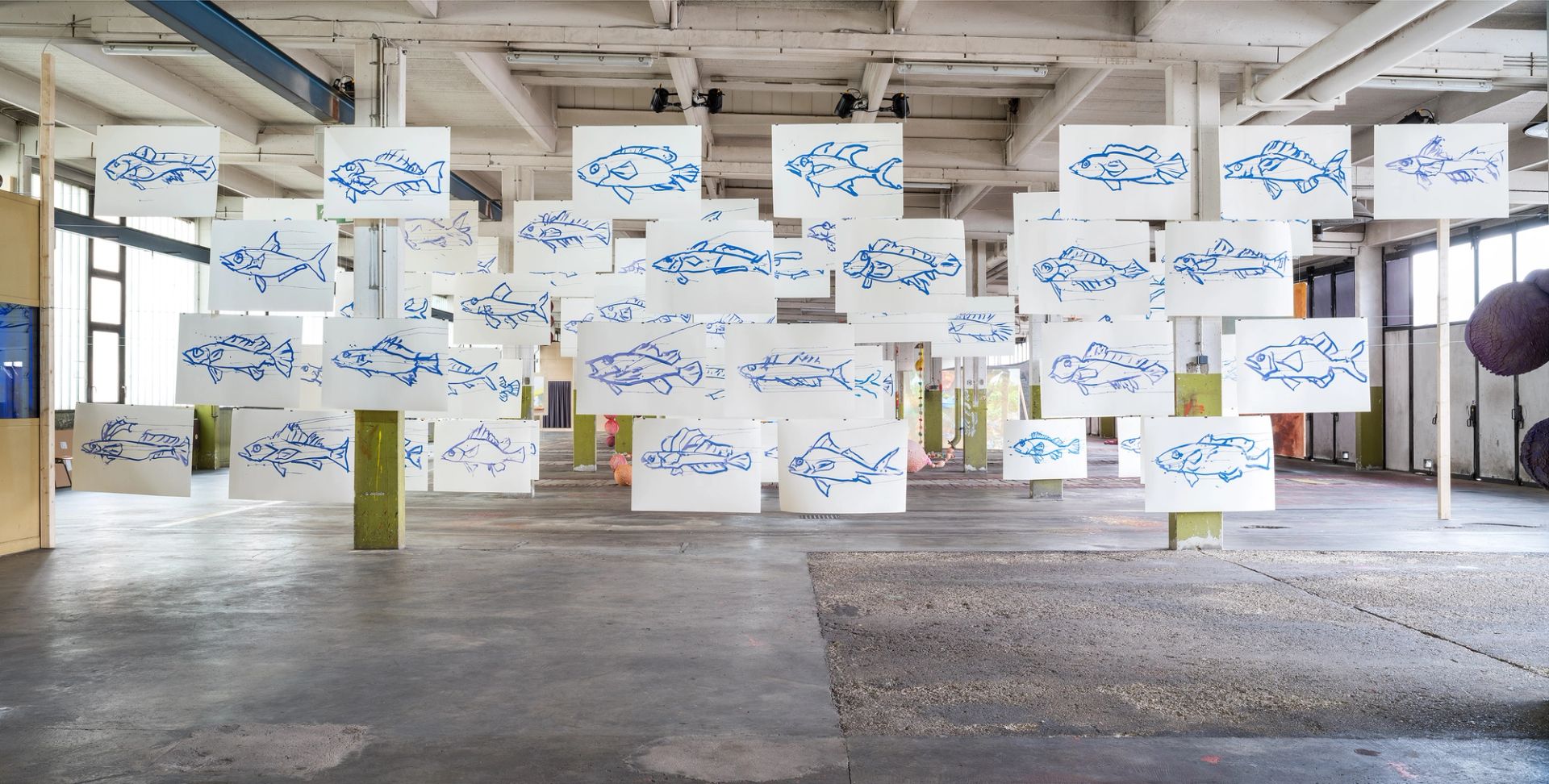
Joan Jonas, they come to us without a word II (2013–23). 68 exhibition copies of ink drawings on paper, variable dimensions. Photo: Filipa Ramos
KOOZ Exhilarating to track the flux of terms that gain and lose their resonance or potential to unlock certain ideas. Following up on the term ‘postnatural’ — as opposed to anthropocentric or even ‘more-than-human’ — what does that ‘post’ prefix imply? Are we done with nature, and is that irreversible?
GA Yeah, it's interesting, six years on, to think about how the word itself has changed. Words are very elastic, and they also mirror certain contingencies in their constant transformation of their meaning. At the beginning, I felt the term ‘postnatural’ carried a slightly ironic tone; a playfulness in the word itself that signified not taking things so heavily, theoretically speaking. When we think about moments in design philosophy or any other discipline, there are certain disruptions — like poststructuralism or postmodernism — that suddenly create a break with what was there before. But what happens when we use this prefix with this with a noun, a concept that is understood as more static? That creates a first glitch in the understanding of the meaning and the temporality of how we approach nature; within that, it implies the mutual relationship between nature and culture — there's no nature without culture and no culture without nature.
There could also be a pre nature — the idea of a state before nature can also trigger certain images that are interesting. There are some cultures that don't even have a word for nature, in reference to a quality that one can point out. What I mean is that the word itself plays its role by dislocating attention, it gets to a periphery of meaning where everyone has their own approach to the word. It creates a polyphony of meanings by itself. So in some ways the term postnatural has become an excuse, or a mirage, or a ubiquitous condition. It's everywhere, but it's nowhere; it relies on certain understandings of contemporary issues around climate change and ecological crises, based on cultural hierarchies — upon structures of thinking that should first be dismantled in order to approach other ways to relate to the world. I guess it is still an interesting term, it does its job.
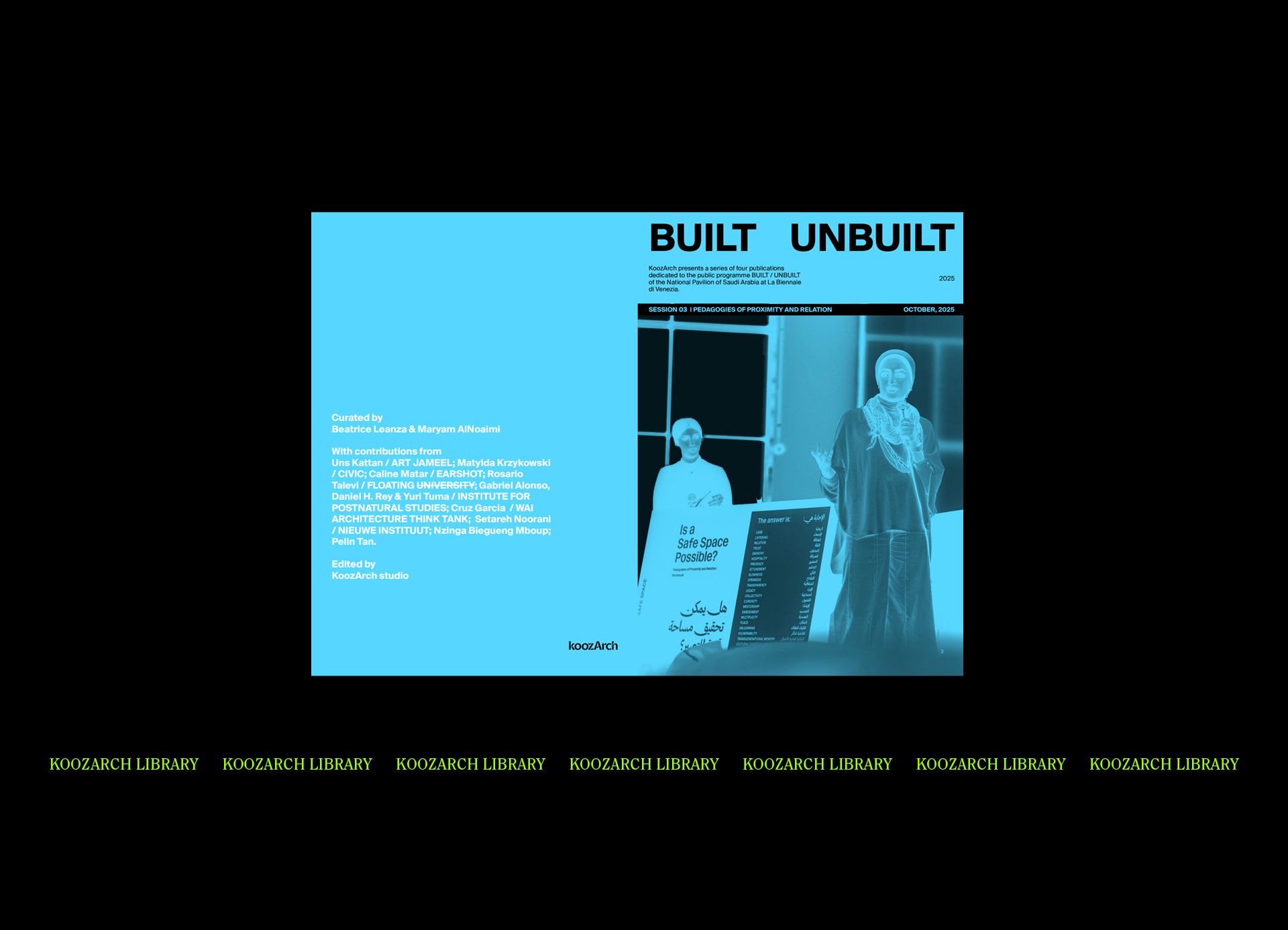
DHR It's interesting to problematise such terms, including our ‘post–’ prefix, through other languages. Last year at the Venice Biennale of Architecture, we supported pedagogical thinking around the Saudi Arabian pavilion; when we translated our name to Arabic, it was a revelation. Seeing our name — Institute for Postnatural Studies spelled out in Arabic, maehad aldirasat ma baed altabieia معهد الدراسات ما بعد الطبيعية — if you remove one particle, it apparently becomes the Institute for ‘Paranormal’ Studies. Then too, when you say ma baed — the translation of post, in this context — it's less about a marker of time and more about intentional following and companionship. So we are the institute that follows nature, in a way.
What I want to point out with that is the way time is embedded into a naming system, and how that plays out in how you negotiate or make decisions. Now that the postgraduate programme is launching at IPS, it's the first core programme (besides the seminars) that doesn't make any reference to time, but rather to difference — it's called Alternative Ecologies. To me, that's really interesting: how even from a place of language, having time as a condition or a determining factor makes a difference; it highlights how naming a program can really set up its universe. I was reading the other day that, arguably, the term abracadabra derives from Aramaic, meaning “I will create as I speak”. Just thinking about that in the context of Gabriel and the team naming this programme, for example, ‘Alternative Ecologies,’ I'm prompted to think about what are we alternating? What is the alternative?
KOOZ Let’s move up in scale from words to phrases: ‘The Shape of a Circle in the Mind of a Fish’ does some pretty heavy lifting, as a title. It sets you up to perform tasks of imagination or transposition, to consider an impossible question: whether non-human consciousness can or should be understood. Lucia, could you reflect on that question and how you have managed to sustain it?
LP Funnily enough, that particular question emerged in one of my long monologues to my psychotherapist at the time. I don't know how I ended up there, but I was wondering about the puffer fish at the bottom of the ocean in The Blue Planet documentaries, swimming in little circles; does the fish imagine a circle like beforehand, and is it then making the image? Or maybe, as it moves its fins to do so, does it experience this circle more like a dance? I love titles; I often name things before I know what they are, and ‘The Shape of a Circle in the Mind of a Fish’ was one of those.
In 2018, I invited Filipa Ramos to think about a single event on interspecies communication as an offsite project as part of General Ecology. What came out was the first The Shape of a Circle in the Mind of a Fish, an evening at the London Zoo on interspecies communication. It could have ended there, but in the research process, we kept finding more things that we felt we should look at from a more-than-human standpoint. Before we knew it, the programme had turned into five symposia, a series of podcasts and a number of books.
The basic suggestion with the project’s title was to imagine what mind and consciousness would be like — what umwelt, what the experience of the world would be like in more-than-human beings. Or rather: how to make space for what is essentially an impossible question. It's nice to have an unanswerable question, because then you have an infinite research project. In several of his writings, philosopher Michael Marder suggests that in thinking about the language of plants, for instance, we need to make space for the untranslatable: that means making space for quite a lot of things which don’t quite fit within human-made institutions and categories.
"It's nice to have an unanswerable question, because then you have an infinite research project."
As soon as you start to go into this epistemological question — how can to make sense of meaning, or knowledge, in a non-human way — you suddenly have to deal with all the things that are in excess of our day-to-day experience, all those things that we foreclose in order for the ‘functional’ human brain to do its thing from morning to night. At the end of all this time, as the vast field of all that is unknowable in this research grows rather than shrinks, I have found myself becoming quite religious, in a non institutional way, by realising that we do, in fact, have a name for that. In human culture, we call that God — the space of the untranslatable, the space of the unknown, of the annihilation of the self. The ultimate meaning of death is the infinite recycling of matter and materials, the fact that we are temporary accumulations of things that then dissolve again. All of those things, we call God. So then God becomes a really interesting subject of study.
KOOZ In European art history, the church sanctions knowledge of anatomy: the human body is sacrosanct, and it was not our place to understand something created by God. I'm reminded of that gap, between whether or not we can know another form of consciousness. These are infinite questions, but you propose that very unanswerable phenomenon gives shape to that which you're describing as God?
LP I suppose so. Everything that's at the edge of perception, awareness or consciousness, and also at the edge of bearability, is what we call God, or the infinite, whatever words we use. Of course, institutional religion has done a really great job of destroying that experience. This is an approach closer to mystical traditions: there is much more in common among mystical traditions of different religions than between those same traditions and the ‘institutional’ version of the religions they emerge from.
KOOZ Let’s return to another sticky question — “who is the we?” — which is quite fundamental at IPS. When we refer to our world or our planet, who is the “we” and to what extent can we speak for others?
GA Definitely. I really like this gap that Lucia mentioned; I’m actually writing a text around the ecologies of distance. Over the last years, we've been navigating terms like entanglement, intertwining — everything bound close together, affecting each other. The question arises as to why we don’t give space for other(s) to have agency? Why don't we create a productive gap where the other can also exist — perhaps we are not all together, consuming each other? Those spaces of opportunity, those ecologies of distance, resonate with the way that we think about the groups and spaces that we are creating for our programmes. The question of the “we” was at the heart of the IPS independent programme. The story goes like this:
I will always remember that first session we held for the independent program online, which brought up this amazing gift from one of the participants. As you can imagine, I was nervous; it was the first online session, with people connected from all over the world, meeting to begin a six month adventure together. I had prepared a seventy-slide presentation to talk about ‘postnature’, crowded with information, theory, references. My first sentence was, ‘We have to rethink our relation with nature’ — which seemed self-evident to me. Suddenly someone raised their hand. It was not even the first sentence, but the first word that provoked this amazing question, a true gift: who is “we”? The floor under my feet fell away. I stopped sharing my presentation, looking at all the faces on screen — this was precisely what we were asking ourselves. Who is the “we”? Is there a we? From where are we speaking, when we speak about nature? What are the words that we're using? Is there a glossary that we can share? Is there a story that binds us together?
We then spent six months thinking about the possibility of a ‘we’ — it was one of the most beautiful experiences of our lives. Really, it was about understanding that as the core question for the Postnatural Independent Program. We also understood — coming back to care and safe space, terminologies that are everywhere in contemporary institutions and that should be also problematised — that building a ‘we’ takes time. There will be friction in trying to answer questions; there will be dissonance, difference. We will feel and understand different things, and that friction needs time for collective reparation. If we give ourselves time, if we stay open to those questions and open to the possibility of being transformed, there will be a “we”. We will be transformed by this collective shared space, that is not only me or only you.
"We will feel and understand different things, and that friction needs time for collective reparation. If we give ourselves time, if we stay open to those questions and open to the possibility of being transformed, there will be a 'we'."
So, collectively, we chose to become a “we” for that specific moment. We learned a lot about how to do programmes, how to hold conversations — I will never again start a conversation with a seventy slide presentation! There's so much to unpack before involving theory or abstract concepts, so much space to be given up to people to simply share in being together. Right now with the new Alternative Ecologies Postgraduate Program, we’re thinking about how to problematise these dynamics and velocities and not take such things for granted from the beginning. I guess that defining the ‘we’ has become a very essential question, which we ask ourselves with every project that we do.
DHR Thinking about the theme of ‘Serve and Protest’, I'm not sure we have all the means to engage with it fully. But there is something about the “we” that worries me, when I encounter the notion “we are preparing for the end of the world”. Arguably, for many, the world has already ended, or is in process of ending right now. It's interesting (and problematic) when any formation of collectivity is treated as an homogenous group. I might not be able to define a collective, but it worries me when that collectivity is treated as something that has to prepare for its future or engage with its own nostalgia.
One of the things that I am pushing for at IPS alongside Gabriel is to ditch both the promise of the future and the lure of nostalgia, to investigate what the expanded present could be. Not only the expanded present as an expanded gift, but also as an understanding of time — in which that indefinable “we” can engage not with now, but with nowness. Again, this is not a definitive claim whatsoever; I don't think we know what now-ness means, nor do we understand the full value of deliberately ditching both futurity and nostalgia — especially in the context of contemporary research and creation. But there is something exciting about the possibility of expansion that time affords us. Before expanding any form of collective gathering, perhaps we can expand the resource of time that any configuration of groups is afforded. I say groups intentionally, not to describe a configuration of people only.
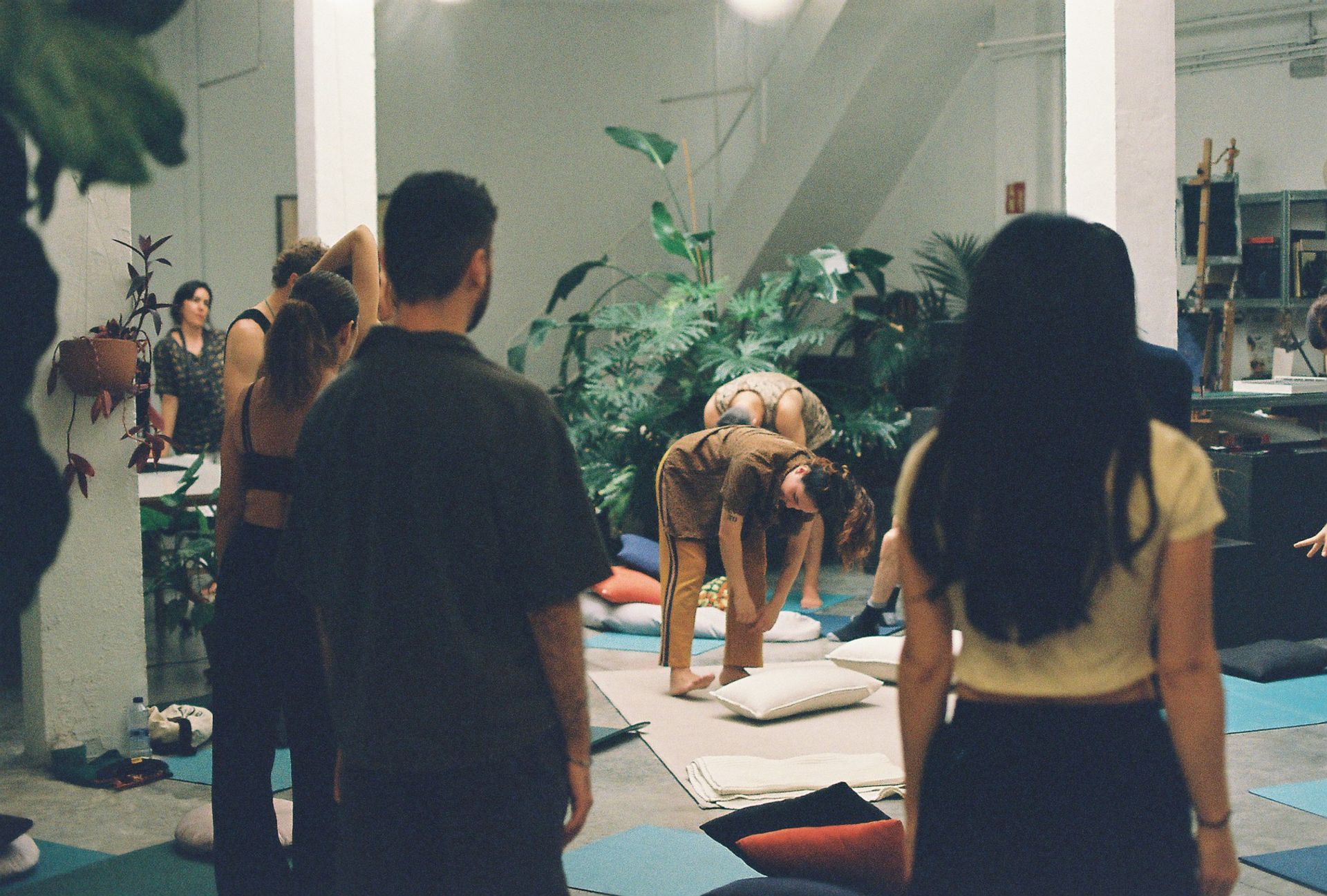
IPS_TUKUY: Mashada Colectiva - Public Program by Synnøve Urgilez Maldonado.JPG
"One of the things that I am pushing for at IPS is to ditch both the promise of the future and the lure of nostalgia, to investigate what the expanded present could be."
LP I'm moved by your mention of nowness. Two things come to mind: one is that I completely agree on the question of the end of the world. I work a lot on the end of the world, but not in the terms that preppers and SpaceX would have. There is a fundamental, epistemological difference between ‘the end of the world’ and ‘ends of worlds’, which is a process, always ongoing, that happens differentially in different places, at different times. These are slow moving, differentially distributed endings and beginnings, they roll into and out of each other, contradictory and multiple. Anthropologist Ernesto de Martino suggests that a world ends when the signs and symbols of that world are no longer shareable within that world. They are no longer readable to the very world that created them.
Recently, I've been writing a bit on the notion of the sanctuary, and doing a lot of work on syncretism and the means by which things are encoded. Things become encoded into other things as they change. With that in mind, I found myself training as a death doula, specifically to think in a different way about the spaces that I am responsible for holding in cultural institutions. I never practiced as one: I was interested in how to hold and make space for experiences or emotions that may be considered unbearable. The question of the unbearable is really important to me: what is unbearable, to whom? To what extent is the unbearable a defense mechanism, and to what extent is it actually a productive place within which to cite oneself? From the point of view of death doula practice, the nowness you mentioned, Daniel, is something that nobody wants to stay within, especially in cultures that have made the fact of death a complete externality.
Staying with that nowness, which is implicated in languages of healing — has to do with insisting that the most painful and difficult thing to do is often to linger in the now. From a death doula practice, for example, the actual presence of and interaction with the dead is fundamentally important to the process of mourning. So nowness makes me wonder, can we tenderly stay in the room with the dead, can we hold that with responsibility? This is not necessarily sad.
KOOZ I don't know that it's a sad note, Lucia — it’s to do with how we're conditioned to think about life, as such. For instance in my culture, mortal life is something to escape in the cycle of eternal returns. What an amazing conversation! I offer a hug of institutional proportions.
LP Thank you. It's always a pleasure to talk like this.
DHR I feel like I’m going to cry — we got really deep!
GA It felt good, thank you.
ABOUT
The Institute for Postnatural Studies is a centre for artistic experimentation from which to explore and problematise postnature as a framework for contemporary creation. It is conceived as a platform for critical thinking that brings together artists and researchers concerned about the issues of the global ecological crisis through experimental formats of exchange and the production of open knowledge. From a multidisciplinary approach, the Institute develops long-term research focused on issues such as ecology, coexistence, and territories. IPS instigates editorial and sonic practices via its in-house platforms Cthulhu Books and Tender Radio.
BIOS
Gabriel Alonso is a visual artist and researcher whose practice lies at the intersection of ecology, science, and critical theory. His work investigates the contemporary shifting relationships towards nature, exploring new relations between matter and narrative, proposing new ways of bonding beings, technologies, and their environments.
Lucia Pietroiusti is a curator, programmer and strategist stewarding research and experimentation at the intersection of art, ecology and systems. Pietroiusti is Head of Research & Emergence at the future Hartwig Museum, opening in 2028. In 2027, she will be the Curator of the 6th Autostrada Biennale in Kosovo. Until August 2025, Pietroiusti was Head of Ecologies at Serpentine, London, where she founded the General Ecology project (2018-2025), an initiative to further ecological research and experimentation in thought, infrastructure and practice. She is a curator and editor of the long-durational project and publication, The Shape of a Circle in the Mind of a Fish (with Filipa Ramos; Hatje Cantz in 2025), an interdisciplinary enquiry into theories of mind across more-than-human species and beings; and an editor of the reader, More-than-Human (with Andres Jaque and Marina Otero Verzier; Het Nieuwe Instituut et al., 2020).
Daniel H. Rey curates, programs, and writes between soils and Wi-Fi. Harnessing Spanish, Guaraní, Arabic, and Norwegian, he studies the formation of diasporas, design vocabularies, and new relational imaginaries across territories, climates, and the internet. He has led exhibition and editorial projects in Asunción, Dubai, Lima, Madrid, and Oslo.
Daniel is Curator of Programs and Networks at the Institute for Postnatural Studies, where he instigates local and international residency programs, strategic partnerships, and pathways for the mobility of cultural agents. In parallel, he sits on the Advisory Board of Uruguay’s Z Art Lab and formerly served as Assistant Curator of Public Programs at Art Jameel in Dubai. Recent efforts include contributing to the catalogue of the 60th Venice Biennale ‘Foreigners Everywhere.’