Closing a decade of invigorating and institution-building activities, the M+ / Design Trust Research Fellowship has produced far-reaching and ambitious research, shaping the identity of Hong Kong’s M+ as an institution. We sat down to learn from M+ curators Ikko Yokoyama and Shirley Surya, former M+ curator and current director of Zaha Hadid Foundation Aric Chen and Marisa Yiu, creator and co-founder of the non-profit Design Trust.
This conversation is part of our partnership with the M+ / Design Trust Research Fellowship, a series of contributions with former fellows and external practitioners to celebrate the 10-year anniversary of the Research Fellowship Programme.
Federica Zambeletti/ KOOZARCH Ikko, Marisa, Shirley and Aric: it's a pleasure to begin this editorial collaboration by bringing you together. We’ve been interested in the contemporary identity of institutions for a while on Koozarch, so it’s particularly poignant to speak to a group of people who have overseen the founding and establishment of a museum even before the existence of its physical site. In a way, the research fellowship almost ran alongside the project of the museum itself, which has been critically formative to establish the idea of M+. Let’s start with a very simple question: what prompted the M+ / Design Trust Research Fellowship programme ten years ago?
Aric Chen I suppose it all started in 2013; Shirley Surya was already at M+ and I arrived towards the end of 2012. It didn't take too much time before we felt the need for more research into the areas that we were exploring, and to really see if one of the things that M+ could do was to support, encourage, and in some cases even generate this research. After all, we were helping to build a new museum with a new collection, with an ambition to excavate and elevate the visibility of lesser known narratives of design and architecture in our region within a global context. Also, it was to recenter the more well-worn global narratives from the vantage of where we were positioned — meaning from Hong Kong, China, East and Southeast Asia and so on, as we radiated out.
It being clear that we were coming across all these interesting things — so many stories that we were hearing, so many works that we were bringing into the collection — how could we start to build new bodies of knowledge around the collection, not only as objects but also as relationships of objects; a kind of microcosm for the broader curatorial framework?
The idea of the fellowship came up while Marisa and I were talking; Design Trust was getting off the ground too, at that point still in its early days, and was looking for projects to support. Your trustees reached out and said, what can we do to support you? That was such a generous thing to do and of course, we were very eager to seize on that — hence the fellowship was born.
Marisa Yiu I find these discussions fascinating because it's about context, in parallel to the transformation or fabrication of culture in the city. Although our nonprofit has been around since 2007, it also prompted this recollection, understanding the role of Hong Kong and how it situated itself, at that time and the Pearl River Delta (PRD), in parallel, the ecosystems building the West Kowloon Cultural District, which was still empty — a tabula rasa then. I thought of tracing back that history; the West Kowloon Cultural District was in a nascent phase in the mid 1990s.. In 2009 we also held the -Hong Kong & Shenzhen- Bi-City Biennale of Urbanism\Architecture (now known as UABB), which invited a lot of people to question what this district — and also the museum — could be. It has been humbling to witness the long transformation, and see how these small events could have shaped the museum itself.
Looking back now, there has been so much change that led up to an epiphany with M+ in 2013: how could this extraordinary new institution work without a building, and how could we participate? I looked back at some notes, to recall the importance of that generosity, of supporting exploration and experimentation. Having M+ curators Aric, Shirley and M+ founding director Lars Nittve around during that beginning phase propelled us to take a lot of risk, when we started this Fellowship programme — which is quite unheard of, for such a new and at-the-time unknown institution. What was exciting was developing a criteria; looking back at my old notes, we were making comments on what would define this fellowship programme, and mapping our role as an independent registered charity — also questioning the state of culture at that time.
I remember internal debates, before we even approached the formal memorandum of understanding; there was a lot of reflection about what this would mean, in terms of the city of Hong Kong culturally and also the power of the PRD region. On fellowship criteria, we had this discussion about originality and expanding on existing knowledge. How do you produce knowledge, in the context of the Pearl River Delta region; then too, because of policy changes, and switch focus to the Greater Bay Area, which encompasses a population of some 86 million people in the region today. We all agreed on this potential of expanding M+, both the scope of the museum and future collections. This is why it is exciting to hear more about how the fellowship allowed for new curatorial strategies and ways of collection or acquisition. Candidates and Fellows helped to support this extraordinary collection and museum, as Design Trust was building up our grant and funding platforms.
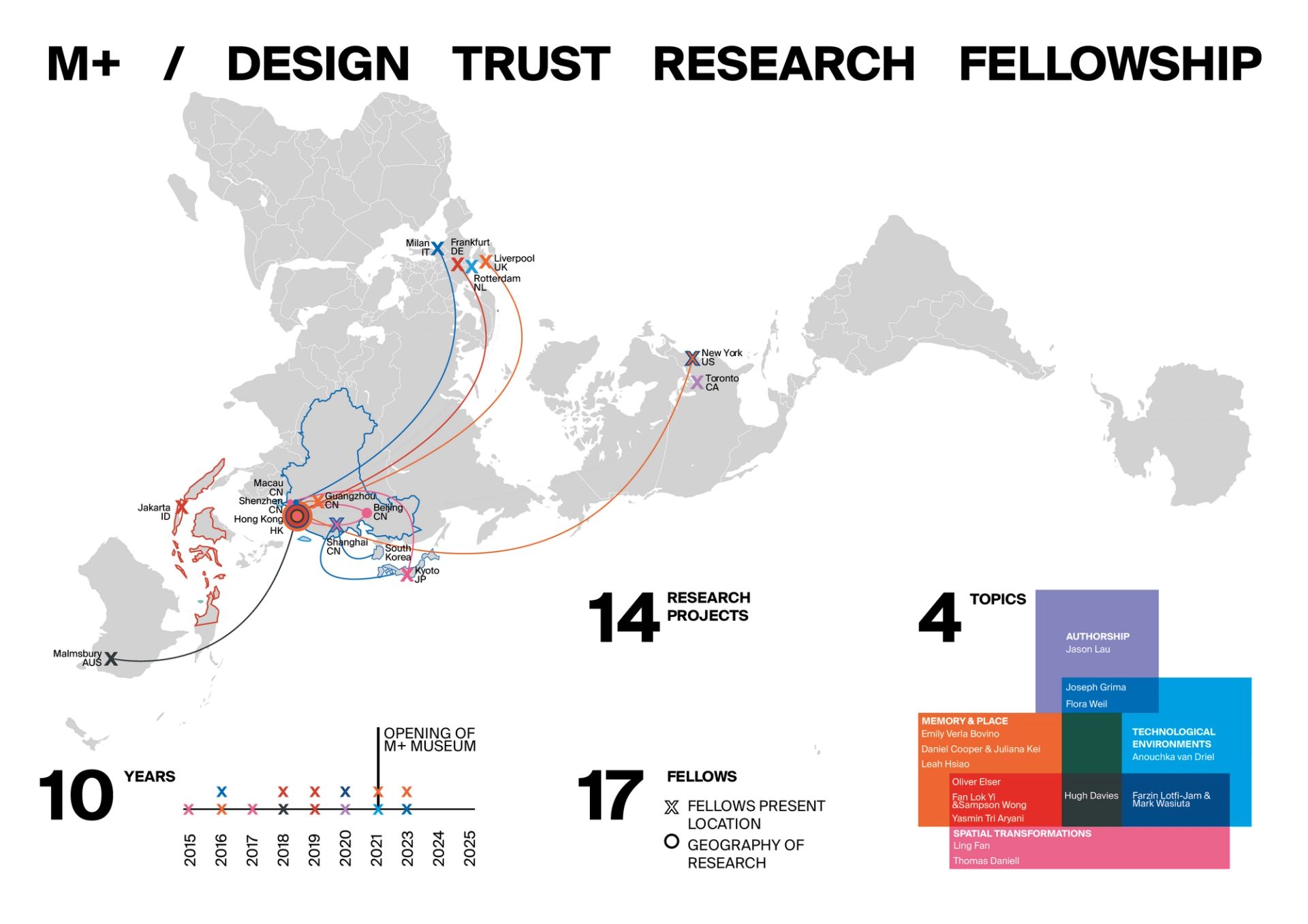
Infographic visualising the research topics, geographies, and fellows of the M+ / Design Trust Research Fellowship, tracing ten years of transnational research across architecture, design, urbanism, and visual culture. Courtesy of KoozArch, M+ and Design Trust
Shirley Surya One question: within your board, Marisa, was there any question around why Design Trust should fund research, and what that might mean? I'm curious because before Design Trust was established, its previous iteration as Hong Kong Ambassadors of Design was very event-oriented, so working with us was a switch in the type of things that the foundation would usually fund.
Yiu At that time, before the establishment of Design Trust, there were a lot of mass public workshop projects. We ran a design festival called Detour, which took place in former defunct police stations; we started the Pecha Kucha events back in 2007. We ran a lot of activations, at locations that we thought needed support rather than remaining as empty heritage sites. As we were building all these mini-festivals, there was a question, about how to bring the on-site studio works to a place of mass knowledge? That is actually why we took a huge effort to transition the charity Ambassadors of Design to Design Trust, which was about modelling funding platforms for Hong Kong with Asian ethos. I was very interested in the Graham Foundation in Chicago for a very long time; Storefront for Art and Architecture was another big influence in driving the new mission and vision.
Taking that model, we asked how we can look at research value instead of mounting these big events. How to build depth and rigour, towards the invisible power of knowledge building, which is both what we wanted to support and urgently needed. From our board or community — also with Aric, Lars, Shirley and many other amazing individuals — there were a lot of internal roundtable discussions about the importance of funding research. That's the difficulty, because right now, people want to see where research funding goes and what the impact is. I really hope, we proved there is impact, especially as we review and are in dialogue with you all.
"we asked how we can look at research value instead of mounting these big events. How to build depth and rigour, towards the invisible power of knowledge building..."
Chen It’s worth emphasising that thirteen years ago, the community of people who shared our questions — the design historical questions, the material culture questions, the architectural historical questions — that community in Hong Kong was quite small, without much infrastructure to support it. On one hand, we can speak of building ecosystems, but Hong Kong was still viewing itself as this entrepôt; there was still this mentality. I remember joking about it: why can't we also be an entrepôt of ideas? So part of the desire for the Fellowship was simply just to bring new people in, to be able to engage with them and have them engage with us, while also filling this big gap — which is what Design Trust was able to fill, in the form of funding for research.
Yiu Funding within the community was narrow; uniquely, the fellowship we developed encouraged that multi-global dialogue around design, bringing in a possibility for exchange that is not just rooted here. For example, we had Joseph Grima here and Farzin Lotfi-Jam; we appointed Fan Ling as the first fellow. Even at that time, we worked with many nonprofits — like Spring Workshop, who hosted them — because the museum was not yet physical. It was very grassroots, mobile research around the city, workshops in different studios and finding places to host talks. The energy was really special at that particular moment.
KOOZ Marisa, you mentioned the word criteria, in terms of the criteria of the fellowship and how Design Trust would engage with it. Shirley and Aric, could you also define the criteria or type of research in which you were interested? In terms of constructing M+, what kinds of gaps or unexplored topics did you seek to invest in, and to whom did you give space to articulate their views on the city or region?
Surya We can use the first fellowship that we awarded, which was to Fan Ling. I remember that the most attractive point of Fan Ling's work was because of his approach towards Hong Kong's influence on mainland China. Of course, the relationship between Hong Kong and mainland China was quite different from what it is now. Today, there is a clearly stated intention of connecting the two, but at that point, it was rare for people to think about these places together. So that was the reason: his way of being local and regional, which was important for us as a criteria. That's apart from it being interesting in a historical sense as well, of course! Originality is a broader term, but I think we really looked out for research subjects that address the condition of Hong Kong, its region, its neighbours and Greater China, in that sense.
Chen Fan Ling is a good example; at that time we were starting to build this collection, which included some canonical works but necessarily — given our mandate and remit — non-canonical works, too. By definition, a lot of these topics had not been studied, much less theorised or anything else. We were looking at the landscape around us, encountering things of interest, stories to be told, but not really knowing what they were. Fan Ling’s topic was really compelling because at that point, it was really resonant and critical in looking at the ways in which China had been developing its cities. China's urbanisation was really at full throttle at that point, and Fan had this brilliant observation that if architecture in China — up until that point — had largely been politically driven, Hong Kong had been more commercially driven, what happens when the two come together? Can we actually trace the contemporary Chinese cityscape via Hong Kong? Of course, a lot of the big projects being built in Beijing were by Hong Kong developers, so it's turned into a bit of a typological study as well. So that was a topic of really great interest for us.
What I remember about that criteria debate is thinking that the things we need to learn about are endless, vast, sprawling… Where do you even start? For me at least, when we were looking at fellowship candidates, I basically had two criteria: how strong or interesting is the proposal, and how strong or interesting is the candidate. We were looking at everything: we had Joseph Grima looking at informal design in Shenzhen’s Huaqiangbei, and the World Fair Expos with Juliana Kei and Daniel Cooper; then it went to Hugh Davies, looking at Hong Kong through video games. All of it was fascinating; all of it, we wanted to do. We could have taken any direction, but I was happy to take on whatever came up, because regardless, it was going to be interesting and useful to us somehow.
KOOZWe've touched on the relationship between Hong Kong and mainland China; some of the research also spans to Indonesia and beyond. Could you talk about the geographical intention of the fellowship and how that relates to the construction of M+ as an institution?
Surya I think it's back to the subject versus researcher; from day one, we wanted to be open to researchers from anywhere. The clear subject matter was initially the Pearl River Delta in Hong Kong; the research on Indonesia was another inflection point, and it was a very deliberate shift. It took a few rounds before we got there.
Yiu It also took my advocacy to get more funding; sometimes I wonder why architects or curators have to become fundraising campaign managers too.
Chen It’s worth noting that we had so many applications with interesting topics and researchers, that within one year, we expanded the offer to two fellowships.
Yiu Yes, we had hundreds of applications in the beginning. That enthusiasm for research and also for the M+ Museum, the ethos of supporting the collections and identity building — that was one part of that hunger. Looking back, as with Fan Ling’s research and also with the north-south connections, I wonder what kind of topics would emerge if we continued the M+ / Design Trust Research Fellowship today, now that the museum has been built. How would you contextualise that? I do believe that particular decade of transition was very special; it was marked with an urgency of research topics that needed unpacking, especially the archives.
Surya You had asked about how this connects with the museum’s goals for the collection. Not every researcher, we realise, will have a direct contribution to the collection. For example, with Fan Ling’s research, we had already been looking into these architects; the materials were not new. Fan brought an emphasis towards understanding them, but we were already looking at the works. So it just helps to add another layer of narrative, of interpretation of these materials and practices. Every single researcher has a very different degree of direct contribution to museum collection. Even the video games — in the end, we couldn't collect them, we can only display them as part of the opening. Ikko, perhaps you can elaborate.
Ikko Yokoyama When I joined M+ a year later, the research fellowship was already in very exciting shape. It was really about allowing diverse formats and range; we never really set the criteria for an objective result. If you look at the fellows, some are very historical, quite straightforward, looking at the second half of the 20th century or the 21st century. But then some of the strands went completely contemporary in their responses, like Flora Weil with the wind project, or Mark Wasiuta and Farzin Lotfi-Jam’s computational and data-driven city planning. The fellowship helped our thinking of planning the museum opening, and going beyond the collection, it has focused our curatorial thinking. Curatorial research is not academic research, so often we were pushing the fellows to think in terms of their outcome: how they can elaborate the stories and convey them to our audiences, rather than a more traditional research format.
That's why we have had many different outcomes in how they presented their research, from Yasmin Tri Aryani’s animation and drawings to Flora Weil's incredible website mapping her research traces and encounters along the way. We’ve also witnessed technological evolution, and that really comes from allowing very open formats for what is deliverable as research, and I think that was very beneficial. Our intention and efforts were focused on how we can uncover histories and extend the canon to be much more inclusive, or much more critical — not only in terms of its stories wise, but also in their presentation. The fellowship really accommodated that.
Surya I think that distinction between curatorial research versus academic research is really the linchpin of the M+ / Design Trust Research Fellowship. We ended up filtering many applications that were perhaps too deeply academic. Even though there were some great researchers, I think we knew that the output would need to be something much more direct and engaging. That was a clear distinction.
Yokoyama And then also, because it's a limited time research, there is no determined outcome; we hope to inspire people, and the potential of those stories continue to be unpacked. One example we've been talking about is Joseph Grima, who took one of these indirect routes. So he started looking at Huaqiangbei in Shenzhen. One year later, the research as Space Caviar took the shape of lamps — the HQB Lamps — exhibited at Atelier Clerici during the Milan Salone. From there with Van Abbemuseum, they presented GEO—DESIGN with Martina Muzi, eventually founding a department at the Design Academy Eindhoven. I see the network growing and having a ripple effect; that's my approach towards being inclusive. It’s not that we have to own the research; it's very organic as to how the fellows continue to use it. In that sense, I think Joseph was a very good example of how the project went so far, the reach resonated much wider.
Yiu It was great, I still remember that excitement. There was something about the flexibility of spatial representation, and to bring different communities together. So although the first fellow was Fan Ling looking at Hong Kong and Beijing, there were few that sparked other unique spaces, like Thomas Daniell and his work ‘Unbuilt Macau’. With the curators, we developed an obsession, with looking for that perfect old Macanese theater, and engaged with the site of Dom Pedro V. Theatre. That site was just really a powerful demonstration of situating ourselves in the context of history, while we were enveloped in the architectural artifice, that represented a certain debate about Macau and its unbuilt possibilities.
In parallel, even before we started the formal partnership that became the M+ / Design Trust Research Fellowship, there was also a lot of effort from the team. There was Mobile M+, a nomadic museum concept, and M+ Inflation — remember the probing Cao Fei inflatables show? — on the role of landscape and culture at this particular moment in time. What was beautiful about this team of curators at M+ — whether with invited advisors or interlocutors — the work was curated, in conversation with the city. So kudos to the extraordinary M+ curatorial team.
This was also right in the middle of a difficult period in Hong Kong. We had a grantee in our foundation, looking at the topic of brutalism, now publishing books on that research. It would have been amazing to hold an event in this Brutalist structure for their presentation, but obviously we could not do that because of the social unrest period during 2019 — and then the pandemic hit. But that project represented a good synergy of how it is not just about the content: it was about community building, being a host and a guest, building a safe community to allow for exploration, with beautiful, convivial activities on the way. That was quite special within this context.
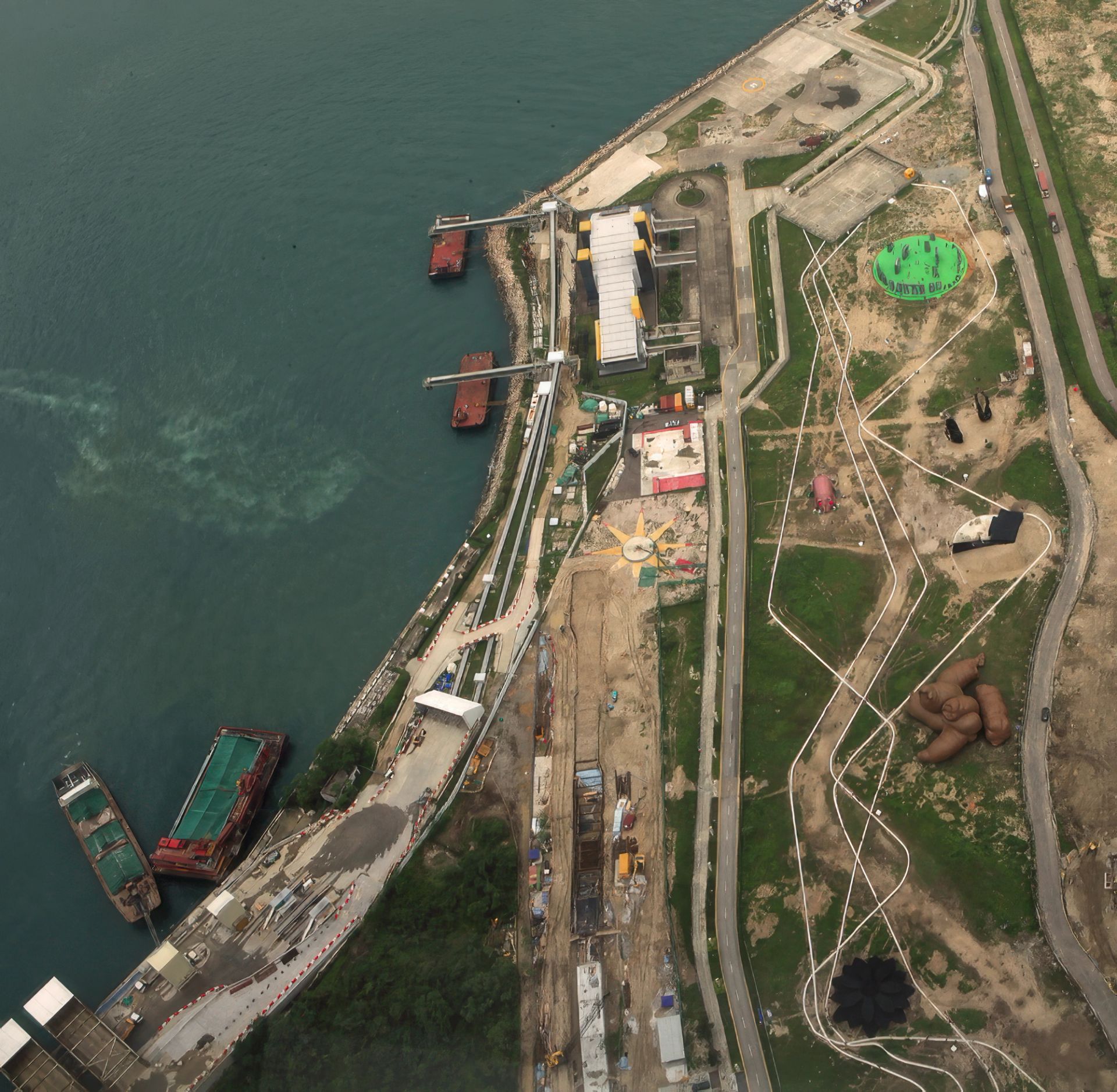
View of inflatable installations at the Mobile M+: Inflation! at the unbuilt site of West Kowloon Cultural District next to the future M+ in 2013 Photo: M+, Hong Kong
Surya I think you're right; having no building forces us to get to the community, with partner events and finding venues and all that. It has its different effect. But for us, the archive is never strictly physical material. Even without a building and the M+ Research Centre, we shared our research materials digitally with our early fellows who were uncovering materials related to Hong Kong architecture. Primarily, it’s about sharing knowledge with or without a building. It’s about the active repository of ideas, and connections found by people that we were able to distribute or share.
Yokoyama I think many people arrived at M+ because of its earlier life, of what it did as a museum without the building. That was a very early commitment, and how I started to hear a lot about M+ while I was still in Stockholm — because it was so active, from what M+ could find on YouTube, in symposium papers, the DT Fellowship, or M+ Matters, the series of public talks. It was quite loud, the voices coming from Hong Kong. I think that was really the aim of being a museum without a building, really to announce that hey, we are coming. It was very smart to use a research fellowship as a format to grow the museum identity; it's not just about making a campaign, it gets into the serious questions about delivering a museum of visual culture.
The museum was already defined in the field of design, art and architecture, but it was a very clear way to introduce a super-ambitious museum, which is something different. It is still grounded in academic discourse, which is very well respected, but the feeling and ambition was that this new museum could push that forward. That was the sense I got, from the outside. The format of delivering dynamic fellowships became an important means, first to build our profile as well as creating a network. As I mentioned, we started to see that this resonance is more important; many fellows went to produce further exhibitions, publication, talks — they continue their research. So they become ambassadors for M+ and that was the format.
Some of our aims shifted as we moved towards the museum opening as well, and influenced the way we make exhibitions. For example, Hugh Davies’ video game project was very influential; we had a section in the opening display that narrates a history of video games, and how Hong Kong has served as a platform and inspiration for the gaming environment of the city. Again, that work has not ended. The same goes for other topics like the Anouchka van Driel’s ‘cosmotechnics’ of fashion, or Flora Weil’s very contemporary theory on wind — managing seasonal wind and desert nomadic life in modern China, super interesting. Probably we will find a link to that in potential future exhibitions, where those researches can feed back in and so forth. A lot of the foundations have been laid in this process.
"The format of delivering dynamic fellowships became an important means, first to build our profile as well as creating a network."
Yiu The Hugh Davies project is a great example of representation, which made it to the opening show. What Hugh’s work did was remarkable, relating the Travel with Trashman (1984) video game with the declaration of independence for British Hong Kong in 1984. At the time, he had researched 180 titles to see how Hong Kong was represented in the video game community. I did catch up with him recently, and he's now up to 500 titles. Wow, 500 video games representing Hong Kong; the connection, representation of the city and its cultural imagination has expanded so much, even since 2019! He did mention the remarkable opportunity of this fellowship, which allowed him to travel from Australia, connect with local grass roots video-game creators, to understand the logic of designers and the landscapes that ground their work. He's been doing more field work in Shenzhen and Guangzhou. So one aspect of the fellowship is this pathway or career opportunity that we cannot predict. These fellowships give you autonomy, but they also allow you to see and think in new ways.
Yokoyama Adding to what Marisa has said, it’s also a huge body of information for us to discover, not only the research itself, for example from Hugh. There are five hundred video game titles featuring Hong Kong, because we have also learned that there are digital asset stores, so people can buy Hong Kong assets, trashcans, taxis and buildings. That's the instant world they can build on impressions; it’s not necessary to know Hong Kong. It's about world-building technology, and how easily people build those worlds today — but that’s something we started to reflect through his research. The research topic opened a wider interest for us; Hugh gave us a hint, as otherwise I didn't know about digital asset stores, where you can buy trash bin archetypes from every different country. Now it’s probably even faster, as AI can generate these things so easily.
Again, research does not necessarily stick to the main story or direction of a project, but the many of the fellows gave us a lot of different perspectives and topics — because indeed, our time and resources are limited. It's a very big museum, with limited time and resources — but huge ambition. We invited the fellows in and asked them to choose a lens, looking at Hong Kong or the Greater Bay Area from a particular vantage point; then their way of looking, their knowledge becomes the way that we really collaborate, as well as informing our research, exhibition making and positionalities in the future.
KOOZ It's so interesting to see what you learned, from activating fellows as a means of really opening up different perspectives with the curatorial team. Could we really explore the value of external research as a way of challenging institutional perspectives? Aric, since you're now helping to build a new institution, maybe you could start us off.
Chen Well, in my new position at the Zaha Hadid Foundation, we are building a much smaller new institution — but part of it, for me, is not thinking of it as an institution as such. To sound more pretentious than intended, I want to think of it more as a kind of para-institutional model — meaning that you operate not as a formal institution but one that works in parallel: between, through, above, beyond and with institutional structures. At this point, I think we're seeing that our old institutional models are not working as well as they used to; broadly speaking, they're still operating on 19th and 20th century paradigms.
I think that was one of the great potentials for M+, as a new institution — that energy that Marisa, Ikko and Shirley mentioned was indicative of this excitement, around experimenting with new models. That involves allowing the old models to be infected — which goes back to your question, about the importance of having external voices, interlocutors or hackers: inviting people in to mess things up.
Even in my previous role at Nieuwe Instituut, before my current one at ZHF, the idea was to seek and invite “people from the outside” to come in, to almost look “at us” objectively, to engage with us as their guinea pigs — not just ideationally but institutionally, and in a structural way. I think we benefitted a lot from that at Nieuwe Instituut; the design and architecture team benefitted from the research fellows — this motley crew of brilliant people with their obscure interests — coming in and showing us other ways, or bringing to us other ways of seeing and thinking, things we would not be looking at on our own.
Surya I actually did have doubts about some of the things presented; it was the question of is this research or not? That was a good question, and I learned to accept there is not one singular way of really looking into something, or questioning. It could be led by investigation, observation, primary research; a filmic way, the way of looking could also be research, as much as one that focuses on digging up primary sources. Previously, I was quite singular in my mode, but over time, we realised that the research bears different kinds of fruits. So I think the external means that there's a bit of an encounter, a bit of productive discomfort. Even with Flora’s research: when we first heard about her proposal, there was a split between us; it seemed like an uncertain subject matter. It has been a real learning process in terms of going into territories that are not necessarily conventional or familiar, or perhaps the method of presentation or format doesn’t align with our intended programme. It's always about discussion and negotiation.
"It has been a real learning process in terms of going into territories that are not necessarily conventional or familiar, or perhaps the method of presentation or format doesn’t align with our intended programme. It's always about discussion and negotiation."
Aric Chen These things are also always exercises in trust. I don't mean to either oversimplify or blow this up too much, but I think when we talk about institutions and how they're struggling these days, a lot of that has to do with dwindling trust. We have to remember that institutions are, by nature, built on trust; they are entirely dependent on it. Ultimately, and regardless of how big your building or your collection might be, the authority, meaning and relevance is totally illusory in the sense that an institution is a construct, built on trust. When you're building and starting a new institution, in order to kind of gain that trust, you also have to give it, too. So with the fellowships, it was so important for us — quite frankly, in an environment that was not characterised by an abundance of trust in general — to create a space for trust, even a small space. We were able to create that as a team within this larger apparatus, and by building and giving that trust, you get that back. That dynamic and that ethos was very helpful in creating M+ as this new institution.
"We have to remember that institutions are, by nature, built on trust; they are entirely dependent on it."
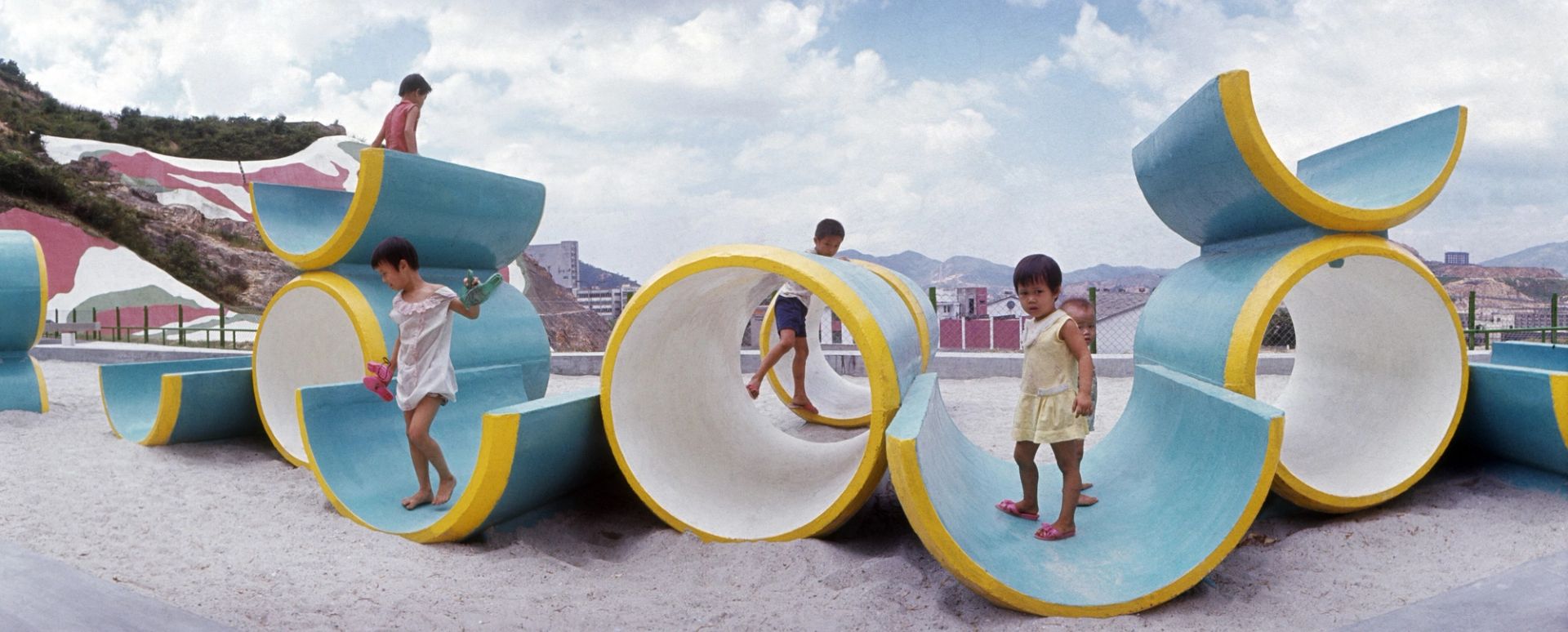
Yiu What I really want to see is how this affects the way we think about policies and urgencies in the city, or in the region. We knew there were a lot of buildings being torn down in Hong Kong, especially relating to certain areas or styles of architecture. As an independent, neutral third space — as a nonprofit — it's always agitating, so for us, opening up that question of how the city is perceived, was a way that allowed us to speculate with more consideration; for instance, City Hall was only declared as a monument in 2022, as a building of importance from the 1950s, and there are other projects like that slated for demolition. So these fellowships actually call to attention and surface some of the city’s issues, whether academic, cultural or through impressive digital media. You can see the value of the fellowships in the decision to restore an archive, or keep a building rather than demolish it. For example, Sampson Wong and Fan Lok Yi looked at the history of revolutionary playgrounds for children, at the same time that we were building a lot of community spaces, challenging policymakers; the concerns overlap, which allowed us to take some of these narratives to the local community for their participation. There is a relationship between these speculative, research-driven projects and institutional frameworks, whether they're finding frictions or working together. When you see outcomes, that impact the culture of thinking about the city and policy making, that's where it gets super exciting. Our ten-year collaboration with M+ is now complete, but we are partnering with other institutions to ensure that similar fellowship programmes continue that ethos — it’s a responsibility to keep participating in that. I think these fellowship programmes are extremely important, so we are still advocating for them.
Yokoyama Everybody has already said so much — but I couldn’t agree more with what Marisa just said, about the extended impacts of this work. The reason we invite external researchers is to extend our own research interest and framework. The mission, and particularly what M+ hopes for is not just in exhibition, nor only in our collections. It’s about finding synergies of how the institution can contribute, it's not necessarily always about one-to-one responses. Collaboration happens organically, and the more informal dissemination, the inspiring knowledge shared through the fellows, it's been fantastic to see. It really contributes to our mission, because it helps to unpack our way of working and looking at design history, architecture history, urban and social history as well as technology. Without the fellowship funding, we wouldn’t necessarily put the focus, resources, and time to these subjects, so the funding also allowed us to give our time; it was very important. That gave us a weight within the institution, you know. This fellowship has been very fundamental in connecting and contributing to what M+ is.
KOOZ You’ve been so generous, I wanted to thank you all — it was so good to hear from each of you on just how mobilising research has been for M+.
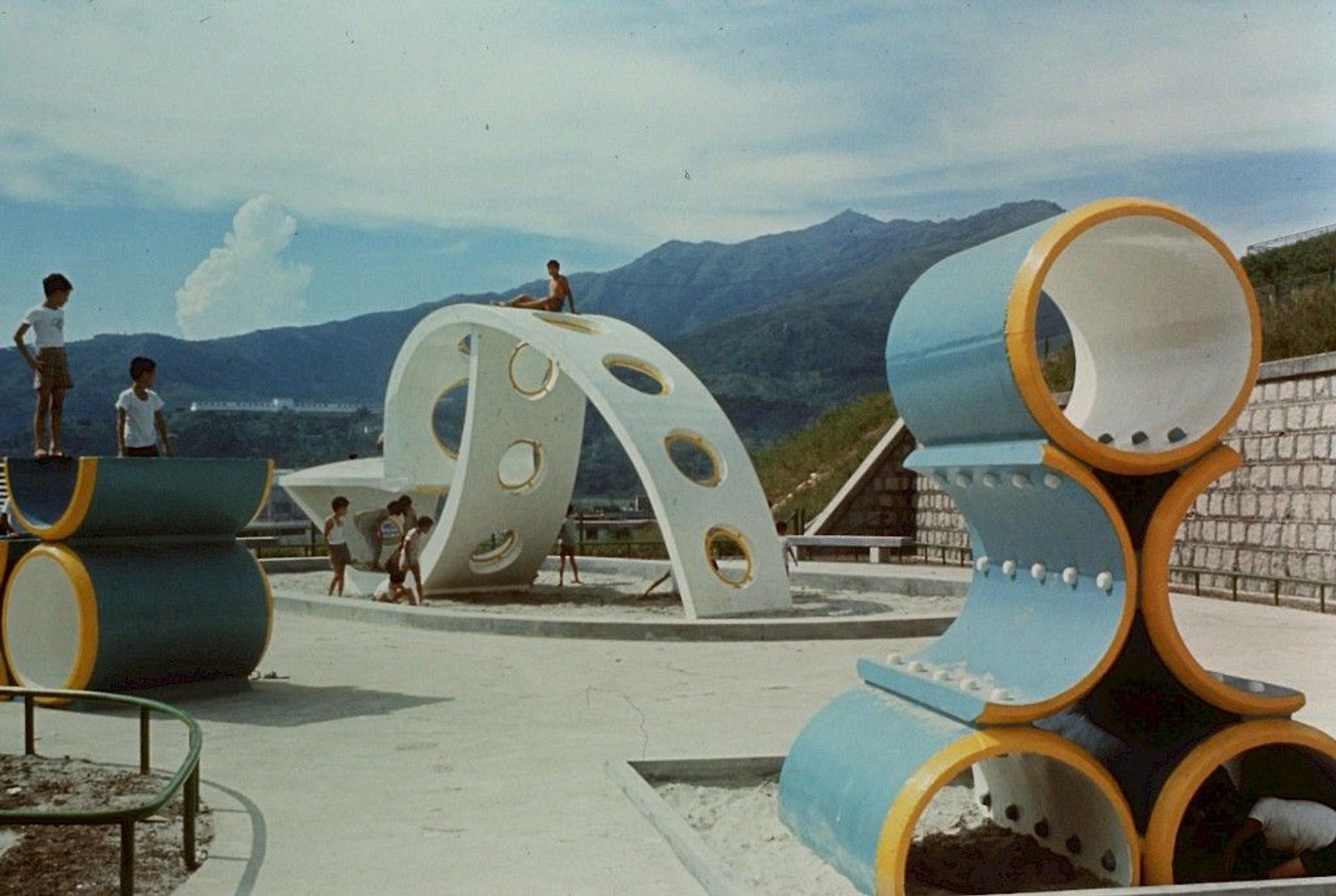
Image of Shek Lei Playground, 1969. Part of M+ / Design Trust Fellow Fan Lok Yi’s research into the history of playgrounds in Hong Kong. Photo: Paul Selinger; courtesy of Matthew Selinger
About
The M+ / Design Trust Research Fellowship (2015–2025) was a pioneering decade-long collaboration between M+ and Design Trust that supported original curatorial and scholarly research into design and architecture across Hong Kong, the Greater Bay Area, and Asia through a transnational lens. Bringing together fourteen research initiatives over ten years, the fellowship fostered critical investigations into regional histories, cultural production, and contemporary practices, significantly contributing to the broader discourse on design and architecture in Asia and informing future research, exhibitions, and collections at M+
M+ is Asia’s global museum of contemporary visual culture. Located in Hong Kong’s West Kowloon Cultural District (WestK), it is dedicated to collecting, exhibiting, and interpreting visual art, design and architecture, moving image, and Hong Kong visual culture of the twentieth and twenty-first centuries. The museum stewards a multidisciplinary permanent collection that includes objects from regions across Asia and beyond. Today, M+ is a nexus for researching and presenting contemporary visual culture, inspiring thought and curiosity.
Design Trust was established as a grant-funding and community platform in 2014 by Hong Kong Ambassadors of Design, a registered charity in Hong Kong since 2007. Design Trust supports creative projects that develop expertise and build research initiatives and content related to Hong Kong and the Greater Bay Area. Working across a multiplicity of design disciplines, from graphics, media, and architecture to the built environment, Design Trust aims to actively accelerate creative research, design, and the development of meaningful projects that advocate for the positive role of design.
Bios
Aric Chen is a curator, writer and Director of the London-based Zaha Hadid Foundation. Chen previously served as General and Artistic Director of the Nieuwe Instituut; Professor and founding Director of the Curatorial Lab at the College of Design & Innovation at Tongji University in Shanghai; Curatorial Director of the Design Miami fairs in Miami Beach and Basel; and Lead Curator for Design and Architecture at M+, Hong Kong, where he oversaw the formation of that new museum’s design and architecture collection and programme.
Shirley Surya is a writer, historian and curator. Since 2012, she has been a curator at M+, contributing to the museum’s collections and exhibitions through her research on plural modernities and transnational knowledge networks in design and architecture across Asia. At M+, she co-curated exhibitions including I. M. Pei: Life Is Architecture (2024-2025), Things, Spaces, Interactions (2021), Hong Kong: Here and Beyond (2021), as well as In Search of Southeast Asia Through the M+ Collections (2018). Outside M+, she curated How Modern: Biographies of Architecture in China 1949-1979 (Canadian Centre for Architecture, Montreal, 2025-2026) and made curatorial contributions to Incomplete Urbanism: Attempts of Critical Spatial Practice (NTU Centre for Contemporary Art, Singapore, 2016) and Yung Ho Chang & FCJZ: Material-ism (UCCA Center for Contemporary Art, Beijing, 2012).
Marisa Yiu is the Co-founder and Executive Director of the DESIGN TRUST initiative, which supports creative and research content related to Hong Kong and the Greater Bay Area within an international context. She has been instrumental in shaping the growth of the NGO since 2014, creating the Design Trust Futures Studio programme. Yiu is also trained as an architect and Founding Partner of award winning practice ESKYIU. Yiu was the Chief Curator of the 2009 Hong Kong & Shenzhen Bi-City Biennale of Urbanism\Architecture located at the West Kowloon waterfront; and curated Studio-X Shenzhen.
Ikko Yokoyama is the Senior Curator and Head of Design and Architecture at M+. Since joining M+ in 2016, she has been playing a pivotal role in building its foundational Design and Architecture collection and developing various exhibitions and public programmes. Prior to her role at M+, Yokoyama served as the Head of Exhibitions at Konstfack University College of Arts, Crafts and Design in Stockholm. Alongside her work at the university, she had been an independent curator and writer, contributing to international exhibitions, projects, and publications across Scandinavia, South Africa, and Japan.
Federica Zambeletti is the founder and managing director of KoozArch. She is an architect, researcher and digital curator whose interests lie at the intersection between art, architecture and regenerative practices. In 2015 Federica founded KoozArch with the ambition of creating a space where to research, explore and discuss architecture beyond the limits of its built form. Parallel to her work at KoozArch, Federica is Architect at the architecture studio UNA and researcher at the non-profit agency for change UNLESS where she is project manager of the research "Antarctic Resolution".