This publication is part of Is This Seat Taken?, a situated conversation series hosted by KoozArch, convening lunchtime conversations between cultural practitioners around a shared table.
Federica Zambeletti/KOOZ We know each other, but this is the first time we are really sitting down like this — so let’s start with a bit of context. As a platform focused on architecture and design culture, KoozArch foregrounds conversation as a means of exchange and production. Since there are so many overlaps between your practices, even if they come from very different contexts, we thought that it would be nice to sit, eat, and talk. Because eating forces you to slow down —
Lyndon Neri Likewise. We never have time to do that, so this is perfect.
Andrea Trimarchi And in a beautiful place, with fantastic food. I already know what I am ordering.
KOOZ To start with something simple: you all come from very different contexts, but your methodologies sometimes feel surprisingly aligned. What contexts have shaped your understanding of design and architecture?
Maria Cosa volete mangiare?
AT Io prenderei l’insalata di lattughino con bottarga e poi i vostri spaghetti al limone.
SF Anche io i vostri spaghetti al limone ma prima le zucchine con senape.
FZ Per il signore gli spaghetti e poi la magnifica paillard di Arturo. Io invece prendo solo la carne cruda con salsina all’Arturo.
Simone Farresin I think our context is each other. I believe we [Andrea and I] would be very different designers if we weren’t together, if we didn’t constantly discuss design and life. So, first and foremost, our context is our shared experience, our togetherness.
LN That is very true with Rossana [Hu] as well. Our context is also movement, diaspora: we are both Chinese, but from different parts of Asia. We studied in the US, then went back to what people call ‘our homeland’. And there was China, twenty years ago, with everything being demolished at an unprecedented scale. That shock changed us. At first, we did not go there thinking we needed to preserve, but the scale of destruction forced us to think differently. There is a Chinese word, ‘weiji’, which means crisis. It combines danger and opportunity. That moment transformed our mindset, from wanting to build new things to question what already exists.
"There is a Chinese word, ‘weiji’, which means crisis. It combines danger and opportunity."
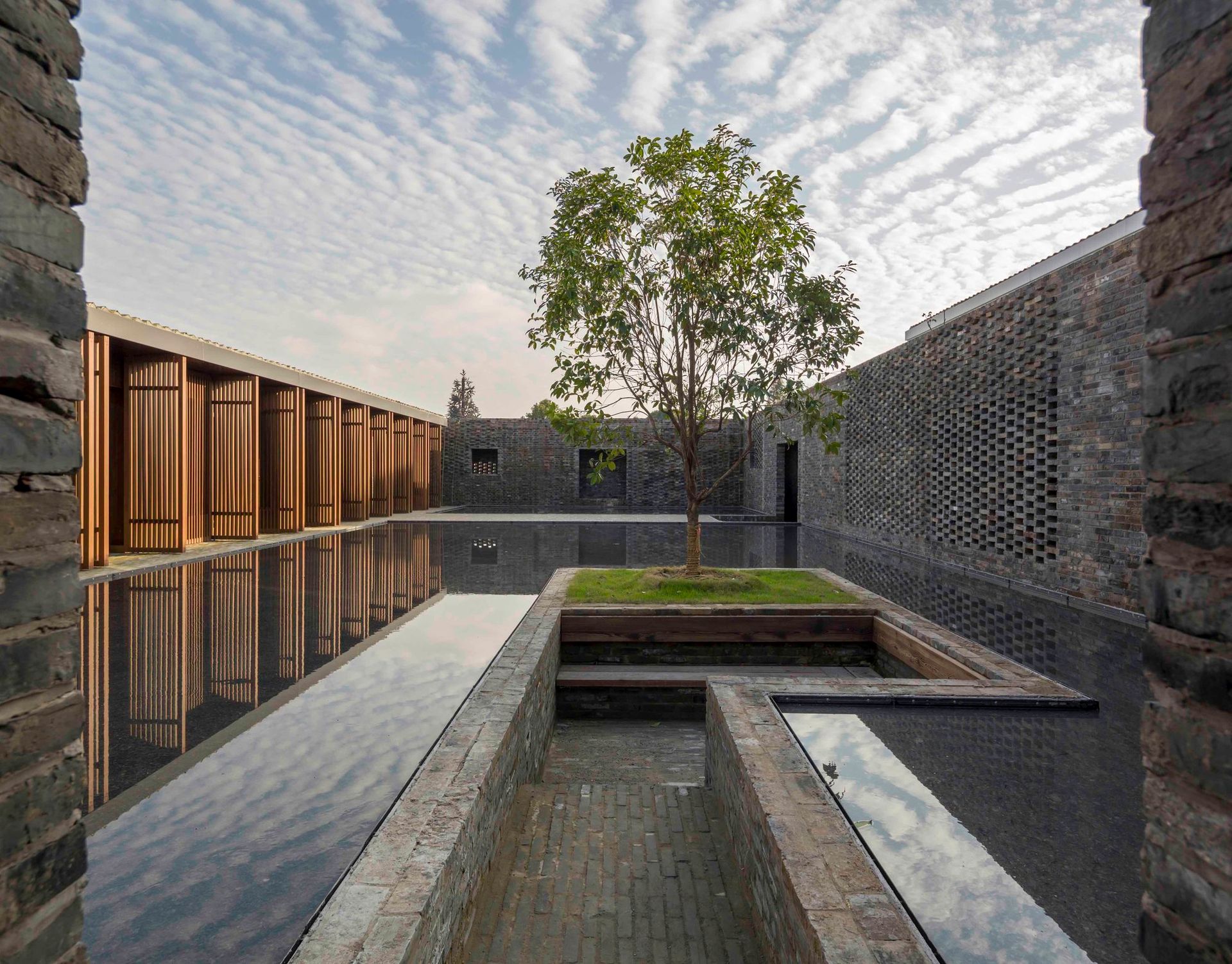
At Tsingpu Yangzhou Retreat, Neri&Hu transform a cluster of existing rural structures into a labyrinth of courtyards, gardens and passages. Constructed from reclaimed grey brick, the project celebrates the material’s texture, patina and history, weaving old and new into a continuous architectural landscape. The brick walls act not as boundaries but as devices for encounter, framing a sequence of thresholds between landscape, architecture and collective life. © Pedro Pegenaute
Maria Ecco qua zucchine, carne cruda e lattughini. Miraccomando la carne mangiala da sotto a sopra.
FZ Grazie Maria — if you guys want to try this is really delicious and you know what they say, sharing is caring…
LN Speaking of context, I really feel at home here with you guys.
KOOZ That’s what I love about certain contexts and ways of hosting with generosity — then of course it’s also a matter of the company …
AT Going back to what you said, Lyndon: for us, it was different. We did not experience that kind of destruction. But living in the Netherlands, in Amsterdam, allowed us to step back and look at our own origins from afar. That distance helped us understand our culture more clearly. A lot of our early work reflects on identity — not in a nationalist sense, but as a way of understanding where we come from.
KOOZ Lyndon, you mentioned that urgency, responding to demolition, while the work of Formafantasma often engages with materials and ecology. Did that come from a similar sense of urgency?
SF Not immediately, it’s something that solidified over time. At the beginning, we were often just irritated by ‘design’. It took time to understand what we liked, and what we did not. Design sits between economy, aesthetics, ecology and social development, all at once. That makes it powerful, but also complicated. For a long time, we worked inwardly, trying to define our position — but one belief was always present: namely, that objects are not just functional or aesthetic. They carry politics. They embody systems. Our first student project was about Sicilian folklore, nationalism, and colonial history, so from the start, objects appeared to be political.
"Design sits between economy, aesthetics, ecology and social development, all at once. That makes it powerful, but also complicated."
AT Even in our first year at the Design Academy, we wrote a manifesto titled “Timeless Necessity” on what timeless design should be. And looking back, it still reflects what we do today.
KOOZ Your practices both span multiple scales, objects, buildings, exhibitions. How do these different scales inform each other? Do you ever feel the need to focus on just one?
LN Tradition tends to place you in a corner. The architect is expected to remain an architect, the product designer, a product designer. But for us, the goal has always been to use the process of designing as a way of finding our identity. That is also why we have been so influenced by certain theoretical positions, particularly this idea of the reflective nostalgia as opposed to the restorative nostalgia as coined by the Russian scholar Svetlana Boym. The restorative simply repeats or copies history. The reflective, on the other hand, tries to understand its essence. And the argument is that if you truly understand the essence of history, you can use it to inform the future.
This way of thinking runs through many of the objects and installations on which we work. In fact, we are not particularly interested in the final form. That might sound surprising, but it is true. We are not afraid of things being imperfect, even ugly, as long as they carry meaning. Something can be very beautiful but if it lacks purpose or depth, then for us it fails.
Many clients approach us expecting a certain kind of outcome. But even when we created the Festival of Design in Shanghai over the past two years, the intention was never to produce a spectacle. It was to engage with ideas and to create a platform where those ideas could be discussed, even within institutional or governmental frameworks. Because ultimately, ideas matter far more than form alone.
"Ultimately, ideas matter far more than form alone."
SF Exactly. If you focus on ideas, then working across scales does not feel fragmented — it gives you freedom. You are not trapped in one system. Many designers who work only in one field become extremely sensitive, because they cannot escape its constraints.
AT And honestly, I get bored easily. I cannot imagine designing chairs for my whole life. I like this idea of evanescence, that you cannot fully grasp what we do.
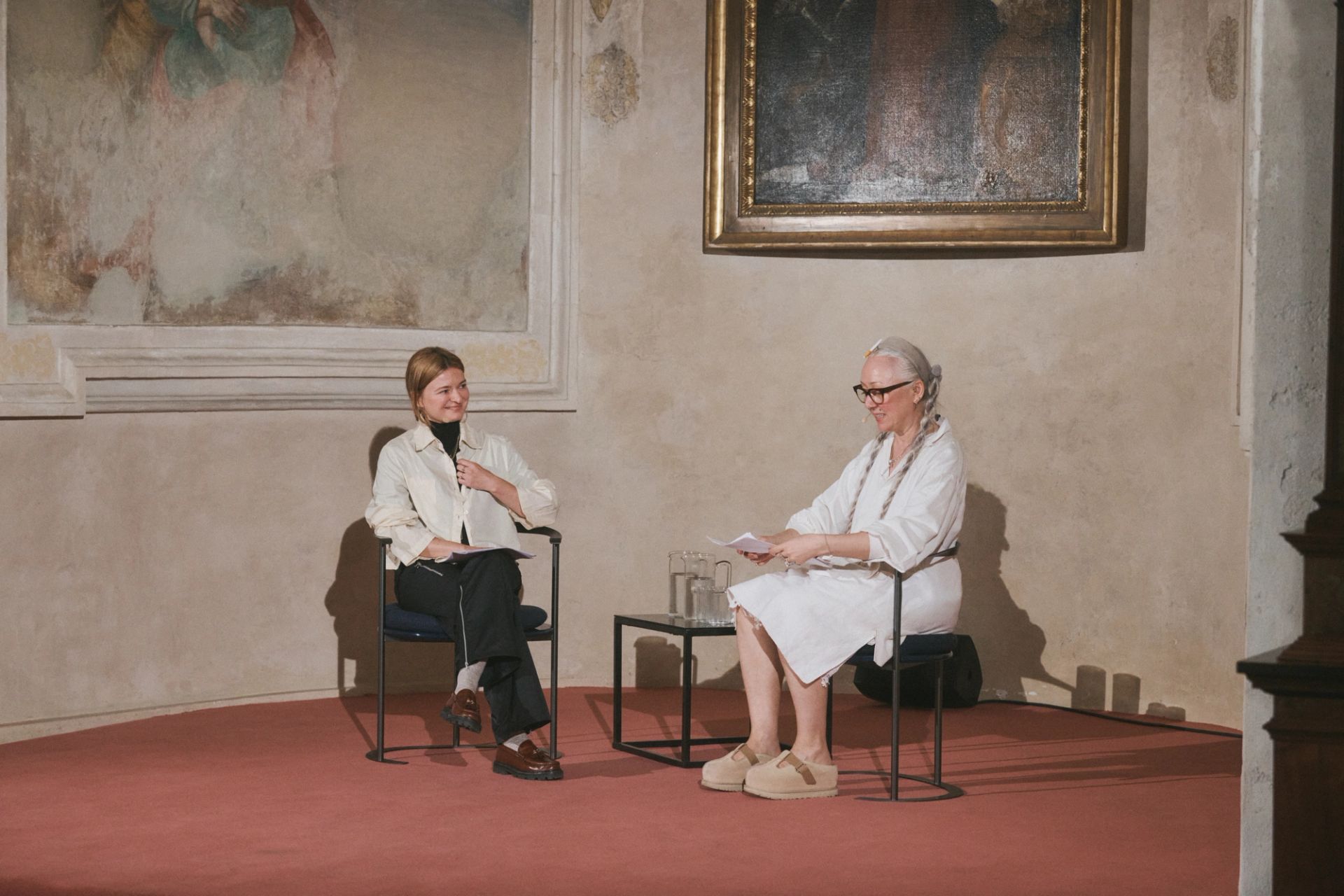
Prada Frames, Prada’s annual symposium curated by FormaFantasma during Milan Design Week, explores contemporary cultural and societal issues through conversations between designers, thinkers and researchers. The 2026 edition, In Sight, examined the impact of image-making today, from AI-generated visuals to the politics of representation and visual culture. © Prada & Formafantasma
KOOZ Let’s bring it to the present, and to your contributions to events like Milan Design Week, particularly through formats such as the Prada Frames symposium, which annually engages critical inquiry and interdisciplinary actors to question the present moment. How have formats like this reshaped or informed the way you think about and engage with design?
AT We have been teaching for many years. Teaching forces you to constantly give and learn. Prada Frames feels like going back to being students — but we choose our mentors.
SF It’s also about how ideas are presented. When people come and listen to the conversations, it’s fascinating to observe their reactions in real time, especially within the space itself. What I’ve noticed over these days — perhaps also because we were in a cloister — is that even when the ideas presented are challenging, when speakers address complex or painful aspects of reality, the setting allows people the time to truly absorb them. This year, with the addition of music, there was a certain sensibility that made the experience more resonant, something people could connect with in a deeper way. It made me reflect on how ideas are often communicated today, frequently in a more aggressive or forceful manner — which you can observe across graphic design, product design and fashion. It made me think about the kind of artistic sensitivity people might need right now. Even if we are personally privileged, the world around us is increasingly complex and difficult. And perhaps that calls for a more considered way of sharing ideas, one that carries a sense of care, or even a certain grace.
"The world around us is increasingly complex and difficult. And perhaps that calls for a more considered way of sharing ideas, one that carries a sense of care, or even a certain grace."
KOOZ I completely agree. We recently curated a festival in Ljubljana, it was essential to consider how over those three days, we could create moments of intensity but also of ease. The spaces, the activities, the way bodies are held within them: all of that mattered.
So I’m curious, Lyndon, especially given that you work across such different scales — from architecture to material systems like the tiles you developed with Mutina, which are deeply tactile and carry a sense of history, almost a lineage of meaning — how do you approach the idea of hosting across these scales, from a material that becomes part of a building to the building itself? And perhaps more fundamentally, does hosting require architecture at all?
Maria Ecco qua Paillard, mangiala calda!
LN You are familiar with Richard Sennett. He speaks about friction, about intimacy, about that moment when the public and the private come into contact. It is not really about housing as such, but about the spaces that exist around it, the balcony, the threshold — what Homi Bhabha would call the third space, the intermediary space. That is where things actually happen. That is where people argue.
You do not argue in your living room. In the living room you perform hosting. Someone arrives, and immediately everything is adjusted: you clean, you arrange, you create a kind of controlled perfection. The people who see your mess, those are your true friends, because you are no longer afraid to open up.
But generally all the tension, all the real exchange, happens in those in-between spaces. That is why, when we speak about hosting, I cannot help but think of the third space; of thresholds and transitional conditions. It is something that interests us deeply, both in architecture and in product design.
If you look, for instance, at the work we did with Mutina, people often speak about weaving and the formal language. But for us, it is really about meaning. A single thread can be beautiful on its own, but it only becomes powerful when it is woven together with others. That is where it gains strength. The idea of community and of coming together is far more important than the individual gesture.
And when hosting truly happens, it is not about one person speaking beautifully, or about the host being remarkable. It is about the interaction that emerges between people, that moment of exchange.
You will see, Federica, that I often try to create situations where even government officials are brought into conversation with others. Because it is not only about the individual; it is about the collective, about the idea of family, about the nation and how these different scales of togetherness can meet.
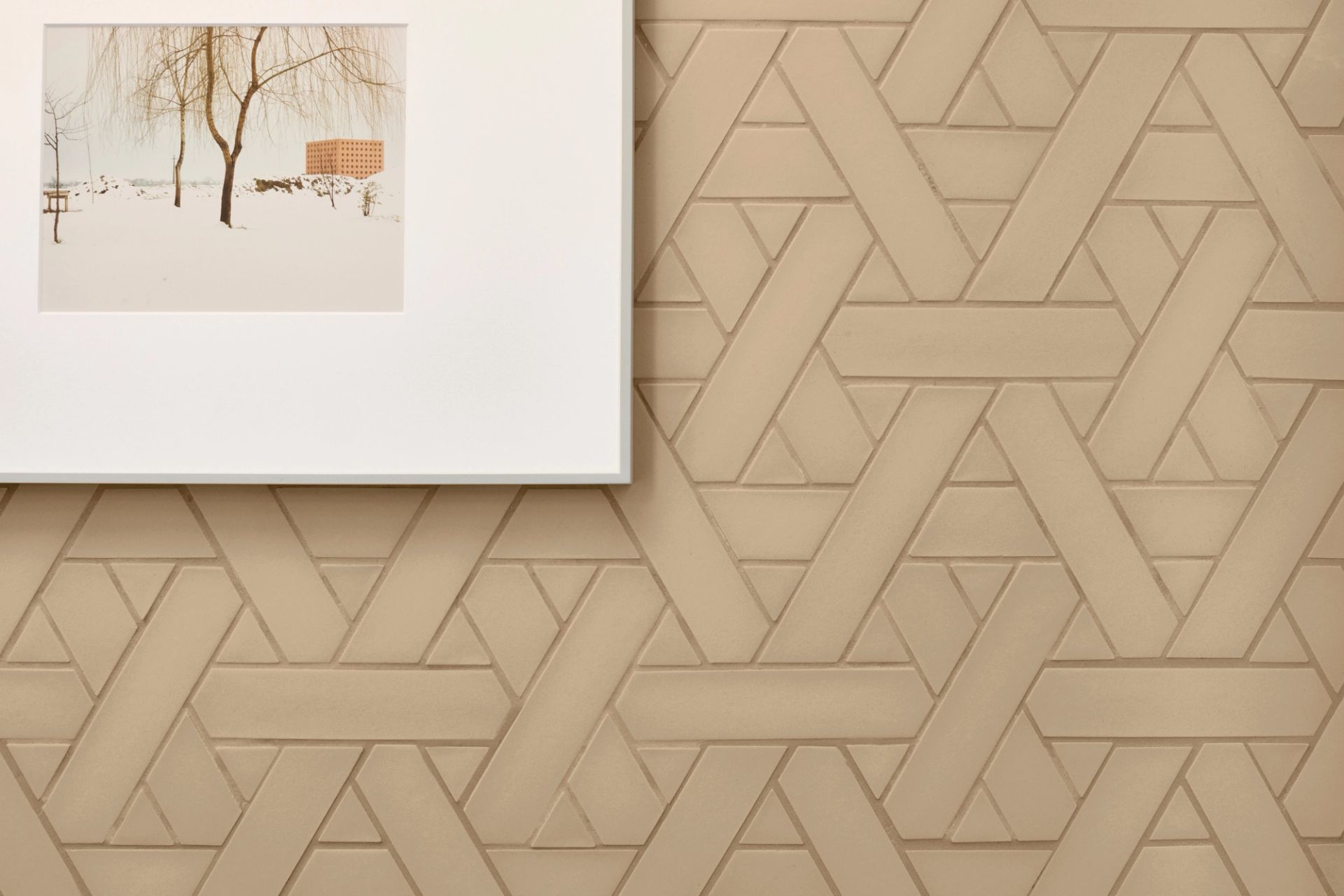
Inspired by the ancient craft of bamboo weaving, Weaving translates a vernacular tradition into a contemporary ceramic language. Through the interplay of solids and voids, the collection explores a theme central to Neri&Hu’s practice: how individual elements gain meaning only through their relationship to a larger whole.
"And when hosting truly happens, it is not about one person speaking beautifully, or about the host being remarkable. It is about the interaction that emerges between people. that moment of exchange."
SF Firstly and if I’m to be completely honest, we design things in the way we want to see them ourselves, for both of us. We don’t really begin by thinking about others; we make things as we would wish them to be. In the past, I don’t think I would have admitted this so openly, but recently I’ve come to realise it doesn’t stem from arrogance — rather, it’s from an understanding that we are not so exceptional.
We’re wary of statements like “the general public wants this” — because who exactly is this so-called general public? Instead, we design in the hope of encountering others through the work. I think the moment you start second-guessing what others might want, something shifts — and not always for the better.
AT This is also why I often feel that marketing, as a discipline, can be deeply problematic, because it tends to reduce everything to targeting, to defining and reaching a supposed audience. There’s something quite limiting or even unhealthy in that mindset, and it’s not something I instinctively trust. If you think about it, a project like Prada Frames is almost paradoxical. For a company of that scale, within an event like this, choosing to foreground conversation rather than spectacle feels counter-intuitive.
Maria Ecco gli spaghetti! Bambina, sei sicura che non mangi nulla tu?
Federica Si grazie Maria
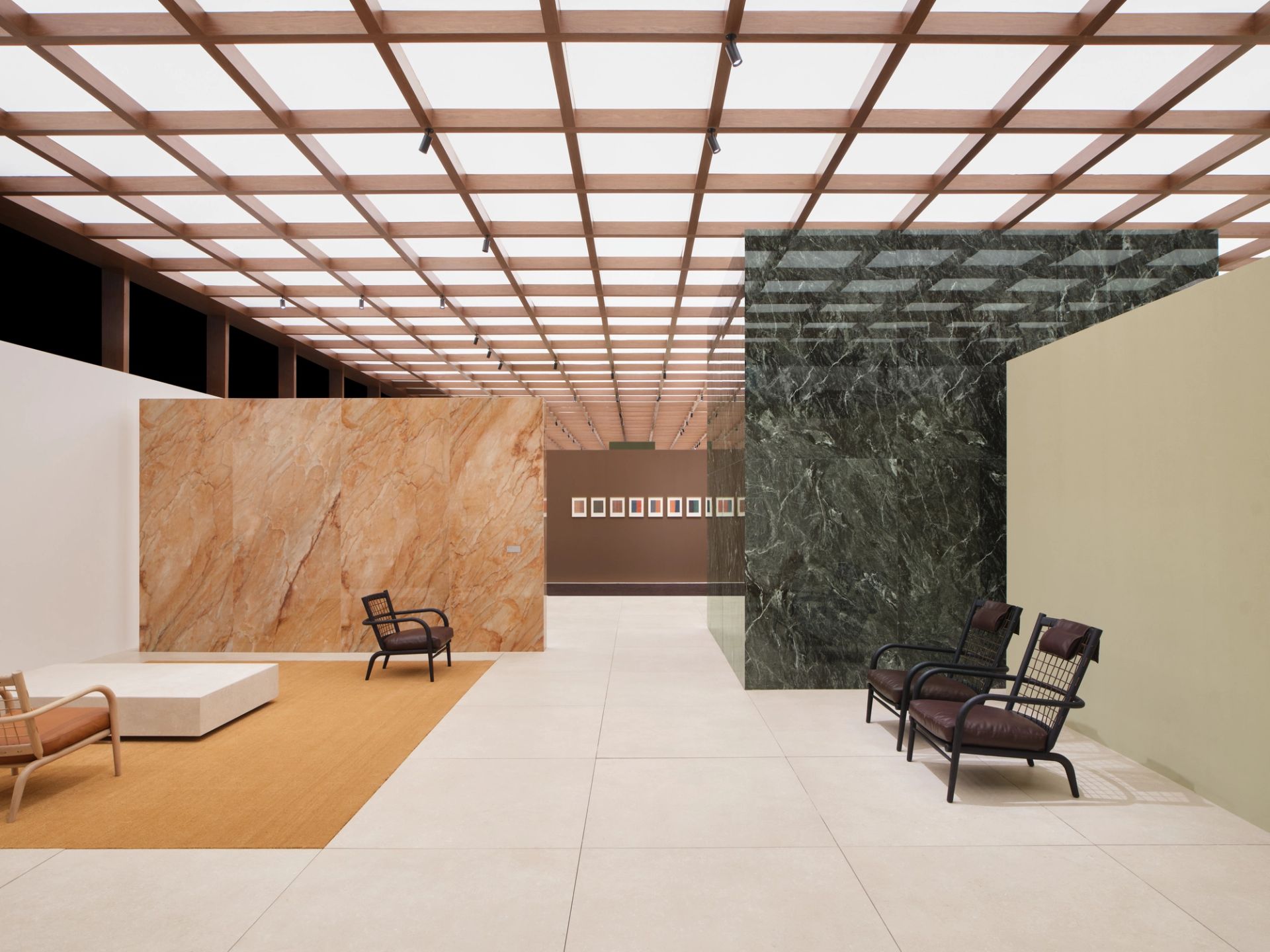
Presented during Milan Design Week to mark B&B Italia's 60th anniversary, Before & Beyond extends Formafantasma's research-led approach into exhibition design. Combining archival material with contemporary interpretation, the project reflects on how design histories are produced, transmitted and continuously re-read by successive generations.
KOOZ Has something shifted for the two of you in recent years? Over the past five years, for instance, you seem to have found yourselves moving towards a more generous, perhaps more understated way, not of hosting exactly, but of allowing ideas to reach others, beginning with yourselves…
SF Personally, some things have shifted for me. After my parents passed away, certain reflections — like the aggression with which ideas are often put forward — took on a different weight. It made me more aware of a general lack of kindness in the world, and of a desire to bring more of that into what we do.
I’m not sure I can fully articulate how this has changed our practice as yet, but it has certainly made me more attentive to an emotional dimension that I would not have acknowledged a few years ago. Not in a way that is poetic or rhetorical, and not in everything we do, but in a quieter sense of care. A greater attention to detail, to how things are presented, to making them feel… more considerate, more humane.
LN What you're talking about is the sense of empathy…
AT Indeed, I think now we are becoming more interested in empathy. In recognising that information alone is not enough; that beyond conveying knowledge, there needs to be a deeper, more human connection in how ideas are shared and received.
"We are becoming more interested in empathy. In recognising that information alone is not enough."
LN Teaching has been part of our practice from the very beginning but around 2017, while working in China, we became more intentional about it. We started to see ourselves as a kind of bridge for the next generation, and in that sense, authorship became less important. It didn’t matter so much whether people knew who we were; what mattered was enabling others to develop their own voices.
At the same time, we realised that teaching only in China and Hong Kong was not enough, especially as many of the most ambitious students were leaving for places like Harvard or Yale. That led us to expand our engagement, and it made us understand how crucial these exchanges are across different contexts. Alongside teaching, we also invested in publishing projects, including not only monographs but also initiatives like ‘Persistence of a Vision’, which interviews a wide range of practitioners in Shanghai. It was a way of simultaneously mapping a landscape and projecting possible futures.
But even that didn’t feel sufficient. We began to understand that it’s not only about producing knowledge, but about engaging directly with the people involved in shaping it, especially students. And that can be challenging. Sometimes the lack of passion is frustrating, and you find yourself almost in the position of a missionary, trying to transmit something you deeply believe in. That also requires letting go of your own ego, stepping aside in order to truly support others.
In the end, it’s a continuous balancing act between sharing, learning and knowing when to pause. Even taking time away, stepping back for a few days, becomes part of sustaining that energy.
KOOZ You also taught a course on Milan at Harvard…
LN It began with a fascination for Chinatown, and with a broader question: is Chinatown even needed today? What is Chinatown, really? It points to the idea of the enclave of what we might call a ‘third space’, often shaped by immigrant communities. That notion is compelling, especially when placed alongside developments like Feltrinelli, part of a remarkable new architectural complex — itself conceived as a kind of constructed urban identity, almost another version of the city. There are references layered within it, from historic models to ideas of civic representation, all tied to how space reflects who we are.
From there, teaching became a natural extension of these questions. And over time, it evolved further, with roles expanding — for instance through Rossana’s position as Chair of Architecture at the University of Pennsylvania Stuart Weitzman School of Design, which brought a different level of engagement. For me as well, it has opened up other ways of contributing, which I’d be happy to discuss further.
Maria Dolci? Cheesecake? Purea di mele? Crema di Fragole?
SF Una purea di mele e un caffè!
AT Per me un deca grazie.
FZ Per me e il signore due caffè!
SF We had a similar trajectory. We began teaching very early on, almost alongside the start of our practice; at one point we were deeply involved, even running a department at the Design Academy in Eindhoven. More recently, we stepped away. Partly out of necessity, with the move back to Italy and the demands that came with it, it simply became too much to sustain. And yet, in a way, I’m glad we made that decision.
What always felt essential to us in teaching was the possibility to address questions that we couldn’t fully explore within our commercial work. Often these were ecological questions, or broader systemic concerns, that require a much longer timeframe, a space for inquiry rather than immediate resolution. And those are not questions that belong to us alone.
Maria Ecco i caffè e il dolce, tra poco vi porto il conto che c’ho la fila fuori!
AT That’s where engaging with a younger generation becomes meaningful. As you were saying, it’s not so much about transmitting knowledge as it is about passing on a sense of responsibility. It might sound a bit strong when put like that, but when you’re dealing with questions about how we will live in the future, it becomes clear that no single author can — or should — claim ownership over them.
"It’s not so much about transmitting knowledge as it is about passing on a sense of responsibility."
SF I have to admit, I’m quite relieved not to be teaching anymore. It got harder, and not only because of the workload but because of the state of things more broadly. A large part of the work was no longer really about teaching; it shifted toward pastoral care, towards emotional support or even care giving, and we simply don’t have the tools for that. At a certain point, it felt like the institution itself wasn’t equipped to respond, either.
This was especially evident during and after COVID. The students we encountered were different, shaped by experiences that go beyond age alone. We often speak in terms of generations, but today the real distinctions seem to come from other factors; from trauma, or from the role of technology in people’s lives. There is a difference between those who grew up entirely with phones and those who didn’t, or between those who came of age during the pandemic and those who didn’t.
These shifts have happened very quickly. The gap between students, even within just a few years, felt profound. At times, it was striking to find ourselves working with people whose way of being in the world was already so different from those we had taught not long before.
KOOZ Looking ahead, are there particular questions or areas that are currently driving your curiosity — things you feel compelled to explore or engage with in the coming years?
SF It’s an open question, and we’re still in the midst of it, but at the moment we’re looking closely at the gendered dimension of European modernism, and how it has shaped domestic space. In parallel, we’re also reflecting on the impact of the postwar period, because if you compare what architects and designers were producing before and after the war, the shift is striking.
Part of it relates to the ideology of modernism itself, with its tendency to strip away what was perceived as feminine or irrational from interiors, redefining them through a more rigid notion of rationality. But layered onto that is the trauma of the Second World War, which profoundly altered how people related to their homes. There was a moment when comfort, decoration, even a sense of warmth could feel almost inappropriate, as if finding solace in the domestic sphere carried a certain moral weight.
What interests us is understanding how these overlapping forces have shaped what was preserved and what was erased; figures who embraced a more decorative or expressive language, who carried a different sensibility of care within design, and who were often written out of the narrative. It seems reductive to attribute that solely to modernism; it’s the result of a much more complex convergence of ideologies and historical conditions. That’s something we’re trying to unpack at the moment.
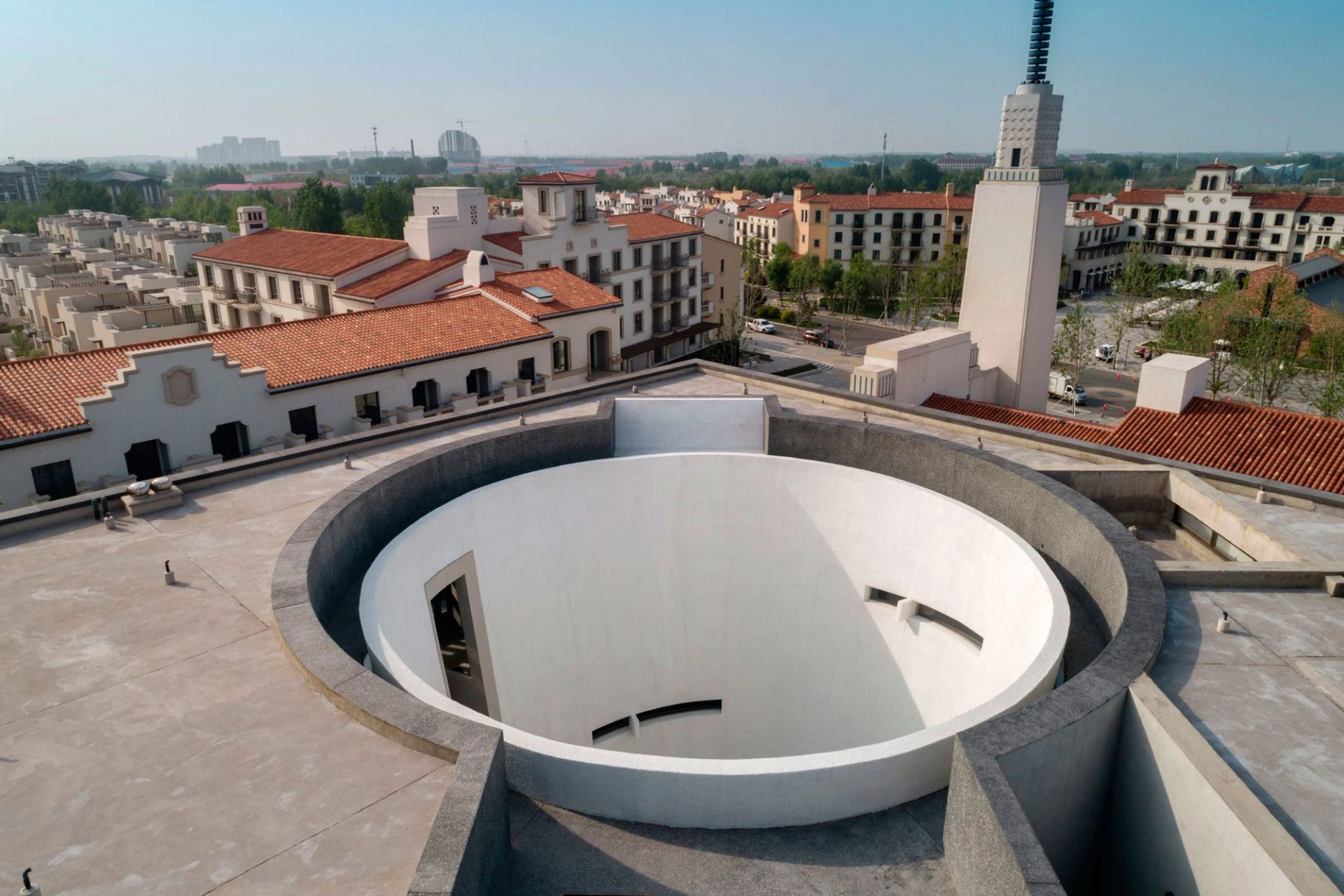
Designed by Neri&Hu for the Aranya community, The Void | Aranya Art Center centres on a monumental courtyard that functions as both amphitheatre and gathering space. Echoing Lyndon Neri's reflections on civicness and collective experience, the project positions architecture not simply as a container for art, but as a framework for coming together.
LN We’re also very interested in the idea of ‘vita activa’, as framed by Hannah Arendt. This relates to the sense that architecture, design and interiors cannot remain confined to their own disciplines, but are rather inherently political acts. Especially in the world we inhabit today, it feels necessary to consider how our work can take a position — how it might push back, rather than simply serve.
Too often, our roles are reduced to questions of structure, shelter, decoration, or the production of desirable objects. But there is clearly the potential, and perhaps the responsibility, to engage beyond that. This leads us to questions around ‘civicness’. Is it something that resides only in form, in the monumentality that Aldo Rossi speaks of? Or is it something more diffuse — something that emerges through use, through encounters, through the ways people gather and inhabit space?
Perhaps civicness is not only about buildings or figures, but about the conditions that allow for collective experience, how spaces are felt and how they enable forms of togetherness. In that sense, it connects back to what you were saying earlier, about hosting, about care, and about the way ideas and environments can shape how we come together.
SF Everything you’ve said today is already political in a sense, because it touches on our relationship to the past, to tradition and to modes of production. All of these aspects inevitably carry political weight. As designers, we might try to position ourselves outside of that but it’s not really possible, because what we do always contributes, in some form, to shaping the world.
At the same time, there’s a certain complexity in acknowledging this. We speak about design as a political act, yet we operate within very specific systems, with their own constraints and contradictions. As you mentioned earlier, even something like a symposium or a project like Prada Frames exists within a particular framework. So there is always this tension between intention and context, between what we want to express and the structures within which we work.
AT I really love how this conversation has interwoven different layers of reality. There’s something special about simply sitting around a table and talking like this.
SF It’s so nice, actually. I have to admit, I arrived in not a great mood — I was exhausted, I didn’t feel like being here — but this exchange has completely changed that.
LN Yes, I agree. We should continue this conversation, maybe in the form of a symposium or another sit-down in Shanghai.
KOOZ Well, thank you all for having taken the time: it was a pleasure to sit with you.
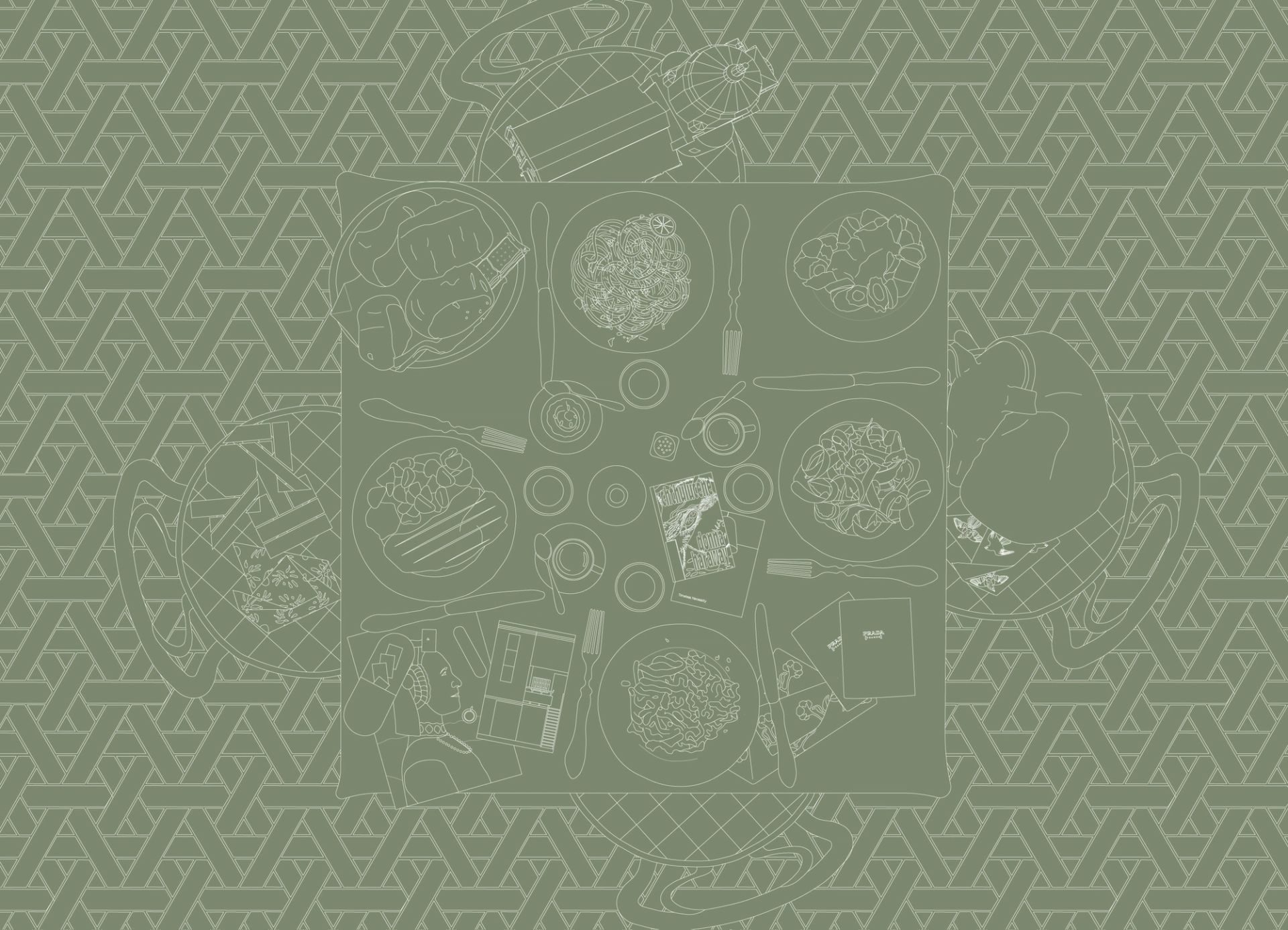
The conversation took place over a table at the historic Latteria di San Marco in recognition of its domestic scale and convivial spirit—a setting where the shared table becomes a site of encounter, exchange, and unexpected dialogue. Founded in the 1960s in Milan’s Brera district and run for decades by Maria and Arturo Maggi, La Latteria remains a discreet institution, known for its intimate atmosphere and daily handwritten menu shaped by seasonality. With only a handful of tables and a steadfastly simple approach to cooking, it endures as a quiet landmark in the city’s culinary and cultural life.
Is This Seat Taken? (ITST) is a situated conversation series hosted by KoozArch, convening lunchtime conversations between cultural practitioners around a shared table. ITST understands the particular pleasure of ‘debates over plates’ as a cultural act — a space of slowness and attention that is by turns critical and casual. ITST holds a seat at the table for contexts where creative energies converge, capturing and catalysing the exchange of ideas through dialogue over food.
Each lunch is accompanied by a drawing by Andrea Derni.
BIOS
Simone Farresin and Andrea Trimarchi are co-founders of FormaFantasma, an award-winning research-based design studio investigating the ecological, historical, political and social forces shaping the discipline of design today. Set up in 2009, and operating from studios in Milan and Rotterdam, the practice embraces a broad spectrum of typologies and methods, from product design through spatial design, strategic planning and design consultancy. Formafantasma’s analytical nature translates in meticulous visual outcomes, products and strategies.
Lyndon Neri is a Founding Partner of Neri&Hu Design and Research Office, an inter-disciplinary international architectural design practice based in Shanghai, China with an additional office in Milan and New York. Prior to starting his own practice with partner Rossana Hu, Neri was the Director for Projects in Asia and an Associate for Michael Graves & Associates in Princeton for over 10 years, and also worked in New York City for various architectural firms.