Federica Zambeletti / KOOZ Let’s start with introductions, and how you came to engage with the question of sacred and specifically multi-faith spaces.
Rebekah Coffman Absolutely. I'm Rebekah Coffman. I currently serve as the curator of religion and community history at the Chicago History Museum, and there I oversee an initiative called Chicago Sacred. When you think about sacred cities across the globe, Chicago may be not the first one that comes to mind. We're not Jerusalem or Makkah, but I have the pleasure of thinking about how contemporary urban heritage can hold a sacred practice or history, and how communities shape that urban heritage in an ongoing way. Chicago is a huge global diasporic city; the entire globe is here and the histories that are visible have international impact.
I’m originally from the midwestern United States; in fact, my parents were faith leaders who started their own community. Because of that, ideas of how space and community come together was just an inherent backdrop of my life. It's not something I appreciated early on; in fact not until my graduate programme did I look seriously at spaces that were considered sacred. I focused on what we might call religious identity — perhaps a fraught term, but it includes the way such identities inform visual and material culture.
I worked for close to ten years in churches in transition — that is, buildings that were losing their original congregation and financial sustainability — thinking through how to reactivate the spaces in a meaningful way. I found myself gravitating towards what I ended up calling the “sacred shift;” this idea of a religious space being reused by multiple communities while retaining a faith-related purpose. I noticed that these examples of adaptive reuse were continually left out of the playbook: "Well, religion doesn't matter anymore, so we ought to think about a more meaningful circus school, or the most energy-efficient coffee shop.” Yet now, layering on issues of secularisation and ‘heritagisation’, what can we learn from that process? That's really the focus of my research — and now I get to do that in a museum setting.
Wilfried Kuehn Thank you for such a personal introduction. In our case, it's almost the opposite: we started from museum practice. We were actually designing museums and spaces for artists and curators, as well as engaging in curatorial work ourselves, over the last three decades. Some ten or fifteen years ago, we began participating in competitions for religious space: quite a departure from the primary nature of our work to date. Dealing with communities that actually share spaces to worship together, or conduct social life together, is a very different matter from making a museum. Museums are a relatively detached typology; objects cannot be touched.
We worked on several religious projects; for instance the rehabilitation, together with an artist, of a Catholic church in Linz; the project was all about guiding a diminished community back to a centralised way of worship in a very large space without feeling lost. We shifted the sanctuary and the sacred space of the altar into the center of the church, building the congregation around it, following the Second Vatican Council. We basically created a church within a church, and it worked quite well.
The competition for the House of One was really peculiar, largely because they did not ask for any religious background. In fact, they required more of a museum-like background; you had to show evidence that you have worked with historical buildings, with light, and with complex spatial arrangements. Initially, it was described as a house for prayer and learning, and it was led by a very small group of people — a grassroots organisation comprising an elder rabbi (who has since passed away), a priest and an imam. It would not be possible to produce a church, a synagogue or a mosque at that scale. Their reasoning at the time was that doing it together would really make the difference — and doing so in the center of Berlin really changes the urban narrative, as its location is on the foundations of the oldest religious site in the city.
We were glad to win the competition, perhaps because we felt a kinship with curatorial work — it was about curating a situation, we thought. We were also glad to have the opportunity to express diversity, identity and difference. In other words, to create relation through autonomy and autonomy through relation, accepting that religion is both an historical and historicised event — therefore religious practice can also grow, as it is in relation to other religions. Of course, these three faiths share the Abrahamic tradition. Yet they are still very diverse; these are not orthodox communities but more liberal, while retaining their specific beliefs.
"To create relation through autonomy and autonomy through relation."
Simona Malvezzi At the same time this is a political project about these three communities that have been based in Berlin for a very long time. But there are others too, who are not included. What is important about House of One is that it is based on dialogue; what we aim to create is a shared space between three distinct spaces, almost surrounding the square where communities can host events, talks and conferences.
Placing these three monotheistic religious communities next to each other is a real challenge, especially now, at a time when multiple wars are both ongoing and predicted along faith-based issues. Of course, we have faced a lot of critical challenges from those holding more orthodox beliefs, who could not imagine a church or synagogue sharing space with a mosque, or vice versa. The idea of the House of One is to design three separate spaces, where the shape and orientations of each would be really autonomous. The synagogue would take on the archaic form of a synagogue; the mosque, the classical form of the mosque; likewise, the archetypal aspects of a church.
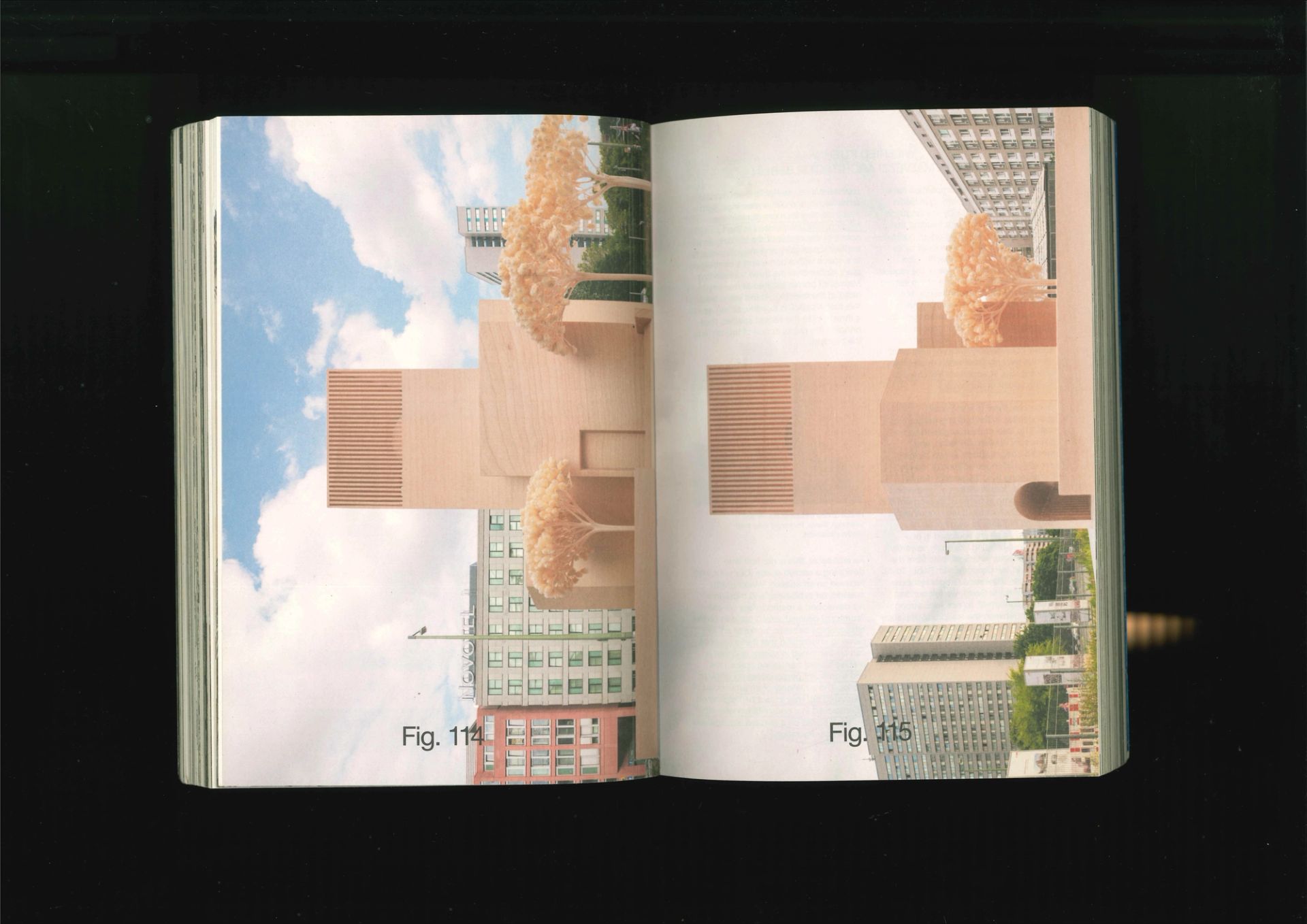
Fig.114 & 115 (2016) Site collage; competition mobel photographed by Ulrich Schwarz Petriplatz
KOOZ Taking a step back, you mentioned the House of One will be erected on the ‘original’ site of Berlin, where the city was born — Petrikirche in Fischerinsel. How does this position relate to the ground condition, which itself speaks to the stratification of the city and its civilisations?
WK You're right, the site is critical. The last church there — a Protestant Church built in the 1850s — happened to be a National Socialist stronghold in the 1930s; many Protestants became strong supporters of National Socialism, with some rather extreme pastors — one of them preached at this church. It was an aggressive and difficult place, for Jews especially; the anti-Semitism that had shaded Berlin’s own history found a particular presence on this exact site.
Another major issue is the fact that Muslims are vastly underrepresented in Berlin’s contemporary cultural life, which has hosted Islamic communities arriving from Syria, Turkey, Afghanistan and many other places over the last fifty years. These communities are obliged to worship at mosques on the urban periphery; the sizes of congregations are much larger than many Christian communities, but there is no place for worship in the centre.
We feel like that political representation — or underrepresentation — also plays a role, especially if you think of all the monumental churches and synagogues we have in the centre of Berlin. So maybe this site is also a contested ground, where political relations and accessibility are related to historical and social injustice.
KOOZ The ‘Sacred Shift’ series comprises an archive of continually renegotiated, if not contested, grounds. Could you share any interesting examples — potentially serving as precedents or parallels for the House of One?
RC The idea of contested ground in the context of House of One is really powerful. At the museum where I work, our methodology focuses on public history. Talking to the public about their ideas on religion can be a very vulnerable process for them — and also for me as a curator. You're working closely with tightly held beliefs involving who you are, and wanting to ensure you do that work right and ethically and with care.
I really appreciate that emphasis, in the House of One, on the notion of dialogue, and how your design addresses it. It’s one thing to recognise adaptive reuse as a typology, or identify archeological layers — but it’s another step to use that methodology to focus on the relationships and hand-offs that have shaped those layers over time. What can we learn through the archive, through oral history and memory, about the relationships and why those changes happened?
I had undervalued how deeply ideas of identity and dialogue could impact sustainable reuse. Through my research, I realised that dialogue is the most important part: I can show you, quantifiably, what energy use or embodied carbon looks like — but I cannot quantify a relationship of belonging. Platinum-grade LEED walls won’t mean much if nobody shows up to your building — that seems so obvious, but it's really not. So perhaps if we frame the idea of heritage as value, we might have a more rallying call.
"I can show you, quantifiably, what energy use or embodied carbon looks like — but I cannot quantify a relationship of belonging."
In the British context, where I began my research, the idea of a nation-state divide is somewhat unique. The Church of England has representation in Parliament and is able to advocate for the heritage and purpose of religious buildings in the future. A heritage listing in the UK — again constructed under the aegis of the Church of England — can frame all other religious traditions as “nonconformist”, not just ideologically but also legally . Methodists, Jews, Catholics, Muslims: everyone's a nonconformist in that context. So thinking about that as an interfaith framework for dialogue became really interesting.
I started mapping and poring over heritage listings, with the intention of proving how often adaptive reuse is considered as a framework for what religious identity could be. The reason comes down to a legal framework around the term “ecclesiastical use”. There were various provisions, protections and funds available if a building was in ecclesiastical use — to determine if this category could still be applied if a church hosted a congregation, but had a basketball court added, or a daycare centre. Well, “ecclesiastical” became even more contested when more and more churches began to be adapted as mosques: the narrative coalesced around a highly contested building in East London, the Brick Lane Mosque.
Originally built for Huguenots — Christian Protestants who were fleeing from religious persecution in Catholic France — in the east side of London, it became a mission called Society for Promoting Christianity Amongst the Jews. Operational for about ten years, it became a longstanding Methodist church; interestingly this identity is very much overshadowed by the Huguenot building use.
Methodists and the Salvation Army were building bridges of care for Jews settling the East End, so it then became an Orthodox synagogue in the late 19th century. After World War II and the decimation of their communities, a lot of inner city folks moved out into the suburbs. The dwindling Jewish community was really emphatic that it could not sustain this building on its own. In the 1960s and 70s, a conversation of heritage came into play; the building was put on a heritage list. Its identity and use is debated and contested all the way: do we call it the Great Synagogue? Does being in use allow us to think of it as heritage?
The story took another turn when no apparent viable user for the building could be found. In the end, it was a relationship between East End Jewish and Muslim communities that informed the decision of heritage officers. In 1975, it was sold to the Bangladeshi community that had increasingly made home in the East End after Bangladeshi Independence in 1971, and has been in use as a mosque ever since.
I focused on that building because it's one of the few case studies in which an adaptive reuse context is acknowledged as part of a heritage listing. Later, it garnered much more attention because the community had wanted to build a minaret on the outside of the building, and that really provoked strong reactions. It's one thing to start making changes inside a building; it's a whole other level when you want to demarcate yourself on the outside. When we take apart a case study like this, I wonder and continue to research how many hundreds or thousands of examples there are that are less well known, but which are shaping the identity of our urban centers and also framing what it means to have a relationship with each other. We’re learning a lot about what interreligious dialogue can achieve, as we shift in our religious thinking globally — people have noticed that while congregations aren't as big as they once were, we will need each other for the future. What does that look like?
KOOZ Perhaps Simona and Wilfried can share more about inter-faith dialogue and the act of building on those grounds. How have those factors shaped the architecture in terms of spatial and material qualities for the House of One.
WK I am very happy to hear about the transitions and transformations of such spaces. The House of One project started from the initial assumption that in order to create one building for three communities — as well as a fourth space that actually expresses interaction on all levels — we cannot use symbolism on the outside because then you create conflict. You can very well have a mosque without a minaret, it’s not a necessary element — nor is a cross, a bell tower or spire necessary for Christian churches.
It was interesting to study the birth of all three faiths, learning that they all originated in spaces that were quite domestic — emerging from the inside out rather than outside in. Temporary spaces exist in the Jewish tradition, where makeshift places endure for hours or moments rather than claiming physical stability or permanence. The sacred texts represent what is permanent, while the architecture is much more transient and ephemeral.
"The sacred texts represent what is permanent, while the architecture is much more transient."
Maybe the most stable architectural expressions can be found in the Islamic tradition and in the mosque, which is not only a space of prayer but also meeting. Transitional and threshold spaces then become very important, across all three religions. What happens between the outside and inside; between the sacred and the profane; between the moment you enter, washing your feet or your hands. You may join your hands, take off your shoes or cover your head. Finally, there’s the fourth space, which in our case follows the idea of the Pantheon, also a quasi-religious space and one of the oldest buildings that we know in the West. It has undergone many transformations inside but remains fully usable, and it's not dedicated to any single religion. In that sense, we composed several different ideas to inform what hopes to be a coherent ensemble of elements that depict autonomy, identity and sanctity without resorting to a symbolic shorthand — then later intensifying those elements through the interior finishes.
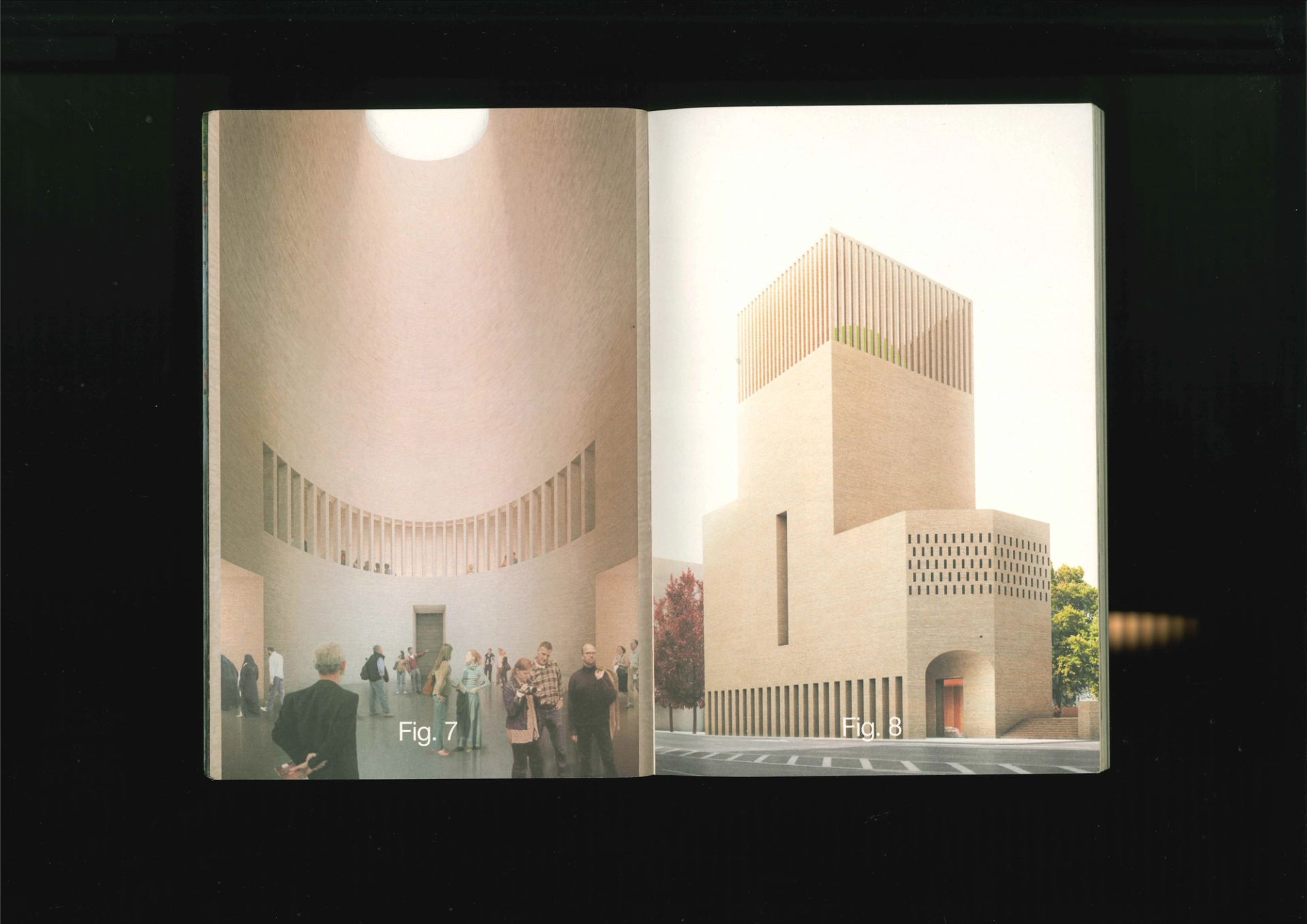
Fig.7 (2012) Vie of central space; winning competition proposal | Fig.8 (2012) View from Gertraudenstraße; winning competition proposal
KOOZ The whole complex is unified on the exterior through use of brick as a singular material — one which can be aligned with all three communities.
SM The bricks were actually required by the brief — but our challenge has been to use them as structure rather than cladding. Our project sits exactly on the perimeter of the foundations of a Neo Gothic Church,and includes the archeological site as an exhibition in the basement level. There is no physical separation between old and new walls; there’s almost a sense of old cathedrals, built as ongoing projects over hundreds of years.
We like to imagine the site as a ruin; we don't know if the project will ever be built. But it is important for the three communities and their representatives to start this dialogue, to begin sharing and using spaces of worship together. The materiality implies harmony as brick can be found consistently, across historical architecture of all three religions; it becomes symbolic without bearing symbols and you read the building as a hybrid monument from the outside.
"We like to imagine the site as a ruin; we don't know if the project will ever be built. It becomes symbolic without bearing symbols and you read the building as a hybrid monument."
WK Brick is an interesting material because you find it in all places across the world, a bit like bread; it's baked earth, the most elemental cultural technique that humans have invented. In this sense, the design for House of One creates something atypical; rather than recalling a particular identity, it creates all the identities. In Berlin, there is also a particular 19th century tradition of brick-faced buildings — starting with Karl Friedrich Schinkel’s Bauakademie — placed in the centre of the city as public buildings, which later became the norm. From that point forward, municipal buildings were also brick-faced — whereas previously brick was only used in the urban periphery, for industrial or lesser buildings; in that sense, it's a humble material.
"Brick is an interesting material because you find it in all places across the world, a bit like bread."
Of course, building monolithically with brick is also relevant for climate concerns, where you create a very thick wall that absorbs heat in the summer without becoming warm inside — like an old church, rather than the more common contemporary challenges of thin facades and curtain walls. At the same time, it's very heavy in terms of carbon costs, as producing brick requires a lot of firing. We also redesigned the structure last year to improve performance, reduce carbon, and make the design more ecological, while retaining the monolithic premise — the idea that you get what you see. The load bearing element is also the façade; the material interface with the city matters a great deal.
RC The idea of brick as the foundational element is so beautiful. When reviewing sites of contested heritage, people are provoked by material choices more than almost anything else; it becomes such a marker of identity. When a heritage officer gives advice about an historic building, they might say something like "Don't you dare change a single brick”. To reverse that concept, claiming brick as the binding and common element is to position it as a material embodiment of coherence. I love the parallel of bricks and bread — we all have this substance, the earth that we come from which then becomes these buildings so let's use that as the anchor.
KOOZ House of One has existed across many disparate museum exhibits and attendant discussions. Rebekah, you have developed the Chicago Sacred Initiative at the Chicago History Museum; what role do these cultural institutions have in cultivating a culture of coexistence — especially when tolerance is in short supply.
RC In a lot of institutions, religion is kept at an abstract level. I’m constantly thinking about how we bridge historical references with contemporary lived experience, in a way that feels meaningful. Returning to the fact of shrinking congregations, museums are an Enlightenment relic. The museum takes things out of embodied everyday contexts and frames them within a different kind of sanctuary. Public history as a method really disrupts that. Our goal is to demonstrate and remind people that these objects were embodied; they continue to have meaning, and there are people alive today who carry that memory with them.
I'm working on a series of three exhibitions that begin next year, called Everyday Sacred; I've been working to examine the built environment of Chicago through our material culture. This research draws from our architectural archives, our photography archives, our map archives; we are creating what we call a cultural and sacred inventory of architectural materials. It documents race, ethnicity, all of the identifications that people use; in fact, we’re starting to do that archival repair first through examining the language we use internally. The exhibition selects objects around specific locations in the city and bridges them to local communities; we want to let people know that we have all these beautiful things about their building, their story. In every instance of our work on this topic, we build on the idea that the current users of a place are not the original builders.
Insofar as museums go, we really value Barry Byrne; we value Alfred Alshuler — these big Chicago figures, who created the celebrated built environment of Chicago. Many people think it’s time to reverse that and even reorient the language we use to describe certain lesser-known sacred buildings around diverse communities that have been in use through time. We'll do that across 15 specific sites; we're starting to see that the story of one site is also the story of multiple communities.
WK What you describe is very exciting; I would like to know more about the museum that you are shaping. We are experiencing big shifts in museum practices at the moment, involving communities to shape perspectives and inform how visions are framed. I think it's very important for the future of the museums.
KOOZ I love it when this happens. Reflecting on the various iterations of the House of One, it was never imagined as static; it would be inhabited dynamically. To round off, could you expand on how you handled ideas of movement and engaging the body?
SM We often ask ourselves how to exhibit architecture; it’s a very difficult task because architecture is about space, it’s a spatial experience. That's why we thought of allowing visitors to experience the three religious spaces from a central place of dialogue. At Le Centquatre cultural centre in Paris, we simply made a drawing on the ground showing the House of One floor plan, at an almost one to one scale, inviting people to enter and experience its dimensions.
When doing such exhibition projects we like to work with artists. At the first Chicago Architecture Biennial, for example, Armin Linke portrayed the three religious leaders as representing three coexisting communities by focusing on the gestures of rituality. Another ongoing exhibition series, Rituals/Materials, uses over 500 images to create a visual narrative showing the design process of the building. The House of One project began with a competition in 2012 – and perhaps it will never actually be built – but nonetheless it exists in the sense that it has been shown and shared a great many times, each time with a different approach. We also made a book that documents the project's development to the present day, across all media that includes texts, images, performances, video.
Regarding the bricks: at the start, the project launched a crowd-funding initiative, whereby people could sponsor one brick for 10 euro — a democratic foundation of sorts. The idea was to avoid having one major sponsor that might influence the materiality of the House of One. Somehow I like the idea that it remains a utopian model — but it could be a built model that exists in other places.
RC I don't want to overstate the importance of museums, but there's something so beautiful about what you just described as the purpose of exhibitions, especially with a project like this. There is something undeniably powerful about being in that physical space; I've been thinking about how to bridge that gap in my own work. But perhaps the dialogues created around the project can proliferate because they're happening in exhibition space. Methodologically, creating that environment for dialogue is necessary for the project to succeed someday; that would be fantastic.
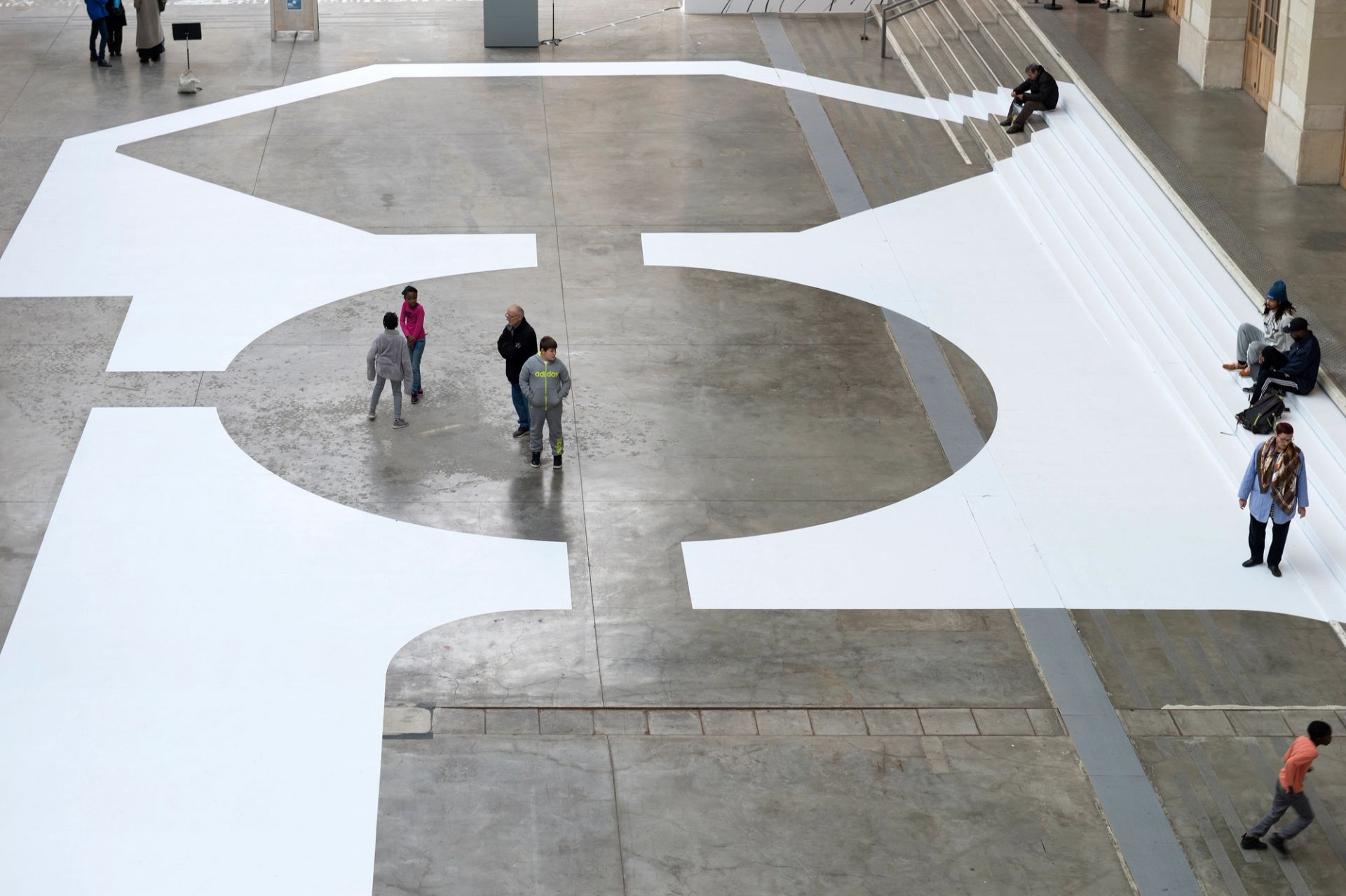
Kuehn Malvezzi, *House of One*, Le Centquatre-Paris. Photo: © Marc Domage
KOOZ Fundamentally it's about how — and where — to create space to discuss tolerance and coexistence; the museum may be one such place. Are there other spaces, institutions or non-institutions that you think could carry such conversations forward?
SM Good question. I know of some likely institutions, for instance the Gemäldegalerie Alte Meister in Dresden held a special workshop on critical approaches towards exhibiting objects that are the result of occupation, of violence, of domination and colonisation. It's a really important topic because it is about repair and respect. The kinds of institutions we need might already exist — not as the mainstream but in smaller initiatives; academia also holds such resources and I encounter more of these discussions in my teaching. I think it's an ongoing project.
RC It's a really big question, and you answered it so well. My head went to a slightly different space, partly because sustainability is my focus in the non-museum, secular realm. The United States has a very different framework from the UK; the separation of church and state on paper and the conflation of those in recurring models of leadership make it a really fraught place to be. I'm trying to lean into some hope about what could be possible: there's this big conversation around religious land use, especially as churches and non-governmental religious bodies are some of the largest landholders in the world.
I've been thinking about how to have interfaith and civic dialogue around what we do with sacred buildings and places — acknowledging the massive changes that will come over the next decades. Interestingly, the UN Climate Change Summit at COP28 was one of the first times that religious leaders were given a platform as stakeholders in climate change. What happens if we start thinking about what dialogue means beyond the advocacy of individual beliefs — towards those larger principles? Maybe they're utopian principles, as Simona said, but maybe they're more than that; maybe there are tangible values within religious communities that could benefit from that level of advocacy. I do think climate change is a great unifier for cross-faith and civic conversation. We'll see what the future brings, for sure.
"I do think climate change is a great unifier for cross-faith and civic conversation."
KOOZ That’s a beautiful way to end today. My heartfelt thanks; this was a wonderful conversation.
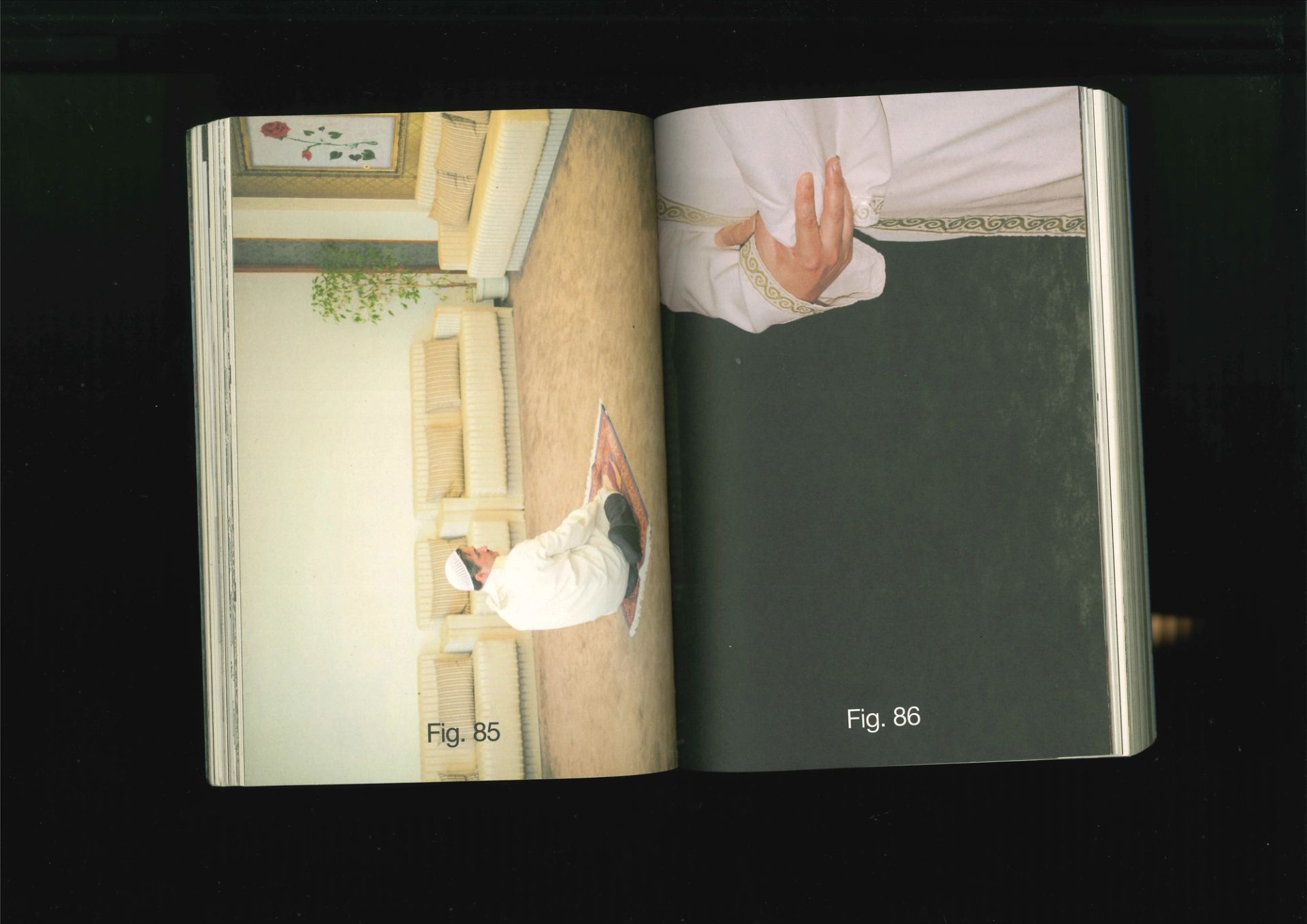
Fig. 85 (2015) 'Armin Linke: The Model of Gestures', installation view Chicago Architecture Biennial 2015: 'The State of the Art of Architecture', curated by Joseph Grima and Sarah Herda
All book scans are from 'House of One', edited by Kuehn Malvezzi, designed by Something Fantastic, and published by Lenz Press (2025).
BIOS
Rebekah Coffman is a curator, public historian and researcher whose work explores the intersections of religious heritage, the built environment, sustainability and collective memory. As Curator of Religion and Community History at the Chicago History Museum, she leads the Chicago Sacred Initiative, an interdisciplinary programme that brings together archival repair, research, writing, community engagement and exhibition-making to foreground the city's diverse religious and cultural histories. In 2019, she founded the Sacred Shift Project, an ongoing international survey of urban religious buildings adapted for ritual reuse by diasporic communities, examining questions of intangible and contested heritage through the evolving lives of sacred spaces. Coffman also lectures in Heritage Studies at the American Islamic College and serves on the leadership of the AIA National Interfaith Design Knowledge Community.
Wilfried Kuehn is an architect, curator and writer based in Berlin and Vienna. He co-founded Kuehn Malvezzi in 2001, a practice known for its work on museums, exhibitions and public spaces. He is Professor of Spatial Design at TU Wien, where his research explores the relationship between architecture and curatorial practice.
Simona Malvezzi is an architect and co-founder of Kuehn Malvezzi, the Berlin practice she established with Wilfried Kuehn and Johannes Kuehn in 2001. Her work focuses on museums, exhibitions and public spaces, bringing architecture into dialogue with curatorial practice. She teaches Curatorial Practice at NABA in Milan.
Kuehn Malvezzi is a Berlin-based architecture practice founded by Wilfried Kuehn, Johannes Kuehn and Simona Malvezzi. Working across architecture, exhibition design and urbanism, the practice is recognised for its thoughtful engagement with cultural institutions, the public realm and the evolving relationship between architecture and society. Its award-winning portfolio includes museums, exhibitions, educational buildings and urban interventions, among them the extension of the Museum Berggruen in Berlin, the Insectarium at the Montreal Botanical Garden and the Julia Stoschek Collection in Düsseldorf. Among its most significant ongoing projects is the House of One in Berlin — an interfaith house of prayer that brings together a synagogue, church and mosque around a shared civic space, proposing a new architectural model for dialogue, coexistence and collective life.
Federica Zambeletti is the founder and managing director of KoozArch, a magazine and creative studio dedicated to architectural discourse, speculative spatial imaginaries, and design research. An architect, researcher, and cultural producer, she explores architecture beyond the built object, using publishing, storytelling, and curating as critical spatial practices. Through KoozArch, she brings together spatial practitioners and thinkers to critically examine the social, political, economic, and ecological dimensions of the built environment, fostering dialogue that contributes to more regenerative and generous futures.