KOOZ/Shumi Bose First of all, thank you for making time in our different parts of the world to be here today. Let me start by asking you to introduce yourselves.
Jia Yi GuI’m Jia Yi Gu. I'm an architectural historian, curator, and a designer, based in Los Angeles. Most of my work is thinking about architecture's conditions of production, with an emphasis around material histories and cultures right now.
Yassine Ben Abdallah My name is Yassine. I'm a designer and researcher based between mainland France, and La Réunion, where I grew up. I mostly work around histories, colonial histories of Europe, and especially the challenges left by the erasure of material culture; the question of how we hold memory when we have no objects left, and how design can inhabit that colonial amnesia. Jia and I met in Los Angeles while I was doing a residency called Villa Albertine, and she was a wonderful host and guide to the city. We had really interesting conversations around modernist architecture, specifically in LA.
KOOZ What are some of the ways that Jia helped to change the way that you viewed Los Angeles?
JYG Oh, I don't think it's me. Yassine brought a certain gaze toward the city, and it was really nice to have him as an interlocutor…
YBA To start with, I came to LA with a really loose research idea; I wanted to look at diasporic objects. It was my first time in the United States, and I spent five weeks in New York before going to LA; I was hoping to look at how objects from one community are reappropriated by another. It was good to get an understanding of the city with Jia: the demographics, how communities are organised — as well the realization that New York and LA are really two different countries, in many ways. In LA specifically, I was invited to look at the famous Case Study Houses, and I started with the Eames house. One of the first things that fascinates me is that you can't enter it unless it's a special event; there’s a certain attitude of enshrinement towards those villas. Their keepers and visitors always emphasise how lucky we are to visit them; they felt like sacred spaces, while for me they belong to a very recent history.
What I then began to notice was the extensive use of exotic artefacts as props to decorate those houses. The Eames for instance had a lot of handmade Indian artifacts, and then I would go to the Hollyhock House made by Frank Lloyd Wright, decorated with a lot of lacquer work from Japan. The Schindler House features strong echoes of a Japanese house too. I was fascinated about how and why those temples of Western modernist architecture have that many exotic artefacts. What is the function of those exotic props, and to what extent do they convey their own narratives? Someone from the Eames Foundation told me that most of the Case Study Houses were meant to be sold; the aesthetic direction was about using industrial elements, and one strategy to ‘humanise’ those spaces involved those primitive props in a way. I find it fascinating how the West spent so much time dehumanising the other, while also using the artefacts of the latter to humanise its own space.
It was this relationship and the underlying relationship to whiteness that became really interesting to me. That’s how my initial research took a turn from the diasporic object towards this observation of how whiteness interacts with the other; how mid-century modernism built a certain posture that is based on the white man.
"I find it fascinating how the West spent so much time dehumanising the other, while also using the artifacts of the latter to humanise its own space."
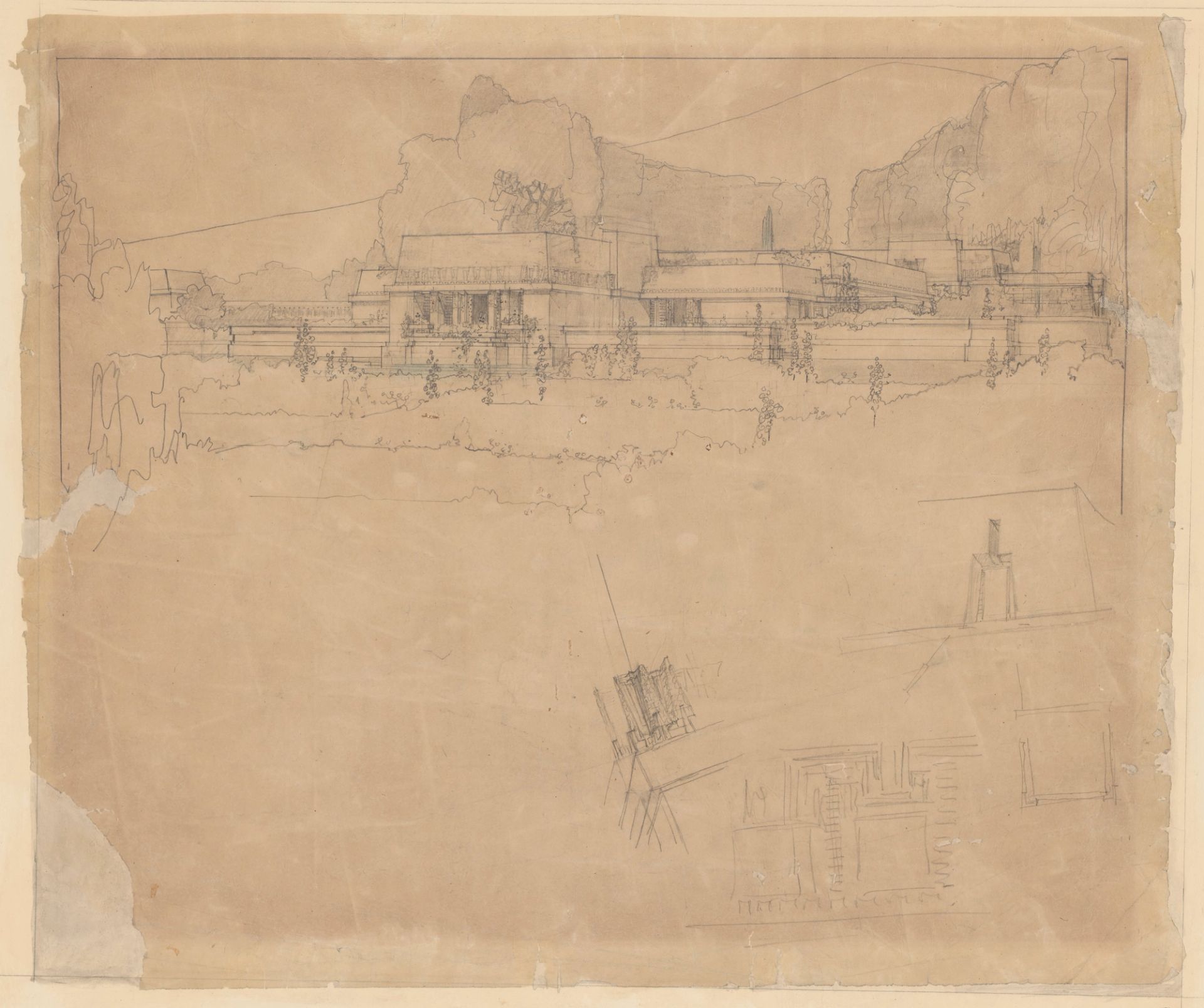
Frank Lloyd Wright (1867–1959), “Perspective for west facade, Hollyhock House,” Hollyhock House Archive, accessed October 20, 2026, https://hollyhockhouse.omeka.net/items/show/
KOOZ Jia, perhaps this chimes with aspects of your own work interrogating mid-century histories: the people, places and stories that are left out as well as the idea of the prop and performance. Could you elaborate on some of the shared currents?
JYG Within the narratives that Yassine encountered there was this incredible dominance of stories around mid-century Modernism, which has — in recent decades— become a really celebrated aspect of Los Angeles’ culture, especially in design and architecture. It can get quite oppressive because the only way that people engage with these histories is through pure architectural enthusiasm.
The Case Study Houses are a perfect example: that programme is often utilised as an idealised past that we can somehow resurrect — for instance, the recent project called Case Study 2.0, which emerged from the recent wildfire devastations in the Palisades and Altadena. This was a private initiative that gathered multiple single-family homeowners to rebuild their homes in relatively wealthy enclaves, proposing this as a new generation of case study houses. That programme did not consider the contemporary question of whether the single-family home is what we still need; it also sidesteps the original socioeconomic proposition of Case Study Houses, which was about affordable housing for workers, teachers, artists. What were the conditions that allowed that original intention to occur, and do those conditions even exist anymore? Does affordable housing at that level of ambition exist in the United States, or anywhere?
On top of that, there’s a total disconnect from questions of class, appropriation and what we need now, for our present day. Yet ‘mid-century modern’ is so widely celebrated in design and architectural media; these deeper conversations about appropriation are avoided in the reification of the later Modernist period. I was a director of the MAK Center, an organisation specifically about advocating for historic houses designed by Rudolf Schindler. Much of the work was about trying to open those conversations to other perspectives and allow multiple interpretations besides the dominant ones. So the moment that Yassine and I connected on these questions, It was just very effortless to find shared currents of thought.
YBA I don’t know if it's a causality or correlation between the resurgence of mid-century modernist enthusiasm and the rise of fascism or white supremacy. I feel that they do share some similar values of order and cleanliness, and am inclined to ask: Who is clean? Who can afford to live as portrayed in those spaces?
JYGIt's difficult; the primary historiographic turn I see is to reinforce the reification of the values of modernism, but replacing the white architect with the non white practitioner. That is fine, we need to have broader histories, but I what I would wish to see today is a concerted effort to think about more seriously how we can change the conditions of productions today — and to acknowledge, as Yassine said, the reason why there are Indian artifacts appearing in the Eames’ house. This has more to do with their relationship to a nationalist culture and the globalizing presence of the U.S., than it does with an assumed universal connection to communities of that region.
For me, it's less to do with looking at the mid-century and rather trying to think about today. For instance, do we still need steel-frame housing units, given that steel suggests highly extractive, problematic mining operations tied to all kinds of exploitation? If we look past the image-based misunderstandings of the mid-century and look instead at what produced the mid-century, we can then connect it back to the way that we produce our world today. This way, we can escape aesthetics to critique, build, and provide alternatives behind and beyond the image.
"If we look past the image-based misunderstandings of the mid-century and look instead at what produced the mid-century, we can then connect it back to the way that we produce our world today."
YBAArriving in LA, I was amazed by the capacity to inhabit the land — from the sea to the desert — homogeneously. You see the same condos in different landscapes; this is another aspect of high modernism, which does not account for the reality and the space in which it exists. Modernity as an aesthetic has been developed to be a-historical; to become abstract and devoid of any ornaments, to be deployed anywhere. This is where the scalability of modernity and mid-century modernism becomes really interesting and problematic, especially in relation to the copy-cat mid-century villas that I grew up looking at on Réunion, a tiny island in the Indian Ocean — the influence continues to be very strong. Talking with Jia, we were also thinking about the communities who lived and were the stewards of the land before settler colonialism, and how there is almost no mention of that in the city. LA is built on the promise or premise of freedom and free land, even as it erases all non-human and non-white resonance and presence.
JYG That is the sprawling nature of Los Angeles and the ubiquity of every surface trying to be something that it's not — yet behind it all lies the same totalising construction system.
KOOZ There is an expansive notion of geographical dominion that is embedded in the histories carried by diaspora objects. Yassine, at the scale of objects, what were some of your research queries?
YBA Yeah, definitely. If we come back to the idea of props, what's interesting is the nature of the object. For example, the artefact that Eames brought back from India are mostly craft objects, created specifically for a white tourist audience. It's really interesting to consider and acknowledge the agency of the non-white people in this relationship; why Nehru, for example, invited the Eames and Le Corbusier to India as advocates of mid-century Modernism and modernity as proponents of how to inhabit a perpetual future. For so long, non-white people and cultures have been seen as being primitive. The statement seems to be that for a post-war, newly independent country like India — which wanted to be on par with the West — the answer was to invite those people and their ideologies of modernity to point towards the future.
A similar thing took place in Japan, where Charlotte Perriand was invited to consider how to ‘civilise’ the culture, creating chairs for a community used to sitting on the floor. Perriand, to her credit, noted that the idea didn't make sense — but it's really interesting to see how modernity creates a hierarchy in how it inhabits a certain future. By doing so, it puts all those other cultures in the past, as being bound to disappear, destined for extinction. And that's why they are collected, and why they become fascinating heirlooms for Frank Lloyd Wright and for the Eames. That’s the function of the primitive artifact — the artefact regarded as primitive — in this environment; bound to disappear, they confirm that modernity can take over. For me, this is the challenge. It's not that I have a problem with mid-century Modernism as an aesthetic; rather, it’s how it becomes a hegemonic ideology, professing itself as the only one to move forward, consuming all other worlds in order to keep going. We might even mention the exception of Paul R. Williams, one of the few relatively well-known Black mid-century Modern architects. In his writing, he says like mid-century Modernism is an aesthetic among others. He never puts it forward as the only way possible; he really considers it as a world among many worlds — and he was an exception.
"It's not that I have a problem with mid-century Modernism as an aesthetic; rather, it’s how it becomes a hegemonic ideology, professing itself as the only one to move forward, consuming all other worlds in order to keep going."
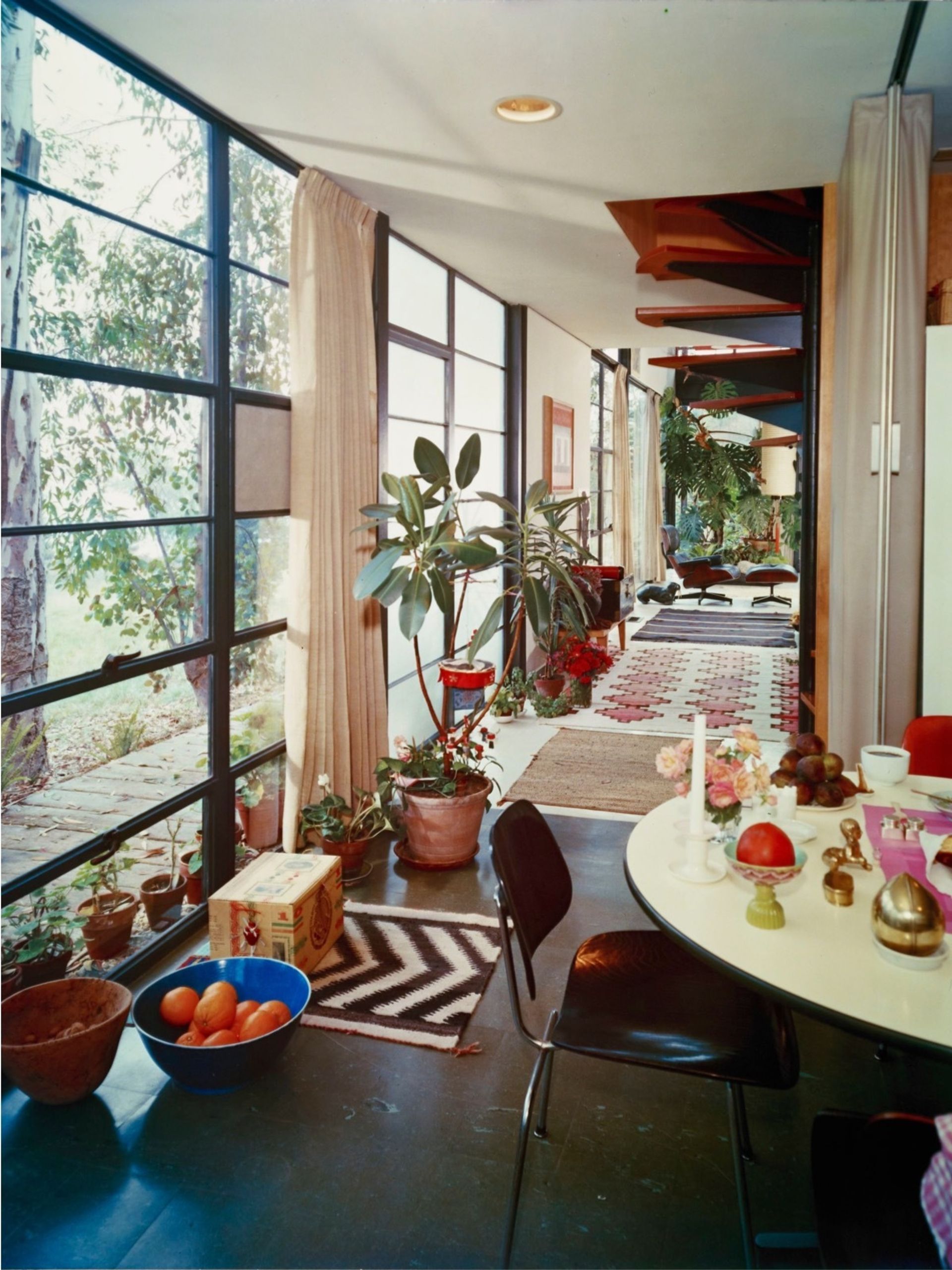
Photo by Julius Shulman. © J. Paul Getty Trust. Getty Research Institute, Los Angeles (2004.R.10)
I feel like it becomes interesting, or perhaps dangerous, when ideology becomes hegemonic; this is why we talk about scalability. Bringing this back to my island of Réunion with its sugar plantation, Anna Tsing has written about this idea of scalability and the plantation: the danger arises when you create a system that can be scalable, because to be able to scale something, you have to create a terra nullius as well. You have to erase culture. You have to erase human and non-human things that were there before, to build your clean mid-century house, your ideology. This is what mid-century modernism has done in order to grow and extend through time; it has erased so many other aesthetics and cultures.
JYG When I'm in Los Angeles, I'm forever crisscrossing between worlds, from design and architecture to other cultural communities. There are so many hyper-specific communities in Los Angeles. From mahjong nights to lowrider cultures, indigenous conservation; sometimes they overlap, sometimes they don't, and they don't have to — we're not all trying to become one together. It's quite beautiful.
Compared to that, the discussions that take place within architecture and design circles can indeed be hegemonic, even oppressively one-dimensional, as Yassine has observed. Sometimes it feels like there's a small number of us trying to craft spaces for alterity, even just for intellectual engagement and discourse, for different kinds of practices and techniques. Architecture here is quite a professional corporate practice, and that disparity has been taking up space in my mind — firstly between how un-liberatory architecture is today in Los Angeles, especially for students and practitioners, and secondly, in contrast to what is often celebrated as the freedom of mid-century Modernism. Unlike Yassine, I live here, so I'm perpetually stuck in this question of what can or should change here.
KOOZ Circling back to Yaseen's project about the wandering object, how did the city alter what you brought with you?
YBA Oh, I think it changed my approach to it quite a lot. It was my first time experiencing a certain non-European idea of the West. LA creates its own definition and its own aesthetic. We all know that the United States was built by immigrants and diasporic communities; I started looking at the diasporic communities who would come to LA specifically, starting at the beginning of the 20th century with the Germans, and how California has always been something like a promised land. I also looked at this idea of the individual and the self, which has been shaped and modelled. This is something we can see in design afterwards, but the fact that it's single-family houses, made for the singular individual. It's never branded as collective, convivial or communal furniture or something that brings community together: it's always about an idea of transcendence of the self, of the one,. You still have this myth going on; what I found fascinating was that German health culture of having of taking care of one's body, of the relationship to the sun; this, had an influence for Richard Neutra, who wanted to create a really hygienic interior for the body — yet the same ideals were used afterwards in Nazi Germany, with the same idea of absolute control and the perfect body.
Le Corbusier’s anthropomorphic figure, the modulor, was supposed to be the perfect male body, at one meter and seventy five centimetres; he made it taller because in English novels, the main character was always taller — and handsome. Designing based on this ideal, you erase so many people. California is also the heart of GAFAM (Google/now Alphabet), Apple, Facebook/now Meta, Amazon, and Microsoft) and all of those companies. The longer I stayed in LA, the more I found narratives and mythologies that have brought us to where we are now, especially with tech and media moguls pushing their own interests. The only urgent motivation is how to succeed; if that agenda erases other people, other communities, there's no problem. I felt I was entering the backstage area of Western ideals.
"I felt I was entering the backstage area of Western ideals."
JYG I'm curious, Yassine, if you feel like you did encounter diasporic forms in Los Angeles — not as the prop as a domestic element within a modernist house, but in terms of where diasporic communities have made themselves a home. For example, it could be the hyper anonymous speculative development communities, like Monterey Park, where everything is a strip-mall business park environment — yet on the interior, where the dim sum houses are, it's a very different, crafted environment. We've had five Chinatowns in Los Angeles; the best-known is the one built by Chinese Americans, as another speculative development. I love it and I hate it, but whether it's the most prominent version of Chinatown or the anonymous strip mall with the dim sum, there is a definite presence of the community. In Los Angeles, the presence of diasporic identity is subtle and can be hard to distinguish.
YBA Yeah, I don't think I did, really.
JYGI didn't take you there. That’s my problem.
YBA No, but I think it's okay; on a five-week residency, it was presumptuous to consider that I would be able to meet certain communities; it takes time to be allowed to enter those spaces and as you say, things are subtle. Being in the U.S. myself, I felt like a moth surrounded by light; everything was shiny. That’s why one of the first things I started looking at were the Case Study Houses. But I remain fascinated to see the differences between how diasporic communities and communitarian enclaves organise themselves, how they spring up and die down.
KOOZ Yassine, you have raised the notion that objects must die; even that they carry ghosts with them. Can we talk about the life and death of places, especially celebrated spaces? When one visits projects by prominent designers, there is a question as to whether their values, principles and aesthetics should be frozen in time. What are your thoughts?
JYGAs a curator and former director of MAK Center, my position is pretty clear,: I do think the conservation of the kind of physical body is important — but in all this conservation work, I acknowledge the fact that we don't own these houses; they're for a future generation and it's worth preserving them. But on the other hand, what kind of preservation culture and ideology do we follow? I've been dragged into a number of these conversations around the Schindler House, one of the historic properties overseen by the MAK. Things don't really matter if you can't build meaning around them, and the pure preservation of an artefact is quite meaningless if contemporary discourse is not maintained in relation to it. That means that the artefact needs to be open to ideas and interpretations, beyond that which was originally intended.
"The pure preservation of an artefact is quite meaningless if contemporary discourse is not maintained in relation to it."
We were always battling because the Schindler House was not owned by the MAK, but by a preservation group of volunteers with a strong, territorial sense of ownership. Some conversations were like a séance; they might say, "Well, Schindler would never have wanted this.” I don't know what Schindler would want, but it doesn't really matter because while there are voices to speak for Schindler, then there surely must be other voices too. This is a much more common idea in Europe, where you're surrounded by historical significance. We were recently in the Pont du Gard near Nimes, noting that there's no way an American government or municipality would let you swim next to a 2000 year old Roman aqueduct, underneath that crumbling stone. There is such a different culture and relationship to history; history is not always preserved in amber.
I also had a really great experience at the Charles Jencks House which is trying to open itself up to a greater extent. I was there for the archive, and they had a really profound understanding of their work as archivists: for instance, what is the point of preserving this if the planet burns in 100 years? They had a kind of sense of urgency of allowing people to engage with the materials of the archive, understanding their own positionality and precarity. If your preservation of a body of work is in complete isolation from the precarity of the world around you, how do you move forward? How can we water the grass of the Schindler House when Los Angeles is in drought? How can this building be in conversation with contemporary issues? Those were the battles: literally, can we stop watering the grass and talk about ecosystems instead of debating what Schindler might have wanted?
YBA When I visited the Eames house in the Pacific Palisades — a neighborhood that was badly affected by the series of major fires in LA in 2025 — I was curious about what would have happened if it had burned down. What would we do with it? What could the space become? Yes, objects need to die and allow for life, in a way. Sustaining something ad vitam aeternam is hubris, and I feel it is a really Western concept as well. The permanence of ownership is important here, to be able to continue to feel dominance over things; I think that's why we have so many exotic artefacts sleeping in Western museums and institutions, rather than being given back to their own communities. In one of my earlier proposals, I wanted to make a shrine for mid-century Modernism, in order to to allow it to die. To say, okay that happened, but now we have to let it go, and to try to position it elsewhere than in this permanent future, declaring it part of the past. What would the shrine for modernism look like?
Beyond the Case Study Houses, when something doesn't die, it becomes a ghost; it continues to haunt us. A friend of mine is working with the story of the Ennis House from Frank Lloyd Wright, used as a shooting location for many horror movies. I think it says a lot how those houses, in a way, will take their former place in the pantheon; the stereotypical trope of the haunted house was an old Victorian mansion, but I think these Modernist homes will become the haunted houses of our society.
"Beyond the Case Study Houses, when something doesn't die, it becomes a ghost; it continues to haunt us."
JYG Yassine, what comes next for you; what have you been thinking about since you left LA?
YBA I think it's still simmering in my mind. I'm still trying to make sense of it and to understand what can come as an object. This residency in the U.S. was far away from my center of gravitation; everything was fascinating, I've never seen the world on such a scale. The spectrum of beauty and horror was immense; I wasn't used to that. Specifically in LA, you can drive by beautiful houses in really fancy neighbourhoods, and turn a corner to find people on substances struggling on the street. Seeing the extent that this is a segregated city, and observing how one is able to live such a beautiful life without having to see or live with the uglier elements of the city: this was quite fascinating to me, as well as the idea of the top down governance; LA in terms of urbanism is really fascinating.
Right now, I'm working on other projects based in Europe; specifically, on the furniture of power in France. In France we have a very French-sounding institution, called le Mobilier national that takes care of furnishing places like the ministry and embassy buildings, and the presidential palace. It is a descendant of le Garde-Meuble de la Couronne, provided to the monarchy. It's really interesting to see that most of the celebrated furniture encountered in such places or institutions does descend from monarchy, from the empire or from Napoleon. This begs the question: what does it mean to think of democracy sitting on the furniture of the monarchy? What does furniture have in common with power? A lot of the furniture is made of exotic wood and other materials, which brings me back to my fascination with transmutation: how do you take mahogany and make it French? Especially when you know that those specific pieces of wood were used as ballast in the slave ships, when they came back empty to Europe. What they carried and how they are loaded is a contaminated story that really interests me, especially in terms of how we build in a certain way power around those objects.
KOOZ Beautiful, Jia. I'm sure you have responses regarding this historic materiality.
JYGYeah, if you can't quite fathom the presence of Los Angeles sprawl, every time I go to London, Paris, I can't unsee colonization. You can't unsee the accumulation of wealth in these epicenters; the constant presence of history and the subsequent relationship to history is really interesting. We've been having a version of this conversation at Atelier Luma: a lot of their work in bioregionalism is really situated in the history of that region, which itself draws from hundreds of years of craftsmanship, knowledge and social organization. Even if they are disrupted over different political regimes, certain techniques and knowledge does get transferred, whether the organizational body itself is dismantled or not. In that site, with its long cultural history, you're looking at somebody mining salt who’s been mining salt for hundreds of years.
In Los Angeles, we had a lot of questions about what it means to do bioregional work, because we don't have that history. We have a pre-industrial and a post-industrial history; we had an indigenous world that's been eradicated, and is now tentatively attempting to reestablish itself through a number of landback, conservation and community organising initiatives. Hopefully such resources will flourish in Los Angeles. We also have the aeronautical industry in our vicinity, which is the result of sheer will rather than hundreds of years of industrial development. If you imagine LA as a timeline, it's got these deep ends, but it's very thin in the middle; there are questions of how you understand LA through time.
One quick thought. Something I really have a problem with is the supposed dominance of the mid-century identity of Los Angeles. Most of what we see now in LA operates in a way that comes straight out of the late seventies and eighties: a city of intense speculative financial forms. All of our architectures at this point are developed from an eighties idea of for-profit development. The modernist housing projects are dying; we are eliminating all of our social housing projects that were initiated in the thirties and forties. One of the last few projects that is actually being demolished right now is the William Mead housing project in Chinatown. There's only about ten publicly owned housing projects managed by local housing authorities in LA, and one of them is now being dismantled — or renovated, which is the term they're using — before being cast into private hands. This is what I'm trying to articulate: that the world of modernism — which was a socialist world, many of these individuals were socialist. Actually, Schindler was socialist — and its belief of social ideals, that’s what is dying. We probably have to grapple with what we're not being able to articulate and what is emerging: a post-industrial hyperspeculative world of development.
YBA When you ask the question of what bioregionalism is or what it would look like in LA, I think this is where critical fabulation can become a possible answer. Critical fabulation was developed by Saidiya Hartman, a Black Feminist historian working on things like historical amnesia. What do we do when we forget? We invent. What we perhaps need is to create new narratives. The hegemonic narrative includes that of the developers, and I feel like we need to create alternatives to resist that.
JYG Yeah, 100%
KOOZ Super. This has been such a beautiful conversation, thank you so much.
BIOS
Yassine Ben Abdallah is an artist-designer based between Réunion Island and Brittany. A graduate of Sciences Po Paris and the Design Academy Eindhoven, he develops a research practice that intersects design and social sciences to examine the cultural, political, and ecological heritages embedded in objects. Through his works and installations, he explores personal and collective narratives that are obscured or marginalised within postcolonial societies. His work reexamines dominant narratives by proposing material counter-narratives that address questions of identity, insularity, and the persistent traces of colonialism. From the Indo‑Oceanic region, he explores design as a tool of memory and resistance.
Jia Yi Gu is a Los Angeles-based historian, curator, and designer. Her scholarly research and teaching center on material culture, the history of museums and exhibitions, and the history of knowledge production in architecture. She develops exhibitions, publications, and experimental projects investigating cultural techniques in architecture, materials, care work, and institutional practices. Previously, she was director and curator at the MAK Center for Art and Architecture at the Schindler House. From 2014-2020, she served as director of Materials & Applications, a Los Angeles based project space for experimental architecture. She is Assistant Professor of Architecture at Harvey Mudd College and one half of the architecture and research studio Spinagu; she also serves as a Board member of the Feminist Center for Creative Work.