In the sweltering summer of 2014, we visited the island of Hashima situated ten miles or so off the coast of Nagasaki in Southern Japan, a site known colloquially as Gunkanjima on account of its uncanny resemblance to a battleship. I was part of a team of artists concerned with exploring what we called ‘the future of ruins’ – a future predicated upon an acceptance of entropy, a wagering with the irreversible, the random. In our naiveté, our hubris, ruins for us, at least at that time, had a pedagogic quality. We thought that they might allow us to live differently, to accept what Jacques Derrida sees as a kind of reverse ruination, the fact that we start ruined, always already blasted, never whole, not integral, opened to the dissipating energies of the earth, born bestride a grave, creatures that blink. But that abstraction was soon shattered. The site visit was excruciating.
"We were all affected by that crumbling monolith of a place, the island they called Gunkanjima. We sweated its turmoil, exhaled its horror, and inhaled its baroque affects, its coiled enigma."
We were all affected by that crumbling monolith of a place, the island they called Gunkanjima. We sweated its turmoil, exhaled its horror, and inhaled its baroque affects, its coiled enigma. For ten long days and nights we said nothing on that island, simply watched and waited as what seemed like a million suns and moons circled and rotated. It was a freak show, a whirlwind of matter. Hallucinations for breakfast. Stars in the mouth. Our thoughts, our bodies, started to fall apart, lost as we were in some interminable sense of time, a black hole. The thickness of boredom, its texture and pressure. Sorrow. An architecture of the eternal return.
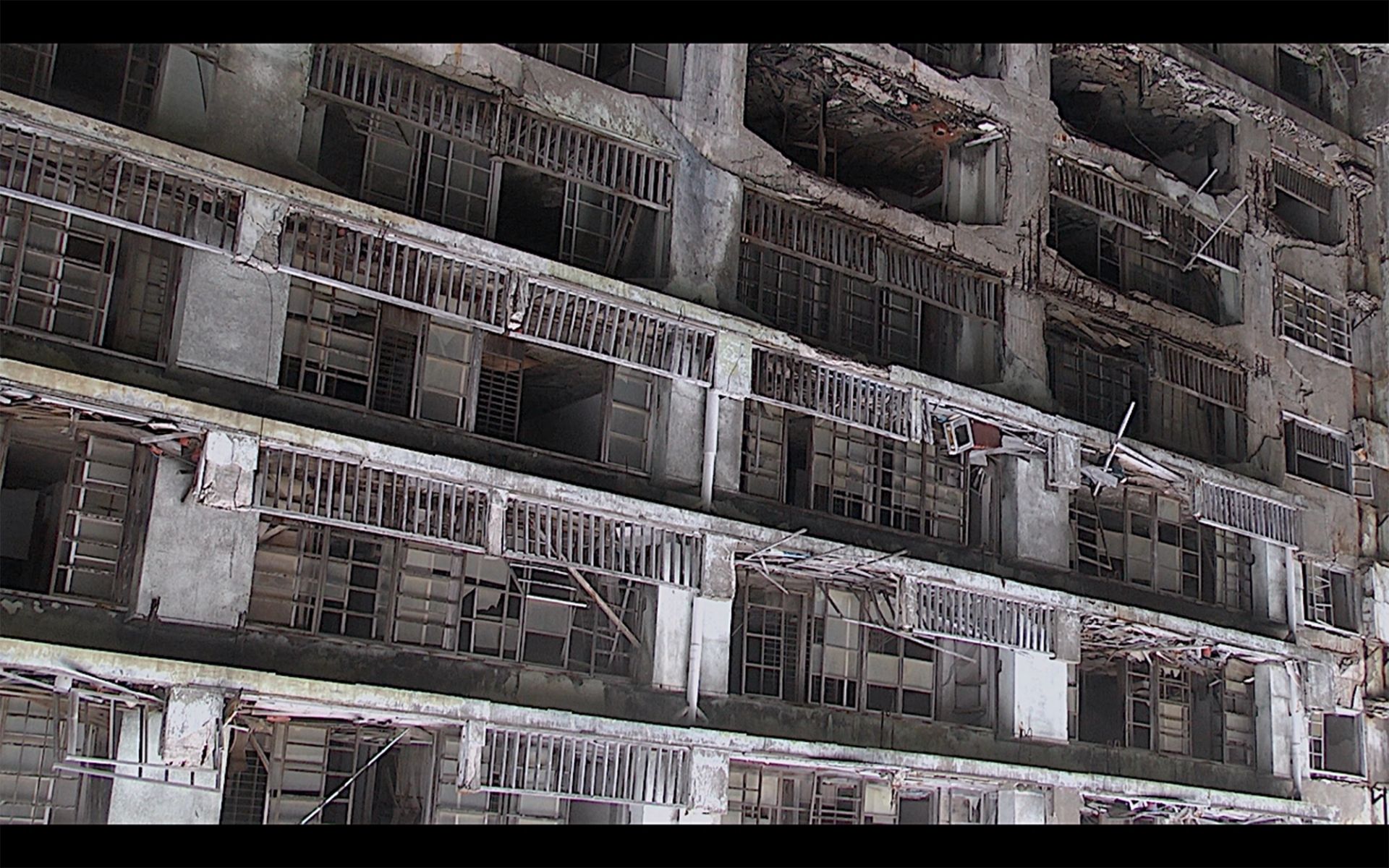
Return to Gunkanjima 1, courtesy the authors.
Although we were diligent and produced the prerequisite outcomes – the sadistic control structures of the art world and practice-research demand nothing less – we never spoke to each other again after departing the island. A severance had taken place; the island, with its broken building and futures had undone us, disclosed the presence of some bizarre, unspeakable catastrophe. From my short and sporadic communications with my erstwhile colleagues, I knew that they, too, felt the same. Something had been set in motion, some ghost disturbed, a constant irritation in the skull, a suppurating wound. The only one who shared my need to speak of our sensations on Hashima was the sculptor Lee Hassall – he, who, perhaps more than any other, had been willing to merge his destiny with the destiny of the island, to the point that, at times, he assumed the shape of a monster, an architect whose destiny was to live dilapidated.
In the texts and images that follow, Hassall and I share some of the writings that we made on the trip, fragments jotted down in haste, in an attempt to come to terms with the seething mass of architectural matter and memory that confronted us and now lives on in our cells. We attribute no specific captions to the writings or images in this chaotic archive, and neither do we purport to present them in any teleological manner. Narrative with a direction or shape is, quite simply, out of the question, superannuated – just another episode in a litany of betrayals. Rather, our aim is to remain faithful to the architecture of desolation that we encountered in its sidewinding. In this crumbled heap, which resembles the formlessness of the island itself, the scraps we present the reader with are as heterogeneous as the matter that inspired them: reflections on representation (especially images), thoughts, musings on film history, perceptions and dream scenarios that have lingered on. Neither Lee nor I can tell what is borrowed or stolen and truth to be told neither do we care. We don’t even know who dreamt what. In this text, the ‘I’ is a joke. We have kept our proper names only out of habit and boredom. The goal was always to die to the image, to ‘out’ its semblance, to shipwreck the ruin. The writing in italics is cited from our notebooks – it plays on and distorts the dreams of others, especially those of the ‘ruin painter’, Joseph Gandy.
"Our aim is to remain faithful to the architecture of desolation that we encountered in its sidewinding."
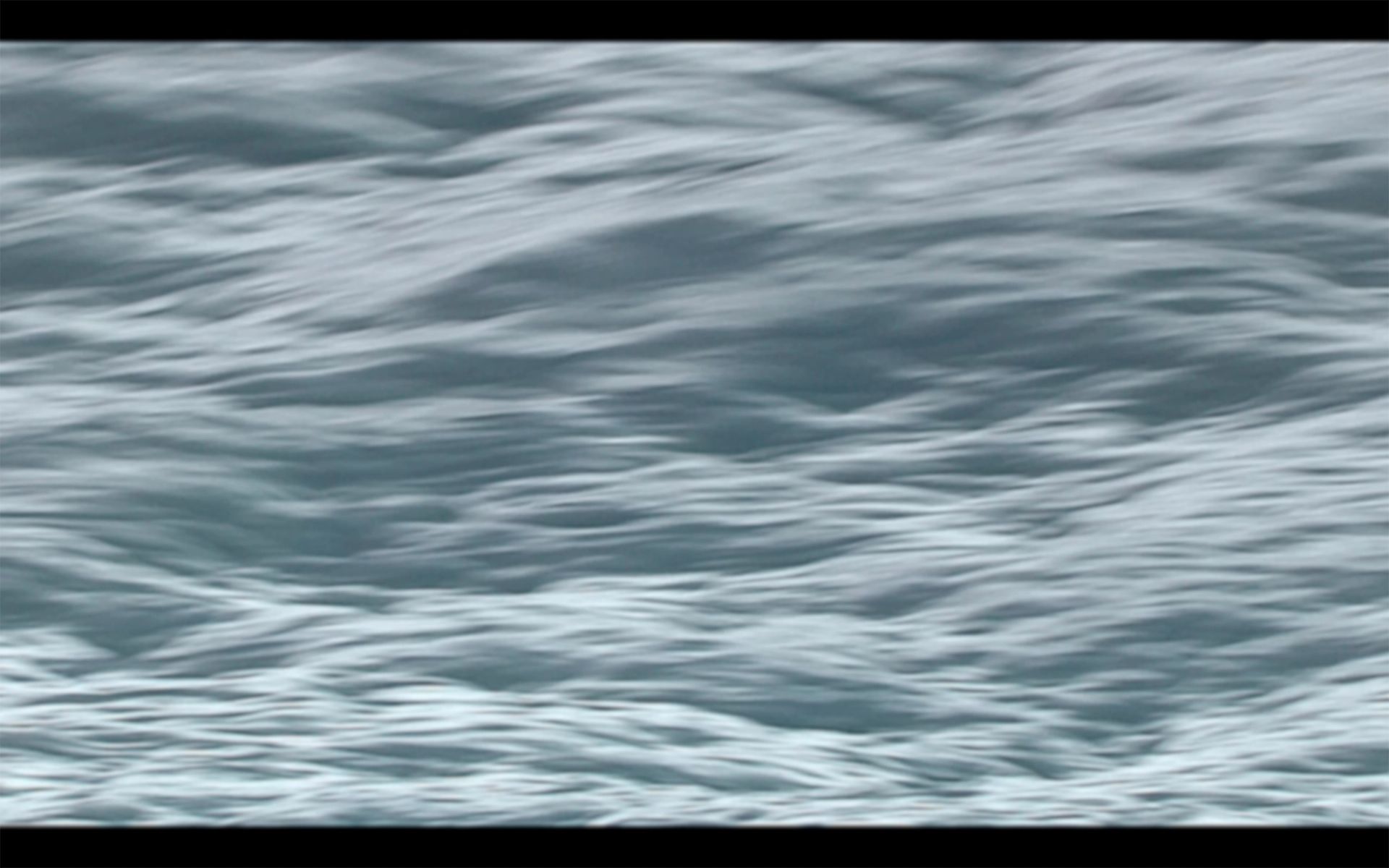
Return to Gunkanjima 1, courtesy the authors.
"The question about the island – the only real one of interest – is a question about representation. How to represent ruins in an age of the internet and photographic archives?"
The question about the island – the only real one of interest – is a question about representation. How to represent ruins in an age of the internet and photographic archives? And more pertinently, how to allow ruins to have a future when images, perhaps like the archive itself, tend to negate extant tropes and so repeat the past in the present without any trace of difference? All difference is dependent on traces; all invention a recycling, a tarrying with a tremulous past. Like a building that trembles. Only theatre that eats itself can save us now.
An intense period of occupation began on the island in 1890 when the Mitsubishi Company bought the 15-acre site for undersea coal mining. The tunnels and chambers carved out of the rock were matched by the erection of (then) Japan’s largest concrete building in 1916, followed by a school, hospital, shops, restaurants, a swimming pool, and shrine, all within an encircling sea wall. This megastructural or monadic environment became a site of forced labour using Japan’s colonial subjects between 1939 and 1945 (these were mainly Korean). In 1959, the island reached a peak population of over 5,000. Mitsubishi closed its mines in 1974 and the site quickly became a ruin. In 2009 the island was made accessible to the public as a tourist destination, and there are plans to transform it into a UNESCO heritage site. The strange, uncanny feel to the island has appealed to photographers, filmmakers, and artists. It features in Ben Rivers’s Slow Action (2011) as well as in the James Bond movie Skyfall (2012). In these works, however, the aestheticisation of ruins has meant, paradoxically, that the terrible history of Hashima, its exploitation of human labour and the earth’s natural resources, has been rendered invisible. The more we look at Hashima, the less we see.
According to Franz Kafka in his posthumously published first novel Amerika, a text in which he turns away from the castles, labyrinths, and dilapidated dwellings of Old Europe towards a New World of talking pictures and theatrical images, photography is not an art of remembrance, but an art of forgetting, a prosthesis that forecloses the always contingent, always impossible work of memory. In making this counter-intuitive, perhaps even scandalous claim, Kafka is suggesting that the drive to record, to make an impression of sorts, acts as a kind of existential or psychic catharsis, a way of setting something down, of ridding oneself of an experience that is too intense, too problematic, too overwhelming to countenance. We are a long way, here, from Roland Barthes’s Bergsonian reading of photography in La chambre claire. In that text, Barthes defines photography as a type of madness, a mode of looking that disorientates our standard punctual, or theological way of dividing time into neat packages of past, present, and future. For whereas Barthes posits photography as uncanny and durational, an attempt to resuscitate the dead mother who haunts almost every page of his book, Kafka sees it as essentially fetishistic, a masquerade that veils and soothes, a type of balm, something hypocritical, to use a decidedly theatrical word.1
The island buzzes with the sound of cicadas.The wind drones through a corroded angle bracket.The screech of a lonely red kite riding a wind pocket.The noise of concrete crumbling.
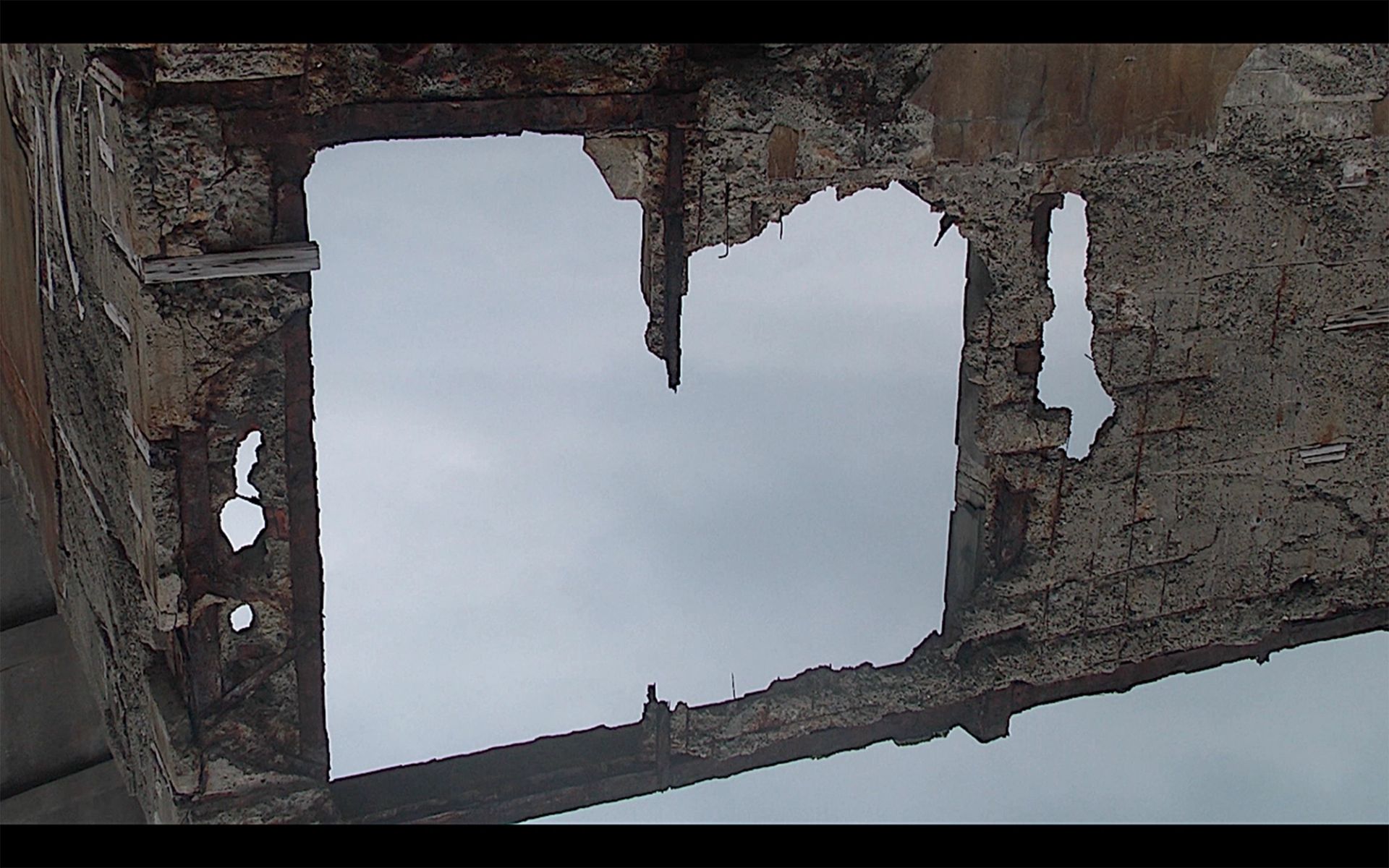
Return to Gunkanjima 1, courtesy the authors.
As I see it, the more we’ve expanded our consciousness as a subject over and against objects, and the more we think we comprehend things in relation to ourselves and one another, we seem to believe that we can manipulate objects/ruins for our own ends. We delude and isolate ourselves in our own subjective domes. We become detached, aloof observers, cut off and isolated from the world in a kind of impermeable bourgeois interior, which encloses the only subjective truth that we can conceive of and experience.
A modernist consciousness, then, forms a solipsistic bubble of awareness. A self-imprisoned self-image trapped in its own awareness, it remains out of touch and out of reach. This kind of consciousness is the opposite of what it might mean to think in and with ruins. It is the death of death – the death of the sublime.
When the ruin becomes art object it dies, because as objects these things are ultimately unthinkable. Trying to maintain the ruin as object is exhausting. Ceasing to grasp at the ruin, releasing our grip on it makes it possible to rupture the bubble, and to move towards ‘the other’ in an encounter of ‘openness’ and dare I say it even communion (or intimacy if you prefer).
I know what you’re thinking. I am well aware that the problem is that for the Cartesian consciousness the ‘other’ is also object. But there is another metaphysical consciousness available to artists. It starts not from thinking and being ‘self-aware’ but from doing, from looking to create a kind of movement towards movement, a ruining of the ruin, the pulse of an architecture before architecture. Some would see it as a neutral moment of desire, a sort of force, I guess.
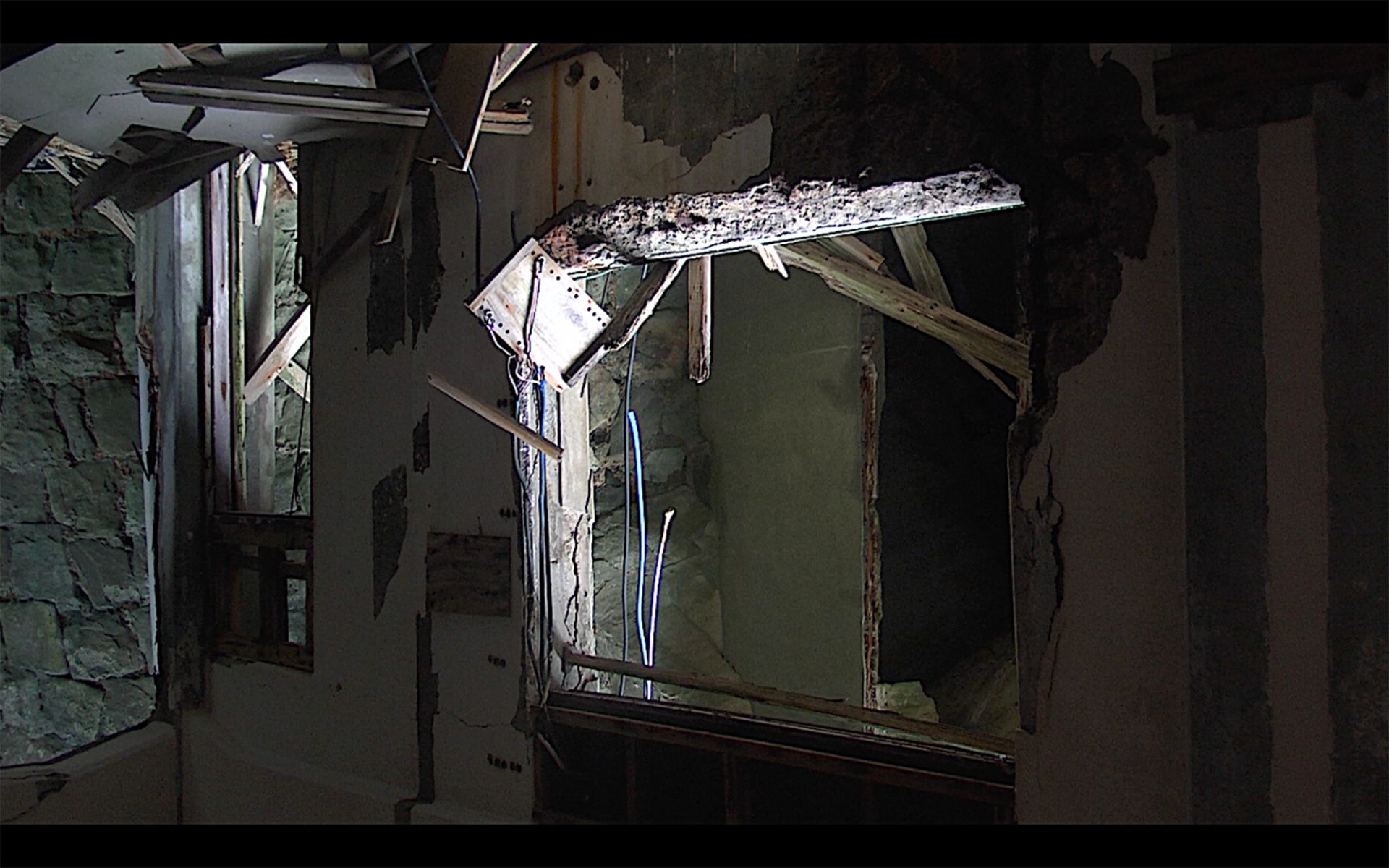
Return to Gunkanjima 1, courtesy the authors.
On Hashima, we encountered the traces of a series of traumas, from the salt rain of the sea to the blast of an atomic bomb, and a landscape of ‘ruin porn’ that has become viral. To enter Hashima is to find a past made future, and to lose oneself in the toxic effluent of plastic rivulets, broken silicon, and petrified steel wire. Hashima is a synthetic Saturn, a dark star of waste. To actualise the monstrous touch of Hashima – its toxicity – the good sense of language, with its dream of measured communication, breaks down, only able to signify in failed fragments.
"On Hashima, we encountered the traces of a series of traumas, from the salt rain of the sea to the blast of an atomic bomb, and a landscape of ‘ruin porn’ that has become viral."
While ruin porn purports to draw attention to ruins, it does so in such a way that the ruin is not seen. Something in the gaze, we might say, drops out of sight. What is absent or made invisible has habitually been equated with (a) people – notably workers; (b) economics; and (c) history. What ruin porn does, in other words, is to efface politics for the sake of aesthetics, to reduce a contested past to a simplistic present. It is simply an exercise in ideology, a way of maintaining hegemony. Paradoxically it shows us a building whose architecture has been subjected to the ravages of time only to present us with an image of eternity, the sense in which, ironically, the ruin appears not only to have always been like that, but as something that will be like that forever. Since the role of ideology, as Roland Barthes explains it in Mythologies, is to transform a state of history into a state of nature, then ruin porn, in as much as it eviscerates history from the ruin, is decidedly ideological. How delightfully comforting it must be to see factories in a state of dilapidation, finally emancipated from those troubling workers who might once have levelled them, wagering on a different kind of use value, infusing the world with time, murdering it, opening it up to a fresh horizon. The heads of the factory owners rolling now and geysering blood, unyoked from the massive bulk of the capitalist body-politic-machine.
The Mitsubishi Company played a paternalistic role on Hashima. To work for the company meant that all everyday amenities – gas, water, electricity, housing – were paid for. There was little else to think about or do, but work. This had its benefits, of course. It gave the residents of Hashima a large disposable income which they could spend on the latest commodities. In the 1950s and 1960s the miners of Hashima and their families had the highest spend per capita in Japan on electronic goods – washing machines, hairdryers, colour televisions. High fashion was also prevalent on Hashima. In the extensive photographic archive that exists of daily life on the island, there is an extraordinary image of two women walking the narrow corridors between the high-rise building looking as if they have stepped out of a French Nouvelle Vague movie of the 1950s and 1960s.
In Antonioni’s 1964 film Red Desert, set in the polluted port of Ravenna, Italy, the psychically disturbed principal character Giuliana wanders lost and alienated through a landscape of factories, poisonous yellow gas, and petroleum-soaked riverbeds. In its focus on Giuliana’s derangement, the film captures the painful coming-into-being of European post-war modernity, a period that saw a marked acceleration in the spillage of chemicals into the atmosphere, as capitalism moved from a coal-based economy towards a petrochemical one. Unlike Georg Büchner’s hero Lenz – the one whom Deleuze and Guattari cite in Anti-Oedipus – Giuliana is unable to make herself into a desiring machine. She is too fragile for that. Too sensitive, swept up in capitalism’s black hole, a victim of an allegorical ‘red desert’, a world where all living in common, all socialism, has been rendered impossible. When she fails to board the plague ship, she makes a despairing utterance. ‘We are all separate’, she says. Her becoming is stifled and disturbed. But this does not mean that Giuliana is totally disconnected. The very reverse in fact. The piercing sound that assails her, and accompanies her every move, driving her mad, is the sound of a tortured Body-Without-Organs that is reacting to and picking up on the toxic frequencies of the landscape and the plague theatre of her son Valerio who bizarrely and maliciously pretends to be ruined, paralysed from the waist down. It is important that we do not see Giuliana as a victim on account of her gender. On the contrary, Giuliana is in the vanguard: her discomfort an attempt at registering the chemical pollution of the world; her falling apart both symptom and act, a programme for experimenting with new forms of being in and within. This is cruelty. This is Hashima. To think that I travelled a million miles to make that connection, when I could simply have read Guiliana’s illness through Antonin Artaud’s essay “Theatre and the Plague”, a text that links ports and theatre with ruined bodies and buildings.
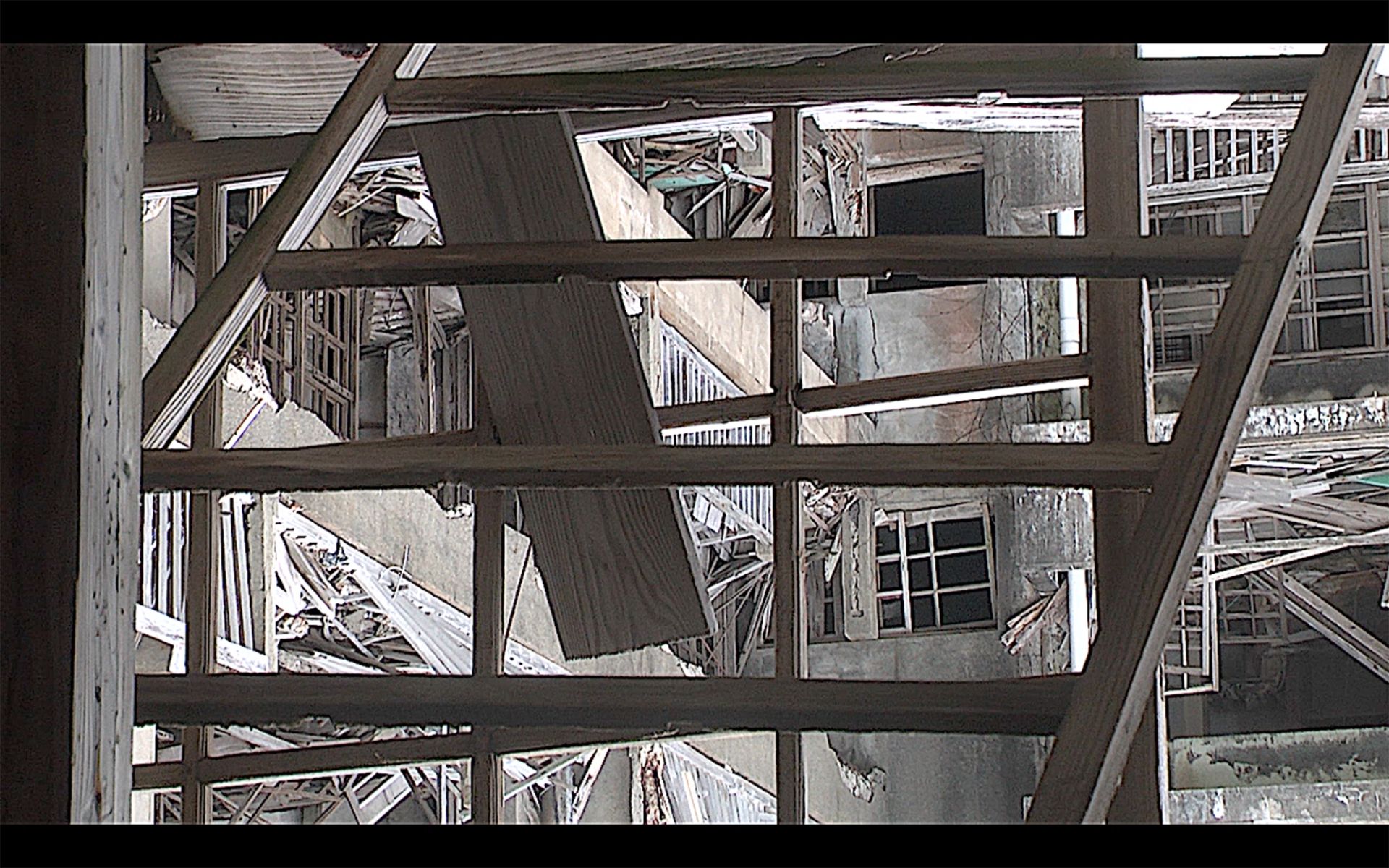
Return to Gunkanjima 1, courtesy the authors.
In the wake of the evacuation of the island, some of the former residents of Hashima had difficulty readapting to ‘civilian life’. There are stories of suicide, of people being unable to cope, terrified by autonomy. Better to die than to exist as an orphan, to lose the all-consuming parent – the company – who deserted the home, along with the battleship island that floats and rots on the sea.
Towards the start of Todd Haynes’s 1995 movie Safe, which depicts the debilitating effects of an unknown and unlocatable allergy on the psyche and soma of a middle-class US housewife in the San Fernando Valley (played by Julianne Moore), the camera pans away from the human drama, centred, as it always is, on the actor’s face, and instead focuses its attention on the urban landscape. And what it finds there in that act of anthropocentric displacement is a world full of haze, a polluted California shimmering in the early morning mist generated by carbon monoxide and lead particles emitted from the limitless circulation of cars on the San Fernando freeway as well as the presence of low-lying aircraft burning up and dispensing aviation fuel.
Although the film, set in the mid-1980s, was seen, at the time, as an allegory for AIDS, the allergy that so troubles the central character that she has to decamp from California to the New Mexico desert, is now read as a consequence of pollution, a toxic transmission that causes bodies and mind to reel, a pathogen that ‘deranges’. Significantly, the San Fernando Valley is home to three types of industry, all of which transmit and emit pathogens: cars, planes, and movies. When I think of Hashima, I think of the San Fernando Valley, and also Las Vegas – sites of black magic, artificial paradises, neon sludge. Each in its own way a type of malfeasance.
"When I think of Hashima, I think of the San Fernando Valley, and also Las Vegas – sites of black magic, artificial paradises, neon sludge. Each in its own way a type of malfeasance."
In some essays that deal with walking, there is a sense of limitlessness – perhaps even freedom. The reader has the impression of being in a landscape as it unfolds in footfalls, like embarking on a pilgrimage. On Hashima Island, by contrast, space is limited, confined, full of narrow corridors, ribboned into each other. In that dépaysement, one could be forgiven for thinking that you were in a medieval city in Europe, concrete tower blocks rising like the spires of Le Mont-Saint-Michel from the flood plains and salt marshes of La Manche.
To walk in Hashima is not an exercise in liberation; it is a practice of confinement, like doing time in a cell. The surface area is so cramped. I was once told the story – or was it a myth? – of a Korean prisoner, Ji-Young, who was interred on the island between 1939 and 1945, and forced to dig for coal 20,000 feet underground. In an attempt to keep sane in that hell of bauxite and flame, Park made the decision that he would walk the distance from Nagasaki back to his hometown of Seoul. Every day he beat out the same repetitive path like a caged polar bear in some mad horizontal wager. It took him six years to cover the distance. In the Hashima archives held in Nagasaki Prefecture, it is said that he had children on the island, the sons and daughters of Japanese miners, who would follow him as if he were the Pied Piper of Hamlin looking for some gap in the rock.
As befits anyone who has visited a lost island, I had strange dreams on Hashima. One in particular stands out. It is 1794 or maybe 2074, I can’t tell, and neither do I care. In the dream, I am a young prodigy sailing to Italy, a prodigy who just come top of the class at the Royal Academy. A painter of landscapes, a lover of ruins. On board, I live the strict routine of the lonely traveller, dividing my day between study in my cabin and exercise on deck with a skipping rope. Two days after Land’s End, somewhere near Iberia, a storm blows up. Violently sick, I eat nothing but a raw egg and red wine. For supper, I have plum pudding and more wine. In bed I read Hamlet. The coast of Europe recedes.
I am standing on a staircase in Hashima, watching a man sweet talk a girl named Ophelia at a window. I am in love with the girl. She looks at the waves; she tastes the spume. Suddenly, a stranger appears and takes my arm. The man whispers that he is my friend. The man takes me to palaces, pays for dinners, and gives me presents. You are the Devil, I exclaim. I am seized by the man, and wake up sweating on Hashima Island, the canopy of the milky way so close I can almost touch it. I am imprisoned in a low dungeon on the island, a dungeon below the zoo and under the brothel. I can’t tell the difference between man and beast. All is grunt and groan. I am horrified. I escape from the low dungeon by climbing a mile towards the light while the Devil, continues to drink with the soldiers, lawyers, pimps, and miners in the adjacent rooms, their faces aglow, ruddy with booze. Outside there is a mountain of empty wine bottles. I make a sudden run up the slope, but the clatter of bottles alerts the Devil who sneers. ‘I find you are like the rest of the world: ungrateful’.
I die in the dream, the images burn out.
Postscript: Islands
Looking back at all of this writing now ten years after the event, the entire venture – the desire to die to the image, the embrace of exhaustion, the temporal slippages – allows me to see that our research trip to Hashima was nothing. A re-creation, a deep fake, a mere riff on the island poetics of Gilles Deleuze. Nothing new under the sun, only a recursive move to some lost origin, a retrieval of feelings and thoughts that were never really there in the first place. The references to so many conventional names, books, and films are the giveaway. We missed all our appointments, the real ones.
No island can ever be defended. The enemy is invariably within and is so from the very start. The sea will erupt, the land surge through. Every island is a performance set waiting to be struck, a play demanding repetition elsewhere, a failure of totality, an absconding.
We were deserters on Hashima and we knew that. Nothing better than a couple of sad clowns, leathery song and dance men, performing their act in buildings as ephemeral as vaudeville tents – the ones you pitch up, canvas architectures that sag as sad as shrouds. The last thing we were – or wanted to be – were realists. We had no interest in representing the truth, for we knew, like Plato, that realists in the theatre only ever copy the image and fix that as essence.
"No island can ever be defended. The enemy is invariably within and is so from the very start. The sea will erupt, the land surge through."
BOOK
Through a collection of writings from architecture and beyond, ‘Instituting Worlds: Architecture and Islands’ (Routledge, 2025) edited by Catharina Gabrielsson and Marko Jobst, show the pertinence of islands for critical spatial thinking and practice today. Islands have long appealed to the architectural imagination, serving as sites for architectural expressions of cultural specificity, conquest and hybridisation over millennia. Covering war and colonialism, detention and tourism, the topics raised in this book range from issues of urban development to close readings of buildings – whether ruined, designed, projected, preserved or absent.
BIO
Lee Hassall is an artist, and is primarily interested in the relationship between landscape, perception, and movement. He has explored these interests as an AHRC-funded PhD student at the University of Glasgow, in the Department of Theatre and Performance. His project is a practice-based exploration of Dorothy Wordsworth’s 1803 tour of Scotland and the resulting journal, Recollections of a Tour Made in Scotland, AD 1803. His research is allowing him to develop his interests, opening them out to incorporate autobiographical events and encounters with atmospheres.
Carl Lavery is Professor of Theatre and Performance at the University of Glasgow. He has published numerous essays and books on theatre, performance, and ecology, including Rethinking the Theatre of the Absurd: Ecology, Environment and the Greening of the Modern Stage (2015), Performance and Ecology: What Can Theatre Do (2017) and An Idea of a Theatre Ecology (2024). He is currently working on two new books, Getting a Taste for Landscape Through Performance: Politics and Ecology and Constellations of the Anthropocene.
NOTES
1. The Greek word for actor is hupokritēs, the one who wears a mask.