KOOZ/ Shumi Bose As a theme, "Urban Age" carries the genealogy of the Endless City moment, of summits and the much-cited statistic that more than half of humanity now lives in cities — a largely quantitative mode of narrating urbanisation. What does the moving image recover about the urban age that the data, the diagram and the conference register tend to flatten?
Paulo Moreira ‘Urban Age’ is indeed a condition that defines how we inhabit the planet today. In bringing this theme forward, what interests us is to explore the multiplicity of lived realities it entails, understanding different forms of urbanity across diverse latitudes, cultures, socio-economic contexts, and perspectives, and how these shape architecture and the built environment.
Film is a particularly powerful medium in this regard, because it resists abstraction. It can portray concrete, situated stories, allowing us to depict how urban conditions are experienced differently. While data can tell us that urbanisation is happening, film reveals how it unfolds, for whom, and with what consequences. It captures contradictions, tensions, and everyday conditions that often remain overlooked or silent in other modes of knowledge production.
"While data can tell us that urbanisation is happening, film reveals how it unfolds, for whom, and with what consequences."
In this sense, the festival creates a space where multiple urban narratives can coexist, while also transporting us spatially and sensorially to places that quantitative accounts cannot reach. Equally important is that the film programme is presented alongside debates, installations, workshops, walks, and encounters in the city, which together allow us to engage with urban conditions not only as something measured, but as something collectively reimagined.
KOOZ How does the programme you've curated inflect "Urban Age" away from its more familiar data-and-summit reading and toward atmospheres, infrastructures, human and more-than-human relations?
Hubert Klumpner Data is obviously interesting, and we need to look at both quantitative and qualitative ideas and information at the same time to make them relevant. In this small cosmological view of the world, we also see information as a basis and fundamental necessity to take decisions. So it's not about data; it's about informed decision making — and this festival will enter and bring us into the world of the imaginary. The imaginary is not only an image, as we know it from photography or film; it is also the imagination. Because cities today are not built anymore out of concrete and steel, but their base material is the imaginary itself.
Klearjos Eduardo Papanicolaou It’s now been almost two decades since the so-called tipping point identified by the United Nations Population Fund in 2008, which reported that more than 50% of the world’s population was living in cities. What has happened since then? A great deal has been said and done in terms of reorienting priorities, and this has manifested in concrete ways through policy, infrastructure, and of course architecture. Yet relatively little has shifted in terms of how the dominance of this urban condition is understood. This is, in part, a question of perception on a societal scale. Where does our food come from? Where does our water come from? Our electricity? How do goods move around the planet? These are quintessentially urban questions, most of which unfold outside urban areas.
So our guest programme, ‘More than Cinema’, which plays on other ‘more-than’ forms of engagement — like the more familiar ‘more-than-human’ — is about thinking through how cinema works as a medium for perceiving the latent elements of this shift into the urban age. What are the specificities of cinema, not simply for understanding in terms of numbers, but also for sensing the relationship that people have to territories, to materials, and to other forms of life? In what way does cinema articulate these facets of experience on this urbanising planet?
"What are the specificities of cinema, not simply for understanding in terms of numbers, but also for sensing the relationship that people have to territories, to materials, and to other forms of life?"
These are the questions that revolve around the installation that we’re setting up at INSTITUTO in Porto, which features the work of our collaborators and interlocutors — sound artist Ludwig Berger, filmmaker Marios Kleftakis, photographer and illustrator Claudia Sinatra, and research architect Michael Walczak — as well as the film screenings and book launch that form part of the guest programme. In this sense, the installation acts as a kind of conceptual and sensorial frame, while the films and the book each take up these questions in distinct ways.
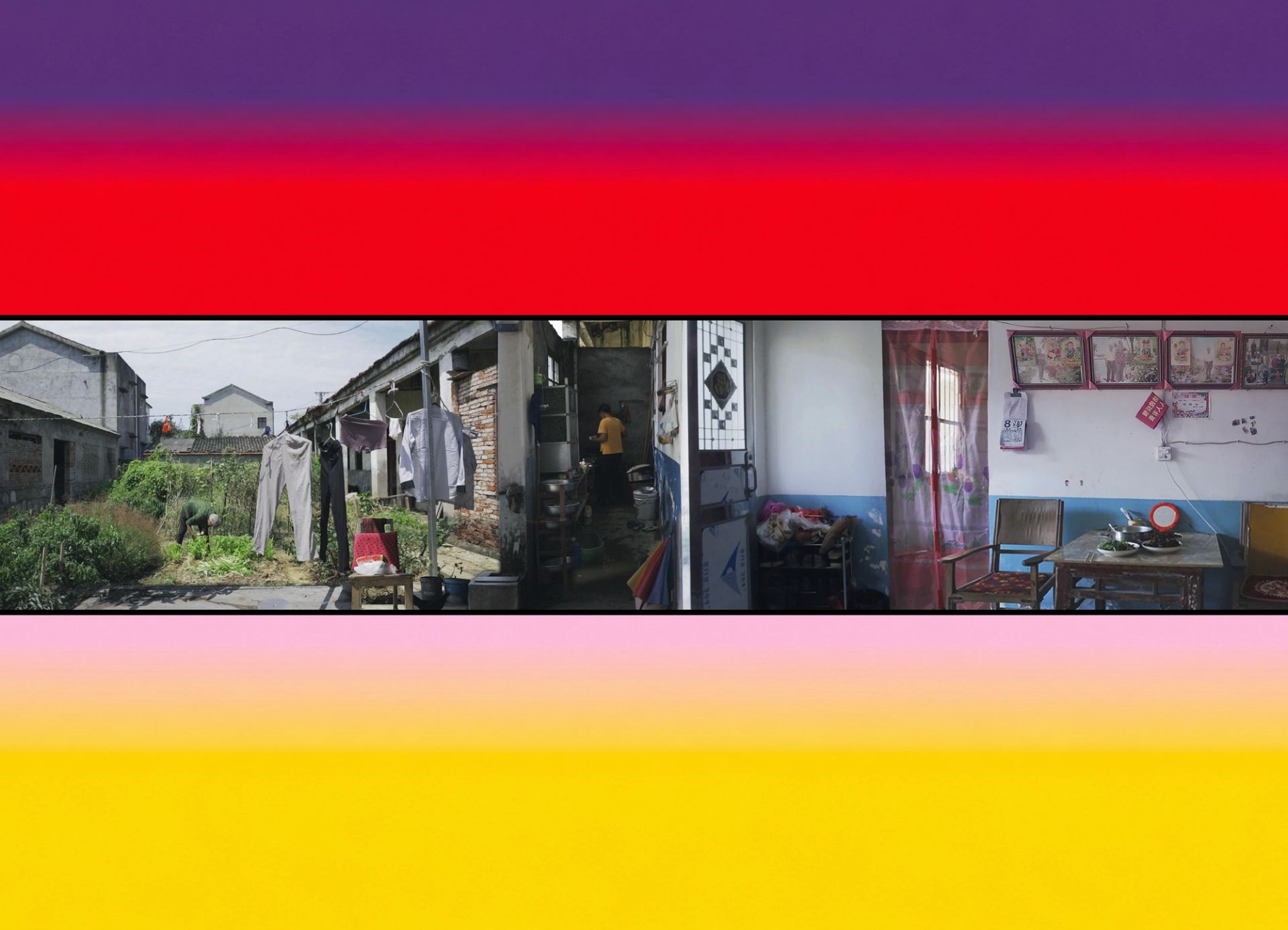
The film ‘Not Just Roads’, which I co-directed with Nitin Bathla,ponders these questions in relation to the massive construction of road infrastructure in India, focusing its attention on the forms of life that exist in the literal path of the construction machines that build these roads. The film asks what infrastructure looks like when seen not only as a developmental necessity, but in terms of the relations, displacements, and interruptions it produces across human and more-than-human worlds.
The film ‘Hot Cold Wet Dry’, which I co-directed with Marios Kleftakis (trailer) and which paints a portrait of Singapore, asks whether the urbanisation of such cities enables or mitigates forms of extinction through species loss and resource depletion. What is important here is the way in which this question is posed. The film focuses on atmosphere, rhythm, details and fragments of everyday life to ask these questions.
Finally, our book, Manual for Designing Urban Imaginaries Colombia (Architangle, 2026), looks beyond critique and toward what we can do — not only as architects, urbanists, and filmmakers, but as citizens — to contribute to urban environments that are not only sustainable in a planetary sense, but also reflect a maturing relationship to this so-called urban age: a relationship based on agency, equity, and an awareness of the forms of life that exist within and around our communities.
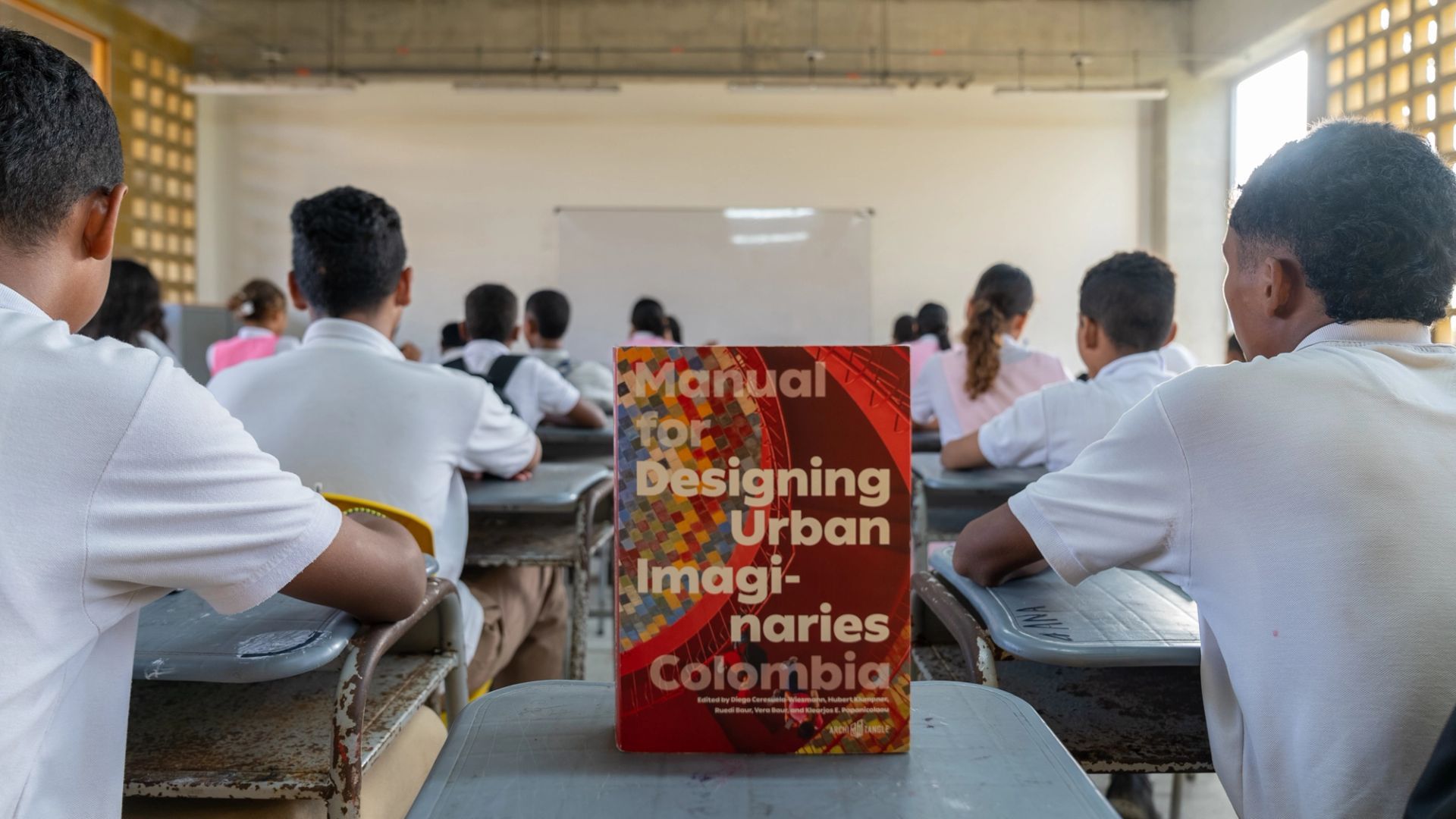
Manual for Designing Urban Imaginaries Colombia (Architangle, 2026), on tour. Image courtesy ETHZ Chair of Architecture and Urban Design
KOOZ Professor Klumpner, you've described a turn to socio-environmental design that broke through, in part, via the exhibition — Small Scale, Big Change at MoMA being just one reference point. The ‘More-Than Cinema’ installation and the launch of Manual for Designing Urban Imaginaries, surface at a film festival rather than in a gallery or on site. What specific appeal does the format of a festival hold in terms of disciplinary discourse?
HK Festivals around the world are becoming the new urban model, with small towns and rural areas entering in the spotlight due to the organization of festivals, biennials and triennials. Even in big cities, festivals leave their stamp. So bringing architecture and architectural filmmaking to Porto is a logical consequence in underpinning this theoretical assumption, participating ourselves in inviting new audiences and engaging with parallel fields of art, namely filmmaking and architecture. There are many, many inter-relations between these two, as the history of this film festival already has shown. So I see this as an almost organic next step of the social, the environmental, but also the cultural importance of festivals.
KOOZ The AFF Official Programme this year is composed of 24 films from 22 countries, entirely gathered through an open international call. How do you balance this openness with a coherent argument about the urban age — and how is a curatorial thesis constructed?
PMThe curatorial thesis is not located in a single moment; it is indeed distributed across selection, sequencing, and discussion. This year, we received 166 submissions through an open call, reviewed by a selection committee composed of Joana Pestana Lages, an architect and researcher working across social sciences and critical spatial practices; Andrea Pavoni, a geographer interested in normativity and aesthetics in urban contexts; Sofia Borges, a filmmaker and visual artist working closely with local communities; and Mira Samonig, an urban researcher engaged with questions of contestation in public space. There is a critical stance within the group, but also a plurality that was important to us, as it reflects the idea that the city is too complex to be understood from a single viewpoint.
In an open and collective process like this, the curatorial argument is not fixed in advance, but gradually constructed through multiple layers. It begins with the composition of the selection committee itself and the process it sets in motion. It continues through the way selected films are grouped into sessions: we worked with a series of clusters that allow films to enter into dialogue with one another – around sub-themes such as everyday life, social organisation, frontiers, expulsion, ecologies, infrastructure, forms of disappearance and lingering, and future imaginaries.
Sequencing, however, is not the only moment where meaning is produced. During the Q&As that follow the screenings, when directors are present, we invite local architects and practitioners as moderators who are themselves closely engaged with the themes of each session. This creates a space where exchanges can deepen and elaborate what has been seen on screen. We also bring the filmmakers attending the festival together in a roundtable, creating further opportunities for dialogue.
In this sense, the Official Programme develops through a process of facilitating connections, rather than defining a single curatorial narrative. This openness allows for the inclusion of films that might otherwise remain outside established circuits, and I’m glad to see that Arquiteturas continues to balance industry productions with independent works, often by emerging directors, including architects who engage with film as part of specific projects or research.
I admit that a curatorial gesture does come into play during the opening session, which sets the tone for the festival. This year, I was interested in grounding the programme by pairing a film rooted in the local context with an international one. Ilha Zaira (2023) by Clara Sprung and Luís Bouça, reflects on the unique typology of the “ilhas” in Porto through the voices of its residents. It is paired with Ellas en la ciudad (Women in the City, 2025) by Reyes Gallegos Rodríguez, which portrays a group of elderly women in three neighbourhoods in Seville, tracing a history of female-led urban struggles through questions of care, social reproduction, and urban planning.
"In an open and collective process like this, the curatorial argument is not fixed in advance, but gradually constructed through multiple layers."
KOOZ Klearjos: this year you're also on the jury, reviewing the full shortlist alongside the larger jury panel. This is a particular kind of immersion — and judging is a different relationship to the medium than making. What did that process reveal about where the field currently locates ‘the city’?
KEP It was a fantastic experience to be in the jury with Luís Tavares Pereira, Rute Nieto Ferreira, João Queirós, and Gustavo Imigrante - together, we brought broad points of view to the table, coming from different forms of practice. It was also humbling to be both a filmmaker exhibiting films at this year’s festival, and a member of the jury — immersed, indeed, in the practice of others. When you’re making a film, it’s very easy to slip into a sort of tunnel of your own practice – in some ways it is necessary – and then it becomes surprising to see how others deal with similar issues in terms of storytelling style and register. Especially working in this incredibly complex field of urbanism, there are infinite ways through which to articulate meaning using sound and image.
One of the things that struck me in the shortlist was an appreciation of the materiality of filmmaking, specifically, the number of films shot on celluloid. There is something very special about using celluloid to tell stories about places and the living things inside of them, a unique coming together of form and content. It is of course more expensive and cumbersome; it requires more dedication than buying an SD card and charging a battery, but this dedication pays dividends in a festival like this.
At the same time, there were a number of films that dispensed with cameras altogether in terms of production, instead exploring our ubiquitously mediated communications environment to tell stories in between spatial, technical, and surveillance registers — stories told through CCTV footage or crowdsourced mapping technology.
What this selection shows or confirms for me, is that as filmmakers, it is a restless moment. We are racing to understand how our tools articulate the shifting realities around us. Most of the time it seems that things are changing faster than we have the chance to even understand them, let alone find ways of translating them audiovisually.
"We are racing to understand how our tools articulate the shifting realities around us."
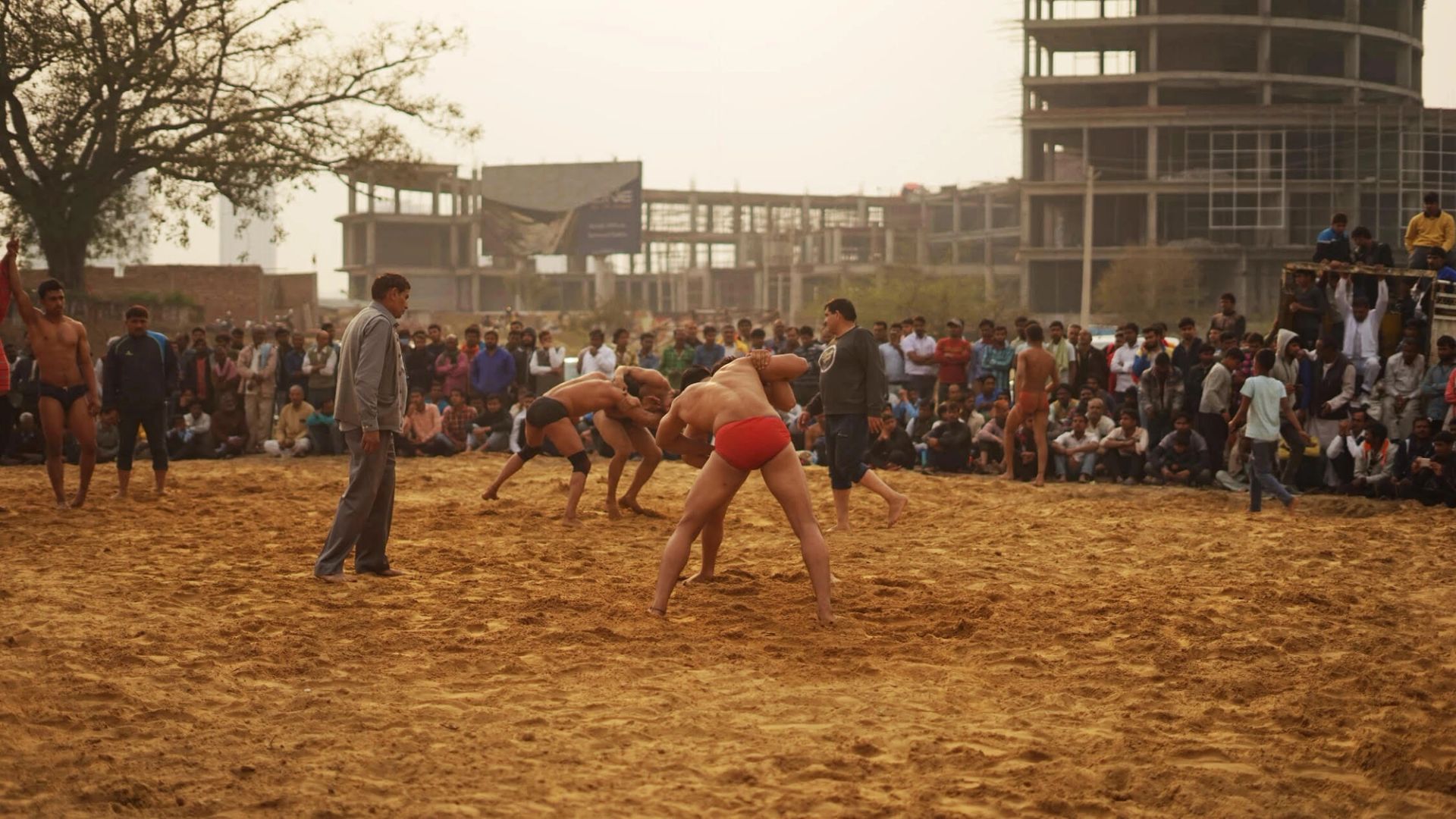
Not Just Roads (Bathla & Papanicalaou, 2021), film still. Image courtesy ETHZ Chair of Architecture and Urban Design
The question of where the ‘city’ is located is a great example, because it seems like the term is becoming narrower and narrower – almost just a political designation – continually being dwarfed by the vast phenomena of urban transformation, which implicate the entire planet through resource extraction, logistics, and ecological change. In that sense, what I found in the shortlist was less a stable image of ‘the city’ than a field grappling with how to represent urbanisation as something dispersed and planetary.
KOOZ The Portugal Special Programme is expanded in this edition. Does this function as a counterweight to the global frame or a set of grounded case studies that test it? What does anchoring the theme in Porto and in Portuguese urban experience allow you to say that the international selection cannot?
PM The Portugal Special functions as a lens through which the themes of Urban Age can be tested and grounded. This year we sought to develop this section in a more integrated and nuanced way, bringing it closer to the overall logic of the festival rather than a separate strand. Five of the seven films in this section were selected through the open call and are part of the competition, reinforcing their connection to a shared set of concerns.
The films span Porto, Lisbon, and Coimbra; they are directed by both local and international filmmakers. Again, this multiplicity of perspectives allows us to look at our own context from different angles, addressing questions of housing, tourism, urban transformation, and the commodification of public space.
These are complemented by two films selected outside the competition, which extend the programme into the city through two critical urban walks directly related to the films: one in the historic centre, around the Sé neighbourhood, in the year marking 30 years since Porto’s UNESCO World Heritage classification; and another in Maia, on the city’s outskirts, opening up a discussion on the broader metropolitan continuum, and creating points of overlap between heritage and development.
Beyond the screenings and urban walks, the programme is further expanded through a photography workshop led by Leon Krige, a South African architect and urban photographer. This introduces another mode of engaging with the city, as a space of direct observation and production. As part of the workshop, participants will capture the urban fabric of the historic centre, as well as visit contemporary architectural landmarks such as Casa da Música, the Faculty of Architecture, and the Serralves Museum. The programme also includes a display of Leon’s photos and two public moments: a debate with the Architecture, Art and Image group from FAUP, and a presentation of the workshop outcomes.
Through this programme, the festival is anchored in the local context of Porto, allowing us to engage directly with specific places and conditions, and turning the city itself into an active protagonist of the festival.
KOOZ What can film do for architectural discourse that the discipline's own instruments — the plan, the render, etc — cannot? What can the sensory or ethnographic film tell about a place that the drawing, the model or the plan cannot hold?
KEP All disciplines turn — sometimes due to technological shifts, sometimes because advancements in certain fields seep into others, especially adjacent ones, and sometimes because of larger-scale social transformations. For architectural discourse, even in just the last couple of years, the number of such turns has been almost dizzying: the socio-spatial turn, the planetary turn, the ecology turn, the species turn. Now we speak of the sensory turn and the ethnographic turn, as well as of the sensory ethnographic turn. The key here is not to spin out in different directions, but to build bridges between these ways of thinking, so that all of these turns move in step rather than apart.
We can spend a long time talking about the ways sensory ethnographic film articulates atmosphere through texture, sound, rhythm, and duration, and about how it can register aspects of lived experience, memory, and relation that no drawing, model, or plan can fully hold on its own. But the less explored question, perhaps, is what happens if we reverse the direction of inquiry. In what ways can these methods also tell us more about drawings, about models, about plans? In what ways can they, rather than simply point to the relative limitations of these traditional tools in describing certain registers of experience, instead equip them with additional capacities?
So can we speak about the sound of a model, the texture of a plan, or the time of a drawing? These might sound like quirky questions, but maybe this is part of the legacy that the sensory and ethnographic turn might leave for architectural discourse: not only expanding what film can tell us about place, but also expanding what architecture’s own representational tools are understood to be capable of sensing and expressing.
PM Film allows for engaging with questions of architecture, without replacing more traditional modes of production and dissemination – which we also display at the festival. At the same time, film brings in dimensions that architectural instruments often struggle to capture, such as atmosphere, time, and social dynamics. It also allows us to connect architecture with its users and reach a wider public, revealing how spaces are inhabited, negotiated, and felt – something we care deeply about.
"Film brings in dimensions that architectural instruments often struggle to capture, such as atmosphere, time, and social dynamics."
HK A film is obviously not the basis for executing the built environment, but there's also the environment of cities and the quality of architecture, as we like to develop it. Films, in that sense, have long since entered thinking about how projects are presented today, not only in static drawings or photorealistic renderings, but in moving images that allow people to navigate through complex buildings, infrastructures, opera houses, schools, public spaces. We are more and more conditioned to see films as the extensions of our own experience, and a very profound testimony of this is ethnographic film making, which has been an academic discipline in itself.
Examples of this can also be seen in the dynamic of feature films. Many of the big productions — not only in film festivals like this one, or in art cinemas — try hard to look like documentaries. Storytelling — which we know from sitting around fires in Neolithic times — has just continued describing the world with the moving image, also absorbing architecture and its representation in new and beautiful ways.
ABOUT
The Arquiteturas Film Festival is a platform for discussing and disseminating architecture through films, installations, debates, and walks, organised by INSTITUTO. It features a programme with three sections: Official, Guest Institution and Portugal Special. The festival takes place in various venues across the city, including Batalha Centro de Cinema, Casa Comum, Casa da Guitarra, Circo de Ideias, and INSTITUTO.
BIOS
Hubert Klumpner is a Professor at ETH Zurich, where he holds the Chair of Architecture and Urban Design, directs the Center for Housing (Wohnforum), and the Network City Landscape (NSL), and serves as the UN-Habitat University Hub for Informal Housing. Klumpner is an architect, and co-founder of the interdisciplinary design practice, U-TT. As Design Principal and CEO of Zurich based Urbanthinktank_next, he is counted among the originators of the turn to socio-environmental design, particularly through the exhibition, 'Small-Scale Big Change — New Architectures of Social Engagement' at the MoMA in New York City in 2010.
Klearjos Eduardo Papanicolaou is a scholar and filmmaker who specialises in urban and sensory ethnographic research methods. His films include The Seven Sisters Indoor Market (2016) and The Disappearance of Robin Hood (2018). He also co-directed Not Just Roads (2021), which won the SAH 2022 Film and Video Award, and co-directed Hot Cold Wet Dry (2026), which premiered at the 28th Thessaloniki Documentary Film Festival. He teaches audiovisual ethnography to architecture students at the ETH Zurich.
Paulo Moreira is an architect and researcher based between Porto and Johannesburg. He graduated from FAUP in 2005 and completed his PhD at London Metropolitan University in 2018. Since 2011, he has led the studio Paulo Moreira Architectures, and in 2018 he founded the cultural centre INSTITUTO in Porto, where he serves as artistic director. He has been director of the Arquiteturas Film Festival since 2021. He edited Critical Neighbourhoods (2022) and Aprender a Desaprender (2024), for which he received the FAD Award for Thought and Criticism in 2025. He is currently a Centennial Fellow at the School of Architecture & Planning, Wits University.