Federica Zambeletti/KOOZ It has been several years since the show Penumbra first opened in the Complesso dell'Ospedaletto. The ‘Trilogy of Uncertainties’ — comprising the exhibition series of Penumbra, Nebula and now Canicula — has almost come to an end. How do you feel about that, and what are you left with now?
Alessandro Rabottini If I try to define — on a very personal level — what I'm left with as a curator, it’s the conviction that things can be done differently if you think in a slightly unorthodox way, starting from the idea to invite the artists to react to a quite loose curatorial framework, which has always been intentionally vague, for each of the 3 exhibitions. When we started, we sometimes felt that we were pushing things a little bit too far, especially if one thinks of the dialogue between the works, the site, the spatial interventions, and the narrative of the exhibition.
I believe that with the Trilogy, we developed an approach that was intentionally emptied of certain assumptions of what an exhibition could or should be today. In the end, I think that the Trilogy proved that if you actually trust the artist to put their works into a context that opens up their meanings rather than narrowing them, things ultimately become more emotional for the viewers, and the show as an experience can be felt at a deeper level.
"It’s the conviction that things can be done differently if you think in a slightly unorthodox way."
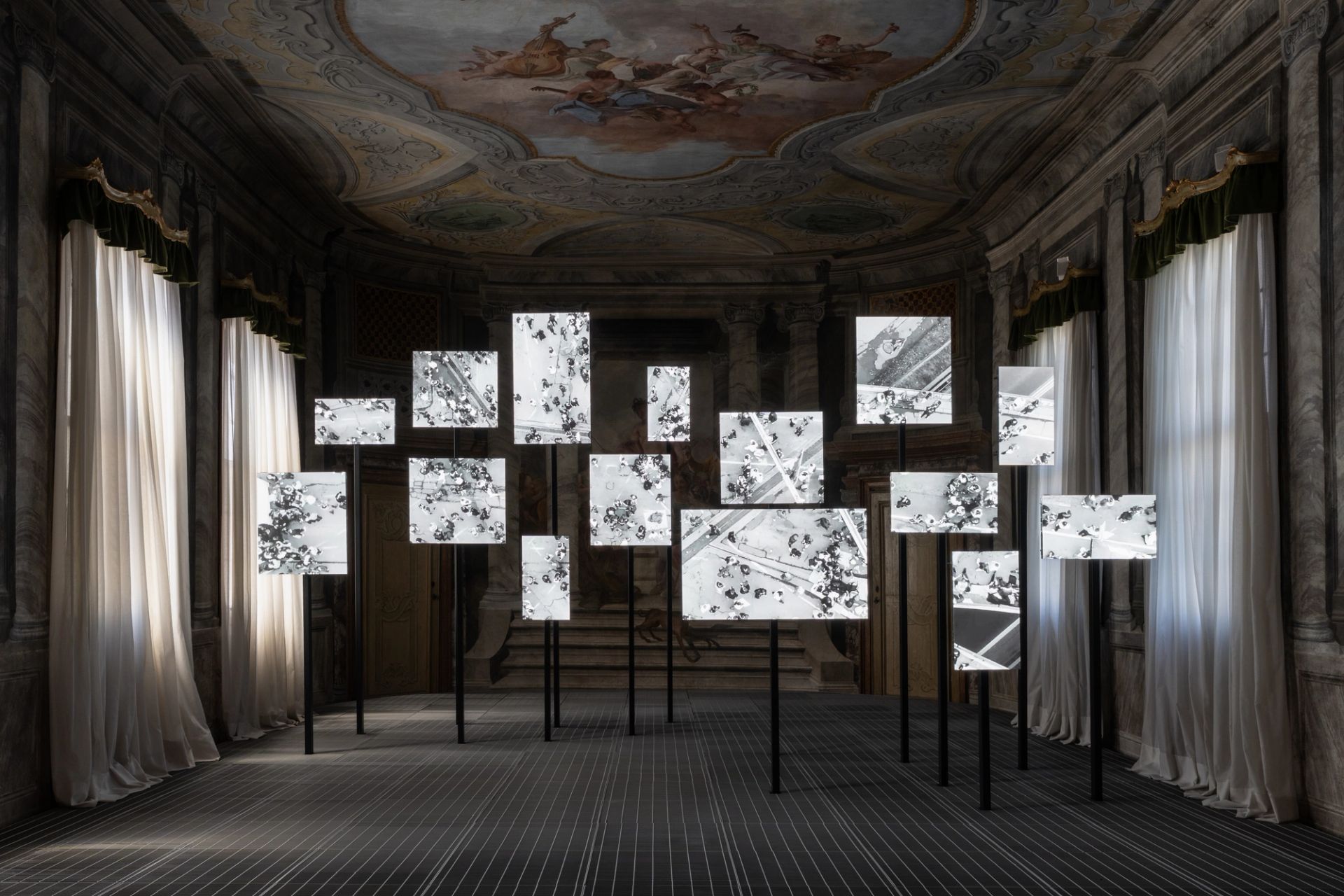
Lawrence Abu Hamdan, The Story of a Fugitive Sound, 2026. Installation view in Canicula, Fondazione In Between Art Film, Complesso dell'Ospedaletto, Venice, 2026. Courtesy of the artist and Fondazione In Between Art Film. Photo © Marco Cappelletti Studio.
KOOZ I would like to hear more about this intentional unorthodoxy; I'm curious to understand where that impetus came from. What does that mean, and what prompted the deliberate differentiation from more orthodox forms of curating?
Leonardo Bigazzi Looking back, there are two main elements that stay with me after the last six years. One is about the impact these exhibitions will have had, not only on the participating artists' careers, but also on the development of their artistic practice. Many of the commissions developed through the trilogy went on to receive wide institutional recognition.
The other is the methodology generated through these exhibitions. It is an inherently collective and often horizontal process that depends on giving time to dialogue, exchange, and confrontation between all the participants, to a degree far beyond any experience that I’ve had previously.
For me, this methodology was more intuitive at the beginning. It belonged to the collaborative way in which I prefer to curate in general, and to the way that I approach my work. Yet gradually, across the Trilogy, it became more of a conscious act. If we can trace a progression in the complexity of these three exhibitions, I believe it's due to the level of consciousness in terms of methodology, and to the capacity to understand that the result is truly more than a sum of parts.
To answer your question about this unorthodox approach: I think we live in a time when speed and immediate results are overvalued. If there is one thing our work sought to demonstrate, it is that giving time to things—allowing space for reflection to unfold at a different pace—can lead to meaningful outcomes. We understood for example that, in the case of Canicula, a seven-week installation period would allow ideas to settle, giving artists the opportunity to work site-specifically, by editing, mixing, and refining their commissions within the space.
"Giving time to things, allowing space for reflection to unfold at a different pace, can lead to meaningful outcomes."
KOOZ A lot of this resonates with the practice of 2050+. Ippolito and Francesca, what’s your perspective on Leonardo’s idea of time invested in something which is ultimately ephemeral — as well as developing a truly collective methodology, also at the heart of how 2050+ operates.
Ippolito Pestellini Laparelli Returning momentarily to your initial question, I think what we're left with is a shared lexicon, in the sense that we had to learn how to talk to each other. The process that Alessandro and Leonardo explained so well is the outcome of an enormous amount of negotiation, both between us and between our different disciplinary perspectives.
Francesca and I come from a slightly different domain, often bridging between the domains of contemporary art and architecture — but I remember an anecdote that sets up the context of this methodology collaboration. I received a phone call from Alessandro asking us to participate in the forthcoming project of Penumbra, and he said something very important: “I really believe in the value of architectural thinking as part of the curatorial process.” For me, that was a crystal clear line of thought that preceded any practical collaboration, but also set up the premise of this more interdisciplinary way of working. It's very rare to find institutions that believe and think in terms of spatial practice — not just as a technical or decorative backdrop, but something that is able to shape and reflect on the curatorial framework. So while I agree that this was a collective and negotiated effort, it had a precise idea at its very premise.
In terms of time, it is absolutely true that this is a project that has taken up an enormous amount of time, and an enormous degree of negotiation and even confrontation between us and the artists. I would argue that this only reflects the generosity given to the process and to ourselves in terms of commitment — as well as the generosity offered to the artists and to the audience itself. Each chapter of the Trilogy produced very important shows that required a certain degree of attention and a slow tempo in order to be understood, experienced, and probably interiorised. We can talk about the differences between one chapter and another, but those differences are really about the construction of a different lexicon — to return to my first point — that has developed over these six years.
Our practice is a very horizontal and collective one: this is the way we work, in the way we try to mediate between different voices and between different disciplines — as well as between different generations, which is an important aspect of our studio. These processes are far less linear and far more difficult; they require time and commitment. I'm happy to say that we found an extremely fertile ground in terms of the conversation that we were able to develop with Alessandro, Leonardo and the foundation at large.
Francesca Lantieri Of course, I agree that the methodology is something that we have been developing together. We started without really knowing what our method would be, including the outcome of the last chapter. Canicula is the product of shared knowledge, and the fact that we learned how to trust each other.
"Canicula is the product of shared knowledge, and the fact that we learned how to trust each other."
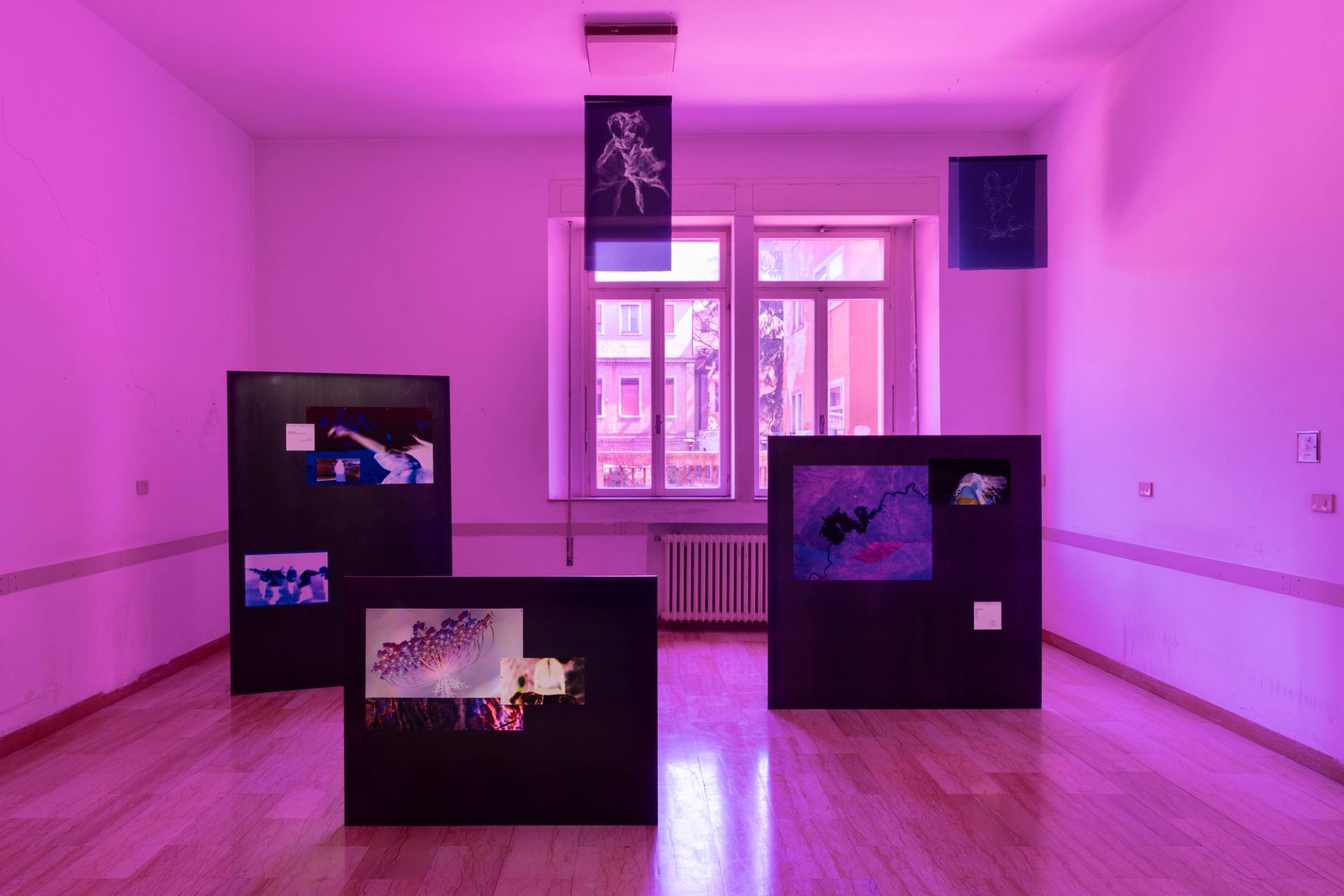
Basel Abbas and Ruanne Abou-Rahme, Until We Became Fire and Fire Us, 2024. Installation view in Nebula, Fondazione In Between Art Film, Complesso dell'Ospedaletto, Venice, 2024. Courtesy of the artists and Fondazione In Between Art Film. Photo © Lorenzo Palmieri.
AR I’d like to be a little more factual about what I said earlier about looking at things in an unorthodox way. When we started working on Penumbra, we knew very little about the final result of our show, but the very first thing we said to each other was that we wouldn’t stage a video exhibition in black boxes. The idea of making an exhibition solely composed of video works but rejecting the conventional device of the ‘black box’ is almost like saying “let's make a painting show without walls.” The black box is the very foundation of the way we understand what we still call “video art”. That opened the ground to an approach to the scenography that has been experimental from the very beginning.
The works in Penumbra were not commissioned for that show. Rather, they were commissioned for a programme called ‘A Foreign Language’. We had commissioned the artists to produce new works with quite an obscure idea about what a foreign language is, and what the act of translation means. That's why all the works in that exhibition were dealing l with the exploration of a gray area, between two opposite categories. When we finally decided to turn that initial commissioning programme into a show, we already had eight works that were exploring penumbral states of being, and we thought this could become Penumbra.
KOOZ Picking up on the moment that you decided not to use the ubiquitous black box, and your statement that architecture should be engaged in the curatorial process: how did you lay the framework for this new lexicon?
IPL Indeed, I think the process can be understood as a sort of two-tier methodology, we can describe it that way. We started working before the films were made, they were in the process of being produced or even written and scripted — but we did have conversations about the general framework; for example, the atmospheric metaphors of the curatorial premise, the trilogy and the idea of uncertainty. Before thinking about how to translate the curatorial framework, in terms of spatial attributes or materials, within the Ospedaletto, we tried to dig into the etymologies and cultural imageries mobilised in the curatorial text developed by Alessandro and Leonardo. For instance, what is the idea of fog within a given space, or how do you translate the idea of heat without being too literal? More metaphorically, what does it mean to reflect on the idea of spillage, for example, in the case of Nebula (2024) or excess in the case of Canicula. This produces a documentation that simultaneously expands the curatorial framework, but through our own spatial perspective, situated within the spaces of the Ospedaletto.
A second tier of intentions are set out in order to work with the artists, and that's where the larger spatial and curatorial approach meets the specificities of the films, and the specificity of the spaces assigned to each artist. Eventually this link between the larger scenography and the requirements of each individual room becomes a conversation on multiple scales: that of the curatorial framework, the scale of the Ospedaletto and the work of the artists. This is something that Leonardo and Alessandro could probably explain better — the artists are brought to the Ospedaletto long in advance, in order to reflect on the spaces of the exhibition and to discuss how their work might be positioned. The spatial orchestration, so to speak, starts at the very beginning of curatorial conception, and is certainly introduced at the beginning of artistic conception.
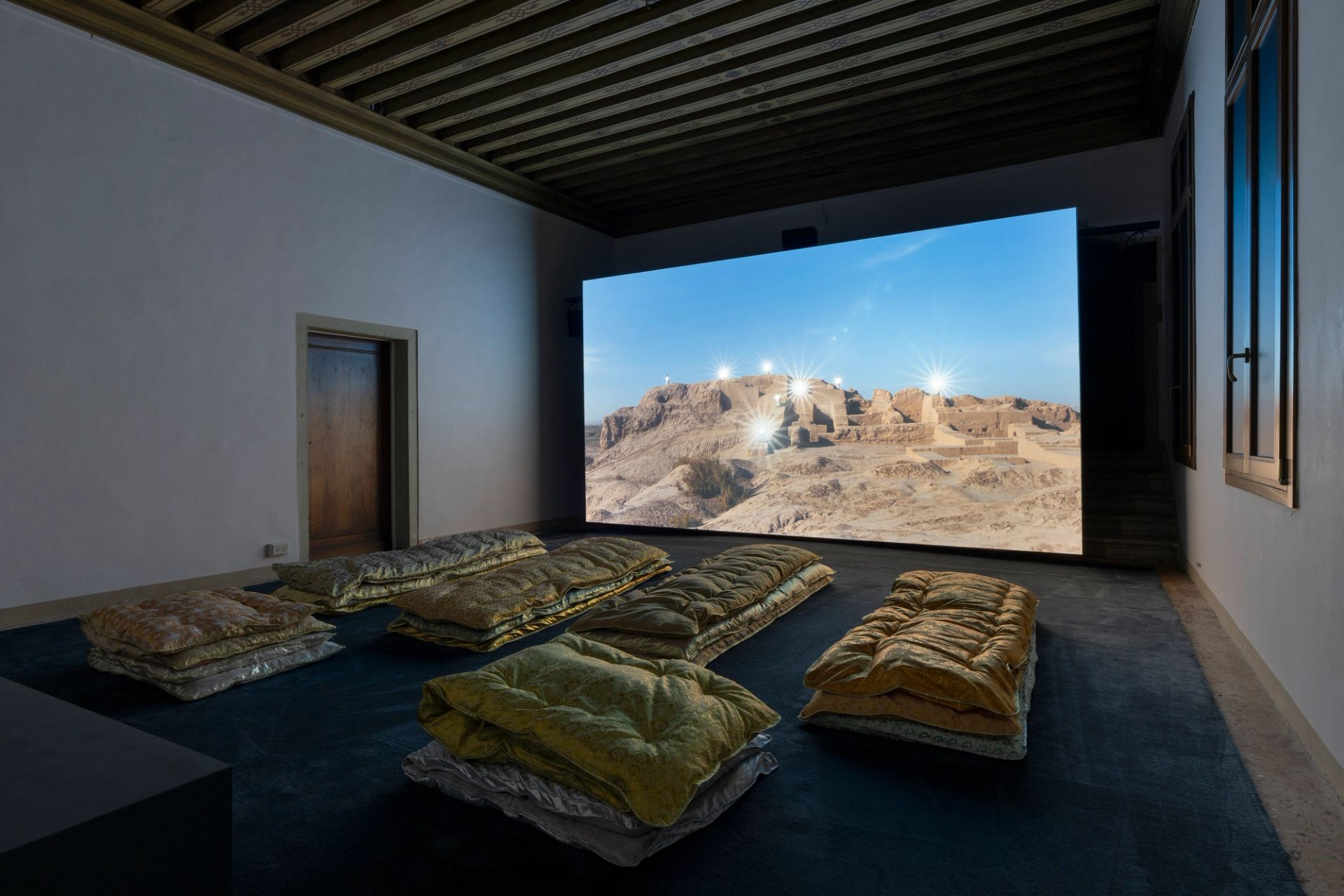
Saodat Ismailova, Melted Into The Sun, 2024. Installation view in Nebula, Fondazione In Between Art Film, Complesso dell'Ospedaletto, Venice, 2024. Courtesy of the artist and Fondazione In Between Art Film. Photo © Lorenzo Palmieri
KOOZ I’d love to learn how, from something intuitive and potentially unorthodox, you manage to structure a cultural programme which is obviously so coherent and even punctual.
LB Embracing the generative potential of the unknown in an exhibition of new commissions is not a free ride — you have to follow the process step-by-step to ensure that all the elements fall into place. I often use the example of an equation with many different variables. At a certain point, you realise that if there are too many variables, the equation cannot be solved. You need to start fixing certain points, and what guided us above all was the coherence of the thematic arc we wanted to trace across the three exhibitions.
It really starts with the artists' practices, and with what Alessandro and I perceive during our first meetings with them. We consider, for example, how certain practices might work within the context of the Ospedaletto — not only in architectural terms, where more intimate works may find their place in smaller spaces, but also in terms of the narrative entanglements their conceptual approaches might generate within the layered history of the Ospedaletto. That is where we begin: building the dramaturgy of the exhibition around a curatorial framework that may seem open-ended but is, in fact, the result of a series of highly conscious and precise decisions, whose sequence ultimately shapes how meaning is conveyed through the exhibition.
For example, take rhythm in an exhibition of moving images. How do you build and sustain the audience's attention over the course of an exhibition with a running time of three hours? For me, this is a fundamental question. In my opinion, moving images are still the most poorly exhibited medium in contemporary art. We visit major exhibitions, biennials, museums, and institutions, yet we still encounter works shown in spaces with too much ambient light and nowhere to sit. The sequence and nature of the works are, of course, fundamental, but so are seemingly simple architectural decisions. Placing a bench against a wall because the duration of a work requires it may seem like a small gesture, but it is precisely this kind of care that ultimately makes all the difference.
I wanted to add one point: you mentioned ephemerality in the medium of an exhibition, which is true, it ends after seven months. But it's also true that these three exhibitions have generated 24 artworks that will endure. This output is extremely tangible. Each work, in its own way, is connected to some extent with the curatorial framework of our show and the history and architecture of the Ospedaletto. Of course, these films exist and will continue to exist; they already circulate in multiple forms across other spaces, from white cubes to black boxes. Yet some of the works retain a potential energy — specifically generated through their engagement with the architecture for which they were commissioned — which will continue to release over time, and it feels very special to think of them in this way.
"The works retain a potential energy, specifically generated through their engagement with the architecture for which they were commissioned."
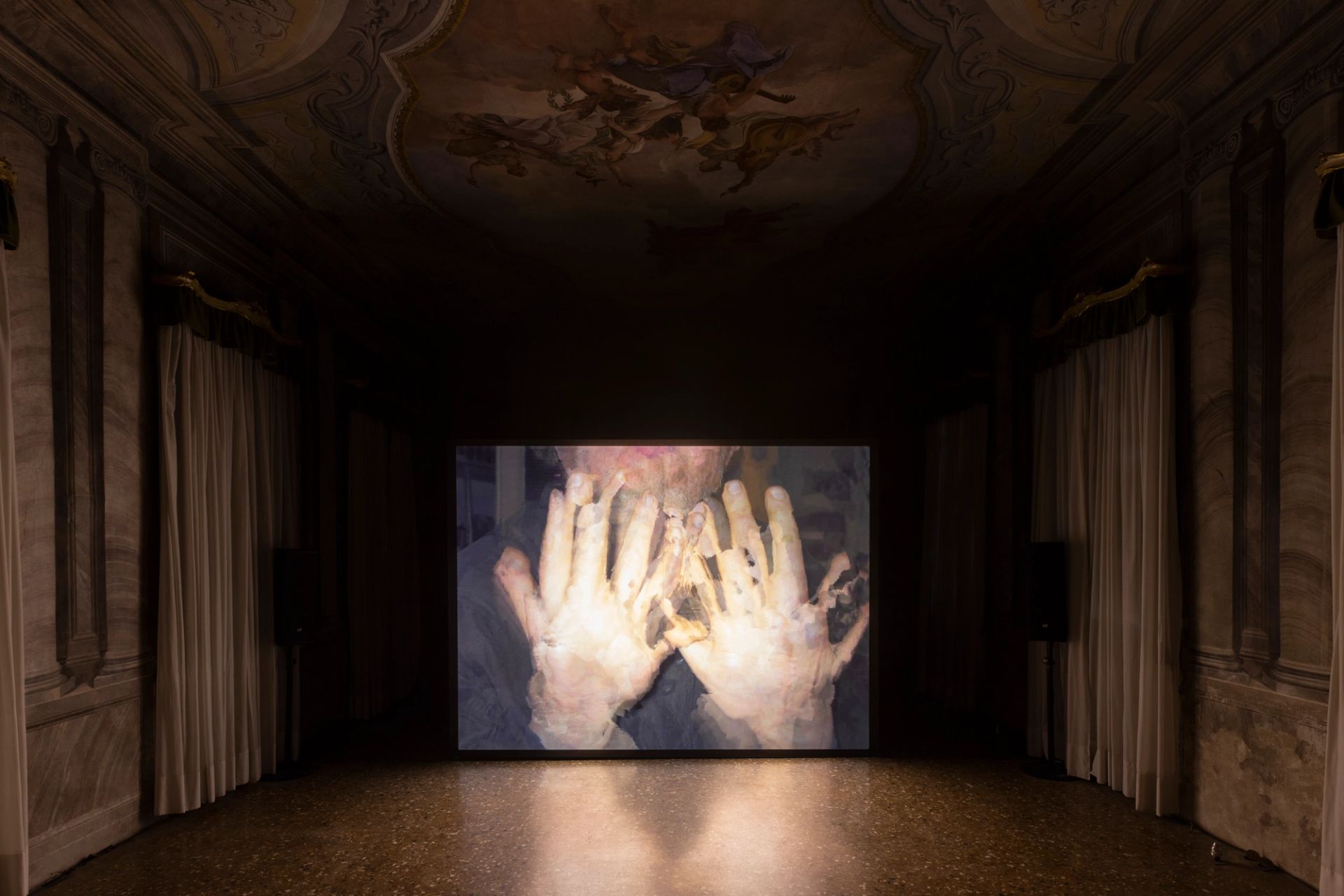
James Richards, Qualities of Life: Living in the Radiant Cold, 2022. Installation view in Penumbra, Fondazione In Between Art Film, Complesso dell'Ospedaletto, Venice, 2022. Courtesy of the artist and Fondazione In Between Art Film. Photo © Andrea Rossetti
FL I would add something here, since we are talking about rhythm. The Ospedaletto is a Frankenstein building — you move from the very rich space of the church to the very intense, abandoned hospital from the 1970s. The first time we entered was a literal disaster. But the strength of the curatorial rhythm is accompanied and underlined by the architecture — that's why our project started by imagining how these in-between spaces can coordinate and create this rhythm. In Canicula, we express this very differently, intangibly and almost without materiality. It is a very ephemeral design, characterized by the use of strong light to punctuate this rhythm — visitors go from very intense, bright moments to much darker points, when they're lost in space.
LB Actually, if we have to think about the most unorthodox element, Canicula is a very good example because the most unorthodox intuition was the idea that a moving image exhibition could be characterized primarily by light. This is a significant shift as we usually operate in a world of shadow and penumbra. So for the narrative arc of the series to culminate in Canicula, where light becomes the main atmospheric factor, felt quite radical.
IPL Tapping into what Leonardo and Francesca mentioned, I also think that's where our contribution really lies: the idea of working around the space of moving images — the in-between or transitional spaces — comes from our interest in turning exhibitions into forms of embodied experience. Very often, the discussions with Alessandro and Leonardo were about how to see beyond the screens — how to transform the experience of moving images from something that you watch, into something that you can feel. If you think about it poetically, what we try to design is a cinematographic experience for the audience.
We conceive these projects in terms of scenographic attributes, and there are two vectors or speeds overlapping: on one hand, the flickering movement of images on screens, and on the other, the movement of the audience through the spaces of the Ospedaletto, within this suspended cinematographic experience.
"The idea of working around the space of moving images, the in-between or transitional spaces, comes from our interest in turning exhibitions into forms of embodied experience."
KOOZ Returning to the question of attention: walking into one episode of the Trilogy of Uncertainties is making a commitment for the next three hours, if one were to view all the works. How do you calibrate attention? For instance, my father popped into two rooms briefly, before returning to the seats with backrests. How do you consider the various durations of engagement in such an exhibition?
LBI think the most important aspect is to create the conditions in which spending three hours might just be possible. Then the self-editing process — in which visitors determine what feels like a fulfilling experience, or maybe not — that's absolutely fine. This is actually what distinguishes an exhibition as opposed to the ritual of cinema. If you walk out of a movie theatre halfway through the film, one has a sense that something has gone wrong — it’s a very codified ritual. An exhibition must be conceived in a different way; hopefully, you offer an experience that is interesting to follow in its fullness, but it's absolutely fine to experience less, or maybe to return in different phases. This exhibition has no entrance fee, it’s free — we often witness people returning over and over again.
This idea of self-editing experience is also entering artists’ practices. There are several examples across the trilogy — from Ana Vaz in Penumbra to Massimo D’Anolfi and Martina Parenti in Canicula — where artists are consciously considering the audience’s posture and mode of engagement. The work of Massimo and Martina is one hour long, but it's divided into 24 chapters. Structured around cycles of construction, destruction, and reconstruction, the work allows viewers to spend a reasonably limited time, so ten or fifteen minutes is more than enough to experience it in part.
It is also about the construction of rhythm in the show, as we mentioned before. I've seen several international exhibitions where, for example, you encounter four long narrative works, one after the other, each with a similar visual language. In this way, you end up with what looks like a maze, with decreasing engagement by the end.
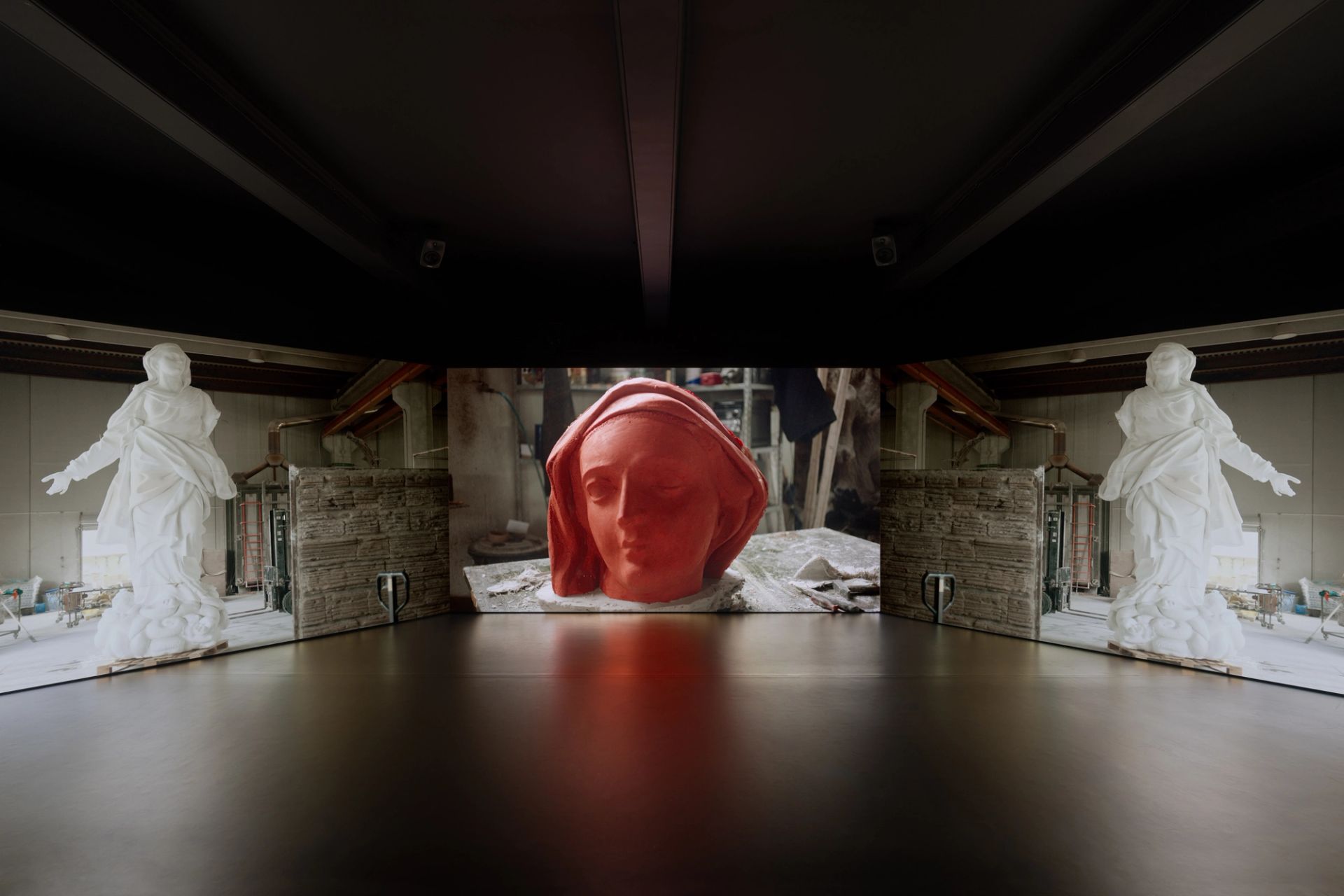
Massimo D'Anolfi and Martina Parenti, 24 Landscapes + A Vision, 2026. Installation view in Canicula, Fondazione In Between Art Film, Complesso dell'Ospedaletto, Venice, 2026. Courtesy of the artists and Fondazione In Between Art Film. Photo © Marco Cappelletti Studio.
KOOZ You've now developed a lexicon or language to carve out a particular experience, in which we feel able to really dedicate multiple hours to inhabiting that space. As our relationship to images continues to evolve, how fixed or flexible is your approach to creating the embodied experience?
AR As always, it is the work of the artists that provides a language and shows us the way. The three shows of the Trilogy, in a way, have also been a way to take the pulse of how artists are using moving images today. Nebula, for example, was strongly concerned with a tendency we have seen a lot in that last decade, namely the expansion of moving images across space and the subsequent fragmentation of narratives.
Right now, what we feel when talking with the majority of the artists is that they don’t want their works to be seen on a laptop or a phone: they want the viewers to be immersed with their eyes, ears and bodies into something that you can’t experience at home, that's the reason why the shows of the Trilogy were so tactile. Perhaps, in the near future, artists will make very short video works, so instead of having shows, like Canicula, with a total running time of over 3 hours, we may have exhibitions of 8 video installations that will take you a few minutes to visit. Who knows? We will have that opportunity in case artists will develop convincing languages that give you a completely different experience of time. The fact that visitors could actually spend three hours at the Ospedaletto was largely because all the works, across the three shows, were very serious, they all had gravitas. We always say that the Trilogy is about the uncertainty of vision… But if you change the word “ vision” with “human experience”, the result is the same. Penumbra was about not just the ambiguity of vision, but the ambiguity of human existence. Nebula addressed the disorientation of what it means to be alive, while Canicula is about a very current understanding of conditions of life as “unbearable” Maybe, retrospectively the 3 shows can be interpreted as contemporary memento mori. Take Canicula, for example: it’s true, it’s a show about things collapsing, but ultimately it speaks of what remains, which is the reason why all the materials looks so fatigued. They indeed bear the effects of heat and light, but they're still there; in all the works, there is something that remains, clinging on, surviving despite everything that has consumed it.
I don't want to sound overly existential, but I think that if people spend three hours within a show like this, it is maybe because they find something in it that connects deeply to something that they feel, regardless of the show. We never really talk about this explicitly but the metaphors of Penumbra, Nebula, and Canicula were born out of a very simple question: “How can we talk about the state of things in the world through a language of very common moods and feelings ? Nebula tried to evoke that feeling of not being capable of touching and shaking those political and economic forces that shape our lives and that we may feel are impossible to fight, those forces that surround us as an atmosphere. The unbearable excess of heat of Canicula contains also a very contemporary and tragic paradox: that of waking up in the morning and witnessing on your phone every kind of atrocity even before the day has started.
LB I might add to Alessandro’s point: while the practices of artists certainly tell us how we should shape our exhibitions in the future, we must not forget that our medium — the moving image — is technologically very specific. As such, technological innovation and accessibility also play a decisive role in shaping the history of this media and how it is exhibited.
In the span of just six years, for instance, the LED walls in Canicula — used to display the work of Lawrence Abu Hamdan, Roman Khimei and Yarema Malashchuk — have become widely available; six years ago, they were either inaccessible or prohibitively expensive. This becomes another factor of negotiation that is extremely exciting and stimulating. Artists are also creating works based on technological developments, and as curators we, in turn, must craft our exhibitions based on these new possibilities.
IPL I would add something that relates very much to what Alessandro described, and maybe Canicula is a good example. The idea of corrosion — the feeling that our bodies are corroded and exhausted by the exposure to excess on a daily basis — is then translated in a space where this is expressed through light, through the scraping of walls, through materials that have been intentionally distressed, which brings the experience of the films from vision to the other senses. That specific and layered experience captures the attention of people in space, not just because they are witnessing a moving image, but because they're directly inhabiting an architecture that echoes the overall intention of the show. Temporary or not, the audience becomes part of the scenography, they become the show. It's not about putting people in front of a screen, but rather letting them understand through bodily sensation that everything around them is part of the same intention.
For Canicula, the idea of corrosion was extremely present, while not explicitly stated, and diffused across the entire experience of the show. For us, that is the perfect answer — although, as Alessandro explained, there is no dogma. Vision doesn't end at the act of gazing. We could talk about Susan Sontag and the idea of becoming numb to the millions of violent images that we experience on our phones constantly, but I would propose that we are numb because our bodies are not actually there. We are held at a distance by the very medium used to portray and document such violence. It might sound poetic, but it's not; when you start designing and letting things land in space, theater is maybe a closer domain for us than exhibition design per se. What we do is not exhibition design. The point is to bring the body back to the centre of experience, — that’s a very important part of what we try to do together with Alessandro and Leonardo.
"Vision doesn't end at the act of gazing."
KOOZ As a final question, following the image exposure that we mediate through our telephones, and the subsequent numbness we develop: what responsibility do you see yourselves holding, as curators and designers mediating an experience between spectator and image?
AR I feel many things but, rather than a responsibility, I feel a desire. I feel discomfort for the way we are looking at things happening today, for how we consume them. I know that we, as an institution, have a great opportunity: we don’t have to “sell things,” we don’t have to seduce the audience nor to package meanings such that they can be easily perceived and consumed. That is not what art is for.
If we can identify a responsibility in an institution like ours it lies within the act of exhibition making and in the editorial work. There I see a shared responsibility in terms of what we're doing with meanings. If we add to this the anxiety that I perceive today for clarity or persuasion, then we could be turning art into an ideologically driven machine, which is not just dangerous but also limiting. In this case, I think that preserving a space for ambiguity and expansion of meanings can be defined as a responsibility.
IPL I totally agree. I think there is great value in fostering attention today, in giving a space and time for attention. It's not about packaging meanings or ideas that can eventually be distilled into consumable products, but rather to provide the space and time to turn your gaze into an attention-seeking moment. For me, that's the point: demanding attention involves taking responsibility in terms of allowing people to interpret and understand reality. If the exhibition succeeds in achieving this, that's the highest form of responsibility.
FL That's why we always start our project with a question mark: the first act of responsibility is made towards ourselves and the way we want to position ourselves within a certain thematic. We start by questioning ourselves as a practice.
LB In my work, I constantly feel a sense of responsibility on many different levels. I do believe that we carry a great deal of responsibility, especially given that we work with a medium that often requires substantial funding. I often feel a responsibility as to where those funds are directed. Considering the world that we're living in today, if there's something that I'm particularly proud of in these three exhibitions, it is that we were able to produce works that are, if not marginalized, then perhaps less consistently visible. I believe that some of the works we commissioned across the trilogy would have faced significant challenges securing institutional support elsewhere because of their sensitive topics.
The responsibility and capacity in enabling an artist to feel supported, safe, and to enjoy a space of freedom, such that they can allow themselves to take a further step in their practice — that's something that I feel very deeply. I also feel a responsibility towards the audience, as Ippolito described: the possibility of crafting an experience with generosity. Ultimately, it's not about crafting specific meanings; for me, it is about taking responsibility for addressing the existential questions we all face today—confronted with live-streamed genocide and a reality in crisis on every front. Within the scope of our work and the means available to us, there is a responsibility we cannot ignore, and I feel that very acutely.
KOOZ Ending on this note feels very strong, framing the whole project as fundamentally one of redistribution. Thank you for this and for your generosity.
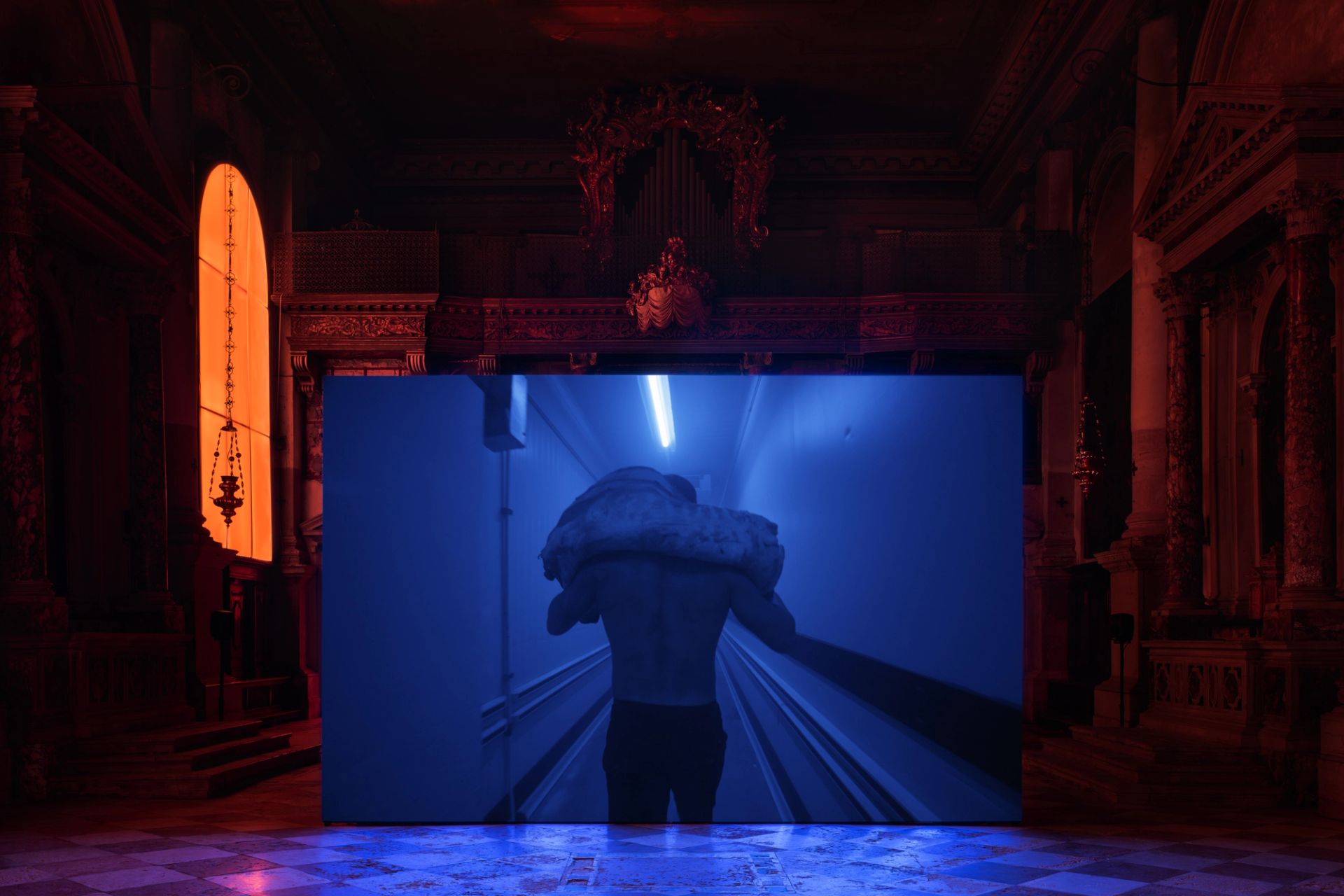
Janis Rafa, Baby I'm Yours, Forever, 2026. Installation view in Canicula, Fondazione In Between Art Film, Complesso dell'Ospedaletto, Venice, 2026. Courtesy of the artist and Fondazione In Between Art Film. Photo © Marco Cappelletti Studio.
ABOUT
Fondazione In Between Art Film was founded by Beatrice Bulgari in 2019 with a cultural programme focused on the role of contemporary moving images and the support of international artists, institutions, and research centres exploring the dialogue between different disciplines. The Fondazione investigates the boundaries of time-based media—film, video, performance and installation—through commissioned projects, acquisition programmes, and institutional collaborations.
BIOS
Leonardo Bigazzi is a curator at Fondazione In Between Art Film, for which he co-curated the Trilogy of Uncertainties exhibitions ‘Penumbra’, ‘Nebula’ and ‘Canicula’ on the occasion of the Venice Biennale in 2022, 2024 and 2026 respectively. He is also the curator of Lo schermo dell’arte – Contemporary Art and Cinema Festival, Florence, as well as founder and curator of VISIO – European Programme on Artists’ Moving Images. Bigazzi has edited and contributed to several publications and recently edited the book VISIO – Moving Images in Europe since the 2010s.
Francesca Lantieri is an Italian architect and designer based in Milan. She has been part of 2050+ since its founding in 2020 and became a partner in 2025. Francesca has developed a multicultural and multidisciplinary approach to architecture through her work with internationally renowned practices. From 2015 to 2019, she worked as an architect at OMA in Rotterdam, where she contributed to projects across different scales, ranging from temporary exhibitions and scenography to architectural refurbishment and heritage preservation. Prior to joining OMA, she collaborated with SANAA in Tokyo, Elding Oscarson in Stockholm, and 51N4E in Brussels.
Ippolito Pestellini Laparelli is an architect and curator whose work encompasses technology, politics, design, and environmental practices. Formerly a partner at OMA/AMO, in 2020 he founded the interdisciplinary studio 2050+ in Milan to deploy space as a medium rather than a goal, carrying out various projects that span curatorial and research practices, exhibition design, scenography, and architecture. In 2018, Pestellini co-curated Manifesta 12 The Planetary Garden. Cultivating Coexistence, in Palermo. In 2023, he served as President of the Jury of the 18th International Architecture Biennale in Venice. Since 2017, he has been teaching at the Royal College of Art in London. His work has been shown and published internationally across a range of media, institutions, festivals, and exhibitions.
Alessandro Rabottini is an art writer and curator who lives in London. Since 2020, he has been the artistic director of Fondazione In Between Art Film, co-curating the Trilogy of Uncertainties: Penumbra (2022), Nebula (2024), and Canicula (2026), together with solo shows by Ali Cherri and Karimah Ashadu. In his previous institutional roles, Rabottini has curated solo exhibitions of artists including Roe Ethridge, Talia Chetrit, Guido Guidi, John Latham, Adrian Paci, Walid Raad and Danh Vo, among others. He has edited books and catalogues on the work of Michael Anastasiades, Gianfranco Baruchello, Andrea Branzi, Latifa Echakhch, Formafantasma, Giuseppe Gabellone, Victor Man, Oscar Murillo, Robert Overby, Sterling Ruby and Ettore Spalletti among others.
Federica Zambeletti is the founder and managing director of KoozArch. She is an architect, researcher and digital curator whose interests lie at the intersection between art, architecture and regenerative practices. In 2015 Federica founded KoozArch with the ambition of creating a space where to research, explore and discuss architecture beyond the limits of its built form. Federica is an Architectural Association School of Architecture in London alumni.