There is a pleasing and productive contradiction in spending five hot July days in darkened auditoria, in order to think more clearly about the open city. Cinema abstracts and frames; it decides where we look, and for how long. The city, by contrast, refuses to hold still, or to submit to a single vantage. That tension — between the disciplining rectangle of the screen and the ungovernable sprawl beyond it — is arguably the raison d’etre of Arquiteturas Film Festival. Now in its thirteenth year, held across a handful of intimate venues in Porto, the festival proposes film not as an illustration of architecture but as a way of knowing it: a method, even a form of research.
This edition gathered its selection under the banner of “Urban Age”. It is a phrase with a history — the demographic tipping point at which more than half of humanity is said to live in cities, and the “endless” or planetary urbanisation that has become the reflexive backdrop to so much contemporary discourse. The festival’s wager is to treat the Urban Age less as a statistic to be reported than as a condition to be felt. What film can do — and what a spreadsheet cannot — is show how urbanisation unfolds: for whom, at whose expense, and with what consequences. Across five days and some thirty films — shortlisted from an open call garnering over 160 entries — this year’s constellation hailing from Afghanistan to Canada, Lebanon to South Korea and many points between — that reframing gathered disparate works into shared lines of enquiry.
"The festival’s wager is to treat the Urban Age less as a statistic to be reported than as a condition to be felt."
If a single anxiety pervaded the programme, it was the ethics of the gaze itself. Ethnographic filmmaking — that loose designation for documentary overlapping with anthropology — carries a persistent suspicion of extraction, of a broadly Western gaze trained on a non-Western subject. It is a charge one could level at 'Softly Brutal,' in which the former festival guests Bêka & Lemoine hold their camera, across seventy-five wordless minutes, on the informal settlements of Bangkok, leaving us alone with the title’s provocation: where does the brutality lie, and in whose hands the softness? This same mode rescues the small story from the large one, letting intimate lives register against transformations that would otherwise dwarf them. So it is with 'A Highway Story,' Wender Zanon’s study of social life along the unglamorous BR-116 in the Brazilian municipality of Canoas; with 'Living Euljiro,' where a beloved Seoul bar becomes the fulcrum for a meditation on urban loss; and with Penny McCann’s experimental and elegiac 'Buses Don’t Stop Here Anymore,' about the isolation of an Ottawa bus station, once the Greyhound bus route ceases to serve it.
Elsewhere the question of who the city is for was pushed past the human altogether. The Unsettling Boundaries award went to the short 'A Weak and Panicked Animal', in which young Australian director Jake Starr assembles news and CCTV footage — making poignant use of artificial voiceover and fly-through — to document nature pushing back, bloody in tooth and claw, against an anthropocentric monopoly on space. It would be unkind to give too much away, but the recurring image of deer, among the gentlest of creatures, leap-crashing through plate glass into markets, medical centres and homes turns the reflex of human fear inside out. The film asks, with wit and something close to a shudder, who ought to be afraid of whom.
'Big Tech Blues', by Elisabeth Brun, stages a kindred resistance to the mediated environment, albeit one argued on human terms. A remote Norwegian village is earmarked for a Starlink ground station — a fairy-ring of technologically burdened toadstools, in their pale-domed proliferation — and the film follows residents as they contest and finally reverse the decision. The ecological stakes are real, including a reserve for protected birds, but the deeper subject is sovereignty: the right to privacy, and to conserve the character and values of a particular place against the frictionless logic of the market. 'Are we,' the director’s voiceover wonders, 'a dot outlined in red on someone’s map?' Of course, we are, whether we know it or not, and the film’s quiet discomfort lies exactly there. That ecological register ran through several works — among them 'Desert Passages,' a feature-length film spanning the bowl of the pan-American Colorado river and the infrastructures built to harness its energy — which stood out for its ambition, winning its young directors an award under the category ‘Urbanising Earth’.
The climatic theme reached its most sensorial pitch in 'Hot, Cold, Wet, Dry’. Directed by Klearjos Eduardo Papanicolaou and Marios Kleftakis and shot over six years in Singapore, the film trades narrative for atmosphere, setting the city-state’s fecund tropical climate against the mechanically controlled interiors that hold it at bay. Nature here is permitted chiefly as spectacle — the synthesised waterfall in Changi Airport, the densely fishy marine life centre — cut between the dank habitat of a Komodo dragon and the fluoro-lit air-conditioned marketplace, where shoppers paw through mass-produced clothes. Meditative and unresolved, it makes a brave attempt to convey through image alone what the city can barely hold: the hostility between what must be tamed and what cannot be.
That film belonged to the strand curated this year by the Chair of Architecture and Urban Design at ETH Zürich — represented by Hubert Klumpner and Klearjos Papanicolaou (joined by architect-educator Michael Walczak and collaborator Marios Kleftakis) — whose organising proposition is filmmaking as research: not a means of illustrating urban design after the fact, but part of its working toolkit. Their installation at O Instituto, the festival’s headquarters, made the case materially, gathering student films, drawings, sound pieces and a set of video interviews with collaborators in Colombia, as a complement to the launch of 'Manual for Designing Urban Imaginaries: Colombia’, published by Architangle. As architecture’s expanded field annexes forensic investigation, game design and transmedia practice, student works read as evidence that the craft of filmmaking now sits comfortably among the discipline’s instruments. One of the Chair’s own features, 'Not Just Roads' — co-directed by Papanicolaou and the Indian scholar Nitin Bathla — traces the construction of the Dwarka Expressway outside Delhi and its attendant dreams of neoliberal growth, across scales, species and classes; characteristically, it offers no easily reconciled ending. To this was added an unscheduled screening of 'Torre David', the 2012 study of the celebrated Caracas squat in an abandoned banking tower, shown in sombre response to the recent earthquakes in Venezuela — a reminder that the sites architecture chooses to document have afterlives of their own.
"Student works read as evidence that the craft of filmmaking now sits comfortably among the discipline’s instruments."
The AFF Awards — inaugurated last year, with trophies designed by Sechaba Maape — map the festival’s relative peaks. Arquiteturas assigns no weighting between its award categories; the jury names them each year after themes that surface across the shortlist, and this year the recipient of the ‘Building Agency’ award felt self-evident. 'Ellas en la Ciudad' (Women in the City) is the début film of Reyes Gallegos, a Spanish architect and educator turned filmmaker, screened in the opening session of two films pointedly directed by women. The project grew from Gallegos’s disillusionment with conventional practice: charged with ameliorating a former Francoist housing estate in Seville, she chose instead to sit on site for a few hours each morning and simply watch. The neighbourhood, as she found, is animated by the same recurring cast — older women who stayed home when the men went out to work, or vanished altogether. These familiar figures hobble frequently across the foreground of the film: carrying groceries, sweeping communal spaces, meeting in shaded corners to trade gossip and grievance.
The estate’s original residents were moved off the land during Franco’s dictatorship, into identical housing blocks thrown up across the country: a Modernist solution that delivered “modern life” while dissolving the very conditions for a communal one. Many arrived illiterate, and an adult school became the unlikely nexus around which they discovered that isolation could be answered by collectivity. The film follows, demand by unabashed demand, how these women conjured a liveable neighbourhood from the skeleton of a housing project — first adult education, then street cleaning and bin collection, a medical centre, a library, safe routes for pushchairs and carts. An urban transformation wrought of sheer will, largely unbidden and entirely uncelebrated. In a poetic squaring of the circle, Gallegos succeeded in petitioning to rename one of the neighbourhood’s squares for one of the women at the heart of the activism. Even as they are relegated to the domestic realm and left there, the influence of these citizens radiates far past the front door, sustained by little more than energy and solidarity — up to and including a programme against domestic violence. The Building Agency award could not have found a truer home: here is a film that ties the realities of architectural practice to the realities of spatial production without a trace of sentimentality about either.
"The influence of these citizens radiates far past the front door, sustained by little more than energy and solidarity."
Awarded under the category of 'Spectacle of the Ordinary’ is Gillian Waldo and Sam Taffel’s ‘Learning from Learning from Las Vegas’ — on one level, an in-joke for architectural insiders, its title nodding to the wilfully transgressive 1972 study by Denise Scott Brown, Robert Venturi and Steven Izenour. Where that book was a joyfully perverse act of recognition — taking the bawdy artifice of the Strip seriously as culture — this recording is a love song to its way of seeing. The directors role-play the architects with evident affection, gathering archival clips and restaging iconic photographs. In doing so, they layer a contemporary consumerism and kitsch over the old. We watch a wedding-chapel Elvis rehearse and retake his lines, and the filmmakers themselves giggling as they get in position for ersatz ‘Denise and Bob’ shots. For all the coterie knowledge, the film’s real subject is the popular; love songs, even for a city as audaciously insincere as Las Vegas, are always for everyone.
Beneath so many of these films runs a current of nostalgia — the impulse, in the face of change too fast and too vast to grasp, is to document, to commit to memory what is being altered. Such acts of filmic preservation can be genuinely moving, as in 'Salatinas,' an archive-rich account of how the university town of Coimbra was remade under the urban ambitions of the Salazar regime, or in the technically-accomplished 8mm experimental 'Passage', made by Raquel Rodriguez and Miriam Ouchi, in which a fluid sense of belonging stutters in schizophrenic relation to the built environment. The contact with a tense reality is echoed in many works — the presence of Palestine, of Afghanistan, of Black Lives Matter and struggles against race and gender-based violence — images against oppression recurring in animated, glowing rushes by various authors. Watching them in sequence, one cannot avoid the discomforting question circled within the festival: the inequity that occurs whenever certain places and people are singled out, put in focus by a discerning lens and enlarged on a screen. We might reasonably interrogate the aesthetic pleasure we take in looking at difficult things. And yet there is no denying the poetry that occurs when vibrant and even mundane narratives are skilfully sequenced — a snarling metropolis behind a naked child taking comfort from a crawling puppy, or the flight of a dragonfly against the carcass of a gargantuan powerplant.
"There is no denying the poetry that occurs when vibrant and even mundane narratives are skilfully sequenced."
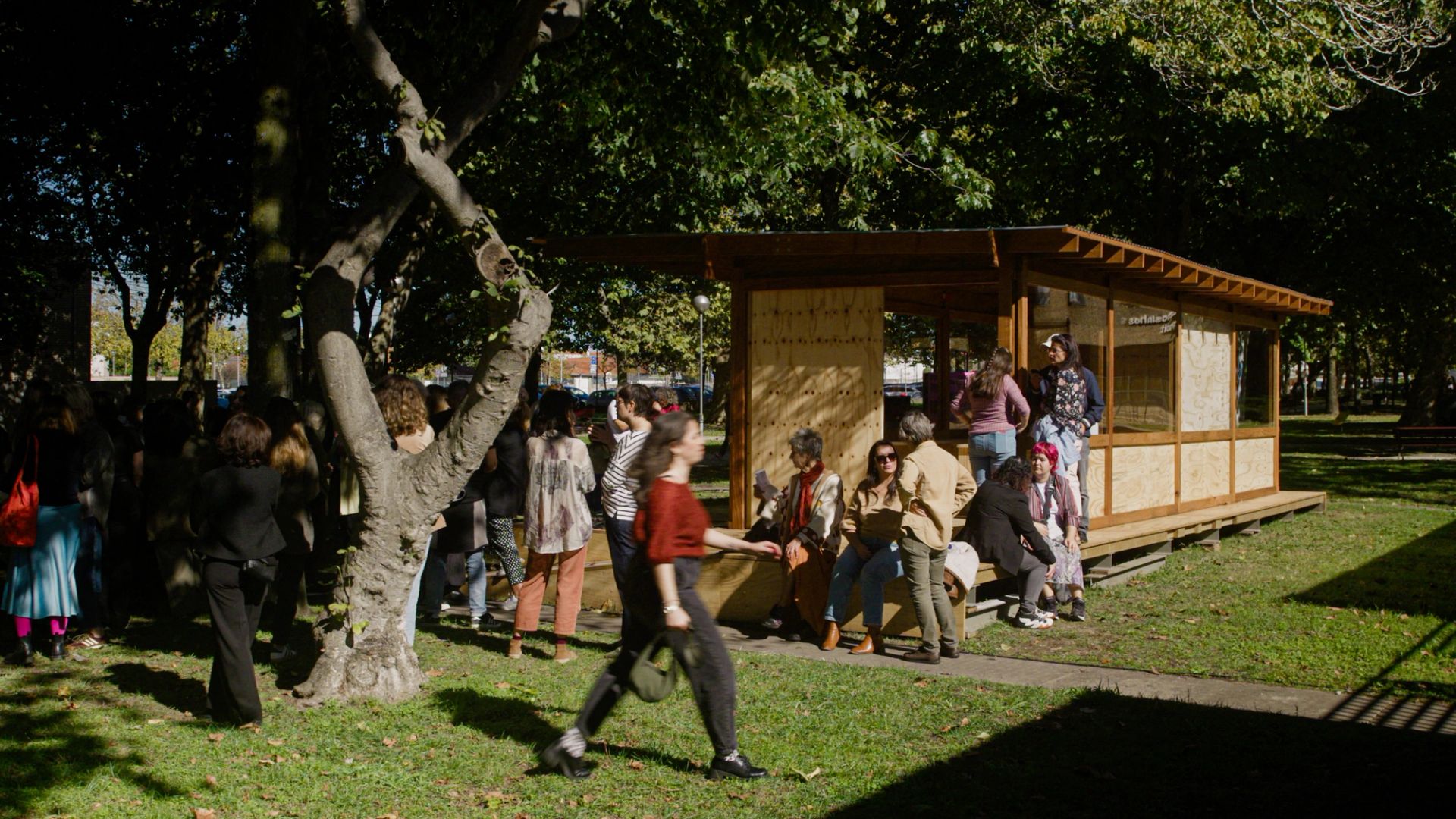
What allows those juxtapositions to land with the viewer is a matter of scale and AFF’s refusal to grow out of intimacy. It remains small by design, and so the conversations it produces are immediate: between invited filmmakers and practitioners, between subjects and audiences, and among audience members themselves, who find themselves part of a temporary community drawn around the object of their shared attention. The schedule is punishing in the best way — a scintillating barrage of one vital narrative after another — but porosity keeps post-screening discussions genuine rather than dutiful. Under the curatorial direction of Paulo Moreira and his team, discrete themes surface between showings, and equal care is taken to build bridges beyond the auditorium and into the fabric of the city itself. The Porto Special programme draws upon those shortlisted films dealing with Portuguese conditions: a screening of the Porto-set 'Maria de Sé' was followed by a tour to the very locations on screen, breaking the fourth wall between image and street, while workshops and walks open the festival to a public beyond its cinephile core. This year’s artist in residence, the South African photographer Leon Krige ran hands-on sessions in digital, analogue and image-editing practice: another way of working directly with the city rather than merely watching it.
Porto is not alone in offering this kind of intensity; other cities hosting similar festivals hold complex fabrics of their own. Rather it is the care with which the programme is assembled that keeps Arquiteturas compelling, into and beyond its thirteenth year: fiercely intelligent and just as fiercely independent. As such, the premise of the Urban Age is less era to be announced than a question to be carried into the light. Stepping out from the darkened theatre into a Porto evening, the city looks briefly altered — less a backdrop than a field in which, this edition insists, we are all implicated: a dot outlined in red, whether we know it or not.
ABOUT
The Arquiteturas Film Festival is a platform for discussing and disseminating architecture through films, installations, debates, and walks, organised by INSTITUTO. It features a programme with three sections: Official, Guest Institution and Portugal Special. The festival takes place in various venues across the city, including Batalha Centro de Cinema, Casa Comum, Casa da Guitarra, Circo de Ideias, and INSTITUTO.
BIO
Shumi Bose is chief editor at KoozArch. She is an educator, curator and editor in the field of architecture and architectural history. Shumi is a Senior Lecturer in architectural history at Central Saint Martins and also teaches at the Royal College of Art, the Architectural Association and the School of Architecture at Syracuse University in London. She has curated widely, including exhibitions at the Venice Biennale of Architecture, the Victoria and Albert Museum and the Royal Institute of British Architects. In 2020 she founded Holdspace, a digital platform for extracurricular discussions in architectural education. She is a member of CICA (International Committee of Architectural Critics) and currently serves as trustee of Architects for Gaza.