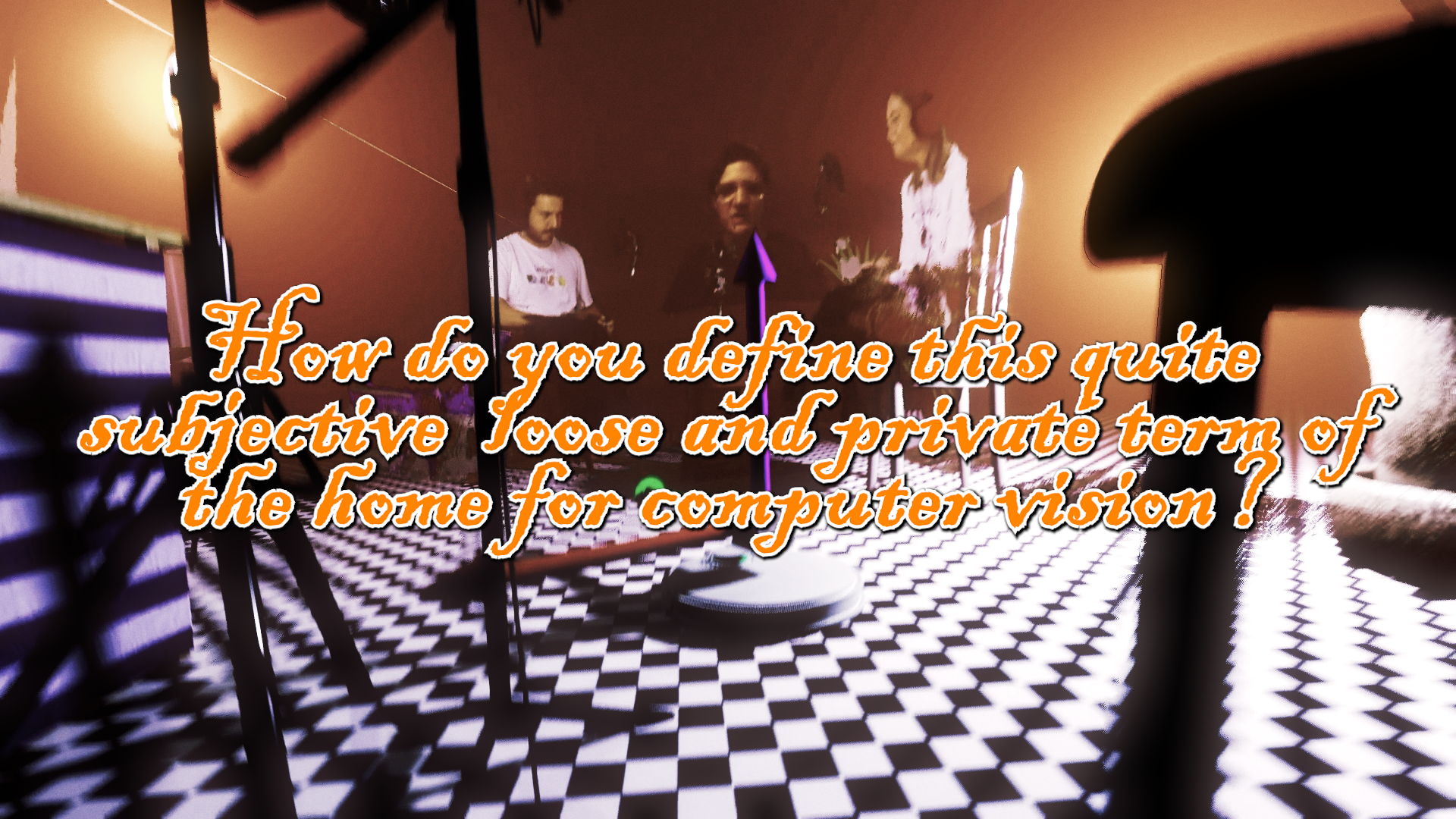
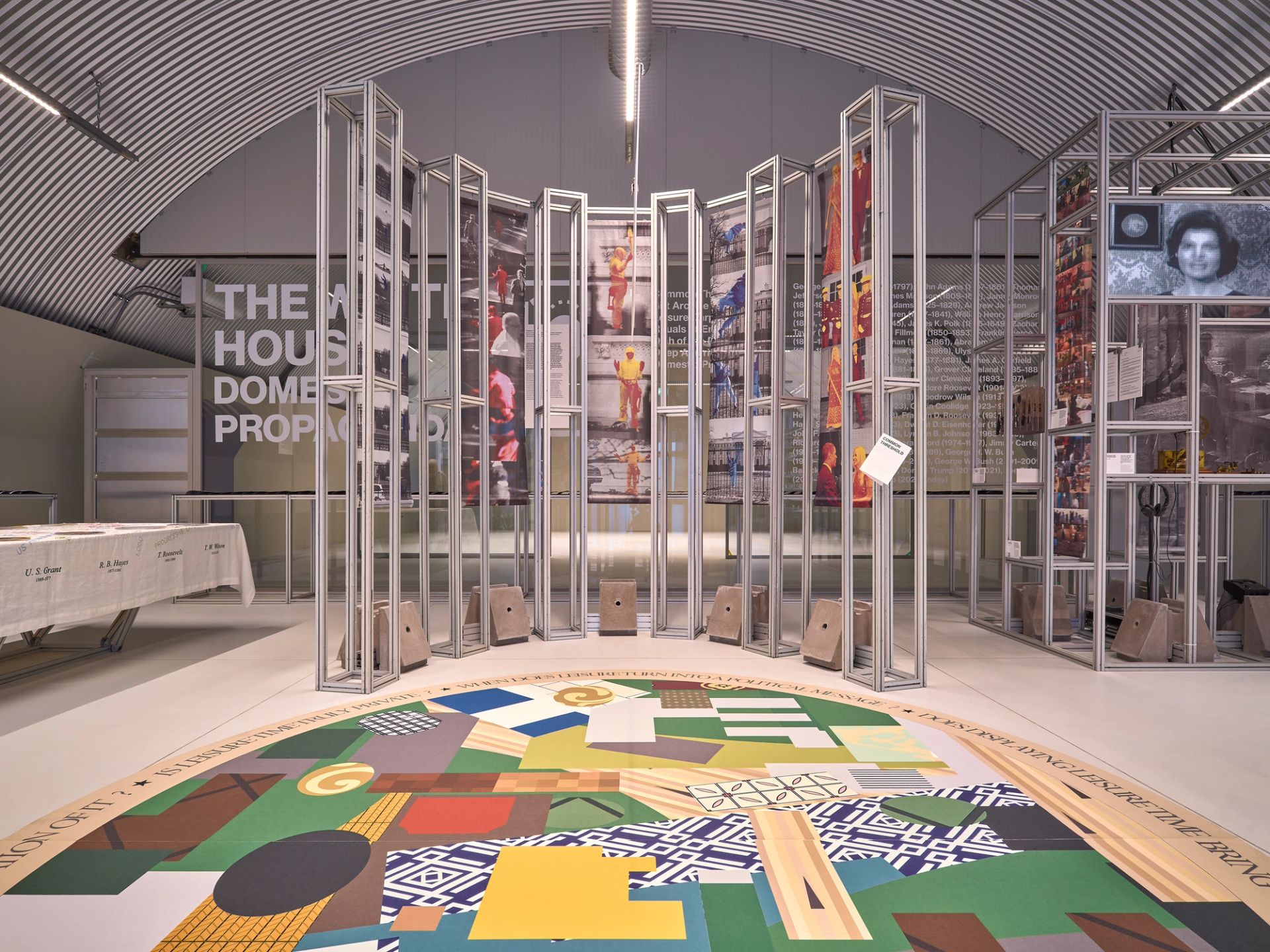
Shumi Bose/KOOZ Laura, Saúl, thank you both for joining me. We’re going to talk about potent things today: assets, speculation and the globalised value systems that determine their fluctuations, particularly in relation to property and heritage. Before that, let me ask you to introduce yourselves.
Laura Yuile I'm Laura Yuile; I'm an artist and currently a lecturer in Digital Media Arts at the Institute for Creativity and Innovation in Xiamen, southeast China. I have what I like to call an anti-disciplinary practice; I work across different forms including installations, performance and video. One main and ongoing project I’ve been working on since 2015 is Asset Arrest, which is both a research framework and something that I publish as a podcast series. Each episode of the podcast involves inviting a guest to attend a viewing with me, usually of an expensive luxury residential property, where we pose as potential buyers
Before moving to ChinaI lived in London for ten years, where this category is the fastest growing type of residential property in construction, despite the ongoing housing crisis. I record a conversation with my guest before and after the viewing. The aim of this has been to publish, through conversation, an alternative image of these exclusive spaces — those we are surrounded by but cannot usually see inside. I started this in response to the abundance of imagery and language related to the luxury property market that fills the city, as well as other forms of representation where these spaces infiltrate the urban fabric.
"The aim of this has been to publish, through conversation, an alternative image of these exclusive spaces — those we are surrounded by but cannot usually see inside."
Saul Baeza My name is Saúl Baeza. I have two main lines of research. One of them is through a studio practice called DOES. We work with everything that has to do with digital identities, transmedia technologies and algorithmic resistance; we try to look for other spaces of reflection, critiquing some of those structures — which also formed the basis of my PhD, at TU Delft in the Netherlands.
I also run another platform called MAYBE, which is more of a cultural platform around curatorial studies, editing, and so on. Since 2018, we've been publishing a biennial print magazine about material cultures, called VISIONS BY. Through the magazine we were invited to create the exhibition IBEX36 for the Mayrit Biennial in Madrid.
IBEX36 is plainly based on IBEX35, which is the economic index of Spain: an indexical list of the nation’s 35 most powerful companies. Our proposal was to reimagine Spain’s National Museum for the Decorative Arts — el Museo Nacional de Artes Decorativas — as company number 36: that was it. But that idea entailed understanding if or how we could truly calculate — and speculate — with the different assets that make up the museum.
This museum collection holds more than 80,000 pieces: these objects are meant to represent Spanish culture. The first time that I visited, I found jewellery and fine art as well as chairs, tables, and other domestic items that you might find in any Spanish home across the land — but I had never seen any of those objects displayed in the museum in my own family home, nor in any other home that I know. Unless items are made with a specific materiality — in metal or stone, for instance — they can easily be lost to history. At the Museo Nacional de Artes Decorativas, all the objects come from extremely privileged origins and perspectives, so everything is conserved with a heavy sense of value.
"For IBEX36, we created an algorithmic system that allowed us to put a selection of museum objects into a virtual marketplace, connected in real time with global stock exchange markets."
For IBEX36, we created an algorithmic system that allowed us to put a selection of museum objects into a virtual marketplace, connected in real time with global stock exchange markets. For example, we are operating sixty seconds behind the New York Stock Exchange. The idea is to note the daily value of selection of objects. How do they fluctuate, moving up and down in connection with the movements of commodities markets? The project exists on an online platform that you can easily navigate to see which objects are peaking, going down or up; you can also navigate through the total value of objects in terms of materiality. For example, you can see the total values of cardboard. gold or diamonds, across the museum collection; you can also navigate through countries of origin.
The project manifests this as a plug-in-like platform that anyone can access online; then too, within the museum space, there is an installation set up to resemble a trading office, with multiple desktop screens, an elite gaming chair, and so on his is the standard set up for a lot of traders speculating on systems related to global economics. This set up is also linked to news platforms, like Al Jazeera or El Pais — the biggest newspaper in Spain — to navigate specific trends or stories from that day in relation to the movement of a specific object within an index of its value.
LY I've been having a look through the online platform for IBEX36 and I'm curious: how much do you see those values fluctuate? How much time does it take to see a change?
SB Firstly, we’re working with a selection of just 200 objects out of a possible 80,000, selected in collaboration with the curatorial team of the museum. On the homepage, you can see top 20 objects, and there are always a few objects that stay up there — usually those made of gold, diamonds, and so on. Then there are other fluctuations that are super interesting: for example, some materials can relate to current markets, because the material elements are still viable for sale. But there are other materials which are currently illegal, which means that they cannot fluctuate in any public market — for example, any animal-derived product like ivory, tortoise-shell, ivory, coral — even human bone.
"There are other materials which are currently illegal, which means that they cannot fluctuate in any public market — for example, any animal-derived product like ivory, tortoise-shell, ivory, coral — even human bone."
Some of these materials do enter our list of the top 20 objects; lately, the value of such materials has been fluctuating rapidly. We had to look at black markets to check specifically for per-kilo prices, and so on. Those are the only ones we update every few days instead of every 60 seconds, because there is no IP index that we can kind of track; we review the black-market values weekly, and then manually feed in that data. That’s one of the more surprising aspects of the project, especially in those shadow-spaces: some objects supposedly date from hundreds of years ago, but there are moments when there is no date or place of origin for an object made of human bone…
Of course there's also a certain fetish for certain objects, and a lot of weirdness in connection with the price and value of objects made of illegal materials. For example, items made of human bone often seem connected to care of the living body — like a toothbrush or a hairbrush.
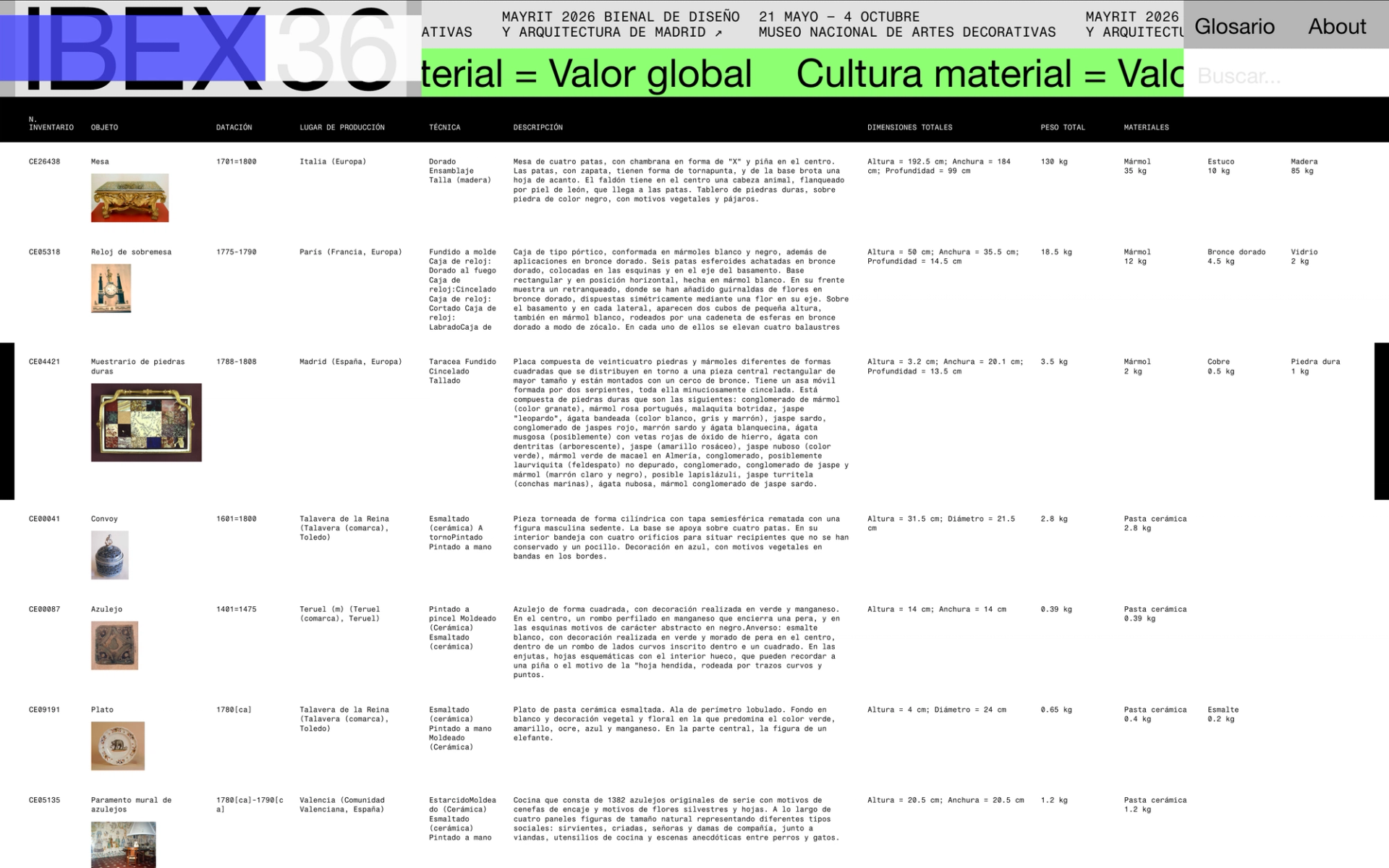
View of the IBEX36 platform.
KOOZ Ethical questions abound, but to clarify: in IBEX36, these museum objects are translated purely through their material quantum — with no value-shift for objects of decolonial or theological interest, right?
SB Yes, that was the idea. Theoretically, the museum arranges all of its objects in a way that conveys a specific and preserved environment. With IBEX36, we intended to eliminate all of that curated perspective, to see what happens when you navigate a decorative arts museum purely through a perspective of economic value — euros per kilo, so to speak.
The museum collection starts around the 12th century and ends with the latter years of the Bauhaus movement. This is the biggest difference between real value within the art market and that of materiality. For instance, a specific chair by Frank Lloyd Wright might be super special; perhaps there's only three or four left in the world, and they have one in the museum, which may be valued at some 100,000 euros — but in our system, the cost of the wood would put it somewhere between €3-5. These differences help us to navigate certain specific perspectives on what value is and where it comes from: a specific movement in time that they represent, or the specific author who has signed that specific piece — that name completely blows up the value of that object.
"These differences help us to navigate certain specific perspectives on what value is and where it comes from."
KOOZ The link between your work lies in the curiosity into how value is constructed, particularly between material and perceived value. Asset value in property can be highly inflated, as the notion of an asset is quite distinct from the pure materiality of a house.
LY Yes. It's interesting that Saúl’s project IBEX36 is focused on historical objects; what I've been looking at is usually a contemporary value, or rather an image of contemporaneity. You mentioned the domestic element of these objects in relation to authentic home life, which made me think about the showroom-domestic spaces that I encounter through Asset Arrest, and how they use objects and materiality to suggest status and luxury. Particularly in London, there’s a strong element of what I have termed global blanding: the spaces seem to be constructed to appeal to as broad a global buyer base as possible, albeit usually featuring a very European-centered idea of luxury. Even in China, show-homes are often set up in a very similar way, using objects and brands that suggest a European fantasy of a luxurious home life. Although we're all somewhat implicated in the systems that we criticize, I’m curious: how has the museum reacted or responded to your index of value?
"There’s a strong element of what I have termed global blanding: the spaces seem to be constructed to appeal to as broad a global buyer base as possible, albeit usually featuring a very European-centered idea of luxury."
SB On the notion of European tendencies of luxury, that’s something you see a lot in the museum. That said, Spanish cultural representation inherently connects to others, perhaps an Asian influence or French spirit visible in specific objects and so on.
I was surprised when the museum accepted the proposal. There’s a lot of enthusiasm to review their own collection, so they were very open to something that could provide another angle — the process was super positive. I was a bit worried at the beginning, as our proposal essentially undermines the daily work of all these experts and curators with knowledge of the artistic practice that they represent: we're deleting all that knowledge to focus on another concept of value.
Since the first day we installed our trading booth in the museum — with a big screen showing the live, fluctuating index of objects — a lot of people would come and watch, chatting behind us. It was the first time that they were able to appreciate the real value of the objects in the museum. For instance, they could now see that just within a selection of two hundred objects — from a possible 80 000 in the collection — the total value of gold alone is in the region of 40 million euros. That was quite stunning; even if people had some conceptual notion of value, they had probably never put a specific number on it
Regarding Laura’s work, the contrast that I really enjoy is indeed about location. In IBEX36, we're working with objects that have been produced in different parts of Spain but nowadays live within the same walls of the museum — a specific contextualized space. Meanwhile, you have been able to look at value fluctuations in relation to different localities in the city.
KOOZ That's such an interesting question about location and dislocation: also who is buying what, and from where? The question of location and its relationship to value is also relevant at an urban scale, both in terms of new development and heritage buildings or districts. Properties are marketed differently within and to various parts of the world either as fantasies or hard-nosed investments, adding on or stripping off layers of meaning as necessary.
LY I mean, it would be incredible to know the value of these luxury properties if reduced to pure material cost — especially as I lived in London for a decade before coming to China, where so much of the value is constructed through proximity and ease of mobility, even global mobility.
For instance, London City Island is a residential development complex in London where I made quite a lot of work; I also briefly rented an artist studio there, which gave me an insight into how art and culture is used to sell property. The complex is located in Newham — one of most economically deprived boroughs in London — but it also happens to be close to the financial hub of Canary Wharf, The marketing of this place was interesting, particularly in the global context: the development itself was a partnership between Irish developer Ballymore, and the Malaysian developer EcoWorld, so a lot of properties were sold through property fairs in Malaysia and in China.
London City Island was sold not only through its proximity to key locations in London — Harrods in 30 minutes, London City Airport in 15 minutes, but also through selling a particular caricature of ‘Britishness’. It’s a performance of culture and contemporary art, along with so-called placemaking — even a rebranding of place — whereby the actual history and complex reality of a place is heavily edited or censored in order to construct a new narrative.
"The actual history and complex reality of a place is heavily edited or censored in order to construct a new narrative."
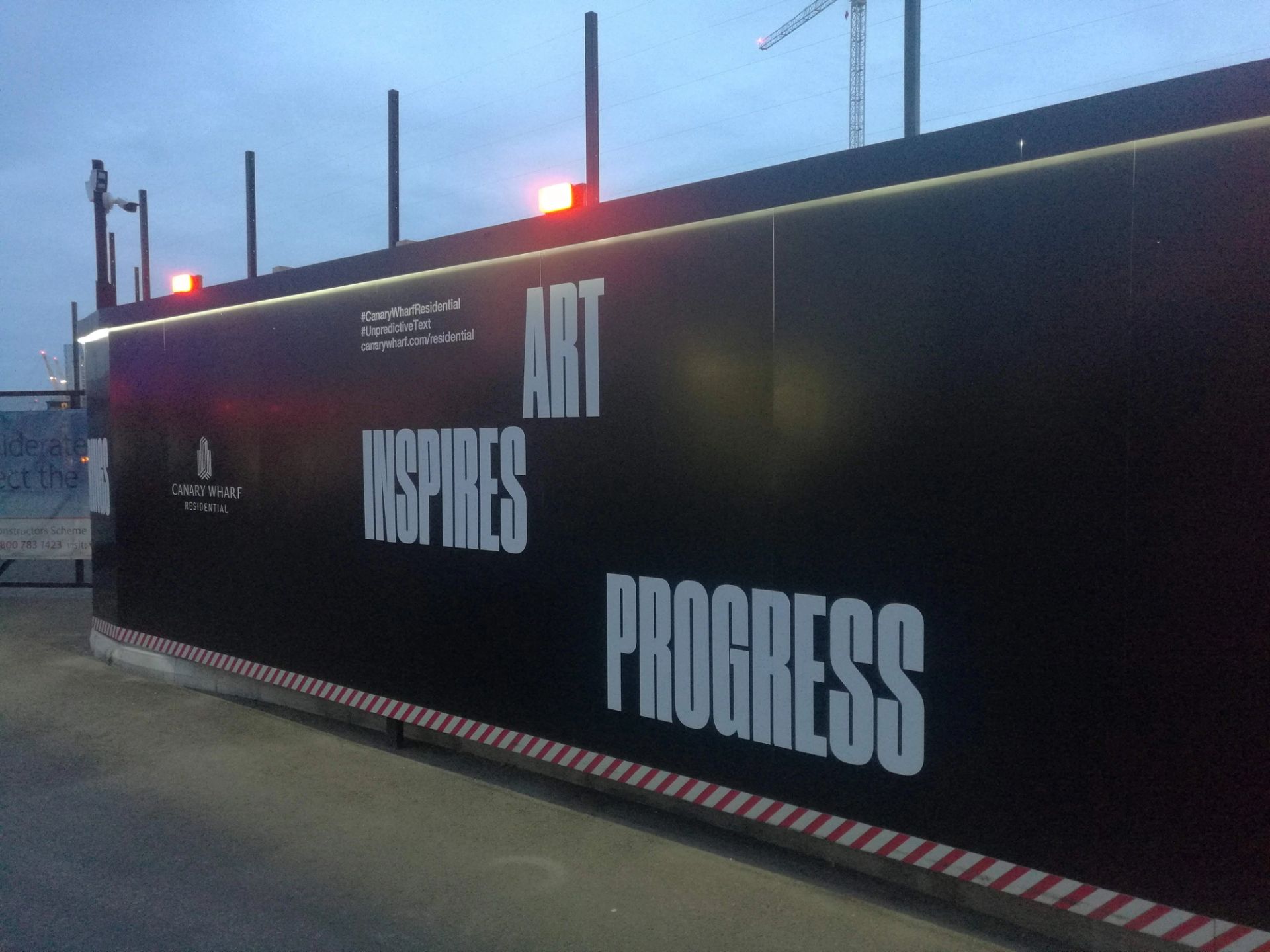
Canary Wharf, 2019. (Laura Yuile)
KOOZ IBEX36 strips those sorts of layers away, looking purely at material composition and value as a counterpoint to ideas of nationhood and even class representation. Are there any totemic objects that you identify as representing a particular lifestyle, to mirror the granularity of the IBEX 36 project?
LY Yes, thinking of objects that would be strategically placed in showrooms, one main recurring item in almost every show home is a copy of Kinfolk — either the magazine or the coffee-table book: I saw that in a lot of showrooms in China as well. As it happens, I've never read Kinfolk, but it was certainly one of the most common signifiers of a certain status. Also San Pellegrino water, in green bottles — high among the commonly recurring objects that I would see.
KOOZ Perfect. I like this idea of speculation as a way of imagining and organizing futures, could you say more about that?
SB I experienced something interesting with this exhibition: every time someone asked me about speculation within the project, I couldn’t tell if the question was about the methodology of speculation that we used to express the project, or the speculation of material values within the project. Indeed, as the Museo Nacional de Artes Decorativas is a national museum, nothing can be sold, only acquired — which is interesting. The museum receives a specific annual budget, and everything is purchased with public money. On top of this, the conservation costs of certain objects can often grow larger than the price paid for the actual object, which is interesting too — not an economic speculation but a value based on cultural and historical grounds, to protect what we have. Objects made of organic materials have complex and specialised conservation processes, requiring highly controlled environments.
Obviously, we work with speculation as a methodology, but not in terms of future value. We looked at a selection of objects that were already in the museum collection — all paid for with public money and intended to represent Spain. At the same time, we worked with a material logic that already exists in stock exchange markets. In terms of methodology, our mode of speculation involves connecting things that somehow shouldn't be connected — values that don't play in the same space, but which are based on real scenarios.
"Our mode of speculation involves connecting things that somehow shouldn't be connected — values that don't play in the same space."
The only thing that we're really speculating on is whether those values come together or not: what happens when one value index touches the other? In terms of markets and museums, what we are doing is perhaps a lesser speculation: the museum speculates on which objects they buy and what they represent, whether they should acquire them or not, and whether it’s possible to create a narrative of Spanish identity through them. To me, that's a much bigger speculation than what IBEX36 does, looking at the value of materiality alone.
LY It's interesting that you mention the maintenance of these objects, and their associated costs. In my own research on property, speculation is made based on selling future or projected profits; it’s not common to mention maintenance costs in that context. It was making me think about the idea of a museum of objects used to sell these properties, suggesting a possible future for the viewer’s life, but which tend not to dwell on suggestions of a future society or culture.
The reality of this “properties as assets” mindset is that the maintenance costs can be huge; that falls to the individual who may have bought into the idea of having a space to live — or onto the investor, in which case they may pass that maintenance, either as labour or cost, to someone else.
KOOZ The idea of maintenance is critical in terms of the difference between a desire-value and an operational value, right? We don't think of the museum objects as assets that we might purchase — yet there's an operationalised relationship between culture and capital, as evidenced in real estate.
LY Yeah, I think the museum project shows the present-day value of these objects, which we would assume to already hold a certain cultural value based on the very fact that they are in the museum. On the other hand, it is accepted that the value of real estate is constantly in flux; you base your entire idea of your future — or future profits — on that fluctuation. Again, that is quite detached from material value, while the IBEX36 puts material and cultural value on the same par, on a moment-to-moment basis.SB Our project involved a relatively simple and specific operation: selecting images of museum objects and connecting them with existing values associated with the IBEX. In your project Asset Arrest, what I found interesting is the series of conversations — without images— and how using only words, you are trying to place those desires and experiences. With your guests, you have to recreate those different spaces and the conversations that you have with the real estate agents. Whenever I've had to look at apartments or homes online, there are very specific aesthetics and approaches in terms of how images are taken: the angles that they use, the lighting, the whole process of visually selling a space, and projecting a way of living. These images are disturbed by the way that you present and talk about these spaces, and that was really interesting.LY We spoke about the show-homes — the obviously image-based ideal of a living space — but many of the properties I would view, particularly in London, were in unfinished buildings. They might not have walls yet: you would be given a hard-hat and a high-vis jacket and taken up a terrifying hoist-lift running up the outside of the building. The speculation, in other words, is not necessarily based on a finished idea of that property.
Estate agents switch between different modes in order to sell those spaces: perhaps the unfinished site feels more real to the buyer, but it’s also much more abstract as you have to project yourself into it. The show-home is maybe more like the museum: you see curated objects, and you're told how people use the space, in the same way that you rely on a museum curator to describe an unfamiliar fobject. We might see a big difference between a museum curator and a real estate agent but it's all about learning a certain language, in order to make people resonate with a way of looking and living with a space or an object.
"We might see a big difference between a museum curator and a real estate agent but it's all about learning a certain language, in order to make people resonate with a way of looking and living with a space or an object."
SB I also wanted to ask you about particular kinds of fetishisms you might have observed — is there a specific architect or even a well-regarded developer that you have observed? Sometimes a marginal quality is used to gain a better presence, like the character of a famous artist or musician living in the area, or who owned the building.
LY Yeah; one example in London might be the Balfron Tower, which was designed by Erno Goldfinger as council housing available for social rent, and then went through various periods of decline during which a housing association was created, yet residents were displaced. It then went into property guardianship and some artists moved in. Eventually it was bought by a developer who played up the appeal of this mid-century architect-designed building — they even created a floor of show apartments that they called the Heritage Collection, apparently refurbished just as Goldfinger had intended, down to the taps and faucets.
KOOZ In a museum, one is usually informed about a given object; our task then is to make sense of the society and culture that produced such an object, both learning from and imagining with it. The speculation one performs when looking at property is about projecting one’s life into it. To what extent does understanding materiality affect our awareness of invisibilised labour and extraction behind these objects?
SB You might expect that in a national museum, most of the objects would be of Spanish origin — but of course, they are not. Through the colonial heritage and identity of Spain, a lot of objects derive from that time; many elements are found in objects that are religious in form and function, as well as materials that were reconstituted once they were brought back to Spain. For example, there are many objects made of gold from Latin American countries; The original object and its cultural context was destroyed and the only thing remaining is the reworked material and its value; in this case, gold.
Another interesting relation in terms of labour has to do with objects that exist within the homes, but which were never used by their owners — rather, such functions were performed by servants or other workers, like cooking utensils and anything related to the kitchen or cleaning. In the museum, examples of such objects can be found in silver, gold, or other precious materials. Apart from silver cutlery used to test the safety of food, none of these items were really used. At most, these objects were used by people working for their owners, but never on themselves.
LY Almost all forms of labour in relation to the construction of luxury properties are hidden; at least, it’s not a particular subject of discussion in those contexts. At most, there might be a discussion around people working as architects or interior designers, rather than those involved in construction or the extraction of materials.
In terms of domestic labour, when viewing higher-end properties here in China, I’m often presented with properties that feature both a Western and a Chinese kitchen. Depending on the value of the property, homes will often include rooms for domestic help or housekeepers, would would work to maintain the property; at the higher end there is a spatial implication that support, in the form of live-in domestic labour, would be integrated into your lifestyle,
There is also usually some form of home office; many luxury high-rise condos have communal areas that would function as privatised co-working spaces along with other amenities like swimming pools and fitness centres.
KOOZ If late capitalism is in the service of transforming every possible quality into an asset — image, materiality, locality, heritage — as opposed to a metric of utility, which values are more resistant to this neoliberal quantification?
LY One would hope that it lies in things like social connection and care — we have spoken about maintenance, though obviously that too can be financialised. In the current chapter of our AI era, I think more about imagination, and how we mighty stop the extraction of that practice from our capabilities. I don't think imagination could ever be fully extracted or taken away from humans, but people who say they want to work creatively are increasingly using AI to perform that work. In critical response, it’s worth noting that imagination is something that feels lacking within the luxury spaces that I've been studying. So imagination would maybe be the one of the most important forces that, hopefully, can resist being quantified or financialised.
KOOZ That seems like an optimistic and powerful note to close; it’s delightful to see how many aspects of your work speak to each other. Thank you both.
BIOS
Saúl Baeza Argüello is a researcher, educator, creative director of DOES and MAYBE, founder of VISIONS BY and content director of VIBE. Baeza is also the co-director of the Master in Design For Emergent Futures (MDEF), organised by the Institute for Advanced Architecture of Catalonia (IAAC) and Elisava Barcelona School of Design and Engineering. Saúl has taught and engaged with various educational and cultural institutions including Harvard Graduate School of Design, University of the Arts London, Institute for Advanced Architecture in Catalonia, and many more.
Laura Yuile is an anti-disciplinary artist, researcher and educator from Glasgow whose work has recently explored the cultural infrastructures of real estate, retail and global commodity systems. Currently based at the Institute for Creative Innovation in Xiamen, her practice-based research examines how infrastructures – such as housing, retail, logistics, and networked technologies – shape everyday life, produce cultural imaginaries, and mediate forms of value, labour, and community.