KOOZ The White House. Domestic Propaganda emerges from an academic studio. Can architecture operate more openly as a political discipline in the academy than in professional contexts?
Davide Fabio Colaci Certainly, younger generations can offer a privileged vantage point and are more politically engaged than we tend to believe. The university has always been a place of civic and political consciousness, one that takes shape through design and research. Nowadays, students reject the notion of a disengaged architect concerned only with form, colour or elegant representations. Indirectly, the school can act as an incubator capable of transforming the profession itself. We must make room for new generations, who are neither better nor worse than others, only different.
"The university has always been a place of civic and political consciousness, one that takes shape through design and research. Nowadays, students reject the notion of a disengaged architect concerned only with form, colour or elegant representations."
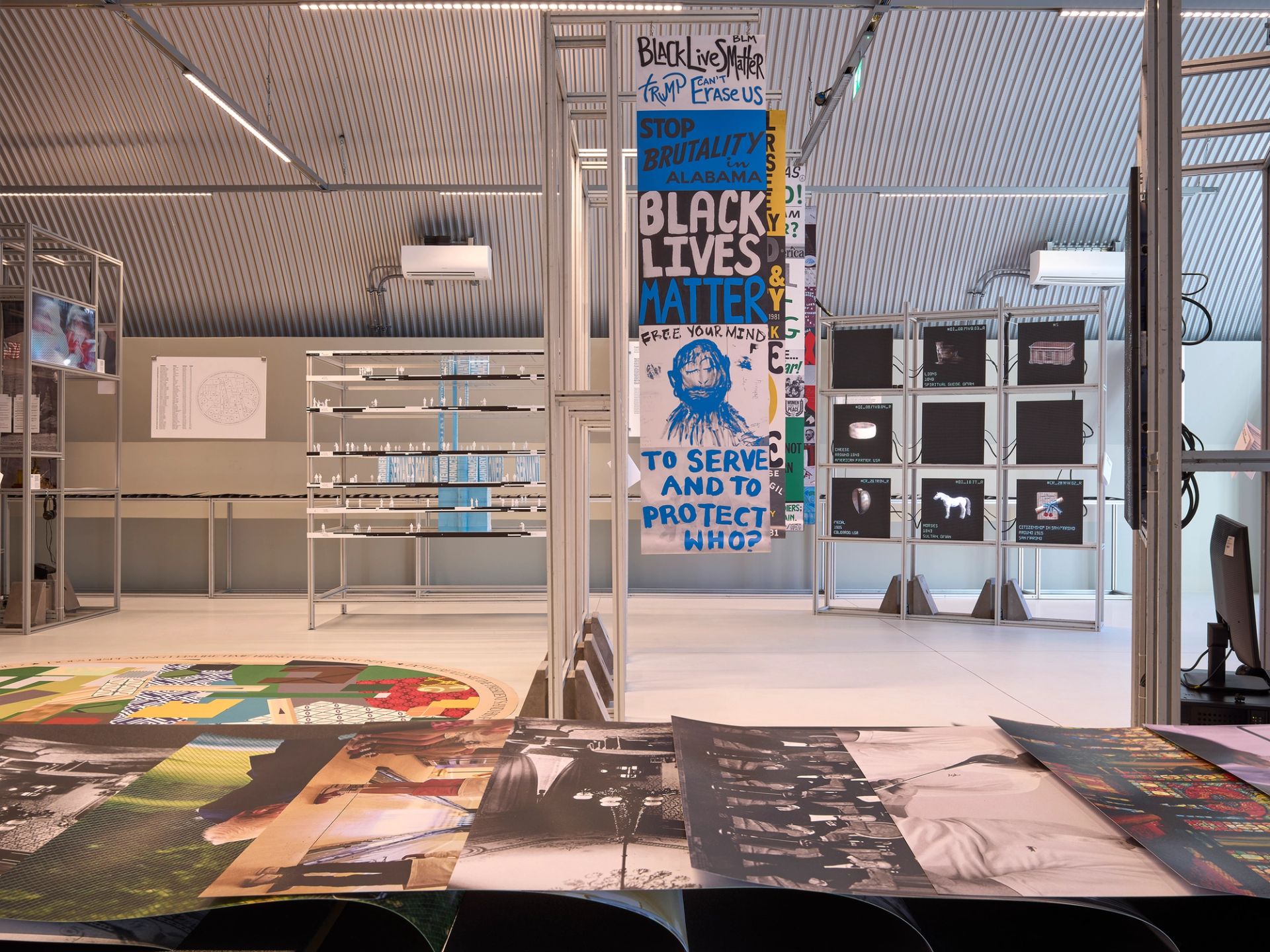
The White House. Domestic Propaganda on show at DropCity
KOOZ The research and subsequent exhibition at Dropcity frame the White House as a “domestic device of propaganda.” At what point does domestic space cease to be private and become a political instrument?
DLC For years now, interiors have surpassed the symbolism of monumental architecture, where scale and permanence traditionally coincided with the idea of the eternity of power. Today, however, power is no longer an element of stability but of uncertainty; from the optimism of infinite progress to the indeterminacy of an increasingly contradictory present, both design and politics seem unable to present themselves as tools for shaping and transforming reality. Interiors have thus become a response to the volatility of a politics that struggles to operate clearly within the real. This contradiction continues to shift dwelling into the realm of communication, an operational space where the roles of citizen and consumer have become almost entirely interchangeable. For this reason, the White House becomes a perfect site of inquiry.
KOOZ If every interior element, from furniture to rituals, acts as a political sign, can architecture ever be neutral, or is neutrality itself a constructed ideology?
DLC This is a difficult question. Personally, I do not believe that a “neutral” architecture exists in itself, but I do think that a project can be open to coexistence and complexity. Some projects speak of an inclusive world, allowing for rituals and habits capable of being rewritten over time. In a sense, the weaker a project is, the more democratic it becomes. This is, of course, assuming that democracy is still the best form of governance for our communities, though even this could be open to debate.
KOOZ The White House is described as a transmedial symbol circulating across multiple media platforms. How does this continuous reproduction reshape the architecture — does it begin to exist more as an image than as a space?
DLC In fact, the White House has always been both. If we think about its spaces, we know them more through television series, films, and media coverage than through direct experience. Suffice it to recall that the famous CBS documentary in which Jacqueline Kennedy presented the newly refurbished interiors of the White House remains, to this day, one of the most widely watched programs in the history of American television. Today, such a concentration of audience would be impossible, as it is dispersed across multiple platforms where content and images have become the primary elements of spatial editing. The White House is, and will always be, a palimpsest of images, storytelling, and staging. The interplay of these elements constructs a real space that no longer maintains any clear distinction from the virtual or mediated one — just as in politics.
"The White House is, and will always be, a palimpsest of images, storytelling, and staging. The interplay of these elements constructs a real space that no longer maintains any clear distinction from the virtual or mediated one — just as in politics."
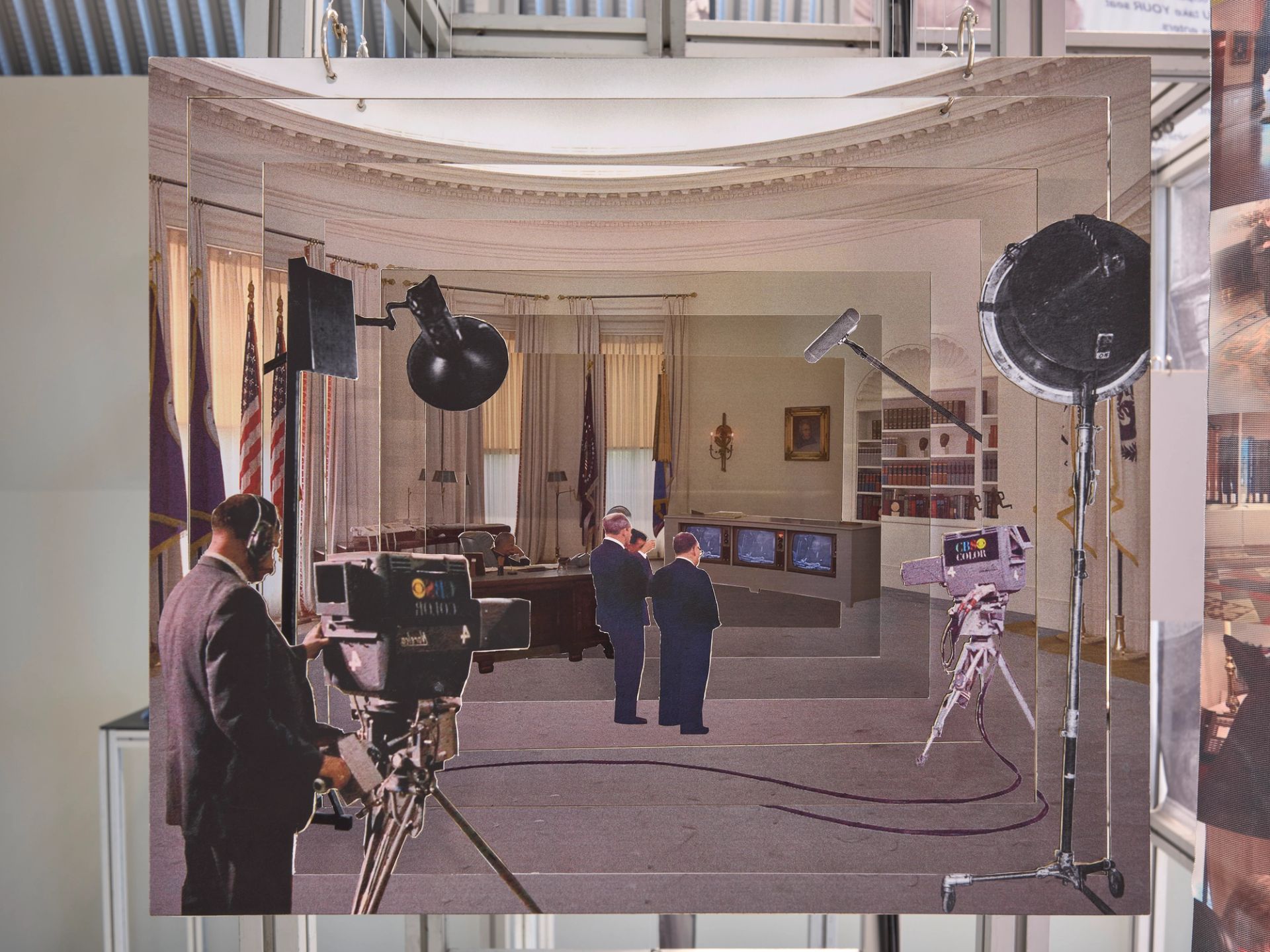
The White House. Domestic Propaganda on show at DropCity
KOOZ The exhibition — which runs until the end of April — unfolds through seven installations. Could you expand on these, and on the curatorial strategy through which they are staged?
DLC It is impossible to convey the complexity of such a wide-ranging research through a single, unified image. The themes were chosen by the students according to their own sensibilities and interests. This too is a way of giving voice to urgencies that do not necessarily align with mainstream narratives or mass media agendas. The seven installations are independent, yet each enters into the dimension of the others, constructing a logical path that allows visitors to form their own narrative. We cannot and do not wish to tell everything, but only what we want you to know. Perhaps this, too, is our own form of propaganda.
KOOZ By exposing invisible labour (Deep America) and ritualised spectacle (Rituals of Entertainment), the project oscillates between critique and representation. How do you avoid aestheticising the very systems of power you aim to question?
DLC I don’t think it is possible to avoid aestheticising these systems of power. On the contrary, it is precisely through aestheticisation that such systems become visible, legible, and therefore open to critique. The risk lies not so much in representing them, but in doing so in an uncritical or complicit way. For this reason, the project seeks to maintain an ambiguous position, where attraction and critical distance coexist. It is not a matter of withdrawing from the image, but of using it as a tool to reveal the contradictions it itself produces.
"I don’t think it is possible to avoid aestheticising these systems of power. On the contrary, it is precisely through aestheticisation that such systems become visible, legible, and therefore open to critique."
KOOZ If the White House embodies a globalised model of political domesticity, what alternative forms of “domestic power” should architecture begin to imagine today?
DLC Today, the question of the domestic is widely misunderstood. It seems to have lost its critical relevance, even within professional journals. On social media, the display of the domestic has become something akin to pornography, only it is not restricted to those over eighteen. Houses are now only observed ‘through the keyhole’, and we are no longer capable of seeing homes as outposts of change. In a kind of short circuit, we are also changing the way we inhabit them, much as has happened with the White House. The difference is that our homes are the theatre of our existence, often a political one as well. Perhaps we should begin again from the narratives of those who lack political representation, from more marginal groups, independent cultures, or those who do not have a home at all, or struggle to afford one. Even our students often face difficulties in finding housing at accessible prices.
KOOZ Ultimately, is the exhibition an act of critique, or does it also risk reproducing the symbolic power it analyses?
DLC The exhibition positions itself within a zone of productive ambiguity: on the one hand, it performs a critical function; on the other, it cannot entirely escape reproducing the symbolic devices it seeks to question. It is precisely within this tension that a space for reflection emerges.
BIO
Davide Fabio Colaci is the director of DFC Studio, which looks at the transformations of contemporary habitat through design and interdisciplinary research. It is involved in design and curatorship investigating the phenomena of change related to design culture with specific experience in exhibition and temporary design, from the house to the event. Colaci is a lecturer in Interior Architecture and Exhibition Design at Politecnico di Milano and Course Leader of the Master’s Degree in Interior Design, IED Milan.