Federica Sofia Zambeletti / KOOZ Thank you all so much for making the time to meet together. Each of you is doing so much to shift the way that architects might understand their capacity to intervene in certain histories, in ways of seeing and understanding the world.
Nasser Golzari Thank you very much for inviting us to participate in this discussion. It is an opportunity for us to critically reflect on our practice, which has been focused for the last two and a half years on Gaza, and our longer term work in Palestine over the last ten years.
While working at the one-to-one scale, we also address the scale of 1:10 000 — tapping into existing systems whether formal or informal, as well as working with different stakeholders, and administrative structures. Working at such disparate levels doesn't normally happen, but over the years we find that in order to be able to achieve anything — especially in occupied Palestine, Gaza and the West Bank — it's the only way: dipping in and out, ducking between different scales and stakeholders. In what we refer to as a foot on earth and a hand in the sky we try to work at the practical and the speculative level: at times, we can put our foot on the ground — addressing reusable materials and emergency shelters — and at the same time, we put our hand in the sky, by imagining together alternative means to heal and disrupt the existing systems.
Yara Sharif Thanks for being here — it’s nice to be in conversation. To follow on from Nasser, our intentions are also to disrupt the colonial systems and power structures that have distorted the Palestinian story or narrative over the years. Part of this is also about disrupting how architecture is dealt with nowadays, particularly when it comes to aspects of Gaza. The whole idea of a master plan, or of what reconstruction could mean — these are very difficult questions. Therefore, our work is also a way of interrupting, of critiquing, pausing and thinking. Could we imagine differently — on one hand, challenging colonial systems, and on the other, proposing alternatives to existing power structures?
"Our intentions are also to disrupt the colonial systems and power structures that have distorted the Palestinian story or narrative over the years."
NG In the context of Gaza — or indeed, Palestine — as architectural practitioners, we work on challenging and disrupting the convention -- which has always been a practice for us, whether it's about opposing imposed masterplans or any other imposed framework. We don't necessarily engage in the ‘iconic’ built form, rather we engage in developing alternative open systems and strategies.
Eyal Weizman This mode of practice that you describe frames the questions we confront in practices like Yara and Nasser’s — and potentially in Forensic Architecture — as belonging to aspects of anti colonial work and struggle. An anti colonial struggle is obviously a revolutionary struggle; it's a struggle that seeks to overthrow a particular system by various means: mobilising the law, mobilising architecture, mobilising public opinion, resistance or support of resistance.
"An anti colonial struggle is obviously a revolutionary struggle; it's a struggle that seeks to overthrow a particular system by various means."
From our perspective, one goes into normative systems like human rights regulations and international law — nothing particularly revolutionary in that. These are instruments of measure, they are about quantifying behaviour. They are instruments designed by states in order to regulate state behaviour; we ask whether there is any potential in them to actually do something more, and in what way?
One can see quite clearly that at the frontier of the struggle — take the anti colonial struggle against Zionism in Israel — international law is at the forefront. You see that for the first time, the ICC — after decades of existence — is bringing claims against Israeli security political figures. You can see that the ICJ is starting to deal with the genocide, and in dealing with it, looking at the longer history of the struggle. You see that the people that provide the most crucial information for the ICC and the ICJ — Al Haq, PCHR, Al Mezan and many other Palestinian civil society organisations — are being sanctioned, or being declared to be terrorists. You can see that the UN Special Rapporteur Francesca Albanese is being sanctioned; you can see that the ICC itself is being sanctioned. So you understand that the site is under a lot of pressure at the moment.
One of the reasons that it's under so much pressure is that there's some kind of potential to be found in it. It became risky, specifically for the continuation of Israeli settler colonial practices. So in that moment, in the very first instance, it became a risk. For years, it was somehow toothless, crashing against a geopolitical reality that is seeking to shut it down. There's a whole question of why that happened and what's in it for whom, but we can return to that later.
Another thing that I would put forward is the idea of architectural history, and how to a great extent, Forensic Architecture is a practice of history. We're dealing with incidents that have happened. We're dealing with events in the past. We have radically condensed, in some cases, the duration of architectural history into what we call the molecular level of time, the irreducible unit of architectural history: the irreducible moment or duration of perception. Time can always be measured in shorter units, but in the law, the unit of perception is referred to as the split-second. The split-second is the official shorthand for the minimum amount of time to which the law can actually refer; nobody asks how long a split second actually is. What happens when architectural history enters into those durations — those micro-durations? In the post war era, there was this big debate in architectural history, between the Annales school of historians of the longue durée and the micro historians who spoke about everyday life — now, we're condensing it even further. This is not micro history; this molecular level history.
"Nobody asks how long a split second actually is. What happens when architectural history enters into those durations — those micro-durations?"
What does it mean to fragment and explore the minimal unit of the incident — the split-second when somebody is shot, murdered by police forces or by the occupation army, or any other agent of the repressive state? We’re using the tools and technologies of architecture to analyse the smallest unit of architectural history. What we found is that by condensing the gaze into a molecular scale of time — by breaking an incident into its minutiae — we rediscover the long duration, the context in which that incident has taken place.
If we are looking — as we have done, at the request of her family — at Shireen Abu Akleh’s murder outside of the Jenin refugee camp in May 2022, we're talking about breaking the micro moment, but finding within it the entire history of settler colonisation. The place of those dedicated frontline journalists that go, risking their life to expose it — like Shireen Abu Akleh, one of many hundreds of journalists in Palestine and now in Lebanon that have been murdered by Israel, in a similar to those human rights organisations, which are being sanctioned. These are attacks in various grades and gradients, upon those people who provide documentation, who narrate on their own terms, who attempt to write a history. So when you hack into the split second, you find not the mesoscale, not the immediate context, but rather the entire history of colonisation and resistance in it. The question is whether that molecular-level history, the history of an intensified gaze, can actually also open up a deep, tragic-contextual understanding — one that shows how the shadows of a long history are actually cast and found within the details of an incident.
KOOZ Thanks, Eyal. Forensic Architecture works with architectural tools; it also engages deeply with other disciplines. What methodologies do you consider important to engage with these micro-moments? I would also put this question to Yara and Nasser, in terms of using speculation to resist the imposed master plan even while engaging on the ground.
NG One thing that struck me among the talking points we considered for today is a reference to intervention — how architecture intervenes. We actually see our role more as mediation, rather than intervention — especially in the case of Gaza. An intervention that is arguably gentle; it moves between systems that exist in order to create and construct possibilities — potentially visible or invisible. Of course Yara and I have always looked at what Eyal and Forensic Architecture has been doing, and felt that we need to complement the power and value of that. We see our work as learning from the analysis and constructing possibilities, but moving between layers as a mediator.
Now, when we talk about challenging the fixed, top-down master plan, it is to do with us creating architecture that challenges colonial modes of practice, ones that work in parts, rather than as a complete whole. By working in parts, we're attempting to create the conditions for it to function dialectically, through the practice of the ground — if you like, a material-objective condition at the ground to grow, to change and become something else. For us, this is a practice of gentle meditation rather than direct intervention.
"When we talk about challenging the fixed, top-down master plan, it is to do with us creating architecture that challenges colonial modes of practice, ones that work in parts, rather than as a complete whole."
YS Perhaps this departs slightly from the question, but whenever we talk about Palestine, I feel very sensitive or careful — especially lately — because of Gaza and things that are very close to our hearts. It is a difficult subject and one that comes with such a responsibility, it's quite heavy. Besides the idea of dealing with a colonial context, we're dealing with a new situation that we've never dealt with before. It's been there, but at the moment, it's pushed to its extremity. Facing this and feeling the urgency to do something about it always puts us under an almost personal spotlight, one that involves much self critique and reflecting thinking: is this the right approach? Is this the wrong approach? Exactly what are we trying to disrupt? Ultimately we're trying to disrupt everything, including what we're familiar with in terms of architecture practice, rethinking a lot of aspects that probably were normalised before. It means rethinking what aesthetics mean, rethinking what normality means, what accumulation of small changes could mean.
Maybe because of the absence of a state, a big umbrella that holds Palestine together, one feels the necessity to mediate, as Nasser says; to step back and ask where the role of architecture starts. A lot of times, this work really strips itself completely of the conventional aspect of building — moving from something that involves object making, designing or arranging, to something that is at times very psychological, almost related to mental healing. It’s about preserving narrative, as simple as that. I wanted to acknowledge this difficulty and the need to bear with us — being gentle even to ourselves — as we go through this work, because it's not an easy process.
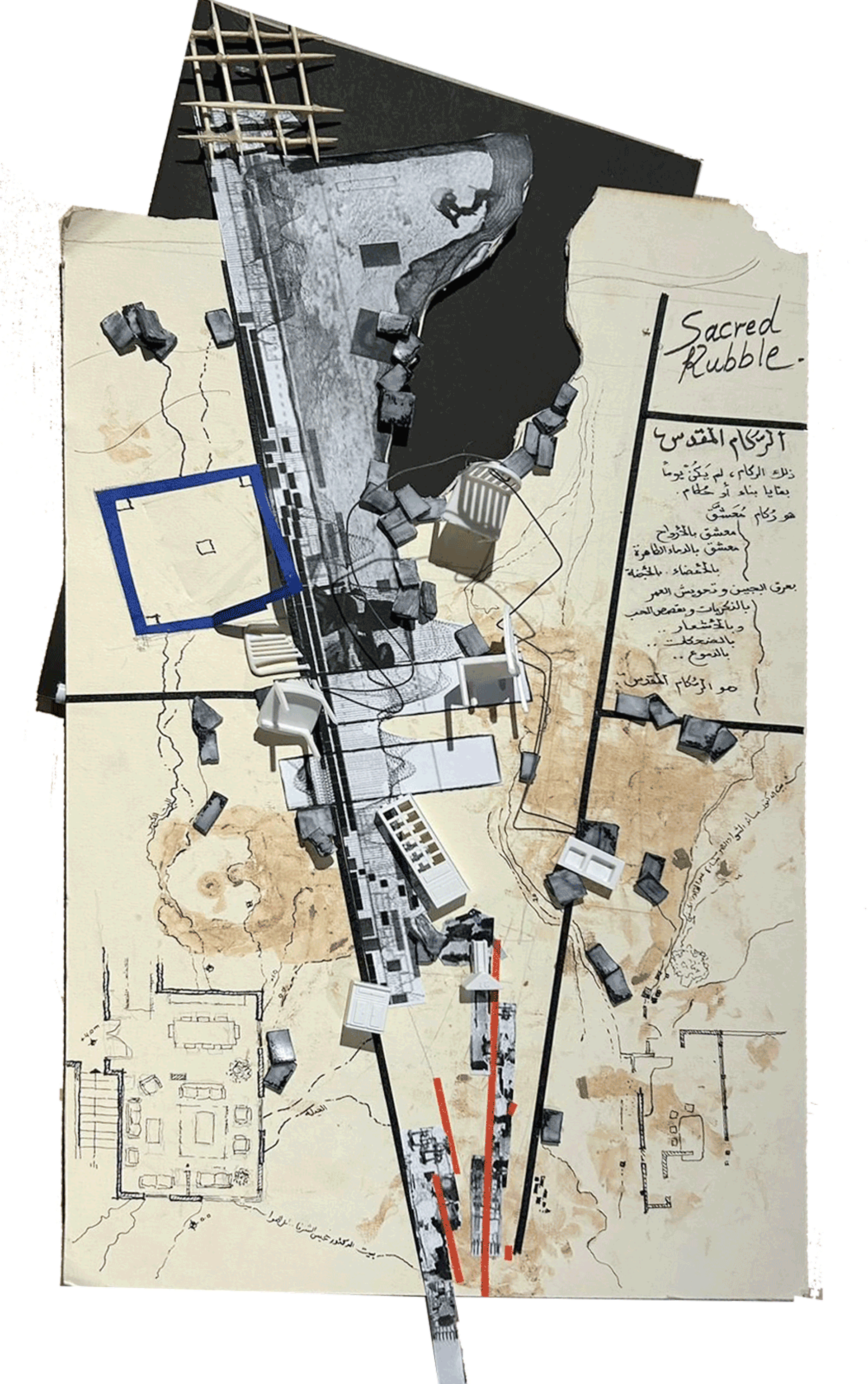
In November 2025, a Cairo workshop brought together Gazan students, architects, and academics to map Gaza’s collective memory through design, capturing the intangible and everyday. This work is titled 'The Sacred Rubble' by Haifaa Khamis Alshurafa.
NG But this gentle mediation has been quite an interesting practice, actually. One of the questions that you have probably encountered, Eyal, is about bureaucratic forces. How do you work with bureaucratic forces? Now, in the case of Gaza and over the past two and a half years, for various contradictory reasons, some of these bureaucratic forces have disappeared; they could not exist. Actually they can't do anything until there are the conditions for them to exist. But the non-bureaucratic forces — including the existing governance of the municipality, the mayor, the engineers — have persisted, and we continue to work with them, often responding very practically and systematically to conditions on the ground in Gaza, trying to facilitate what can take place. It might appear that we intervene to interrupt things gently — because interruption is required. But you do have to anticipate how bureaucratic forces are included at some point; that's where some kind of negotiation has to take place. That’s not necessarily an architectural discussion, but it will come to shape the everyday society and community of Gaza in real ways.
EW Okay, I'll say two more things: one in response to Federica's question, and then picking up on what Yara and Nasser have just shared. The first is a general question about Forensic Architecture. Now, what are the tools of the historian — what kind of history do you write, and for what aim? For us, things like fluid dynamics, among various material simulation practices, are modes of seeing, modes of understanding history in all its dimensions — because history always involves the interrelation between people and things.
Our practice involves what we call situated testimony, in which testimonial practices are undertaken within a kind of a process of building a model of a site and walking through it, as recollection and architecture get entangled again. Testimony and evidence are entangled together, they're not separate; the practice of history is both. It’s about living in the world, and it works as a relation between people, their dreams, their aspirations, and the material world that is being changed and dragged around. So in any act of historical narration, the task of the historian is to understand all the agents that operate and shape the world. As architects, we feel that we're bringing in architectural tools to act as tools of the historian. That can be quite provocative as a statement: I don't often frame Forensic Architecture as basically a practice of architectural history. Obviously, history is not only about the past; it's about subjectivity, narration and about imagining the future through situations.
"The task of the historian is to understand all the agents that operate and shape the world. As architects, we feel that we're bringing in architectural tools to act as tools of the historian."
Over the past several years, as we have witnessed together with our partners in Palestine — in Ramallah with our organisational partner Al Haq, and in Gaza with Ain Media — many parts of Palestine are experiencing erasure, at different scales and intensities from what is happening right now in the West Bank, particularly along the Jordan Valley. It is very reminiscent of what is happening in Gaza: a campaign of murders and rapes undertaken by Israeli soldiers together with settlers, intended to completely “cleanse” the area and and resettle it. What is happening now in South Lebanon is very similar to what happened to Beit Hanoun, Rafah and Jabalia. The south of Lebanon is being completely ungrounded, erased. What we see in all those places is that there is a certain kind of destruction — not as in other battlefields, where you see buildings that are destroyed and maybe collapsed onto the ruin. Instead, we see total erasure. Even the traces of destruction are being removed, they're being ploughed over. The earth is being upturned, so that no site remains; lines negotiated over the generations between Palestinian residents, farmers, urban dwellers in the camps in the cities everywhere, are just being erased. There is a kind of a tabula rasa that is being created that erases even the traces of erasure.
This is really where practices like we described before by Nasser and Yara are actually the most important practices happening today, because their way is very gentle. This is why it's so moving for me to be in this conversation of resistance in architecture by reinscribing the surface back with meaning and with its history. Those development plans by Trump’s psychopaths — or by the Arab state, maybe not less psychopathic, to some extent — are just continuing the acts of erasure; that tabula rasa is like blood for real estate sharks. It allows them to imagine something new. The very act of imagining of something new is the continuation of genocide by other means. Right? The minute that you design — or when non-Palestinian architects are daring to design housing, public spaces, mosques, universities, for Palestinians, on top of ignoring the wishes of the people, this is a continuation of the same act of erasure. Architecture, in this sense, is the continuation of genocide by other means.
"When non-Palestinian architects are daring to design housing, public spaces, mosques, universities, for Palestinians, on top of ignoring the wishes of the people, this is a continuation of the same act of erasure. Architecture, in this sense, is the continuation of genocide by other means."
What I've seen in the practice of Yara and Nasser is a very gentle attempt. It comes from a very different kind of intention — without bravado and against that erasure — to reconstitute communities, to actually involve people in reconstruction, and to make the process of reconstruction an act of social and communal building. It's really the only way to face that abstract cartographic violence that is applied to these places. The phrase ‘bottom-up’ has become banalised, but it’s really about something that grows from the ground —including the social relations that existed in place. So I find that to be the most hopeful practice that one can actually encounter these days.
KOOZ Nasser, you mentioned the dual aspects that drive your practice; when working on the ground, what stakeholders are involved? You also launched a seed funding initiative in October 2025 — what role does this strand of activity play in your work?
NG Firstly, it was really wonderful to hear Eyal describing our work in that context; thank you very much for that. We have always learned so much from what Forensic Architecture does, and in many ways, if that work had not been implemented and applied in the way it has, we probably wouldn't be able to do what we're doing now. There is always a need for different parties, different anti-colonial forces — people who are aware of class struggle and so on — to act simultaneously, so that we can build aspirations, but also theoretical positions; that's always been the case for us. Going back to this idea of the hand in the sky and the foot on the ground, this concept has developed since we started working in Palestine, in 2014 or even earlier. The speculative is quite critical as it breaks the power of the colonial or occupational forces by creating possibilities as dreams. As architects, we believe that one has to be able to dream. We cannot avoid dreaming. We have to see what's possible — just as the Constructivists, after the Russian Revolution dreamed about things that seemed impossible. They were actually creating things that many, including Stalin, believed to be impossible; it couldn't exist. But still those dreams had to be visualised somehow.
"The speculative is quite critical as it breaks the power of the colonial or occupational forces by creating possibilities as dreams. As architects, we believe that one has to be able to dream."
We cannot avoid dreaming. We have to see what's possible — just as the Constructivists, after the Russian Revolution dreamed about things that seemed impossible. They were actually creating things that many, including Stalin, believed to be impossible; it couldn't exist. But still those dreams had to be visualised somehow.
Putting your foot on the ground, and working with different organisations, like municipalities, housing councils, the UN and with engineering groups. It is a continuous process of gently mediating and interrupting, but also facilitating. In terms of the speculative, it's just so critical to be able to continuously remind ourselves that the wall doesn't always have to be there. Occupation doesn't always have to be there. Just as Marx said, all that is solid can anytime melt into air. And we've seen it. We're seeing it now. What's happening in Iran and global politics is impossible to predict; now it’s a game of chess. The reality is that we have to be able to see that the wall will ‘melt into air’, at some point. It could be any time.
So keeping that foot on the ground: we launched a seed funding initiative, as a means of handing over what we've been doing to those with local agency (though our organisation Architects for Gaza includes a large cohort of architects and participations, both internationally and specifically in Gaza). We've also launched other grants — and actually, we just received a very small grant to set up what we call the Open Room. The Open Room is a very practical initiative, responding to the present conditions of Gaza under siege, where nothing is coming in or going out again. The only practical means to operate is through the Open Room, which would be run by the locals — we are setting up stakeholders within Palestine and Gaza itself. This is a place where they could get together collectively to test and discuss reconstruction methods. The Open Room is about acknowledging the local knowledge and skills in Gaza and seeing it as a spine to any intervention rather than something imposed from outside. The idea of the Open Room is that we'd be running it for three or four months, with a small budget from our grant — then crucially it would be handed over to the local stakeholders to continue, and eventually provide uplift and employment. Most importantly, it provides a place for debate and discussions — speculative ones as well as the very practical.
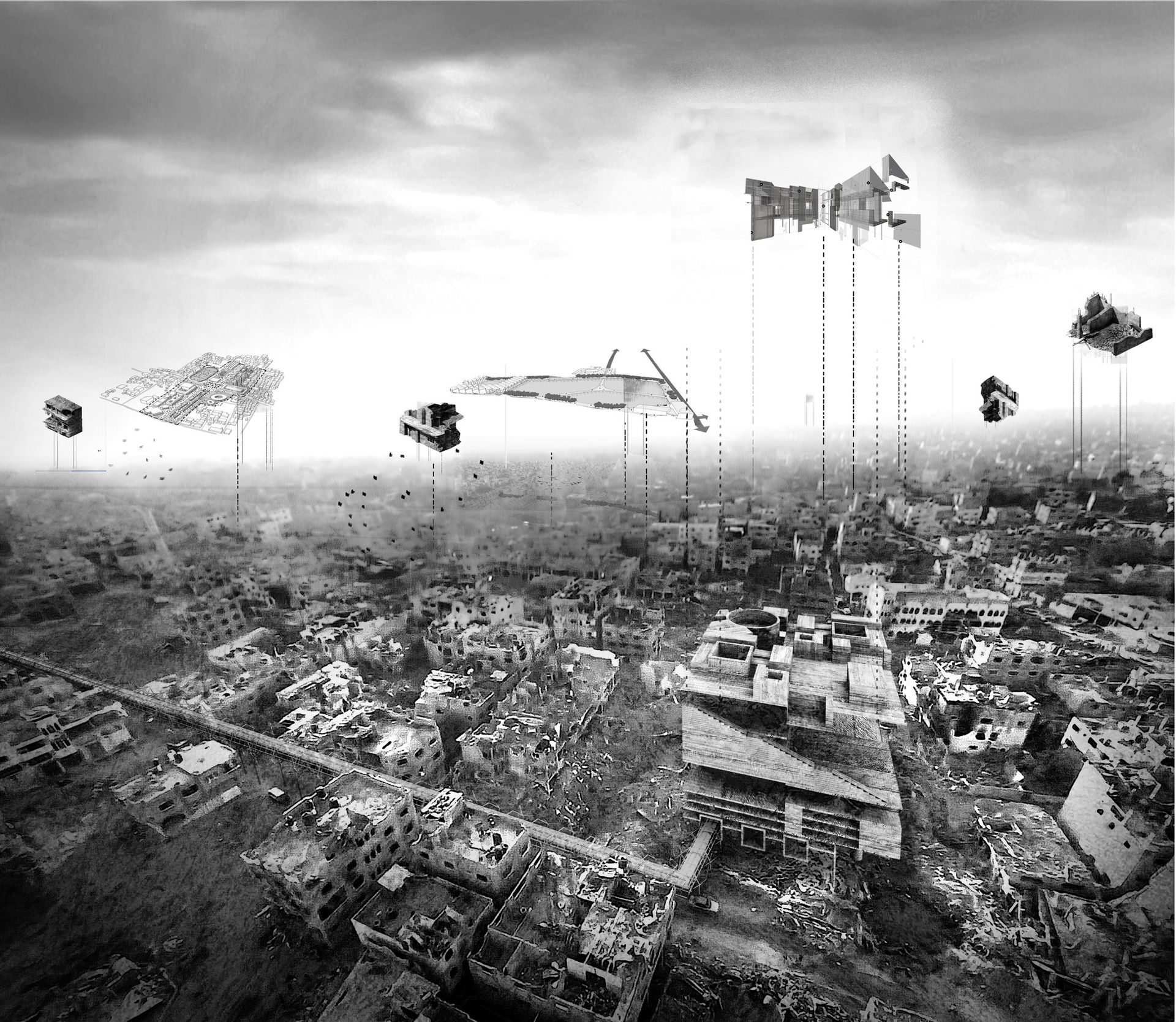
Architects for Gaza, Architecture of Parts, 2025. AFG’s overarching strategy for healing and empowering Gaza through accumulated small-scale, site-specific interventions is an alternative to master plans and the one-size-fits-all approach.
YS This also relates to the seed funding, in the sense that the provision of seed funding is probably a design decision. Returning to idea that architecture takes an alternative role, it was important for us to work with the municipality and the local stakeholders in Gaza to discuss specific sites in which they were interested, but while we might speculate and facilitate thinking around some general ideas, the seed funding becomes a tool to give agency back to local people, ensuring that they take the central role in design. Regardless of what comes, that money or fund always goes out to local architects to provide agency, given their capacities and present urgencies. Through this practice of accumulating small changes, the seed fund is intended to empower local people, local architects and engineers who are already in Gaza — which aligns with the Open Room as an urban forum or even a common living room, a place to host local discussions on what will happen in different contexts and places in Gaza.
"Through this practice of accumulating small changes, the seed fund is intended to empower local people, local architects and engineers who are already in Gaza."
NG The collaborative work with the municipality builds on two selected sites and briefs that they have provided. The joint initiative is viewed by the municipality as their ‘dream’ to defy siege, and desperation
Again, it’s about agency and empowerment. About taking ownership to stress on the right to land, right to city and right to resources. . These sites rethink existing and proposed interventions to reclaim Gaza’s narrative and respond to the genocide, from very practical needs, like a research centre for prosthetic limbs for the countless injured, to a women’s sport facility.
YS … Or a swimming pool or a cultural centre: the municipality is trying to emphasise that cultural aspects of Gaza are just as important as the residential. Of course, there are a lot of difficult questions and uncomfortable questions as well. What do you build? Who do you build for? What does it mean to build in a context of urgency? How do you deal with ruins? There are a lot of difficult aspects that Eyal also discusses in his new book, which is amazing.
EW I’ve seen — also in work that you've done with students — that the word “seed” also emerges when looking at the restoration of indigenous plants; in a sense, understanding architecture to include the entirety of the biosphere. I think that with any act of restoration and repair, those terms are so interesting, because even reconstruction — the minute rejection of the erasure itself, the abstract erasure of the surface, and the act of reinscribing it with communities and life — it can only ever be a part of a repair; of a colonial repair, that has a much longer horizon. The way that I've heard you speak about the strength of communities, even while incarcerated in a concentration area like the Gaza Strip, proposes that they would be able to claim their return to the areas from which they were expelled in an even stronger way. It's always about gentle acts in the present with a long horizon. This collapse of temporary temporal scales — between the building and the biosphere, between now and the long duration of liberation — somehow resonates with the long duration of a split second that I mentioned earlier, the relation between the molecular and the social level.
It’s looking at a place through a particular soil with particular vegetation that is restored with a particular concept of home, that is reconstructed in a notion of community, which itself is reconstructed in relation to a larger claim that is never abandoned.
It's also important to understand that when one faces levels of erasure — which, by the way, are still rising; the ceasefire did not stop anything. Those areas that are east of the so-called yellow line that divides Gaza from the bigger part [of Palestine] — almost 60% in Israel — is a full-on construction site. There are hundreds of bulldozers using that area as if it was their own: reshaping the landscape, building new mountains from rubble, organising and building road networks, adding lights and asphalt to this road network, connecting it into the Israeli electricity and traffic grid, tying it together with that violence.
This is not only architectural; in a micro sense, it is really against the soil — the depth of the soil, the water, the plants that are unique to the eastern part of the sandstone ridge that divides the east and west sides. Gaza itself is the largely sandy western part, while the eastern parts are a very complex combination of alluvial soils that each enable a different kind of cultivation. So one has to look at repair in relation to the totality of harm. An attack on those fields, on that soil, decreases Palestinian food sovereignty. The degrading system of destruction and control of aid coming through, in which Israel decides how much aid and to whom is being given is amplifying the other harm, the erasure and destruction of the environment. It takes millennia to form that unique soil of Eastern Gaza and an instant to destroy. Thinking about repair is really about being tuned to those different temporalities in the entanglement of nature and architecture.
The seed, in that sense, reminded me of some of your previous work, where the careful act of repair is also attuned to the indigenous forms of life in that place, trying to preserve plants and seeds that are lost — so that when liberation happens, they could be used — and this involves thinking about architecture in its multiple temporalities. A building may last 20 or 50 years, even if there's no war, while the architecture of the soil can last for millennia; the ecosystem of Wadi Gaza, for example, has its own temporalities. There are multiple durations being brought together.
YSYou're right, Eyal. It’s related to what we call the very uncomfortable questions, this whole notion of rejecting the erasure, as you rightly mentioned. What does repair mean when you want to reject erasure, but also when you work with an apparent emptiness? Can one accept temporality and incompleteness — how do you work with incompleteness? How do you work with an emptiness that is not empty? How do you deal with a site of ruins despite its contested content? Ruins act as markers of history but also of human bodies and memories, which make the whole notion or subjects of repair very difficult to confront. In the West, when one talks about repair, it can suggest that something is broken, not working. We can repair it and get out; the process is finished. Life goes back to normal. But in this case, it's a destruction of memory and culture, the soil, the plants and the cycle of the ecosystem. There is a process of degradation going on, and so it's very important to keep rebuilding slowly in order to reject that notion of emptiness that colonial powers are trying to superimpose. And it's not an easy task. So all these ideas around what is an act of repair, are you repairing life, memory or the object — the soil or the seed — they all probably need to work together.
NG We may frame the ongoing work over the last two and a half years or so in Gaza is a form of reparatory practice, at different levels. At times, we have set up frameworks for students to finish their studies and receive their qualifications via an existing University, so we were repairing a damaged system of education and institutions. At the same time we've been pushing for a recognition of the importance of ruins. How might one actually document or produce an atlas of ruins, whereby the ruins become an important part of local history, marking a duration and sense of ownership to the scale of the street, to the neighbourhood, homes. We consistently underline, in our gentle discussions and mediations with various local institutions, the importance of the ruins and their maintenance, as part of liberation.
KOOZ If we have space for one last thought: you positioned the work of Yara and Nasser in terms of repair; I wonder if you also see Forensic Architecture as engaged in acts of reparation?
YS Framing it from our perspective, if I may: I think that the work of Forensic Architecture engages in a very important act of repair, because it's about capturing and holding that moment of history, that fraction of time that is very important to narrate — precisely because there is a constant process of distorting that narrative. It's one of the key and strategically important methods of repair to hold that moment. Forensic Architecture — with its analysis of the history, the past, the present, and maybe even speculating the future — is performing an important aspect of the repair that is needed, and doing so very beautifully. Perhaps beautifully is not the right word — rather painfully — but it is very much needed to complement the narrative, to complete the story, and to allow us to imagine what could happen next. And we cannot live without that.
EW That's too beautiful for anything to come afterwards. I'm so grateful for these words, that was lovely. And I’d love to talk about the new book with you — it's really about the story of one hundred years of the south-western coast of Palestine, told from the perspective of soil.
YS Of course. Going back to Nasser’s description of the hand in the sky and the foot on the ground, it also relates back to the soil, because the soil is so exhausted, the land is so exhausted. Sometimes we need that distance to liberate one’s mental space, but it will be really good to read about those stories from the soil.
EW Thank you for inviting us to do this together. It was such a pleasure, and somehow I'm leaving in a better mood, for what is going to be a very difficult day ahead.
YS Thank you Federica and thank you Eyal — it’s always nice to listen to you. And it's very important to think about aggregating our powers, in terms of the power of resisting — we should keep going, complementing and empowering one another wherever possible. Thank you all.
NG Thank you so much for your time.
KOOZ Thank you very much. Take care.
BIOS
Yara Sharif and Nasser Golzari are practising architects and academics. They interrogate through their work the interlink between architecture, politics, ecology, and social justice, co-founding Palestine Regeneration Team (PART), a design-led research group that aims through speculative and live design projects to search for creative and responsive spatial possibilities. Sharif and Golzari’s collaborative research and live projects have been nominated and have won several awards including the 2013 Aga Khan Award, 2014 Holcim Award for Sustainable Construction, RIBA President’s Award for Research 2013 and 2016, and the Civic Trust Award.
Eyal Weizman is the founder and director of Forensic Architecture and Professor of Spatial and Visual Cultures at Goldsmiths, University of London, where, in 2005, he founded the Centre for Research Architecture. In 2007, with Sandi Hilal and Alessandro Petti, he established the architectural collective DAAR in Beit Sahour, Palestine. He is the author of numerous books, including but not limited to Hollow Land (Verso, 2007), The Least of all Possible Evils (Verso, 2017), Forensis (Sternberg Press, 2014), Forensic Architecture: Violence at the Threshold of Detectability (Zone Books, 2017) and most recently, Ungrounding: The Architecture of Genocide (Penguin, 2026). In 2020 he received a MBE for services to architecture. Forensic Architecture is the recipient of the Right Livelihood Award, a Peabody Award for interactive media, the European Cultural Foundation Award for Culture and the RIBA Charles Jencks Award.