Shumi Bose/KOOZ Anna, Bernardo, thanks for joining from Bernardo’s hometown of Porto Alegria in Brazil, while we’ll be talking about ‘The Terminal Beach’ — a film shot in Algeria, which premiered at Porto’s Arquiteturas Film Festival, curated by Paulo Moreira, earlier this year. Tell us a bit about yourselves..
Bernardo Zanotta I'm a filmmaker from Brazil. I am based between Brazil and the Netherlands,where I met Anna, and where I studied and developed my practice over the last ten years. My work sits between fiction and research. I write and draw characters both from real life and taking inspiration from literature. In terms of this project, I think Anna and I had been wanting to do something together since a while back.
Anna Moreno Well, I'm a visual artist from Barcelona. I studied in Barcelona before moving to the Netherlands; while I was teaching there, I met Bernardo. I ran a workshop — an interrogation between ethics and aesthetics — and we became friends. We were thinking about the overlaps between art and activism, and we share overlapping interests in cinema and literature.
BZ It was very non-hierarchical, between students and teachers; it really felt more like working on a project together, even then.
KOOZ Anna, can you share where your specific interest in Ricardo Bofill — one of Barcelona’s more flamboyant and influential architects, at least in the late twentieth century — came from?
AM The fascination with Bofill didn't exactly come from his architecture but rather through my own preoccupation with the future, or imaginaries of the future. I had been looking at how different generations, through different moments in history, have attempted to anticipate or imagine the future — from the start of the twentieth century through to today.
In the end, the period that struck me the most was the 1970s, with the sheer number of utopian projects that arose during that decade. Evidently, there was a lot of desire to redefine the way we — and here, I'm talking about the West — live as a society; to redefine how we understand urbanism and the city. Of course, that architecture held a lot of ideas but at the same time, I found it slightly problematic that these ideas were mostly male, white, bourgeois… To me, Ricardo Bofill represents a very good example of that phenomenon, particularly because he operated within the 1970s, while we were still under a dictatorship in Spain. I also live very near to Walden Seven, one of Bofill’s most iconic buildings from that period — so it has always been part of my imagination, I guess.
KOOZ Many things resonate from what you’ve said; certainly the idealistic Western fantasies of the future do seem to have been authored by men, proposing a certain type of so-called Utopia. That remains sadly evident today, where powerful men still make most of the big decisions.
AM Yes, what was interesting was not only the Utopian futures that arose in the 1970s, but also how those ideas have since been revisited; in 2017 there was even a symposium dedicated to it. Yet Bofill himself rejected his future-facing projects in the 1980s and 90s. He literally stated, in one of the symposium events, that he would talk about the utopian projects only to demonstrate what one should not do in architecture.
KOOZ So it was that the disowning and turning away — utopia abandoned — that sparked your interest. In fact, the project you address in The Terminal Beach was not a utopia — rather, it was a proposal for economic development in the young republic of Algeria, right?
AM Yes, that’s right. My projects on Bofill form a trilogy; I had already worked with two previous projects from Bofill Taller de Arquitetura — namely, the City in Space Madrid (La Ciudad en el Espacio), designed at the very beginning of the 1970s, and Walden 7, which was completed in 1975. In a way, I was looking for a project that would fit or complement those two. The project featured in The Terminal Beach — the Houari Boumédiène Agricultural Village, completed in1980 — is the last in the trilogy, and one of the first projects of Bofill’s office outside of Europe. I thought it was so mysterious, so problematic and so interesting …
BZ We had a lot of curiosity about the context in which this project was carried out, and especially about how people in that place still live their lives within the architecture envisioned by Bofill. What was this place like? How has it changed and been adapted? We had no real sense of what we might encounter over there; we couldn't really find a lot of information online about the village, other than the initial intentions of the architecture.
AM … That’s right. If you look at the website of Bofill Taller de Arquitectura, you can see pictures from its initial construction, but not much after that. Bofill himself described, or perhaps dismissed, the project as being lost to the dunes.
BZ We were also drawn to the utopian themes through our shared interest in science fiction, which resonated with Anna’s trilogy project. This connection between science fiction and the architecture, which Anna provided, gave the project a very distinct direction.
KOOZ We’ll return to the Houari Boumédiène Agricultural Village and to The Terminal Beach momentarily; perhaps you can rewind and expand a bit more on the Bofill trilogy and these literary influences.
AMThe trilogy is a juxtaposition of three projects by the office of Ricardo Bofill, with three short stories by JG Ballard; indeed, the title ‘The Terminal Beach’ comes from Ballard. The films extend again from my interest in the imagination of the future; I think the science fiction in which Ballard was interested is the future that happens five minutes from now — not in 3000 years, but a near future. I started reading a lot of his stories, and initially started working on the first Bofill project in what became a trilogy — that was this failed project of The City in the Sky in Madrid. Bofill had a proposal for the whole neighbourhood of Moratalaz, which was not designed by him in the end. Curiously, he decided to make what he called a “happening” in public space, in the middle of nowhere where this neighbourhood was supposed to be built.
KOOZ That’s a phrase we see in the counterculture art world of America, right — the psychedelic sixties birthed the idea of “happenings” or mind-altering events.
AM Yes — except this was also a strategy to sell houses — a marketing strategy, if you like. It was about cultivating interest and attracting a particular kind of person — the people that Bofill considered as the “right kind” of inhabitants for his vision. This particular happening was convened as a means to attract the right interest and investment in the project. When I found out about this “happening” — which was not published anywhere, though the project itself is broadly known — I decided that I had to remake it as an event. So I restaged the happening in the same location where it took place, working solely from stories that people had told me about it, as there was no documentation whatsoever. That became the first chapter.
KOOZ I love the idea — but there's so much cynicism involved in the strategy of inviting groovy, well-heeled and culturally aspirational people.
AM: After that, I was invited by the Fundació Joan Miró in Barcelona; it was an invitation to contribute to a programme called Beehave, about the decimation of honey bees and how that would impact the future. As I was already looking at Bofill, I chose to present Walden 7 as a beehive. I made a speculative installation about a future where honeybees become value markers, like petrol or gold, and that film developed into a video installation.
Finally, I found out about this project in Algeria. Bofill was invited by Houari Boumédiène, the second Algerian president — and former chairman of the Revolutionary Council, who remained Algeria’s head of state until his death — to design the prototype for a large number of agricultural villages. These were intended to be built for semi-nomadic settlements across the Algerian Sahara, but he ended up building only one. Upon learning more about the project, I realised that this interrogation had to become a film, and possibly one entailing a road trip or road-movie approach. This seemed like the perfect moment to collaborate with Bernardo.
KOOZ Bernardo, please continue; I’m intrigued about how you came up with the fictional narrator for this road-movie — the photographer who travels to visit the site, whose character is voiced by Anna.
BZ I entered this project, in a way, to shake up the narrative. Formally, we needed to think about what devices to use, in order to capture the trip while being open to all experiences. Much of the narrative construction of the film comes from the fact that we had this camcorder, with which we were recording all the time — this brought a travelog-like, first-person perspective to the journey. Some things we just filmed from the car, passing through. Other things were slightly more staged. Eventually, I think we realised that there was almost a third character emerging between us, a sort of fictional observer…
AM We knew that we didn't want to make a documentary in the tradition of architectural films, contacting academics from local universities and studios in Algeria and so on. We had to face the question of why we would do such a thing; our interest was not in the intricacies of the discipline, but in the village itself...
BZ Yeah, we really didn't want to have talking heads, explaining ideas about architecture or the Algerian context, necessarily.
KOOZ I hear you; it’s certainly not an educational documentary that explains the design. I'm thinking now about those encounters with places that one visits with some preconceptions — but then the place does what it does, and a different story emerges.
AM That's what happened. We were confronted by a lot of things; we were already feeling this as we were preparing for our trip to Algeria, because it felt a little strange to tell a story that didn't belong to us — we are not from that place, but we found it fascinating.
KOOZ Can you elaborate on that discomfort?
AM I mean, neither of us is Algerian; let’s start there. We don't even speak the language. Neither of us had travelled in that region before — and our gaze is different from Bofill’s not least because he was invited to impose his vision. This was at the centre of our preoccupation, and it shaped our decisions around how to do certain things.
BZ In a way, placing this question of discomfort into a fictional character was how we tried to acknowledge the extractive aspect of the film, within its own narrative. There’s a parallel or mirroring between the experience of the architect that went there in the 1970s to build an experimental prototype for a series of agricultural villages, and this photographer going there to take pictures. There is a difference, perhaps, in their ethical relationship, but there’s also an almost symbolic mirroring.
KOOZ So you sublimated your experience into this character.
AM Like the photographer, we had cameras, our camcorder, microphones and different sorts of equipment with us. We were wondering who to interview, as we didn’t know what we were going to encounter, nor what kind of reception we might get. Maybe we’d find someone interesting in the village who could take us around; we had to be prepared for that and a number of other possibilities — but we could not predetermine anything. Since we set foot in Algeria, so many things started happening that we had to reconsider all our initial ideas. That was critically challenging, because every time we set the camera, we asked ourselves whether what we captured was truly interesting for the film, or whether we were simply fascinated by a place that looks and feels so different from what we know — the desert, the landscape, the dunes.
BZ We were really questioning ourselves in terms of authenticity, versus something exotic or simply beautiful..
KOOZ I can imagine. To some extent, the medium of film suggests that one doesn't necessarily need to apologise for prioritising beautiful images. Yet because of the power dynamics of who you are and what you were doing, it raises some issues. I recall the scene where you showed drawings from Bofill Taller de Arquitectura to some of the village residents —
AM That was the moment in which we decided that we would include and show our conversations with local people in the film, because all the scenes apart from those exchanges are quite objective, from the narrator’s point of view. Of course, there's a huge amount of hospitality there in the village; you're always invited for tea, you enter people's homes. At that time, we were trying to find a possibility for more of an exchange in the film.
BZ When we arrived in the village, we realised that the specific history of how the place was designed and built was not widely known. People knew about Houari Boumédiène, of course, and they were familiar with the broader initiative to build agricultural villages, but there seemed to be little connection to the story of the foreign architect.
KOOZ I guess that’s where you entered into a point of shared interest, beyond that of foreigners looking at their lives. That’s the essential nature of what the film addresses: the clash of a certain dream or “utopia” imposed on a lived reality, which makes the intersection and exchange with the residents so charged. What other events changed your mind while you were filming, and which decisions were shaped by your experience?
BZ In the beginning, we were quite fascinated by filming actual ruins in the desert. We wanted to juxtapose these with images of the village. But that was a point at which we recognised what we began to call the ‘National Geographic gaze’. These were the same images that are always produced in the desert, do we need to have them in our film too?
AM We had a lot of these in-jokes that helped us step out of ourselves, like this idea of the National Geographic gaze, and away from stereotypical documentary formats. These things helped us in our constant self-interrogation.
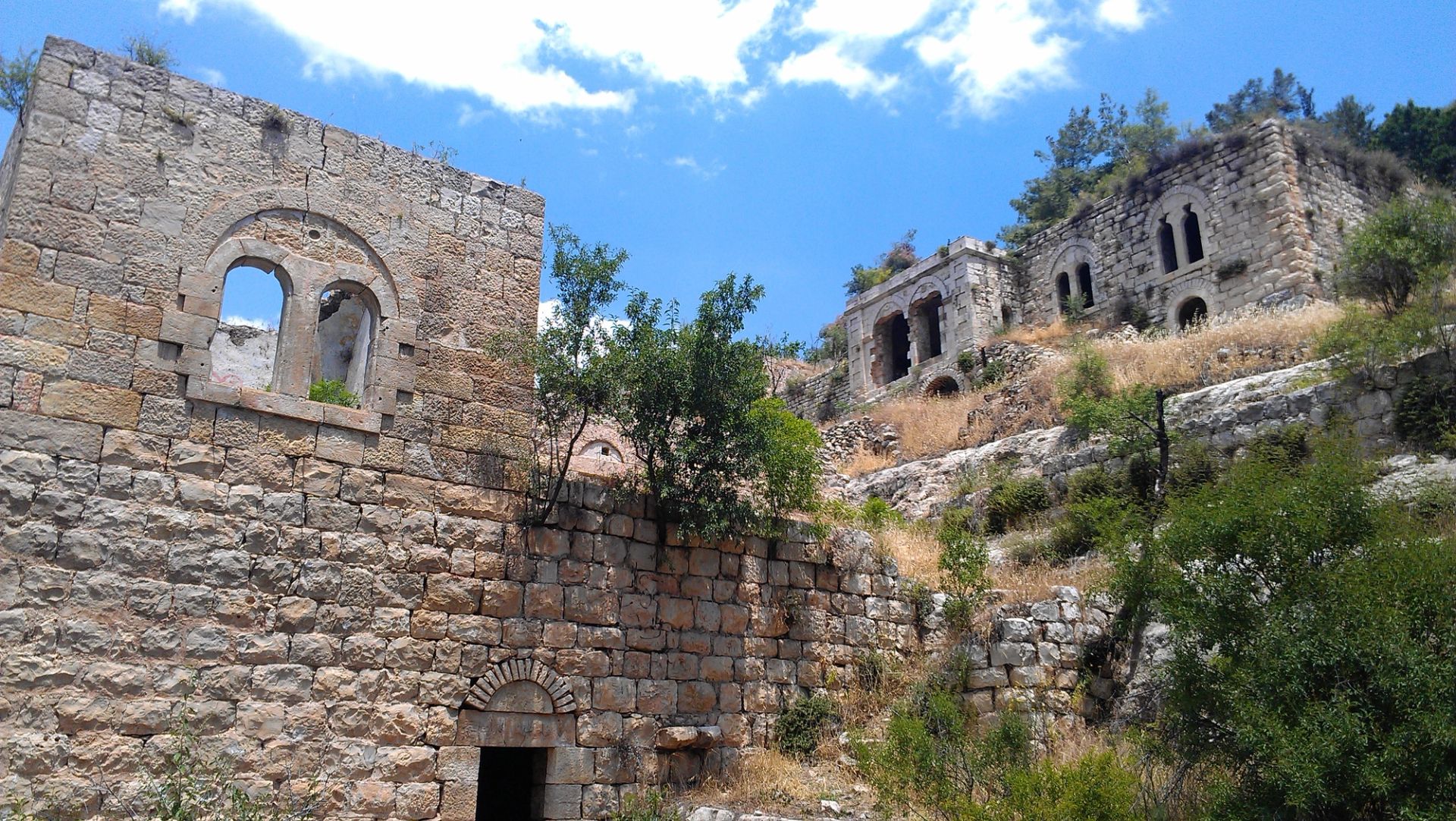
That's why the character experiences the same dilemmas in the film; she questions the whole notion of photographing ruins. The village is not a ruin, and it has not been swallowed by the dunes — there are people, whole communities, living their lives there.
BZ This realisation was very important to define what we would point our camera towards — also how to establish a relationship with the residents, because then they would show us things that they appreciate about the village. Our common interest was around the discussion of the use of space more generally, and in day-to-day life.
AM It’s also a heavily pressurised area in political terms. The Houari Boumédiène Agricultural Village is near the border of Morocco, so it's heavily militarised. Many of the local residents face difficult economic conditions, which is striking, considering the region’s wealth in terms of natural resources. The atmosphere is very confrontational, and you can see it. Again, we had to make a decision not to delve into this aspect of people's lives for this project; we are not experts in this field.
BZ I'm now thinking about the last chapter of the film, filmed in Béni Abbès and the hotel — that is quite important. Talking about this extractivist relationship to place and the power of the camera, we stumbled upon this parallel history that took place at what is now the Hotel RYM, in Béni Abbès. Here, the Italian film director Bernardo Bertolucci shot part of a film called ‘The Sheltering Sky’ (released in French as Un thé au Sahara, and in Italian as Il té nel deserto), starring John Malkovich and Debra Winger. As part of the film set, a massive structure was built in the desert to recreate a historic Berber ksar, because the existing site didn’t match the director’s monumental vision of a desert city. It became a literal construction of an imagined desert; an example of how cinema can overwrite reality, at times with little ethical consideration.
AM We did know about the hotel before we went; we went on purpose. Bernardo and I filmed all that we could in the village and in the last days, we decided to go to Béni Abbès, to stay in this hotel and film some more. At that point, we already knew that we would deploy a fictional character or narrator for the film, and that they would appear as a narrator — we had even started filming small fragments, like my hands, to explore how that presence might visually take shape.
Bofill had described the Houari Boumédiène Agricultural Village as being swallowed by the dunes. We realised that the character had to enter that turmoil of confounded expectations in some way. Around that same time, we also came across a behind-the-scenes documentary by a local Algerian filmmaker, showing the shooting of Bertolucci’s film. That footage became very important to our editing process.
KOOZThe story of a European filmmaker who goes to the desert in search of a particular aesthetic, and when he doesn't find it, builds it into reality: it’s everything that you were trying not to do, in a way. On screen, your protagonist relaxes; suddenly she's in a familiar fantasy where, in a sense, she fits in. It also exaggerates the turmoil that the narrator experiences, in terms of image-making and extraction. It also means that your film is not strictly about Bofill’s prototypical agricultural village — rather, it’s about a way of looking at it.
AM Exactly. That was it; we didn't want to centre it so much on Bofill, because it's not about Bofill. It is about an ideology, and a way of interpreting what happened.
KOOZ Earlier on, you remarked that you were interested not in Bofill or the building — nor even in how people live their lives in this place — but rather something in between. It’s also about the fact that you — and we — are looking at this complexity, from within and outside the village. What is really at the centre of the film?
BZ It’s about the encounter. At its core, the film is really about the gaze, and the encounter between different ways of seeing, between us and the place.
KOOZ It’s interesting to parse between your interest in the formal project of the village, and the fact that Bofill effectively dismissed it — abandoning it, as you say, to the dunes. Is there room to ask what you think of its architecture and what happened to it? What was your own reaction when you saw the project in real life?
AM We were interested in the project itself, to some extent. We did research on the construction. It was interesting to interview the head of construction, who lives in Valencia now; he's an engineer, so he was explaining exactly how the villages were built and why they were made like this.
BZ That includes the vernacular techniques to manufacture the bricks, and even the military involvement in its construction. That was quite interesting.
AM It is really a great project, and that's what I love about working on Bofill — he is a problematic figure, but he was really good, too. The actual village works fantastically; urbanistically speaking, what he did there is truly interesting. He researched Algeria’s vernacular architecture and was inspired by the materials present on site. They told us that at that time, Houari Boumédiène was obsessed with developing Algeria, and he did so by pouring concrete all over it. But concrete is not a material that naturally occurs in the desert; it was being imported from the Soviet Union, and at a high cost to the Algerian government. When Bofill arrived, he refused to use concrete; instead he restarted the operation of a local brick factory and set up a team to teach locals how to make bricks, using local clay.
KOOZ While not unique for the time, it was still quite radical and forward thinking as a proposal; today, perhaps the village would be up for social sustainability awards.. Yet neither of you are confessing to an aesthetic judgement — perhaps because of all we’ve said about the exotic image. Did you plan where you would point the camera before you got there, looking at photos and drawings? Or were you trying to remain open to experience?
BZ It was more of a sensorial experience, to be taken to places by the locals and by whatever sparked our interest on the spot.
AM When you're filming like this, you are often not sure of what you're doing; you need to find certain threads as you go.
BZ That was another joke between us, where we asked each other “Are we making an architecture film?” We were second-guessing ourselves in terms of those very beautiful but sometimes clichéd shots, with hard shadows… One of the threads we kept hold of was about filming the buildings and the interactions people had with them. But ultimately, we gathered a huge body of materials that were organised later, during the editing process. Only by weaving between these materials, we found the film.
AM In terms of the main character or narrator of the film, it became easier to displace the things that were happening to us onto her. She arrives. Then what? She enters — no, it wouldn’t make sense. She could start looking at this or that. So that’s how the decisions were made, in terms of filming as we moved through the space.
KOOZ Is that something you've done before, to fictionalise a character as a narrator?
BZ I often work with twin narrators, as well as unreliable narrators. One of my films has multiple narrators, revealing a story through the perspective of all these characters. Then too, what we made was already fiction, to some extent. Indeed, this preoccupation with the real was something we had to negotiate all the time, especially with the fictional thread we were trying to create in The Terminal Beach.
KOOZ Bernardo, you had previously mentioned your next feature film, would you like to share more about it?
BZ That’s a very different project. The feature film I am working on now came to me in a very personal way. It’s based on a story my father wrote before he passed away, in which he invited me to make a film about his own death. It was a strange process, but also a very beautiful one. We filmed together for a couple of weeks before he died.
What began as a documentary is now evolving into something more hybrid; I’m continuing the project using actors, bringing in fictional elements. I think that my experience on The Terminal Beach, especially in the collaboration with Anna, really helped me embrace that openness to be less rigid about fiction of documentary form, and more responsive to the process itself. Working on The Terminal Beach changed my relationship to the idea of documentary quite a lot.
KOOZ That sounds remarkable… We are so sorry for your loss, but how beautiful to continue creating together. Anna, what are you working on now?
KOOZ That sounds remarkable… We are so sorry for your loss, but how beautiful to continue creating together. Anna, what are you working on now?
AM Well, here in Brazil, this is my ‘return’ to thinking about architecture, after working on another project that had more to do with futures and less with space. My current project is about putting two buildings in dialogue — namely the Copan building in Sao Paulo by Oscar Niemeyer, with the Coaty complex in the Ladeira de Misericordia, designed by Lina Bo Bardi in Salvador, Bahia. I was invited to join this residency in Brazil because of my practice with architecture, and at this moment they are starting the process of restoring Bo Bardi’s buildings in Bahia.
I’m not quite sure how the film is going to turn out, but possibly a two-screen dialogue between the buildings. I'm still trying to figure out the perspectives to represent. The Copan has become this rather cool or hipster space with history; from what I hear, there's a lot of Airbnbs and it’s one of the first things people want to look at in Sao Paulo. I’m wondering what's going to happen in Salvador through the restoration of Bo Bardi’s project there: what will the impact be on that place, and the people there.
So in September, I'm going to Bahia, again taking a foreign gaze into this. I’m trying to find threads through things that I know about, like gentrification. Being from Barcelona, I know exactly how these things work. I think The Terminal Beach is going to help me quite a bit in that, in terms of the uncertainty around what I’m going to shoot and feeling my way as I go. My experience in working with the Houari Boumédiène Agricultural Village has also taught me that we don't have to stay faithful to the imposed visions of what could have been, but rather to look at, and stay with, what there is now.
KOOZ One thing I wanted to come back to is your question of art versus activism, and whether you think your architectural films are doing either or both. Are these positions contradictory?
AM Not necessarily, but I don’t think of our film as activism. If anything, I think we did try to present things as slightly ironic. There are certain bits of dialogue, as well as the juxtaposition with Bertolucci; these are quite funny, but perhaps reveal something critical as well.
KOOZ That’s it — the little moments of reveal, where you do show a critical understanding of that place — of the village through the inhabitants, for example, or through the narrator’s own self-doubt.
BZ It’s also true that the way the film will circulate, in terms of distribution, determines that it is not an activist project. In terms of the journey it will take, it will be shown mainly at film festivals and exhibitions, in the context of art or culture and predominantly to European audiences. To add one last point, if there's anything in the film that could be considered activist, it’s perhaps this aspect of cultural exchange: the fact that people living there now have access to photographs and stories from the time their village was being built. In a small way, the film contributes to reconnecting with a part of the village’s history that wasn’t always visible or shared.
KOOZ Indeed, one beautiful outcome of The Terminal Beach is that the people of the Agricultural Village have more possession of the history of their place, which is empowering. Thank you both so much for your time and all power to you for your future projects.
AM Thanks so much.
BZThank you.
Bios
Anna Moreno is a visual artist and researcher based between The Hague and Barcelona. Her artistic practice is research-driven, focusing on the unfinished nature of historical events and those about to unfold. She examines how past utopias continue to influence the present and the interaction between human history and speculative futures. Her recent works explore the intersections between 1970s architecture, Mediterranean history, and speculative economies. She has participated in several global art residencies and has exhibited internationally. Moreno also integrates teaching and writing into her artistic career, publishing essays on art, politics, and architecture while teaching artistic research internationally.
Bernardo Zanotta is a Brazilian filmmaker who graduated from the Moving Image department of the Gerrit Rietveld Academie in 2018. His short films, rooted in the interplay between the familiar and the fantastical, have gained international recognition, including at the 72nd Locarno Film Festival, where his 2018 film Heart of Hunger won the Pardino d’Argento Award, and at the 48th Drama Film Festival in 2025, where Tragédia received the Best Production Award. Additionally, his work has been presented at major festivals such as Rotterdam, FID Marseille, BAFICI, Cartagena, Berlin Critics’ Week, and Pesaro, amongst others. He is currently working on his first feature film.
Shumi Bose is chief editor at KoozArch. She is an educator, curator and editor in the field of architecture and architectural history. She is a Senior Lecturer in architectural history at Central Saint Martins and also teaches at the Royal College of Art, the Architectural Association and the School of Architecture at Syracuse University in London. She has curated exhibitions at the Venice Biennale of Architecture, the Victoria and Albert Museum and the Royal Institute of British Architects. In 2020 she founded Holdspace, a digital platform for extracurricular discussions in architectural education, and currently serves as trustee for the Architecture Foundation.