This is an excerpt from the BUILT / UNBUILT: Material Ecologies reader edited by KoozArch on occasion of the Public Programme accompanying the Pavilion of Saudi Arabia at the 19th International Architecture Exhibition which is available to download at this link.
Federica Zambeletti / KOOZ Could you start by introducing your practice and relationship to materials?
Studio Ossidiana We work across artworks, installations and exhibitions, and what connects all of these different projects is a focus on materials, their agency, their ability to tell stories, to build affection and care. We are very interested in the process of the domestication of matter into materials. In particular, for many years, we have been working with the technique of terrazzo.
We are fascinated by loose and petrified materials, such as sand and soil, and how these can become mineral gardens, playgrounds or buildings. Our very first project, ‘Horismos', was a playground for an elementary school in Utrecht and an opportunity for us to rethink the materiality of playgrounds, avoiding the usual plastification and the use of already-made objects. The project prompted a material research and long-lasting collaboration with Tomaello, a terrazzo manufacturer based in the port of Rotterdam.
What’s interesting is that your material research really engages with other species. Could you expand on this ongoing research and how it has been spatialised to date?
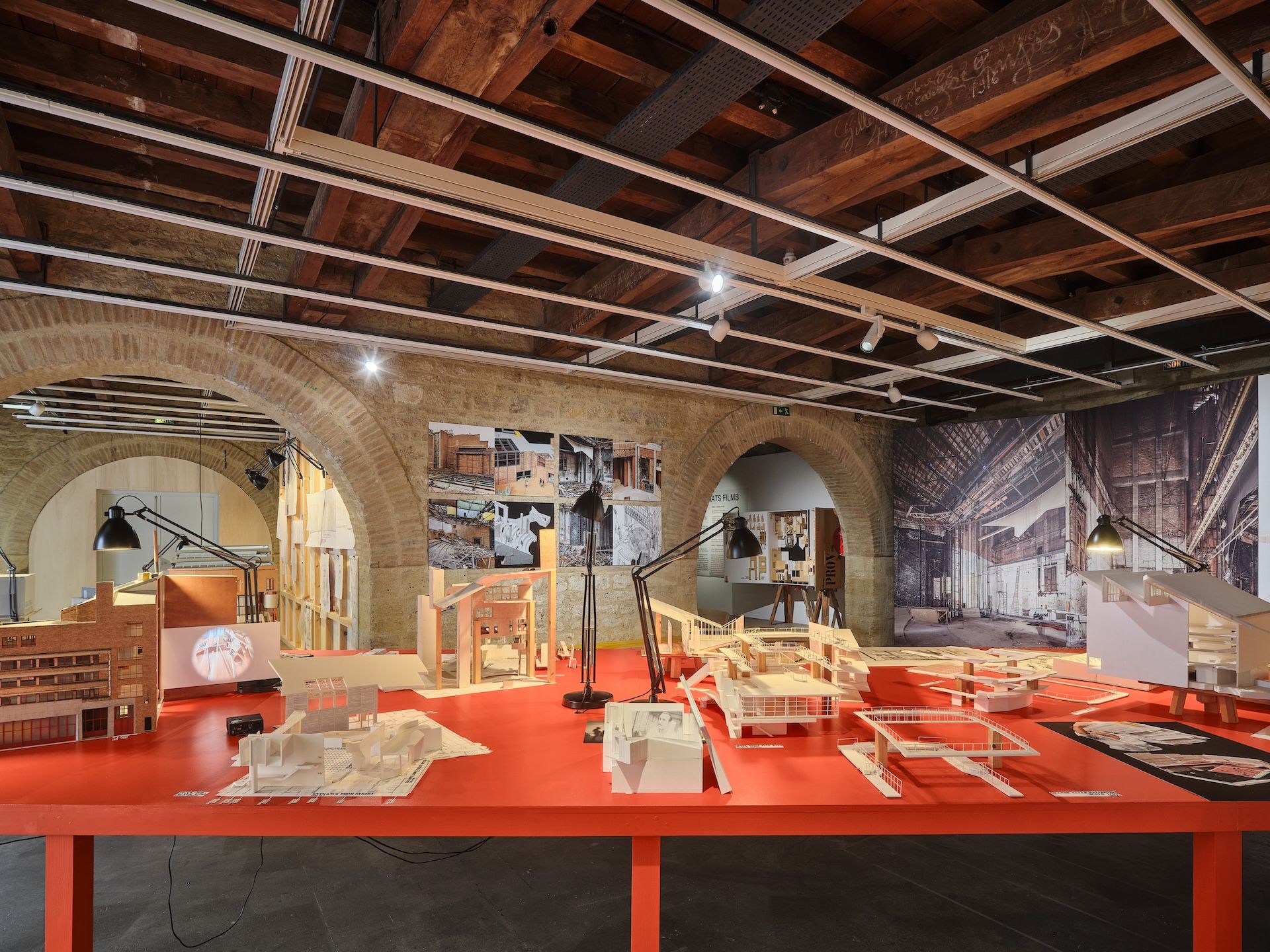
Yes, for a while we have been interested in exploring spaces and objects that mediate our relation with other species, in particular with birds. The research started by collecting different architectural types that speak of these relations, from cages to pigeon towers, perches, aviaries. We then started translating this collection into architectural models and prototypes, some of them became ‘Platforms for Humans and Birds’ — in which nature is somehow abstracted, lakes becoming water bowls, mountains to blocks of clay, forests to perches. This research was first presented within the context of the 2021 Venice Biennale in a large installation which mediated different scales, from the birds to the human.
Beyond testing ideas within the space of the exhibition we very much engage with public space. One project which we are particularly fond of is ‘Utomhusverket’, a collaboration with ArkDes in Stockholm for their entrance which we undertook the same year of the Biennale installation. As this was realised during covid, thereby at a distance, the project was conceived through a map oriented towards planetary axes, rather than a canonical plan. So on the 21st of June and 21st of December, the four main axes of the pavilion would mark dawn and dusk as a sort of pointing towards the axis of sunset and sunrise.
The project is a mineral playground, imagined for both humans and birds, constructed out of artificial rocks and loose materials on the ground as gravel and shells. And what’s interesting is that while we were developing the more theoretical background of the research through the installation at the Biennale, the ArkDes curators were slowly turning into birdkeepers, organising yoga sessions and performances capitalising on the cuteness of chicks. I think the project spoke to the literal sense of curating which lies in taking care, in this case, of human and non-human inhabitants of both the architecture and design institution as well as of Utomhusverket, negotiating between different desires of different species.
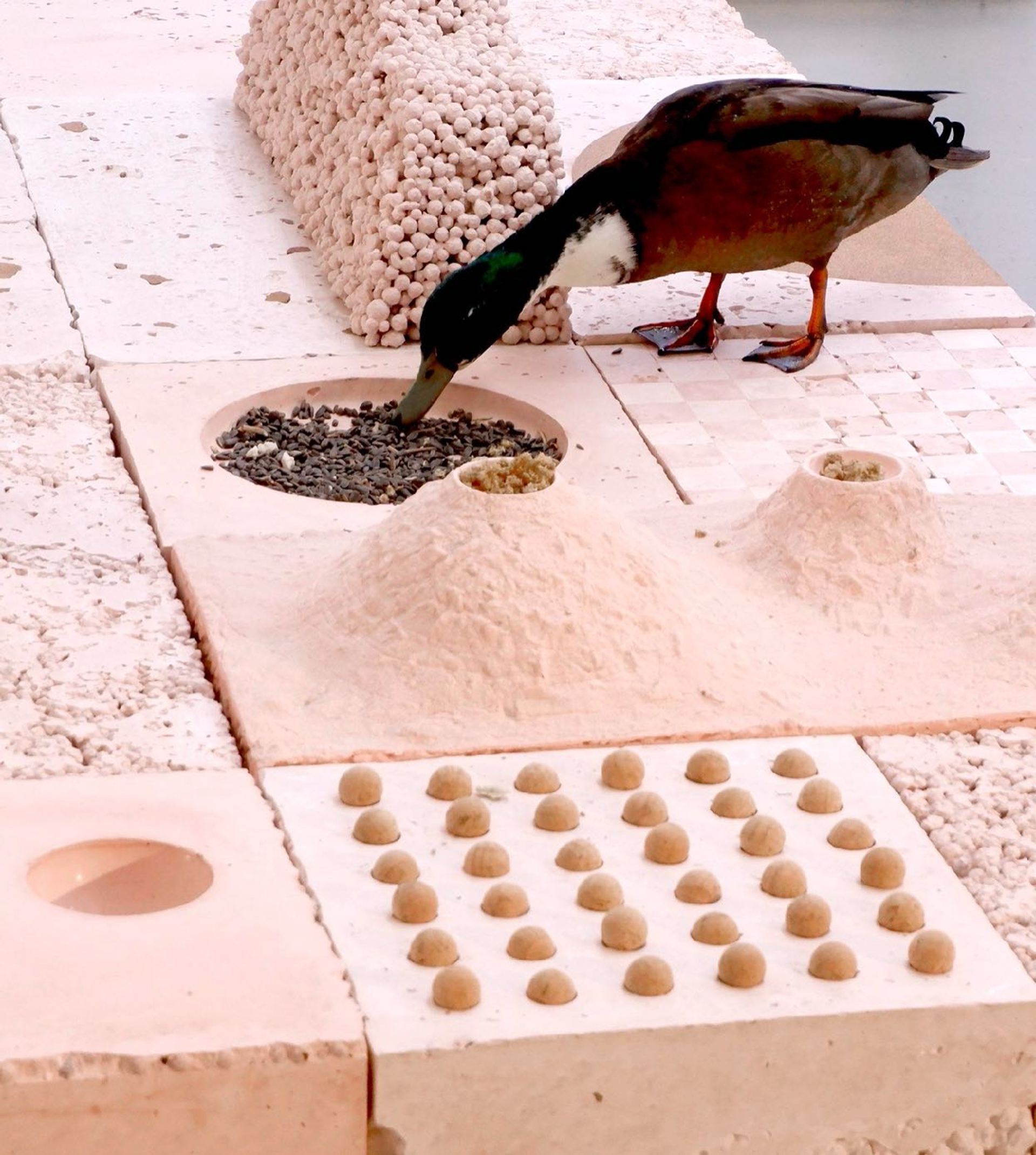
‘The Platform for Humans and Birds’, is a modular, cast landscape, rich in affordances and possibilities of action: a place to eat, play, touch, and negotiate boundaries between our specie and others. Image © Studio Ossidiana
At the beginning of this exchange, you talked about matter and loose materials such as sand and soil. Could you expand on these explorations?
Two projects which really speak of this interest are ‘Firedunes’ in Utrecht and the ‘Earth Sea Pavilion’ in Bruges. Starting from the former, the project is really rooted in the flat landscape of the Netherlands where heaps exist as a genre of the landscape; from the dunes that protect the coastline, to the sand, coal and gravel that travels on barges along canals, to the temporary piles of sand in construction sites. Heaps are the exception to the surface, a warning that something has happened, or is about to happen. ‘Firedunes’ is constructed from the sand of a nearby construction site and a series of fire making structures (ovens, kitchens, barbeques, open air chimneys) to create enclosures which negotiate between the campsite and the domestic. The project invites one to form new urban rituals which span from the barbeque to climbing and exploring; for some, the project turned into a playground.
From sand to turf, the project for the ‘Earth Sea Pavilion’ in Bruges counters the mineral materiality of the medieval UNESCO patrimony town through a living diorama of soils, a contemporary chimera of bacteria, plants, animals, that together composed a breathing entity. Matter was organised from the heaviest at the bottom, to the lightest at the top; visitors were invited to press shells into the clay floor, creating delicate compositions that echoed Roman and Renaissance grottoes adorned with shells. As a living entity where soils were constantly shifting and settling, allowing for plants to grow, the project became a space to be tended.
Continuing our discussion on soils and temporality, could you tell us more about the Floating Gardens project? How does it engage with notions of time, transformation, and the living dynamics of soil — both as a material and as a metaphor?
Yes, that project is called ‘Büyükada Songlines’ and it was conceived as a place at the threshold of politics, design, and ecology. Specifically, the barge travelled the waters of Marmara and the Bosphorus throughout June and July of 2021 hosting along its routes both leisurely events such as radio streamings, dancing classes, and diving competitions, as well as more charged conversations which addressed both global and local issues such as the evolving migration patterns of birds, the depletion of fish, the interferences between spontaneous, cultivated, native and non-native species amongst others.
The project unfolded through both the design of a garden and of a journey through the archipelago, where materials, plants, seeds, soils were collected at each stop. After six weeks of this travelling laboratory, the barge returned to Buyukada, where the larger pieces were installed in a park, and the plants gifted to the inhabitants.
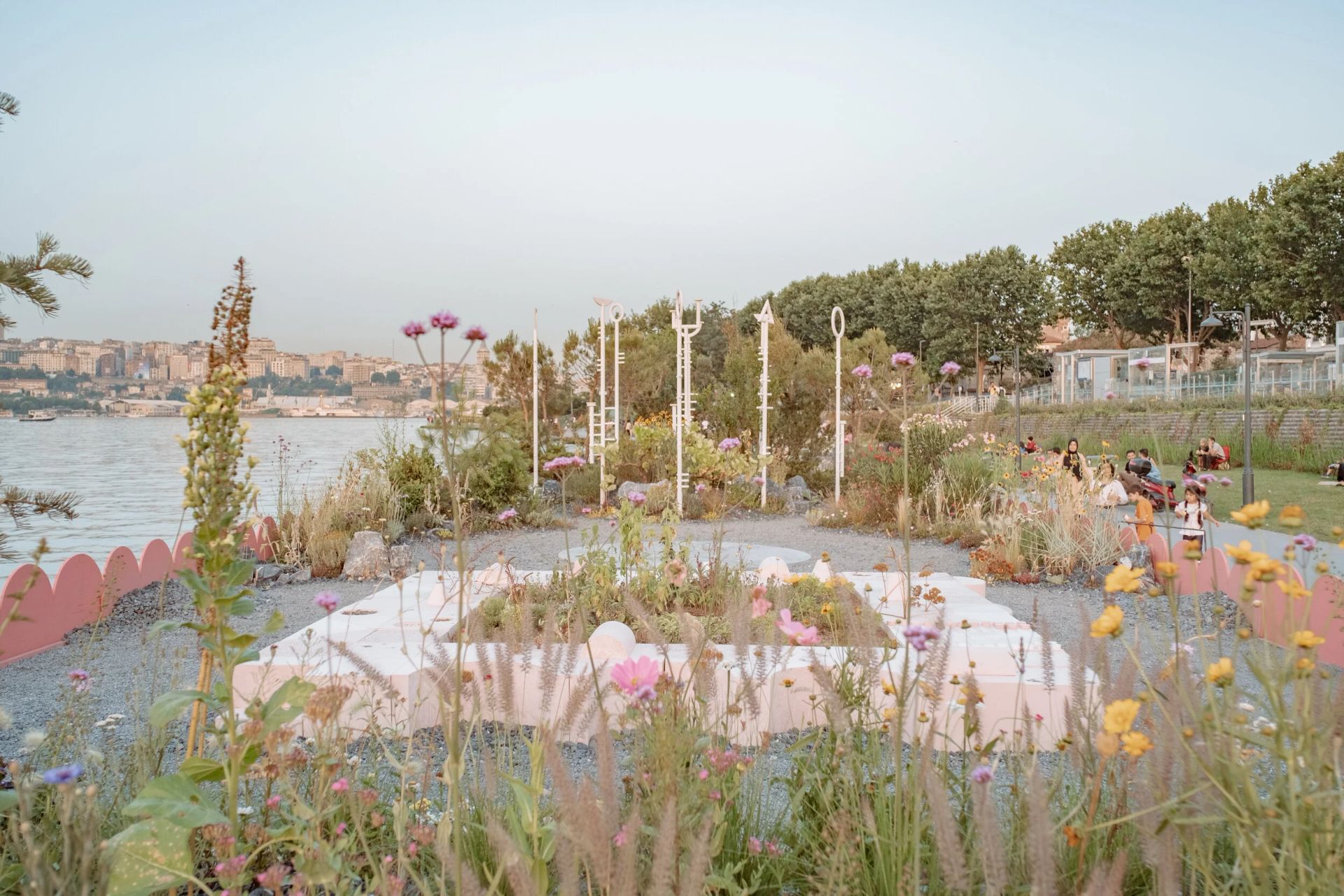
‘Büyükada Songlines’, is a floating garden, designed to cruise the waters of Marmara and the Bosphorus, connecting Istanbul’s Princes Islands with the city’s Asian and European shores. © Riccardo De Vecchi
A lot of the works bear the colours of their material construction. How do you approach the use of colour in your material-based projects, and how do materials, context and aesthetics influence your choices?
We think of colour as both visual and material. In terrazzo or cement, for example, colours come from pigments — like the pink we often use, which is essentially crushed iron. While inexpensive, practicality, not cost, guides our choice. In cast mixtures, colour also depends on the type of sand used, which can drastically change the outcome.
Colour is therefore tied to materials, but also to aesthetics and context. In Bruges, for instance, we introduced pink to contrast with the predominantly white brick surroundings. There’s also a sense of softness we aim for in public spaces — adding subtle tones to dark, concrete surfaces to make them more inviting.
On the occasion of the 2023 Biennale in Venice, I recall walking through your installation on the island of La Certosa; I believe that is when you started exploring textiles as an alternative material. What prompted this shift and where has this research led you?
The project is a response to the rigid threshold of the cloister of La Certosa and its “hortus conclusus” or enclosed garden. Specifically, the design unfolds a new kind of enclosure: a soft partition made of textiles which was both protecting and framing a large seedbed which we imagined would be plowed and collectively sown. Here the textiles were conceived as brushstrokes across the landscape which were moved by the wind, evoking a walking, nomadic encampment. When the fences were eventually removed, the traces of the visitors’ sowing remained.
Building on this exploration of textiles, our latest textile project is a nomadic embassy for the centre Pompidou which will be closing for five years and whose first iteration was within the Grand Palais in Paris. The project is entirely made out of felt and envisioned for both big and small assemblies, events, exhibitions, a space where to be together, where to play, where to discuss. For us, it was very important to create this kind of small speed of niches, tents where to hide, have a nap, be alone, to find this intimacy of the shelter a few steps away from the exhibition or the performance.
And how does this all come together within the context of the Um Slaim school and the material lab you have been working on?
When envisioning a Material Lab for the Um Slaim School, we knew we wanted to engage with a set of essential questions. Foremost among them was the relationship between material and matter — between the raw substance of the world and the labour and knowledge that transform it into something usable, meaningful, and domestic. Equally important was an awareness of locality: what it means to think, work, and make in Riyadh. Yet this reflection carries its own risks: there is the danger that “thinking locally” can slip into nostalgia, escapism, or a kind of blindness to the city’s contemporary landscape.
Together with the students, we proposed to read the city as a quarry — a vast, ever-changing construction site where the old and the new, the natural and the built, are continuously entangled. In this view, everything becomes a potential reservoir of material resources.
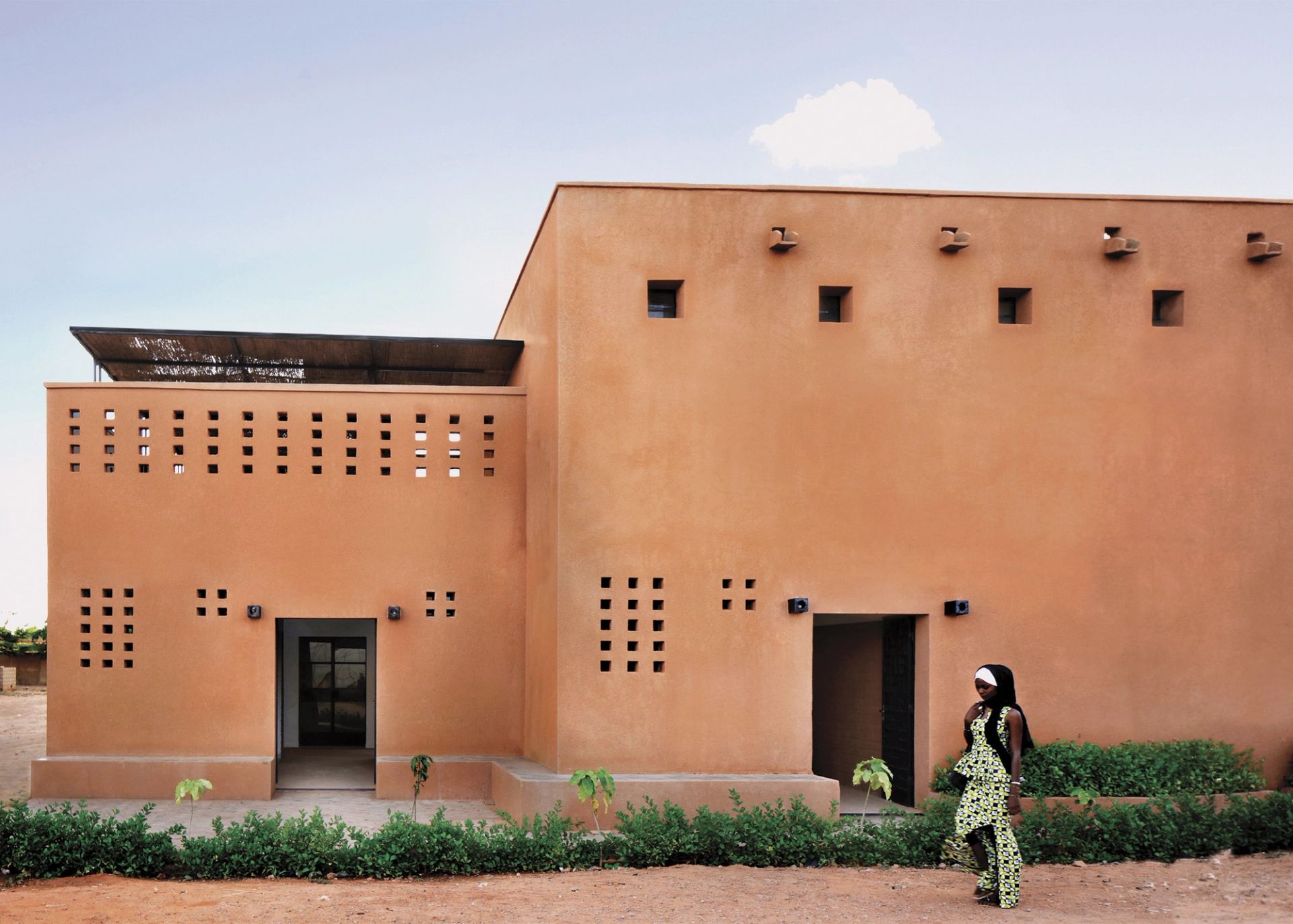
We were particularly drawn to the mud houses — structures at once beautiful and burdensome. What interested us was not their historical or national symbolism, but rather their living quality: the way they fuse architecture with action. These buildings are not static monuments but active partners in labour. Like living beings, they offer shelter in exchange for care; their walls must be touched, repaired, and nourished with mud. They are homes that demand tending — architecture that behaves more like a companion animal than a monument. In this reciprocity, we sensed something deeply valuable: the potential for a renewed relationship between humans and architecture.
The Material Lab emerged from these reflections as a kind of mobile shovel — a nomadic space-tool capable of transforming raw matter into usable resources wherever it travels. Guided by the research of Sara, Lama, Ghada, and Abdullah, we explored Riyadh’s contemporary geology: tracing the Wadi, gathering and sorting materials, and cultivating intimacy with matter — from industrial fabrics to fragments of handmade tiles and terrazzo. Through this process, we developed both affection for materials and a sense of belonging grounded in touch and transformation.
Some of these materials, gathered in Riyadh, are with us today; others will arrive tomorrow, alongside contributions from artists, architects, and designers. Together, they mark the beginning of a tangible Material Lab at the Um Slaim School — a living experiment in how we might once again learn to build with the world, rather than merely upon it.
"These buildings are not static monuments but active partners in labour. Like living beings, they offer shelter in exchange for care; their walls must be touched, repaired, and nourished with mud."
About
The Um Slaim School grew from the research-driven work of Syn Architects and the Um Slaim Collective — originally focused on vernacular Najdi architecture — into an alternative pedagogical prototype to be established in Riyadh after the Biennale. Aiming to redefine architecture education in Saudi Arabia, it fostered transnational dialogue on practice-led and research-centered methodologies, exploring how architecture can recalibrate relationships among natural, social, and technological systems through regenerative and participatory approaches. Guided by terms such as Matrilineals, Situated Practice, DIY Archiving, Ritual Matter, Adaptive Reuse, and Sprawling Grids, the program developed a situated spatial vocabulary while pursuing actionable outcomes for the School’s future. The Public Programme Biennale sessions — titled BUILT /UNBUILT — were built around core thematic investigations which included: Archiving Otherwise; Material Ecologies; Pedagogies of Proximity and Relation and Building Participatory Infrastructures. The programme was curated by Beatrice Leanza and co-led by Maryam AlNoaimi.
This conversation is excerpted from one of four readers documenting the laboratory activities, conversations, and key participants of the public program organized in Venice from June to November, as part of the Pavilion of Saudi Arabia—The Um Slaim School: An Architecture of Connection. These readers serve as companion pieces to the two publications produced as part of the Pavilion project, both co-published by Mousse Publishing and Kaph Books.
The Um Slaim School: An Architecture of Connection – 19th International Architecture Exhibition. La Biennale di Venezia (Mousse Publishing & Kaph Books, 2025)
Connections as Method: Relational Pedagogies and Participatory Spatial Practice (Mousse Publishing/Kaph Books, 2025)
Bio
Studio Ossidiana is an award-winning practice working at the crossroads of architecture, design, and landscape. Balancing research and fabrication, the practice explores innovative approaches through buildings, materials, objects, and installations. In 2018, Studio Ossiadiana was awarded the Dutch Prix de Rome, the prestigious prize for architects under the age of thirty-five. The studio’s work has been exhibited in international exhibitions, including at the Biennale Architettura, Istanbul Design Biennial, Chicago Architecture Biennial, International Architecture Biennale Rotterdam, and the Bi-City Biennale of Urbanism\Architecture in Shenzhen.
Federica Zambeletti is the founder and managing director of KoozArch. She is an architect, researcher and digital curator whose interests lie at the intersection between art, architecture and regenerative practices. In 2015 Federica founded KoozArch with the ambition of creating a space where to research, explore and discuss architecture beyond the limits of its built form. Parallel to her work at KoozArch, Federica is Architect at the architecture studio UNA and researcher at the non-profit agency for change UNLESS where she is project manager of the research "Antarctic Resolution". Federica is an Architectural Association School of Architecture in London alumni.