This essay is part of KoozArch's Issue #6 "Serve and Protest".
The Oldest Building In The World’s Largest Urban Oil Field
It’s late morning, just before noon on a Thursday in Los Angeles’ Baldwin Hills, and I’m lurking outside the open meeting of a statewide organisation that calls itself Realtist®, as in realtor and realist combined. Perhaps a new form of expertise, Realtist® is a black organisation. It owns and occupies the building I’ve arranged to visit. I hear a Realtist submit a vote for treasurer. There is a box of Dunkin’ Donuts on the table in front of me. As I’m waiting, I look at the posters mounted on the wall and read a text explaining the organisation’s seven decades of history. In order to transfer real estate to black folks in Los Angeles, the organisation had to counter official real estate boards and practices and change statewide policies. The need to invent a new word hints at this. A realtor would not organise against the racist policies of a real estate board, the board that licenses those very realtors. A Realtist would, out of pragmatism, perhaps in accord with another grammar of capitalism, one where profit and protest converge.
The Realtist® meeting is being held in a wide open room under exposed beams, in an extension to the oldest structure in Los Angeles: an adobe building built in the eighteenth century on a Spanish colonial cattle ranch in Baldwin Hills. It is this adobe ranch house, called Sanchez Adobe, that brought me here.1 Those ranchers arrived as colonising Spaniards and kidnapped Africans. The adobe structure was almost certainly built by enslaved African labourers. It is now black-owned and is sited in one of Los Angeles’s historically black neighbourhoods. As I tell a Los Angeles architect that I visit later in the week, this building is older than Yale, older than most of the Ivy League. She laughs. She and I both move through such East Coast institutions that associate their preservation of knowledge with their physical continuity through centuries.
When I finally make it inside, I feel the temperature drop at least three degrees. The thickness of the walls keeps the space cool by soaking up the sun’s heat during the day and dissipating that heat at night. As I touch the walls, I can feel the cool evening temperatures on my palm. The walls hold photographs of past presidents of the organisation. There’s a piano to the side of one door. The other door is blocked by plastic garbage bags that seem to be full of tablecloths or curtains or both. It reminds me of my grandmother’s home, as well as my uncle’s, both in Washington, DC, and of so much black life that blurs between photos of the South and old folks from the South who could be in DC or Chicago or uptown Manhattan or here in California. When the meeting is over, I hear cheering and speakers start booming out an upbeat Drake song. Folks are getting donuts.
Afterwards, I decide to walk up the Baldwin Hills Scenic Overlook. I’m wearing Gucci loafers. The shoes are an androgynous hand-me-down from my ex-mother-in-law. I had chosen to wear them, over my more comfortable Nike Ambush sneakers, because I figured the Gucci loafers would serve me well as an indicator of some kind of status, and they did. The Realtist® treasurer gave me a quick once over before enthusiastically exchanging email addresses to follow up on their building preservation.
On the drive over to the Sanchez Adobe that morning I noticed all the oil pumpjacks on the hills. I thought if I walked the scenic overlook, I would find a place to take some photos of them. My phone is filled with dozens of photos of blurry pumpjacks beyond car windows. I take photos to understand things later; it is a form of note-taking.
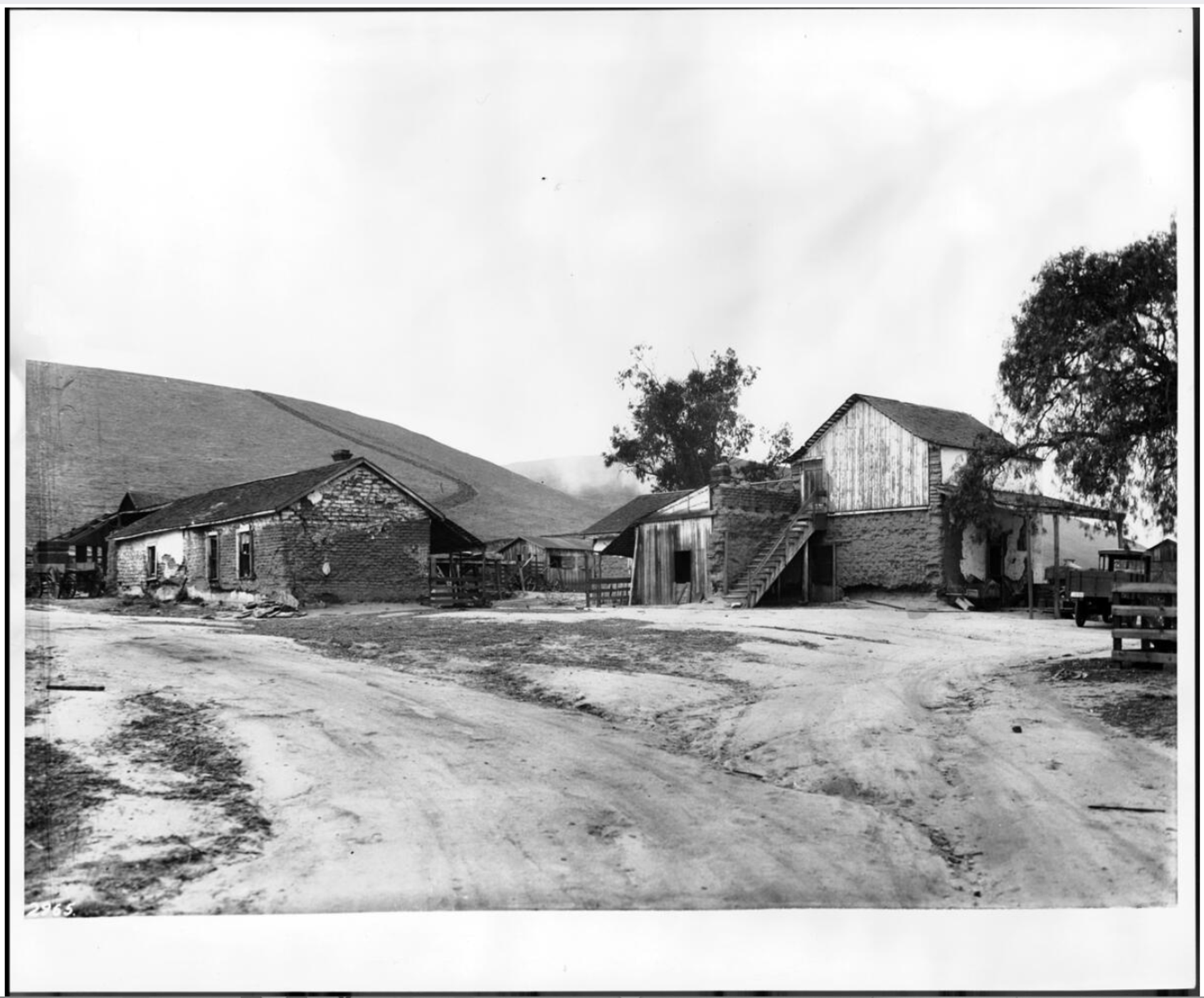
Rancho Cienega de la Tijera, adobe from the east end, ca. 1924. From the Title Insurance and Trust and C.C. Pierce Photography Collection 1860–1960. Courtesy of University of Southern California Libraries and the California Historical Society. Digitally reproduced by the USC Digital Library.
And yet, as I walk the trail leading up through the hills, I am struck first by all the soft chaparral, the closest thing that Los Angeles has to an Indigenous scrub. It’s a dry-looking, hay-colored brush also called Buckbrush. The scientific name is Ceonothus cuneatus.
Mike Davis’s Ecology of Fear has accompanied me on a number of trips to Los Angeles. Davis’s book chronicles the “natural hazards and social contradictions” of Los Angeles, the fear of earthquakes, floods, and fires, of dangers and disasters both real and imagined. His account charts, for example, how the Los Angeles Times and other powerful institutions cultivated a white imaginary that would consider wildfires a sign of criminal activity. “Fire prevention and crime prevention in California are becoming one and the same,” announced the Los Angeles Times in 1993.2 Davis relates this conflation to a larger colonial history of erasing Indigenous fire practices. “Anglo-Californians have always criminalised the problem of mountain wildfire,” he says. “The majority have never accepted the natural role or inevitability of the chaparral fire cycle.”3
Davis links the loss of Los Angeles’s ecological diversity primarily to the spread of suburban-style sprawl in the twentieth century, but also specifically to the loss of the chaparral. Los Angeles lost its terrain of soft chaparral to the paving over of roads and the conversion to grass. This can be traced back to Spanish colonial cattle grazing practices. But it is not just the matter of the lost plants. As Davis writes, there is a pattern and rhythm of burning. His famous chapter, “Let Malibu Burn,” is not only a tongue-in-cheek call to working class uprising and an earnest appeal to design justice. It’s also an homage to the Indigenous practices of regular chaparral burning.
As M. Kat Anderson explains in Tending the Wild, before Spanish colonisation, Indigenous groups in this area used fire to care for the land, manage wildlife, and to prevent large scale wildfires. Chaparral burning also acted as a form of pesticide and harvest automation, while enabling new growth. Anderson cites ethnographer Harold Driver, who records notes from the Tolowa: “Burned under tree to make acorns drop off; also to kill parasites on or underneath tree.”4
Davis tracks the growing paranoia across twentieth-century white settlements in the hills — not Baldwin Hills but Santa Monica and Malibu — over (intermittent) attacks by grizzly bears, coyotes, and cougars. The language the white men use — they are mostly men quoted but occasionally white women — slips easily from people hunting to species extermination. Davis quotes Charles Holder, California sports hunter and biographer of eugenicist Louis Agassiz. Holder writes, “We inevitably ran down game. If it were not a coyote, fox, or wildcat, it would be a Chinaman, a burro, or a dog.” 5 Davis glosses over these slippages from animal hunting to people hunting — calls it “hooliganism” — and focuses instead on the interplay between the wilderness, farming, and wealth concentration within white Anglo-American dominated California. There is some kind of protocol that goes unstated that mixes geology and Blackness and Chinamen and hunting. I am trying to trace what it is that gives permission for geology and oil to engulf black life.
I walk the full Overlook Trail without a single glimpse of the pumpjacks. It’s only then that I realise the path had been designed purposefully to conceal them. It’s too complete to be accidental. Later at my desk I would look up the project description and find this concealment spelled out in words. The architect’s words do not announce the decision to conceal the pumpjacks but, rather, stage a conflict between oil wells and a “natural past.” As the lead architect explains in the design brief — the summary of their design goals — on their website, “The turbulent history of the Baldwin Hills site, from oil wells to plans for massive residential development, stripped this mountain of most of its natural past. The challenge was to design structures that feel integrated into their setting and enhance the experience of being in the natural landscape.”6
In this summary, the phrase “turbulent history” and the word “massive” modifying residential development hint at the presence of black life entangled in oil extraction. The pattern of racial covenants and zoning that entangle oil wells and residential development are hidden in this description, with as much sophistication as how the pumpjacks are hidden from the park paths.
At the top of the scenic overlook, there’s a State Park pavilion and a building with a historical exhibit about the site. I ask the park ranger attendant where I might see the pumpjacks. She tells me if I go to the far end of the parking lot behind the park building, I might get a glimpse. I dawdle in the park building, looking through a binder of carefully captioned black-and-white photos, before walking out to the parking lot. There, around some brush and across another hill, I see them: four or five pumpjacks, bobbing up and down.
The adobe building I visited in Baldwin Hills is older than the oil extraction that surrounds it. The oldest oil field in the Los Angeles district and the largest urban oil field in the United States, which operated from 1892 through the first decade of this century, runs east to west in downtown LA. Called Los Angeles City Oil Field, it begins at what is now Dodger Stadium and what had been the Mexican neighbourhood Chavez Ravine.7 The field extends through to Chinatown, just below historic Filipinotown, passing through the Consulate General of Mexico in Los Angeles. If you have ever been to Los Angeles, you have probably driven past it.8 This is almost certainly so if you are not from California, since the sprawling field lies between LAX and downtown LA.
While the largest oil field in the world is Ghawar Field in Saudi Arabia, the largest urban oil fields in the world are here in Los Angeles. As of January 2023, there are forty-five active oil fields in Los Angeles County with over eight thousand active oil wells.9 LA is a city that famously looks like anything but a city: hills, cars, freeways, one-story houses.10 The suburban or even ex-urban look of most of the city renders any edge–periphery distinction blurry and nonlinear. But still there is a sequence. Halfway between LAX and downtown you see machines rising from both sides of the freeway — machines the height of two- or three-story buildings, moving up and down, bobbing into the ground. They are pumpjacks — oil extraction machines made of an engine and counterweight, attached to an arm that moves a pivoting beam up and down.11 They are drilling into the middle — if one can say that of a non-centered city — of Los Angeles.
The Inglewood Oil Field extends over 1,000 acres. In the odd municipal geography specific to LA, this oil field is located both within and outside of the City of Los Angeles, spanning a number of the municipal governments and unincorporated areas that comprise LA County. A large swath of Inglewood Oil Field lies in Baldwin Hills. Since the Standard Oil Company (now Chevron) 12 started drilling these 1,000 acres, over 1,600 wells have been drilled, over 400 million barrels of oil sucked out of the ground in the past century. In the past decade, the extraction from this field in the middle of Los Angeles amounted to about three million barrels a year, dredged up in the midst of schools, backyards, and parking lots, next to parks and playgrounds, sidewalks, highways, and fast food joints.
How is it that oil fields locate themselves within the historically black (and Filipino and Mexican) neighbourhoods of Los Angeles? What collusion of geological planetary time and the afterlife of slavery can be read here in this ground?
Baldwin Hills
Baldwin Hills is colloquially known as the Black Beverly Hills. Los Angeles, as a whole, has never been majority black. Unlike Charleston or New Orleans, it was never a place where wealth was defined primarily by the exchange and kidnapping of Africans, nor by the terrorisation of the descendants of kidnapped Africans for easily monetizable work and pleasure. To trace the becoming of black neighbourhoods in Los Angeles requires a figure–ground reading. This means looking at the whiteness of the page, along with the black marks on it. It requires understanding the spatial tactics that facilitated white life and the exclusion of nonwhite people, especially black people.
These spatial tactics, themselves, are inseparable from geology. These spatial tactics mediate geology through houses. In the context of covenants, deeds on houses have worked to racialise the effects of geology. Property deeds contained clauses banning nonwhite occupancy, fully backed by the force of property law and civil suit until the 1948 Supreme Court case Shelley v. Kraemer. These clauses, known as racial covenants, concretised the white possession of Los Angeles through the single-family house. In 1931 the Chief Counsel to the Title Guarantee and Trust Company in Los Angeles explained it this way:
A provision in a deed against the sale, lease or rental of the property conveyed to any person not of the white or Caucasian race is a restraint on alienation and, therefore, invalid… A provision, however, against the use or occupancy of the property by persons other than those of the white or Caucasian race is valid and does not violate the Federal constitution.13
A covenant that disallows black residents sifts both possession and dispossession. Coupled with zoning that banned multi-family construction, 14 these covenant algorithms territorialise whiteness throughout most of Los Angeles.
The few black areas then, built as zones of exception, seem to be released from such displacement and dispossession. Yet, the release from racial covenants cannot be disaggregated from the release of oil. This situation cannot be reduced to a matter of “cheap” housing in “undesirable” neighbourhoods. Being in the midst of oil extraction is a mode of labour — breathing the smells, ignoring the machines, tracking notices about spills or leaks, surviving inevitable crises. For residents who live in the midst of urban oil fields, such labour is uncompensated. The drilling of oil in Inglewood is facilitated by the survival of black neighbourhoods. Simultaneously, the spatial racial order of California is facilitated by the extraction of oil. Black neighbourhoods, black home ownership — black life mapped onto the built environment forms a material and spatial buffer between white life and the risks of oil extraction.
Specific neighbourhoods in LA — Crenshaw, Central Avenue, Baldwin Hills, Inglewood, Long Beach — are entangled with oil and gas extraction. The ground itself in these areas is opened to extraction and its immediate toxic impact. The ground is converted at once into a geological information field, commodified fossil sludge — into arrays of easements and claims and machines. And black people are invited into that field. Los Angeles oil requires black people in order to camouflage itself. California oil extraction requires black people to provide the buffer that it refuses to acknowledge any (white) body requires.
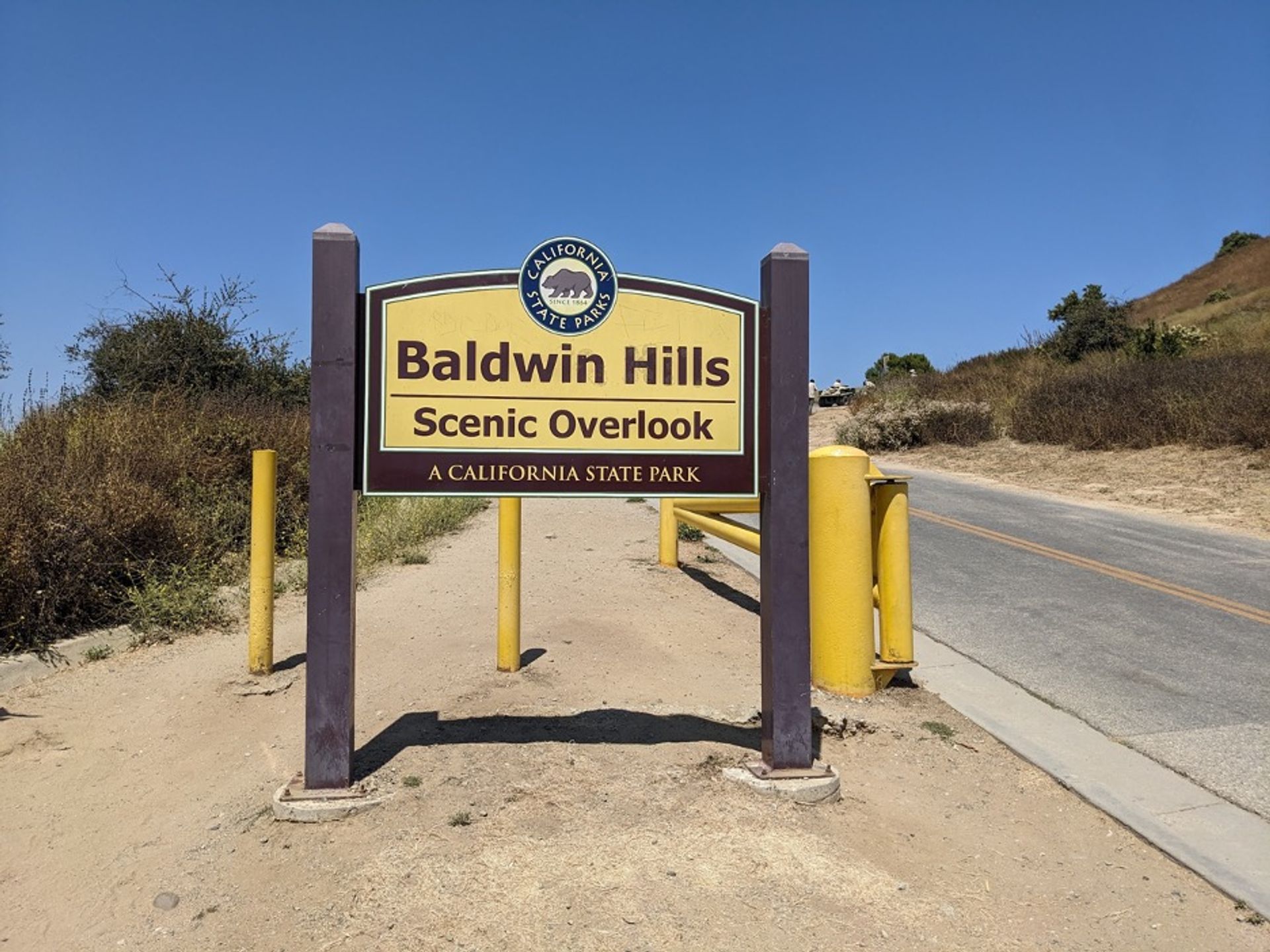
Baldwin Hills Scenic Overlook, Culver City, CA, 2023. Courtesy of the author.
The presence of black people enables the proliferation of pumpjacks, gas leaks, oil fires, and toxic gums to be rendered as a character of neighbourhood, rather than as a suite of toxic hazards enacted upon the city, the landscape, the nation, the planet. The presence, the very existence of black people within these bounds enables the 6,000-foot rupture of these wells to recede into blackness. By that, I mean recede into the antiblack patterns of erasure naturalised around blackness. It took that camouflage of antiblackness for the Baldwin Hills reservoir collapse not to expose the conflict between fracking and Los Angeles.15
The pumpjack in Los Angeles deploys this structural racialism to embed itself in the middle of the city, to become a machine for racial spatial planning. “To look at what, precisely, the US oil industry brings with it from place to place is to look not only at the mobility of technical, legal, and infrastructural forms, but also at the mobility of segregation, white supremacy, gendered domesticity, and what [Partha] Chatterjee has called ‘the rule of colonial difference.’”16 Black people living in mansions across Baldwin Hills can see oil pumpjacks through the windows of their expansive living rooms and bedrooms. The oil machinery becomes entangled with black presence, in a way that naturalises extraction and its hazards.
Such an arrangement repeats itself at various scales. Black life becomes a form of stability for Los Angeles urban oil extraction, a form of separation without enclave. The industry and logic of extraction requires such separations. As Sara Ann Wylie notes in her study of fracking, “An examination of how oil and gas extraction sites are separated from the surrounding social, economic, and physical landscapes through corporate and nationally controlled enclaves reveals how lucrative extractive industries’ violent creation and protection of stable environments for extraction succeed in and depend on destabilising other local economies, social relationships, and land traditions.”17
What better way to craft a stable environment for extraction than inviting the people excluded from the whites- only landscape to make a life right in the midst of it? The ongoing extraction maintains stability through the repetition of that racial exclusion — whether via covenants or zoning — and the disenfranchisement of oil’s black(ened) 18 neighbours.
Until recently, the distinction between “city” and “county” in Los Angeles was often secondary to the spatial effects of racial covenants. When Reyner Banham describes Baldwin Hills in his twentieth-century classic Los Angeles: The Architecture of Four Ecologies, he describes the oil landscape, topography, and racial segregation in one naturalised vista:
Baldwin Hills is an area of unlovely scrub largely given over to the oil industry, cross-country motorcycling, or just waste, topped by a concrete reservoir that burst one memorable night in 1962 and is still dry. But on the north face (wrong, for a start; foothill settlements typically face south) and round to the east, is perfectly typical foothill development complete with tortuous roads and restrictive covenants in the title deeds which exclude Negroes and Mexicans. 19
The Supreme Court case that declares restrictive covenants unconstitutional — Shelley v. Kraemer — does not undo the covenants or wipe them off the title deeds. The case instead rearranges the relationship between the state and the production of whites-only space. The transition from Shelley v. Kraemer to Berman v. Parker — the 1954 Supreme Court ruling initiating the wide erasure protocols of slum clearance — might be understood as a transition from positive spatial eugenics to negative spatial eugenics, that is, from the state protecting whites-only claims at the property level to the state enabling antiblack erasure at the neighbourhood level. In Los Angeles, the flow of oil mediates this transition.
On the Fourth of July in 2023, I ended up on the south side of View Park and just east of Baldwin Hills, a neighbourhood that from within Baldwin Hills is called the Views. I was, perhaps, in a perfectly typical foothill development that had previously excluded Negroes and Mexicans. I can say “previously” with confidence because we were a house full of black folks. I was there with my filmmaker friend and her community organiser friends at their backyard pool. The hosts told me a bit about their talented university-age kids and offered me a plate of barbecued salmon, macaroni and cheese, and greens that they had ordered from a man named Bootsy from Inglewood. Bootsy started his barbecue delivery company during COVID-19 and become something of a local celebrity.20 The salmon was delicious — crispy, really seasoned on the outside, yet somehow not overcooked. I ate two plates.
The community organiser couple had only recently returned to Los Angeles. As we swam in their pool, I learned that after having been married in California, living in Baldwin Hills and starting their family there, they’d left to go to New York City for twenty years. They’ve come back just this year to rent this house until they find a place to buy. They tell me — or the husband tells me, laughing — how earlier this summer they were surprised by strangers knocking on the door. They almost didn’t answer, thinking the unexpected knock might be religious proselytisers. The strangers were activists from an organisation called SCOPE. The husband was laughing because the SCOPE that exists today developed out of one of the organisations that this couple had co-founded in the 1990s. The name is an acronym for Strategic Concepts in Organizing and Policy Education.21 The SCOPE activists came knocking on their door because the rented house is two blocks outside the city boundary. The city finally put a moratorium on oil exploration in 2023 and started a twenty-year timeline to phase out all drilling.22 The oil exploration moratorium does not apply at their house, the SCOPE activists said, and they’re sitting on top of an oil field. If they want it to stop — the proliferation of pumpjacks and drilling all around their lovely house with the pool — they have to get organised.
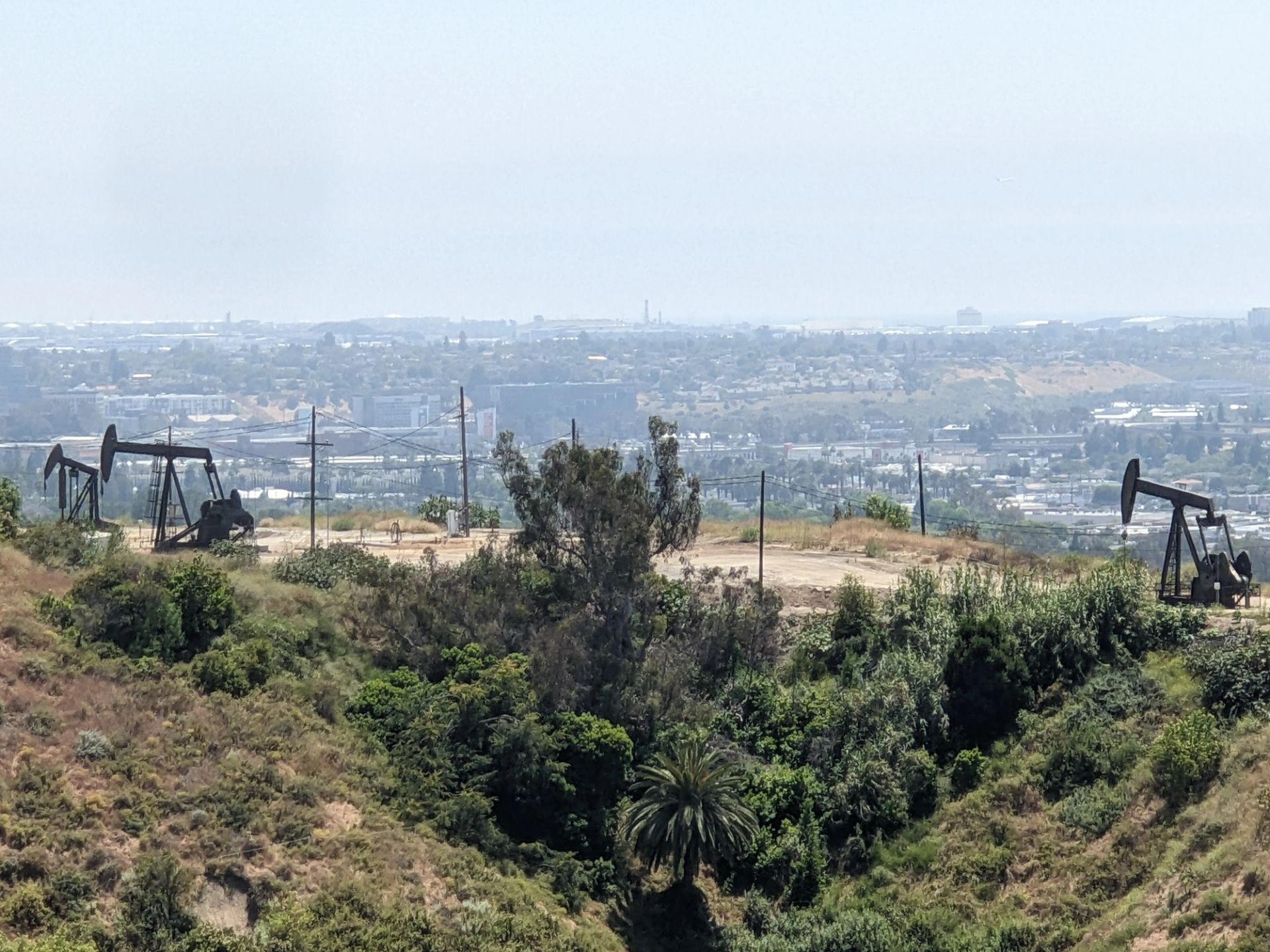
Pumpjacks at Inglewood Oil Field as seen from Baldwin Hills Scenic Overlook, Culver City, CA, September 9, 2021. Courtesy of Wikimedia Creative Commons.
Book
Erasure by Design by V. Mitch McEwen (Columbia Books for Architecture, 2025) tracks the methods, terms, and racial protocols that continue to do the work of displacement, demolition, Erasure by Design shares first person narratives of growing up in the wake of slum clearance — that is, “urban renewal” — in Southwest, Washington DC, while assembling archival references that narrate racialised erasure and its legal and spatial precedents. It traces a military complex under construction, where St Louis’s cleared grounds and blacked out sites are also defined by satellites, body experiments, explosions, and emptiness. It moves through specific grounds in Los Angeles — dirt walls, hills, oil fields, gas lines, and houses in the forest — to trace how those grounds matter and how their holding intersects with maps that plan erasure, inhabitation, and extraction.
Bio
V. Mitch McEwen is an assistant professor at Princeton University’s School of Architecture and principal of Harlem-based design practice Atelier Office. She is one of ten co-founders of the Black Reconstruction Collective. McEwen’s design work has been exhibited at the Museum of Contemporary Art Detroit, Museum of Modern Art, and the Venice Architecture Biennale.
Notes
1. “LA May Have Uncovered Its New Oldest Building in Baldwin Hills,” Curbed Los Angeles, September 6, 2012, https://la.curbed.com/2012/9/6/10332590/ la-may-have-uncovered-its-new-oldest-building-in-baldwin-hills. More information can be found at Baldwin Hills Homeowners Association, “History of Baldwin Hills Estates,” https://www.bhehoa.org/history
2. “Don’t Blame Mother Nature When There Are Arsonists: Why Wildfire Prevention Now Becomes Arson Law Enforcement,” Los Angeles Times, November 5, 1993, https://www.latimes.com/archives/la-xpm-1993-11-05me-53361-story.html. Quoted in Mike Davis, Ecology of Fear: Los Angeles and the Imagination of Disaster (Verso, 1998), 132.
3. Davis, Ecology of Fear, 132.
4. Quoted in M. Kat Anderson, Tending the Wild: Native American Knowledge and the Management of California’s Natural Resources (University of California Press, 2005), 145. Also see: “Regular burning of shrubs also helped to recycle nutrients in the system. It made available to the plant nutrients that would otherwise be held in dead and dying branches” (238).
5. Davis, Ecology of Fear, 225.
6. “Baldwin Hills Scenic Overlook,” Safdie Rabines Architects, https://www.safdierabines.com/portfolio/baldwin-hills-scenic-overlook/
7. That is until post–Berman v. Parker racial erasure in the 1950s. See “Erasure” in this book (p.27).
8. See Mara Marques Cavallaro, “The Deadly Consequences of Urban Oil Drilling,” Nation, October 19, 2022, https://www.thenation.com/article/ environment/los-angeles-oil-drilling-nalleli-cobo; and Bz Zhang, “To Be a Body Along the Perimeter,” Avery Review 66 (February 2024), https://averyreview.com/issues/66/a-body-along-the-perimeter.
9. See “Oil Fields of Los Angeles County,” Los Angeles Almanac, accessed August 26, 2024, https://www.laalmanac.com/energy/en14.php.
10. Reyner Banham, Los Angeles: The Architecture of Four Ecologies (Harper & Row, 1971), especially chapter four, “The Transportation Palimpsest”: “Los Angeles has no urban form at all in the commonly accepted sense,” 75.
11. R.F. Yerkes et al., Geology of the Los Angeles Basin, California — An Introduction, Professional Paper 420-A (US Department of the Interior, 1971), https://pubs.usgs.gov/pp/0420a/report.pdf.
12. For a corporate timeline and list of operators, see “History of Inglewood Oil Field,” Inglewood Oil Field, https://inglewoodoilfield.com/history-future/ history-inglewood-oilfield.
13. John F. Keogh and M. L. White, Building and Race Restrictions: A Review of the California Cases Supplemented by Other Authorities (Title Guarantee and Trust Company, 1931), 14.
14. Mike Davis, City of Quartz: Excavating the Future in Los Angeles (Verso, 1990).
15. “Baldwin Hills Dam (California, 1963) | Case Study | ASDSO Lessons Learned,” Association of State Dam Safety Officials: Lessons Learned, https://damfailures.org/case-study/baldwin-hills-dam-california-1963. “The crack could have been caused by the movement of the schist below the dam, a combination of that natural phenomenon and the injection of pressurized liquid into the oil field near the dam, or the heavy equipment used during construction.”
16. Hannah Appel, The Licit Life of Capitalism: US Oil in Equatorial Guinea (Duke University Press, 2019), 27.
17. Sara Ann Wylie, Fractivism: Corporate Bodies and Chemical Bonds (Duke University Press, 2018), 306 n. 11.
18. Zakiyyah Iman Jackson, Becoming Human: Matter and Meaning in an Antiblack World (New York University Press, 2020).
19. Banham, Los Angeles, 79–80.
20. Bootsy’s BBQ (@bootsy_bbq), Instagram, https://www.instagram.com/ bootsy_bbq/?hl=fr.
21. SCOPE: Strategic Community Agenda, https://scopela.org.
See “Oil and Gas Drilling Ordinance,” Los Angeles City Planning, https://planning.lacity.gov/plans-policies/oil-and-gas-drilling-ordinance. “The adopted Oil Ordinance requires the phase out of these oil drilling activities, which are known hazards to public health and safety, by immediately banning new oil and gas extraction and requiring the removal of existing operations after an amortization period.”