This conversation is the second of a series produced by Me AndOther Me as part of their ongoing WebRTC BackRooms project, a podcast deep-scrolling into XR, AI, and the future of hanging out in the spatial internet, hosted by Koozarch. You can listen to the full episode via our podcast channels or watch the video version on the Me AndOther Me Substack page.
Me AndOther Me Welcome to The Backroom of Internet Aesthetics and Liminal Spaces w/Valentina Tanni. This is an excerpt from our conversation in the WebRTC BackRooms, a podcast series deep-scrolling into XR, AI, and the future of hanging out in the spatial internet.
In this episode, together with Valentina, we discuss the memetic strategies of internet aesthetics — how visual trends emerge and vanish overnight, and how glitches, lo-fi graphics, and uncanny renderings signal belonging within online communities. From the eerie familiarity of the Backrooms to the strange humor of Italian Brainrot, we trace how internet culture builds its own mythology, visual codes, and collective memory, shaped through repetition, remix, and participation. We also turn to AI-driven aesthetics — ASMR imagery, looping generative visuals, and the flood of synthetic images shaping online taste — asking how these evolving image cultures shape perception, act as tools for imagining futures, and turn the internet into a liminal space we continuously inhabit.
M&OM Let’s begin our conversation with the Backrooms itself. What drew you to this internet myth, and what makes it such a compelling way to think about our digital condition?
Valentina TanniAs you know, I’ve always been interested in internet culture in general. I graduated in 2002 with a thesis on internet art, and I’ve always been fascinated by how varied it is. In fact, it’s probably better to use the plural — internet cultures — because there are so many different ones.
Regarding the Backrooms specifically, I was already familiar with creepypastas and similar phenomena, and I had been researching the concept of lore. So I was very aware of these large-scale collaborative narratives — forms of collective writing and imagining that take place online. What makes the Backrooms lore so fascinating to me is its richness and variety, and the way this specific mythology resonates so strongly with so many people. I think one reason is that, on one level, it evokes the myth of the labyrinth and the concept of infinity — something humans have been grappling with since the dawn of time. At the same time, the Backrooms lore is deeply rooted in contemporary culture. It’s profoundly shaped by video game culture, connected to the aesthetics of 3D rendering and procedural generation. It concerns how video games simulate space and draws heavily on horror literature and cinema. So it carries a dense network of references, and I think that’s what makes it so compelling — and probably why it captured my attention.
M&OMYeah, and then there’s how you reach the Backrooms, which I think is so brilliant — the idea of no-clipping out of reality.
VTYes, that’s a gaming reference, right? The original Backrooms post — the first one with both the image and the caption — says that you might end up in the Backrooms if you no-clip out of reality. In a game, that means passing through a wall or an object, ignoring the limits of the game space. You can exit the environment entirely and end up somewhere that is basically nowhere — under the floor, above the ceiling, or outside the designed world. So you escape the borders of the game environment.
Metaphorically speaking, if we bring that idea into the real world, no-clipping in reality would mean ending up in a mysterious place outside of it — another world we know nothing about. The original meme suggests that this can happen accidentally, if you’re not paying attention. But it never explains how to avoid it — what you should actually do to not end up in the Backrooms. And that’s part of the mystery. The space itself isn’t truly infinite, but it’s so vast that it feels infinite. I think someone once said it’s something like three or four times the size of the Earth.
M&OMSomehow, it reminds me of Borges's Library of Babel as well.
VTThat’s one reference that many people immediately connected to — the Library of Babel by Borges. It’s the idea that if you take the letters of the alphabet and the components of language, you can recombine them infinitely and produce every possible book. At the same time, it resonates with kids today who are playing video games and wandering through these endless corridors. When you’re playing first-person games — especially horror ones — you often find yourself alone in empty spaces, moving through them without knowing if something is hiding around the corner. I think this relationship between older mythological elements and contemporary culture works really well in capturing people’s imagination.
Personally, as a researcher, I was also really fascinated by the investigation that internet users conducted over the years to find the origin of a particular photograph [which circulates in conjunction with the notion of the Backroom.] That was another incredible adventure — this deep rabbit hole. I don’t know if you’ve seen it, but there’s a shared Google document online that anyone can access. In it, you find all the clues, all the information, and everything that has been discovered over the years, along with the many attempts users have made to locate where the photo was originally taken. Now we know the location, but for a long time it remained unknown. A large community — mostly gathering on Discord — kept posting updates about this collective investigation. So we ended up with this massive, almost monstrous Google Doc full of information. I think it’s one of the most interesting Google Docs on the internet. It’s such an incredible journey.
M&OMYour book Exit Reality delves deeply into the aesthetics of internet culture. You explore different types of “cores” and “waves” — like vaporwave, weirdcore, dreamcore, corecore — as well as obsessions with ASMR, the Backrooms, and liminal spaces. These are not marginal curiosities, but central to contemporary visual and digital culture. You also write that they aren’t simply escapist fantasies, but bottom-up experiments that reconfigure our relationship to reality itself. They are constantly being remixed, emerging from the collective imagination of millions of people contributing to them. Building on that, how do you see these aesthetics functioning both as symptoms of a certain alienation — perhaps linked to surveillance capitalism and emotional disconnection — and, at the same time, as expressive tools for communities to process forms of belonging or longing?
VT Of course, the whole issue of surveillance capitalism — and more generally, the fact that we live in a technological environment heavily controlled by a few very powerful companies — plays a major role. Algorithms regulate what we see and have a significant influence on what we create, distribute, and consume. So we always have to take into account that this environment is present and shaping what we do. But having said that, I think people are still producing original content and continue to find ways to connect with others and express themselves. They’re also constantly finding ways to free themselves from certain constraints. When it comes to internet aesthetics, I think you’re right to describe them as symptoms — I use that word as well. They tell us something about the cultural atmosphere we live in, about a particular way of seeing and feeling the world. In that sense, they function as visual symptoms of how we experience the present, which is why I chose to focus on this aspect of contemporary culture.
"When it comes to internet aesthetics, I think you’re right to describe them as symptoms. They tell us something about the cultural atmosphere we live in, about a particular way of seeing and feeling the world."
For example, the obsession with liminality is connected to a feeling of being stuck — of powerlessness, of living in uncertain times. We’re going through politically difficult, socially complex conditions, and the ecological crisis weighs on people constantly.
At the same time, there’s this persistent sense that time doesn’t quite work the way it used to. In the book, I refer to Mark Fisher and to the idea that, in the contemporary moment, we are constantly revisiting and remixing the past. We have access to vast online archives of human culture, and we can move through them almost instantly. This creates the impression that time is no longer linear — that we can travel through it imaginatively, recall situations, and conjure atmospheres from different historical moments. I think this reshapes our perception of time, often on a subconscious level.
So, coming back to this idea of liminality, we feel like we’re in a space between two states, without knowing how long we’ll remain there. This is also connected to the Backrooms. You’re in a place that feels mysterious and unsafe, and you don’t know anything about what comes next. There’s a sense that this liminal condition could even become permanent. That’s one aspect. But within internet aesthetics, we also encounter other sentiments and ideas. Nostalgia is an obvious one. We’re surrounded by vaporwave elements, so nostalgia becomes a key component. What’s interesting about contemporary nostalgia is that it’s no longer just about wanting to return to the past. It’s more about mentally traveling through time. It has more to do with imagination than with memory. This means nostalgia is often projected onto times and places we never actually experienced. That’s why you find young people online — people who were born maybe twenty years ago — claiming they feel nostalgic for the 1990s. Of course, they never lived through that period. But through the traces they encounter online, they develop a sense of its atmosphere, as if they can access its vibe. They can pick up the vibe and feel nostalgic for a time they never experienced. And this is very present in many internet aesthetics.
"It’s more about mentally traveling through time. It has more to do with imagination than with memory. This means nostalgia is often projected onto times and places we never actually experienced"
M&OM Valentina, in your book, you also describe these aesthetics as conceptual tools for imagining the future. So it’s not only about the past and the present — a way of moving back and forth — but also a way of projecting forward and imagining what could happen. We were wondering if you could unpack this a bit. Maybe give us a glimpse of the kinds of futures you think are being shaped or hinted at through these visual languages, processes, and the cultures surrounding them.
VT What these aesthetics do, in my view, is influence our way of thinking, but mostly on a subconscious level. They work more like dreams. It’s not even about desire — it’s something between a premonition, a vision, and a feeling. You know when you wake up from a dream that felt very real, and you have the sense it might carry some kind of meaning? I think that’s how we engage with these aesthetics in relation to the future. They feel like clues, even if we don’t fully understand what they’re pointing toward.
If the future were a place, I think we often imagine it as an empty labyrinth or a complex video game. And sometimes, when we feel more optimistic, it appears as a peaceful green hill — you know what I mean.
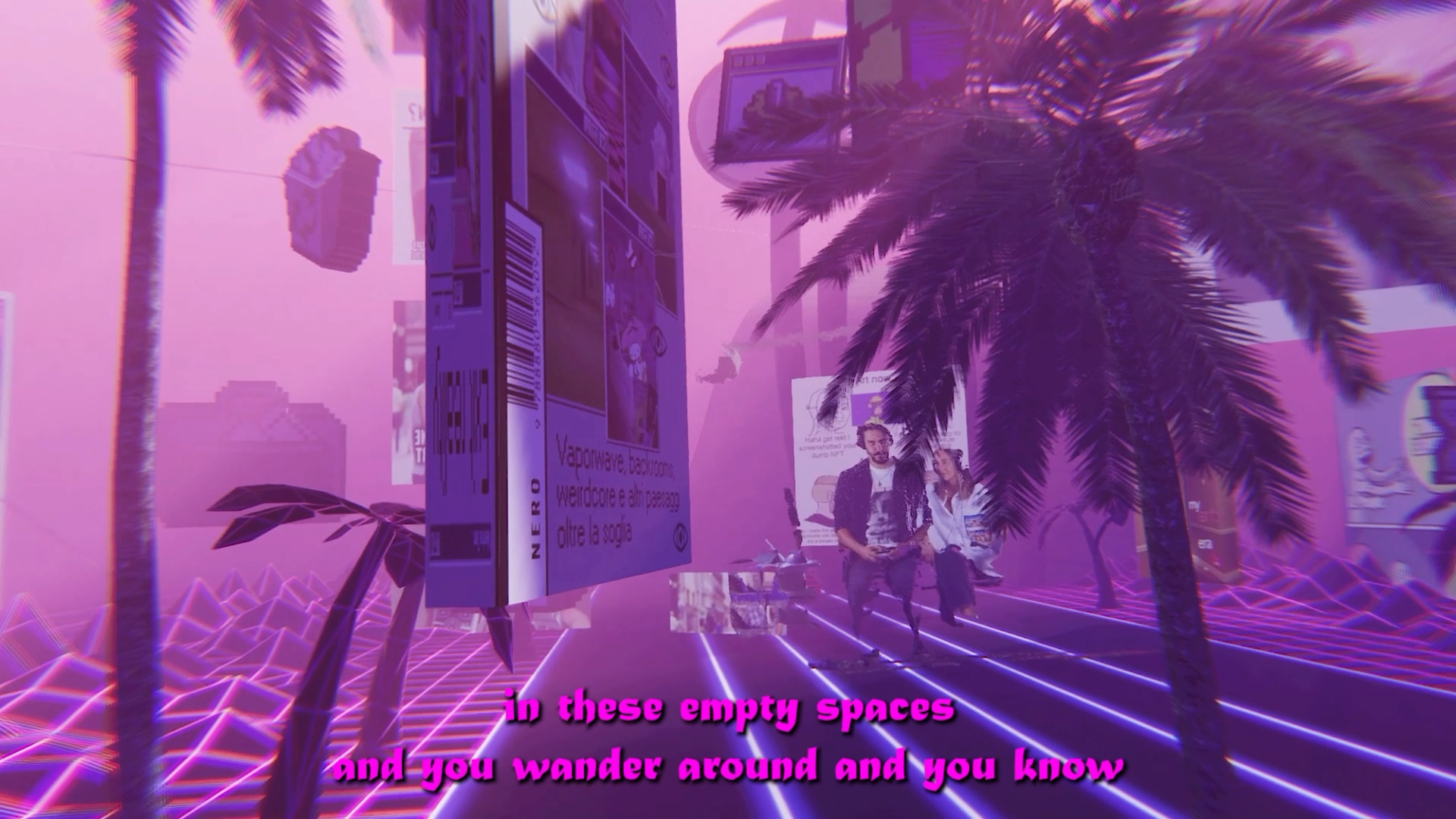
"At some point, there was a shift — when we stopped sharing these deep feelings through words and began using constantly evolving visual languages on the internet to express them. And I think memes have become a kind of language of their own."
M&OM Yes… I think it’s interesting that, at some point, there was a shift — when we stopped sharing these deep feelings through words and began using constantly evolving visual languages on the internet to express them. And I think memes have become a kind of language of their own. Like we just discussed the Library of Babel as an endless system of possible combinations — memes seem to add another layer to that. In your book Memestetica, you approach memes almost as a language in themselves. You describe their internal logic and how they shape the way we communicate today — how they circulate, mutate, and reshape culture in profound ways.
I’m also interested in how they become politicised. For example, Pepe the Frog — what started as an innocent meme has been deeply appropriated by the alt-right. I’m very curious to hear your thoughts on how memes become politicised and the patterns or dynamics behind it.
VT Yeah, so answering this question would take an entire new book. When I wrote Memestetica, I was immersed in a different environment. I was already beginning to see memes being weaponised for propaganda and becoming a more charged form of language. Now, we find memes everywhere. And in that sense, they are a language — a shared language. The logic of memes is rooted in appropriation. You take something — “steal” it, in a way — and change its meaning. Sometimes the shift is very subtle, just a small twist; other times, the meaning is completely transformed. Then we have the problem of irony. You know, the levels of irony keep stacking, so that a lot of memetic language is becoming increasingly hard to understand. It’s no longer just about a meme being niche — where, if you have the references, you get it, and if you don’t, you don’t. It’s not just that. Some memes are actually designed to be confusing. They can be simple jokes, obscure statements, or highly compressed philosophical ideas. They can function as propaganda tools, sometimes designed to deceive and spread misinformation. But they can also be part of an everyday language that people use to communicate. So memes are all of these things at once. You can see how it becomes difficult to talk about memes in general.
M&OM There has also been a lot of discussion around so-called “sludge content” on platforms like TikTok and YouTube Shorts — those hyper-fast edits with multiple videos, texts, and sounds layered on top of each other. How do you see this? Do you understand it as purely an attention-capturing mechanism, or as a new kind of visual language shaped by the interaction between our brains and the platforms themselves? We also came across Stimulation Clicker on your website — an art project that playfully exposes the logic of clickbait and the attention economy, showing how images can be rapidly recycled and reframed. So how do you see this kind of content differing from memes and more traditional forms of remix culture?
VT So Stimulation Clicker is interesting because it turns this into a game and shows how addictive it is. It’s a very effective way to make people aware of how fragmented their attention has become. As for sludge content, I would say it’s both. It’s a type of video in which the screen is divided into two or more parts, with different kinds of content shown simultaneously. You might have someone talking on one side, while on the other, there’s ASMR content — someone playing with slime, for example. This connects to the short attention span issue you mentioned, because over time, people have developed the habit of consuming content very rapidly. And as a result, you lose the ability to concentrate on a single piece of content for a longer period of time. Some users have found that listening to something while watching another piece of content that captures their attention keeps them more engaged. That helps them stay focused. It doesn’t work for everyone, but many people — especially younger generations who have grown up multitasking — feel very comfortable in that kind of environment. They’re able to split their attention, following the words while also being visually entertained by another stream of content. And, of course, this has emerged naturally from the media ecosystem.
At the same time, it’s also turning into a visual language. We could even connect it to the practices of many avant-garde filmmakers in the past, who experimented with similar ideas. So, to answer your question, I would say it’s both: a side effect of our media environment, and something that is gradually becoming a visual language. I think it has a lot to do with how your brain works. In my case, I’ve changed over time. I used to be someone who needed silence to concentrate. Now, when I write — especially longer, more complex pieces, like the book — I need to have something in my ears. I actually mention this on the last page of Exit Reality. I listen to Arctic sounds, and without them, I really can’t function.
M&OM Your book Conversazioni con la macchina: Il dialogo dell’arte con le intelligenze artificiali draws on a range of rich metaphors to explore our relationship with artificial intelligence — from the computer as a mirror or alter ego, to the artist as a kind of shaman casting creative spells with AI, or even the machine as an offspring we nurture in an ongoing, recursive learning loop. We were wondering if there is one particular metaphor that you personally find most illuminating for describing our fast-evolving — and often unsettling — relationship with AI today.
VT The book you mentioned is a short essay about AI in art. I chose to focus on the relationship between the artist and the machine, looking at it specifically as a form of collaboration. I set aside the idea that the machine will replace the artist or produce art autonomously. Instead, I’m more interested in what happens when artists actively choose to build a relationship with the machine. So it becomes a dialogue — that’s the initial idea. And my favorite metaphor is definitely the one used by Harold Cohen. Cohen was a British artist who worked mainly in the United States, and he’s considered a pioneer of AI art. He wasn’t working with machine learning, but with symbolic AI — a different kind of technology. Still, he was one of the first artists to engage in a deep and sustained exploration of what an artist can do with a machine. He built and programmed his own drawing and painting machine, and he always thought of it as a collaborator. Instead of following the logic of replacement, he engaged in a dialogue with it, exploring what kinds of art and culture could emerge from that encounter. He used to say that the machine was his “other self.” I find this idea very compelling. In this case, creativity doesn’t reside in the artist or the machine alone — it exists in between, in the conversational space they share. It’s fundamentally dialogic.
The idea of outsourcing the artistic process to a machine doesn’t feel particularly meaningful. What matters more is the relationship that forms through interaction. And I also believe that technology is culture — it’s not something separate from it. So computers aren’t alien machines coming from outer space, ready to invade us. Let’s set aside, for a moment, the question of who decides which machines we use — that’s a whole other conversation. What matters here is that machines exist in a symbiotic relationship with our culture. So we need to investigate that relationship. We need to actively engage with these systems and develop a deeper awareness of what they do. For this reason, I think the metaphor of the collaborator is the most meaningful one.
M&OM Yeah. In the end, we’re going to use these tools — they’re deeply embedded in our society. Not all of them are unavoidable, of course — there are still choices to be made — but many have become part of everyday life. So exploring them and understanding what they mean is something everyone should engage with, in one way or another.
VT Sure, and that’s partly the topic of my next book. It will be published in Italian in mid-November, and it focuses on how we can appropriate technology — and even misuse it [The book is now published, and it’s titled Antimacchine. Mancare di rispetto alla tecnologia]. Because that’s how I think we should engage with it: not by simply following instructions, but by hijacking, misinterpreting, misusing, or even breaking it to understand how it works. It’s about disrespecting technology — I like to use that expression.
M&OM Sounds super interesting, looking forward to that! I want to ask about what could be seen as a misuse — or perhaps a strange use — of technology: AI slop. As early large language models and image diffusion systems accelerated the production of high-volume, low-quality content, we began to see terms like AI garbage, AI pollution, and AI-generated dross emerge. One of these terms is AI slop. Early uses of the term seem to have appeared around the release of AI image generators in 2022, describing this flood of low-grade material. Alhassan Elwan writes about AI as “the displacement of human subjectivity as the sole meaning maker. Spam, bots, moderating bots, dynamic pricing algorithms are all operationally autonomous simulacral subsystems where signs circulate, mutate and affect outcomes without any necessary tether to human meaning. As Trump said, everything's computer. We've all seen stage five mechanisms exemplified in the recent feed infection, known as SLOP. Slop is what happens when an algorithm is trained to maximize engagement in a context where meaning, intention, and authorship are treated as irrelevant. Slop is cheap, fast, and frictionless. It flattens the sublime and the stupid into the same effectless stream. It's not just content, it's control. Slop is a tool of power.”
In its visual expression, we’ve seen things like Shrimp Jesus memes, and more recently, so-called Italian Brainrot — a wave of surreal, AI-generated videos featuring strange creatures with pseudo-Italian names, distorted voiceovers, grotesque humor, and nonsensical narratives. There’s something slightly unsettling here, especially when we consider historical moments like Futurism, where Marinetti framed war as a kind of cleansing force, or when AI is described as a new aesthetic aligned with authoritarian tendencies. So when you look at these emerging meme ecologies — from Shrimp Jesus to Italian Brainrot — do you see them as empty AI slop, or as strange aesthetic experiments that might still be telling us something about power, memory, and the future of images?
VT There’s a lot of confusion when people talk about AI-generated images. We have AI-generated images, AI art, AI slop, and then phenomena like Italian Brainrot. All of these things can be defined differently, and this confusion doesn’t really help us understand them. As I understand it, slop refers to content produced without any intention of creating something meaningful. It’s about generating large volumes of material that capture attention. So it becomes a way of polluting the internet with content that circulates without much sense, produced mainly to accumulate clicks and generate revenue. There are even what you might call “slop factories.” If you go on YouTube, you’ll find dozens — maybe hundreds — of videos teaching people how to produce slop and make money from it.
So yes, it’s closely tied to the politics of platforms. But I don’t think we should analyse slop primarily in terms of control. It’s more of a by-product of a media ecosystem, where monetisation is the main goal and views are what get rewarded.
"I don’t think we should analyse slop primarily in terms of control. It’s more of a by-product of a media ecosystem, where monetisation is the main goal and views are what get rewarded."
Within this chaotic production of content, you sometimes get accidentally interesting images — like Shrimp Jesus or other surreal visuals. They carry this strange, unsettling, uncanny quality. At times, they’re so absurd that they become interesting, but that’s really just a side effect. That’s what I would call slop. Then there’s another category of AI-generated imagery that is more directly tied to propaganda. These are images produced with the intention of spreading political ideas — like depictions of Donald Trump saving kittens or people from floods, or Kamala Harris portrayed as a communist. These are clearly designed to communicate specific messages. Sometimes it’s not direct propaganda — it can also function as ironic commentary.
But it’s true that many right-wing groups have embraced this aesthetic and use it to support their narratives, especially on platforms like Instagram or TikTok. That’s one reason why people often associate AI-generated imagery with the political right. Still, I don’t think this is inherent to the aesthetic itself. Comparisons with Futurism, for example, seem quite superficial to me. As an art historian, I see the relationship between Futurism and fascism as much more complex than it’s often presented. That said, a significant amount of AI-generated political imagery leans to the right. Part of the reason is that these models tend to produce very standardised, easily readable images — often based on stereotypes. This kind of visual language aligns quite well with certain right-wing narratives. At the same time, many people on the left are more cautious in their approach to AI. There are concerns about who controls these tools, about energy consumption, and about biases in the datasets. So there’s generally a more critical stance toward their use.
And finally, Italian Brainrot — that’s a completely different phenomenon. It’s connected, of course, because the same tools are being used. And it’s true that some of these memes, in their original form, included racist elements and offensive references to different religions — so they were quite problematic in content. Especially Tralalero Tralala and Bombardiro Crocodilo — the early versions contained phrases that, to an Italian speaker, sounded very offensive. The crocodile one also included references to Gaza, so it clearly has controversial components. But we can connect this to what I was saying earlier about memes in general. Many memers use politically provocative or deliberately inappropriate language. This tendency existed long before the arrival of AI. I also think the original memes were created by very young users trying to be edgy and provocative — that’s how I understand it. At the same time, memes can always be appropriated and reused in different ways. Even if something starts off as relatively minor, it can be weaponised, so we need to stay attentive to how these forms circulate and evolve. On the creative side, though, I find the whole Italian Brainrot lore fascinating. It’s another compelling example of collective myth-making — of building a shared narrative, characters, and an evolving story world. What really struck me is how quickly it spread. I saw it emerge from the depths of the internet, and within just three months, my daughter — she’s ten — was already asking me to buy the toys.
"Memes can always be appropriated and reused in different ways. Even if something starts off as relatively minor, it can be weaponised, so we need to stay attentive to how these forms circulate and evolve"
M&OM There are now theatre productions and musicals for kids...
VT Oh, yeah. Oh, sure
M&OM Yeah, I think my concern was initially, as you said, the excessive use of all sorts of AI models — from text to image, image to video, and then AI voiceover, text to speech — all becoming consumable content. But they are very much charged subliminally with some kind of meaning, where Ballerina Cappuccina is actually a serial killer, and Bombardiro Crocodilo is bombing kids. Then we suddenly see a theater production for kids that is being imposed on them.
VT It’s a very complicated moment for parents around the world, because there isn’t a simple way to protect children from harmful messages that can be embedded in things that seem harmless. And this kind of content is everywhere. So yes, it’s definitely a concern. But I don’t think it’s specific to the Italian Brainrot phenomenon — there’s a vast amount of online content that can be harmful to kids.
M&OM That's why I was reflecting on how the whole attention economy behind this is based on rage and anger.
VT This is more of a reaction I see in adults. Kids are having a lot of fun with it — they enjoy it because it doesn’t make sense. It’s the power of nonsense. I explored this quite a bit in Memestetica, because nonsense has always been a central aspect of memes, even before this.
M&OM You recently posted that AI-generated ASMR is currently one of the most interesting genres of visual content on social media. What makes it so interesting to you?
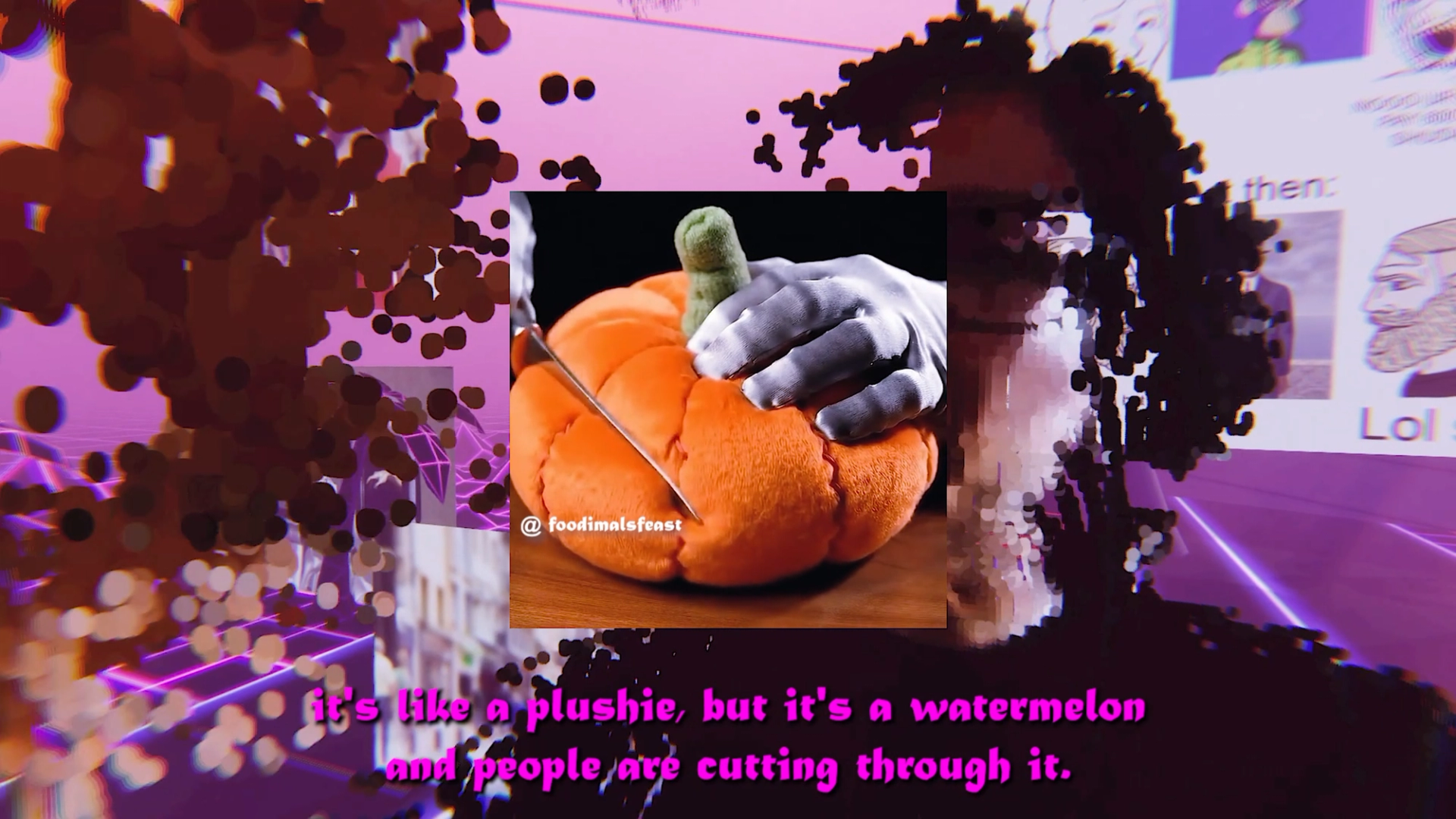
VT Okay, so I also talk about ASMR in Exit Reality, because I find the trend really interesting for several reasons. I’m not personally into it — I don’t get much pleasure from watching ASMR videos. I prefer ambience videos and ambient sounds. But this newer form of ASMR, created using AI-generated video and sound, is something I find fascinating. People are producing videos that feel very close to how surrealism approached objects. For example, you might see a watermelon with a plush-like texture being cut open, or objects made of glass that are sliced while producing very specific sounds. You might see someone sleeping in a bed made of lava, or water, or clouds. So ASMR continues to explore materials — just in new and unexpected ways. In the past, people would do this by hand — working with actual materials, manipulating things like slime or liquids. Now, with AI, they can simulate any material and create the most absurd combinations. And that’s what makes it so fascinating — it really reminds me of what the surrealists were doing. I don’t know if you’re familiar with the fur-covered cup.
M&OM By Meret Oppenheim...
VT You have an unexpected encounter between two things that don’t belong together. It really disrupts your sensorium — you’re instinctively drawn to one aspect while being repulsed by another. It feels strange and fascinating at the same time, evoking the sensation of touch and sound. It stimulates multiple senses that are usually not engaged when you’re online.
M&OM Valentina, before we end, I have one last question about Endcore. Shumon Basar describes Endcore as living in an Extreme Present — where change accelerates faster than we can process it, reality feels unstable, and endings never quite arrive. What do you think about this idea, and does it resonate with the way you see culture unfolding today?
M&OM Yeah, I think it really resonates with this notion of an Extreme Present — so dense that everything happens in the now, and tomorrow already feels like a completely different trend. Even within these aesthetics, something can be a “core” today and no longer one tomorrow — so quickly that it almost ceases to be a trend altogether. So yeah, exactly. That kind of cuts off a lot of hope for the future. But I agree — we shouldn’t lose that hope, and we should find a way to take a step forward.
"many of us might be getting a bit carried away with this constant orientation toward the apocalypse.[...] Maybe we should try, even if it’s difficult, to set that aside for a moment and think about building new ways of imagining the future — even when the future feels like it’s approaching an end."
VT Generally speaking, yes. I don’t think anyone can deny the existence of that sentiment. I was referring to something similar earlier when I mentioned Mark Fisher and this idea of being stuck in time. It’s not exactly the same, but it’s connected. At the same time — and I include myself in this — I think many of us might be getting a bit carried away with this constant orientation toward the apocalypse. You can see it in corecore and similar aesthetics. I understand the sentiment, and I’ve expressed similar thoughts myself, so I include myself in this critique. But I wonder whether it might also be an easy theoretical position. Maybe we should try, even if it’s difficult, to set that aside for a moment and think about building new ways of imagining the future — even when the future feels like it’s approaching an end.
M&OM Yeah, I think it really resonates with this notion of an Extreme Present — so dense that everything happens in the now, and tomorrow already feels like a completely different trend. Even within these aesthetics, something can be a “core” today and no longer one tomorrow — so quickly that it almost ceases to be a trend altogether. So yeah, exactly. That kind of cuts off a lot of hope for the future. But I agree — we shouldn’t lose that hope, and we should find a way to take a step forward.
VT Completely! Or, I don't know, maybe change the point of view and look at the same apocalyptic stuff from another perspective. I’m not sure — I don’t have an answer. So maybe we should try to find a way around it. But that’s still an open question for everyone. As I mentioned, the next book takes a different direction — more closely connected to my roots. I graduated with a thesis on internet art, or net art, so I’ve spent a lot of time studying the 1990s and early 2000s. There was this idea of a tactical media approach, of hacking technology, right? To most people, it might sound like an old idea, but I think we should take that idea back, even though we live in a different media ecosystem, technology is much more pervasive, and our tools are much closer. The idea was good, it was right!
M&OM I hope it’s, in a way, a bit like what we’re trying to do with this podcast format. In the sense that we use the technology, but the data we generate is streamed to our own private server. It’s not accessed by others, and we don’t store it. The space itself isn’t fully public or exposed to everyone’s gaze — it remains a more private kind of virtual room, where different conversations can unfold. Exactly — we don’t need to escape these systems entirely, but rather stay within them and actively practice them.
VT And also messing with it a little bit.
M&OM Definitely. Thank you so much, Valentina — we really appreciate your work and you taking the time to be with us.
VT Thank you for having me. It has been great! Ciao ciao.
Bios
Me AndOther Me is a new media-driven artistic and architectural research studio exploring the future of our spatial experiences and communication through practical applications of social mixed reality experiences focused on online culture, counter-platforms, and the spatial web. The studio is directed by Innsbruck-based architects, educators and researchers Cenk Güzelis and Anna Pompermaier. They are interested in how social media and the internet have evolved to accommodate online communities in networked virtual spaces that have become alternative places to practice social and cultural activities, and how these virtual spaces affect the architecture of our social lives and social selves.
Valentina Tanni is an art historian, curator, and lecturer based in Rome. Her research investigates the intersections between art and technology, with a special focus on internet culture. She teaches Meme Culture and Aesthetics, Digital Media Culture, and Introduction to Visual Culture at John Cabot University in Rome. In the past, she has taught at La Sapienza University of Rome, the Polytechnic University of Milan, and NABA | New Academy of Fine Arts in Rome and Milan. She is the author of several books, which have been translated into several languages and are distributed internationally.
Podcast Credits
Direction & Production: Me AndOther Me
Virtual Camera: Cenk Güzeliş, Luca Lazzari, Viktoria Märkl, Lilly Krüger, Ruben Ungerathen, Adrian Weiss, Linus Memmel
Technical Setup: Me AndOther Me, Luca Lazzari
Sound Design: Memo aka Mehmet Çakır
Audio Mix: Kristaps Andris Austers
Volumetric Streaming: Me AndOther Me, Marek Simonik (Record3D)
Text: Me AndOther Me
Thanks to the ORF III Cultural Advisory Board. Produced with the support of the Federal Ministry for Housing, Arts, Culture, Media and Sport as part of the funding program Pixel, Bytes + Film.