Shumi Bose/KOOZ Pelin, James, thank you for joining me. You know each other, but could we start with brief introductions?
Pelin Tan Thank you. I'm Pelin Tan. I'm basically an academic or teacher; I’ve been working within university faculties and institutions since 2000. I'm based in the southeast of Turkey, in a region that is mostly populated by Kurdish people. In 2013, I came here from Istanbul with my mentors to establish an architectural faculty; that was at the time of the first peace process between the PKK (the Kurdish Workers’ Party) and the Turkish government, which failed. Now we are in the second peace process, a new one: let's see. This is a region of many communities; the political process and extractivism affecting the Tigris River are also very intense. It's a very complex region, and I'm trying to run a film department there. I also belong to an artistic and architecture collective called Arazi Assembly; we mostly do long-term engaged research to produce visual and narrative archives of non-extractivist practices.
James Bridle I'm James. I'm a writer and artist; I moved from the UK to the Mediterranean over a decade ago now. Alongside that, I've seen a shift in my practice, from a critical focus on technology — particularly network technology and computers — to a broader ecological agenda. I’m looking at how we relate to the more-than-human world, with an increasing focus on super-practical projects — like how we all stay alive in a very uncertain future.
KOOZ Certainly I encountered James’ work through perspectives on surveillance and network technology, which has since shifted. Pelin, much of your work also happens in places where visibility is not a neutral thing.
PT I met James in Matera, Italy; we were invited by Joseph Grima, who was the artistic director for Matera as the 2019 European Cultural Capital. We discussed archive practice, visible and non-visible archives: who or what is in control and who is not, in relation to the history of Basilicata, which itself involves an intercolonial history of Italy. It was important to me in terms of the Mediterranean's alternative heritage, solidarity practices, motifs, and heritage that modernity has oppressed. In this project that we titled DeArchiving Dwelling which I co-curated with Liam Gillick, we focused on housing and dwelling.
I lived in Istanbul for a long time and became involved in urban and neighborhood resistance movements there—both in an academic and a non-academic sense—sharing knowledge and supporting the resistance. That came to a head around the Gezi protests, after which we created a video archive called bak.ma., a video infrastructure for Turkey's social and political history. We thought about what an autonomous archive is, and through bak.ma we produced a book called Autonomous Archive, a learning process about how we can make things visible and non-visible. What does that mean?
Visibility can be dangerous and even pose a threat for us and others, so it is important to consider what kinds of narratives or metaphors we use. For example, one video was made with my comrades in the collective, recording and mapping refugee routes from Syria, Iraq, and Rojava, through southeast Turkey to Antep, Mardin, and all the way to Berlin: we archive while remaining anonymous. In Mardin, in 2013 my aim was to build a curriculum about social architecture. Generally speaking, the education system became very conservative, propagating the mainstream patriarchal ideology of the Turkish state, which renders other communities and their knowledge invisible. I mostly work with Ezidi communities, whose traditional houses and dwellings take very different forms, reflecting spatial practices rarely included in architectural curricula. There are many issues to address, both in pedagogical and social terms: many things are made invisible, and the things that are visible are only permitted in line with Turkiye’s sanctioned, mainstream ideology. I wouldn't put all the blame on the state, either: it's also on us — as people, as institutions.
Now I'm in Batman, a primarily Kurdish town with Ezidi villages and Armenian heritage in Sasson and up to Bitlis. Our campus sits along the Tigris River, which runs from Diyarbakır to Mosul, Iraq, and the region is among the country's most politically controlled areas. It's a very militarised landscape due to various infrastructure, water dams, and other border controls; at the same time, it's so rich with many communities: Ezidis, Chaldeans, Christian Arabs, Kurds, Armenians, various Sunni communities, and others as well. Culturally, it's rich, and consequently there are many non-visible, non-extractivist practices; with my research collective, we are thinking about how to make these visible. But visibility brings further extractivism; both visibility and non-visibility have these double-edged problems. Ethically and practically, we constantly ask ourselves questions. Right now, my colleagues and I have an exhibition running in Diyarbakır; we created a non-linear ecological calendar, collecting narratives from women along the Tigris River, as well as nomads and transhumance pastoral practices. These come together to form an alternative ecological calendar, rooted in cosmologies, local communities' ancestral knowledge, and so on — the visualisation of which took five years of reflection.
KOOZ That sounds like a beautiful project.
PT Yes. We wanted to convey that sense of collective knowledge and let younger and future generations learn practical information, while making this knowledge visible in a non-linear, non-modernist way. How can we both make this attractive yet avoid fetishization? What are the ethics of visibility, and how do we create something that doesn't fall into consumerism — instead declaring a silent, sustained solidarity? I say sustained because solidarity is about failure; continuous failure.
"Visibility brings further extractivism; both visibility and non-visibility have these double-edged problems."
KOOZ James, I’m thinking now of visibility and the phrase “the world is watching” which rose up during the live-streaming peak of the Occupy Movement and attendant protests.
JB Well, these questions of visibility and invisibility have been really central to my work for a long time. I was dealing initially with the critique that these technologies — as well as the non-technological but systemic forces that shape our lives — are largely hidden and largely illegible to most people, either bound up within large bureaucratic and governmental systems, or literally locked in the little black boxes that we keep in our pockets. That invisibility is a huge part of their power, and so the standard critical response has been, “well, let's make it visible.” So things that I've done — like the ‘drone shadows’ that I've drawn and still draw occasionally, these big outlines of massive flying death-robots — tended towards very direct demonstrations or explanations. And I became really disenchanted with that approach, for various reasons — the main one being that it's not really working. It mostly scared people and turned them off.
There's this belief that if we could just explain it better, if we could only show people what's going on, they'd understand, and do something: it's such a lovely idea, but it's actually not what happens. The way we've been communicating about the climate crisis — for decades — has been to tell people how bad everything is and show them pictures of terrible things. I think it has the opposite effect; it shuts people down even further, creating greater apathy. People who are suffering the effects of climate change may have some agency, but it’s not meaningfully increased by showing something terrible.
I've really tried to move away from this dichotomy of visibility and invisibility, and towards practicability and agency — finding the tools that shift a situation, rather than merely point to the problem. Of course, you run into similar questions that Pelin mentioned: how a practice resists appropriation and remains largely non-extractive. As soon as you discuss action, you can easily get sucked into a very technologically-oriented kind of solutions debate. I think practical work on specific questions, enacted at local and communal levels, are really, really important. We desperately need to formulate ways of discussing these issues that are not geared towards scale and solutions. This was very clear to me at the 2025 Venice Architecture Biennale, where we shared some work about local material works on our island, using local clay and seagrasses. It was presented as a laboratory, but it was not; you couldn't do anything, only look at these new materials. There was our seagrass; someone else was making stuff out of banana fibre; there was hempcrete and in the next room, the elephant-dung arch. But it was presented as though one of these things will magically save us: an outcome, not a process.
KOOZ You mentioned the little black boxes we carry around in our pockets, linking our biometrics to vast databases. Is it possible or even desirable to be strategically invisible? What does non-belonging look like, in response to systems of control?
JB I'd like to put that question to Pelin, because you use the term “off the grid” — in which I'm really quite interested. We know the violence done by these homogenising systems of social, governmental, technocratic and quite authoritarian systems: we know that's happening. I'm trying to go off grid quite literally: I'm building a wooden house with its own water retention systems, solar panels and so on. But I really don't want to go off grid, because I think that’s fundamentally a deeply conservative and somewhat individualistic position — the opposite of the kind of work we need to be doing. But we do need new grids. We need new coalitions; new solidarities, as Pelin says, that are not homogenizing in the way that previous systems have been. The modernist grid proposes agency and freedom, but it becomes a self-reinforcing structure; I like the idea of a non-homogenising grid, a network of things that we learn from.
"We do need new grids. We need new coalitions; new solidarities, as Pelin says, that are not homogenising in the way that previous systems have been."
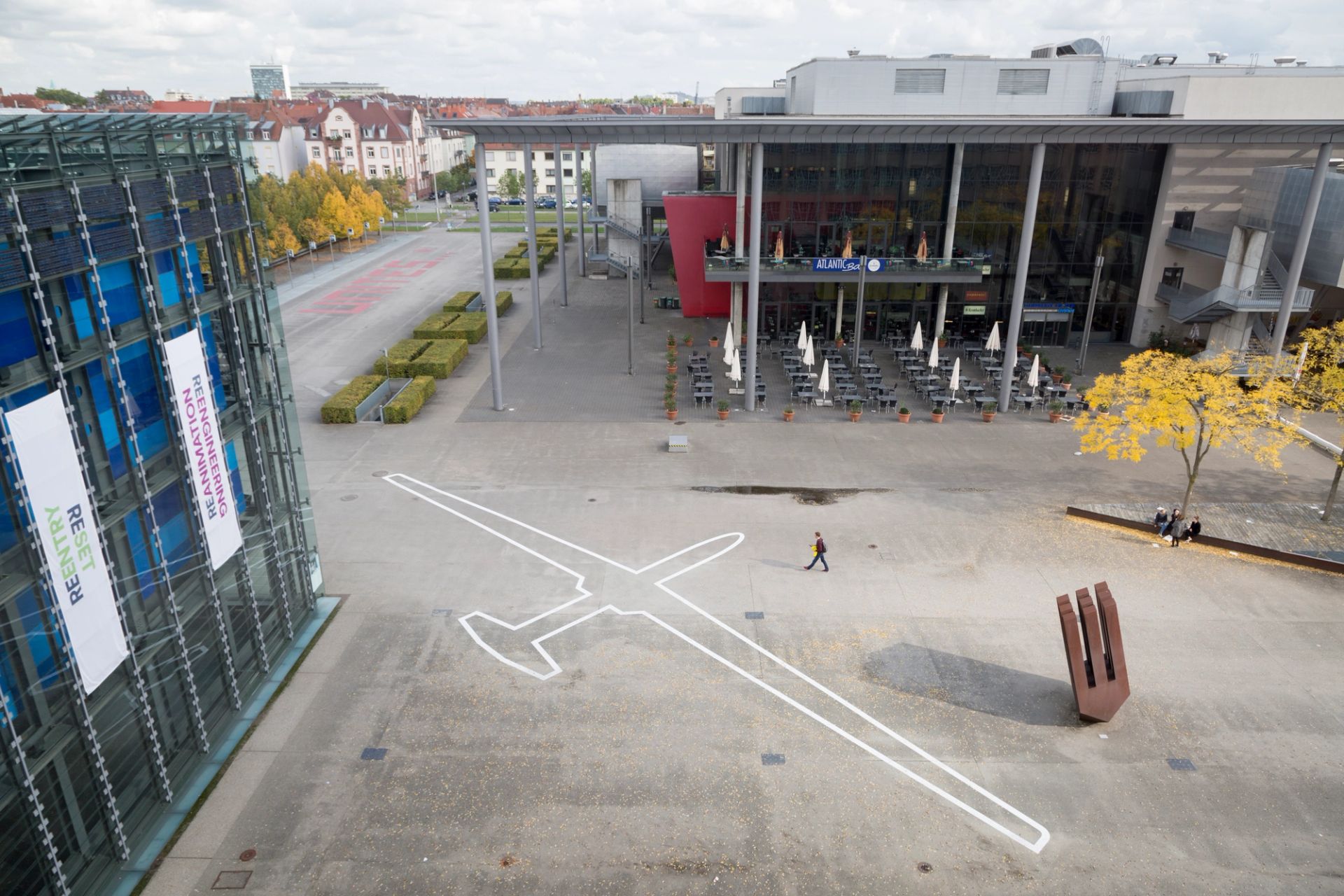
Reaper drone shadow installed at ZKM Karlsruhe for the exhibition Globale, October 2015. 'Drone Shadow 009', James Bridle (2015), courtesy of the artist.
PT Sometimes I think that certain knowledge finds its own world and its channels for dissemination; at other times, I find myself categorising certain types of knowledge. It is important to think about the knowledge you create and how it should disseminate, and in what institutional environments. Sometimes what we produce at Arazi Assembly ends up in a contemporary art or architecture exhibition. Is that bad? I'm not sure. On the one hand, there is a large audience, and the experimental material you produce can really influence people, especially younger generations. This matters more than academia; for one thing, it's faster. A video of mine is in the exhibition right now: an experimental mix of fiction and documentary in which an Ezidi woman speaks about non-extractivist practices on Earth, her relationship with Earth, and the many Ezidi hymns that refer to non-humans. Meanwhile, many Kurdish people haven't even met Ezidis in the Batman region; there are cultural differences and a very violent history of conflict — indeed, this is why many Ezidis did flee to Germany. For me, it’s interesting that the dominant population doesn't fully know its own region; this is the danger of a perspective that seeks to dominate and homogenise everything. Yet, as I mentioned, many communities live here. There are many hidden histories and practices, invisible partly because minority communities are afraid of persecution.
It’s true that a contemporary art exhibition is a relatively soft way to bring knowledge to the surface, and it carries a different meaning in this region. But I do believe in the more hardcore institutional structure: how to bring this forward in a state-funded university, for example, which is difficult under political oppression. We are currently working on a project to bring Ezidi villagers to our universities; we hosted a lunch, inviting all the villagers, who noted it was the first time a state institution had invited them anywhere. These are big gestures, with major impacts on social democracy for people who want to live together. Turkiye is going through a tough political and social situation — yet each of us can have a little power to change things. I believe in multiple, heterogeneous, layered knowledge dissemination; it’s not only on the street or at the protest, that's not enough for me. We can keep pushing institutions in classrooms, boardrooms, and offices; these are small steps, and change doesn't come very fast. Coming to James’ work, it's important to think about what kinds of autonomous threshold infrastructure we can create.
JB I like what Pelin said about the need to do this work in a parallel fashion, presented in different contexts; it's really important to be clear and honest about that. It's a big part of my thinking: I do this work and it will look like this to one audience, but like that to another audience; it will do different work in each of those places. This also points to the need for parallel and ultimately new forms of institution. Many of us have been dissatisfied with art-world infrastructures for a long time, and they are sometimes brought into sharp relief. For example, trying to have an ecological art practice when you know that you can't put a plant in a gallery; it will die there. White cube galleries are conceived as hermetically sealed spaces — the opposite of the work that we need to be doing.
I don't think this pertains just to art institutions; we need a radically different form of institution in time, space and in ecological terms. Space-wise, such institutions need to be open to the environment around it in different ways; in terms of time, they need to respond to something like Pelin's ecological calendar. The timeframes in which we produce this kind of work do not match up with the ‘opportunities’ available, whether that's a one-month residency or a one-year project, they’re not tied to growing seasons, to meaningful lifecycles. Time and space need to shift in that direction. Ultimately, or hopefully, these new and parallel institutions become new, load-bearing infrastructures — because ultimately the act of building parallel institutions is, in various ways, intended to reclaim power from where it currently resides. Quietly build your little institution until the dominant thing that you're essentially replacing becomes irrelevant.
"Quietly build your little institution until the dominant thing that you're essentially replacing becomes irrelevant."
A super practical example: we're building a local community-owned energy generation plant. It's a parallel institution to the electricity company that refuses to stop burning brown coal. We're using sola, but you can do this with wind or water power, or even with battery installations. Community and city-owned energy is a powerful, brutally literal way of taking power back: we are aiming to redistribute power by taking ownership of the energy generation in the community. That's a parallel institution. We're going to physically change the energy supply — and we're going to do it as artists and creatives, too. This is not a field of black glass solar panels; it will definitely have some weird art in it, which is quite crucial as well. This approach is important to stress: doing the practical part doesn't mean you abandon creativity — in fact, it's critical. We do a lot of science-based research; as non-specialists or non-traditional thinkers within these subjects, we may actually devise approaches that are not otherwise taken.
KOOZ Thinking of dams, checkpoints, digital borders, material undersides of digital networks: infrastructure is understood as a service, but evidently it can also exert control. What does protest look like, against something so diffuse as a system of infrastructure?
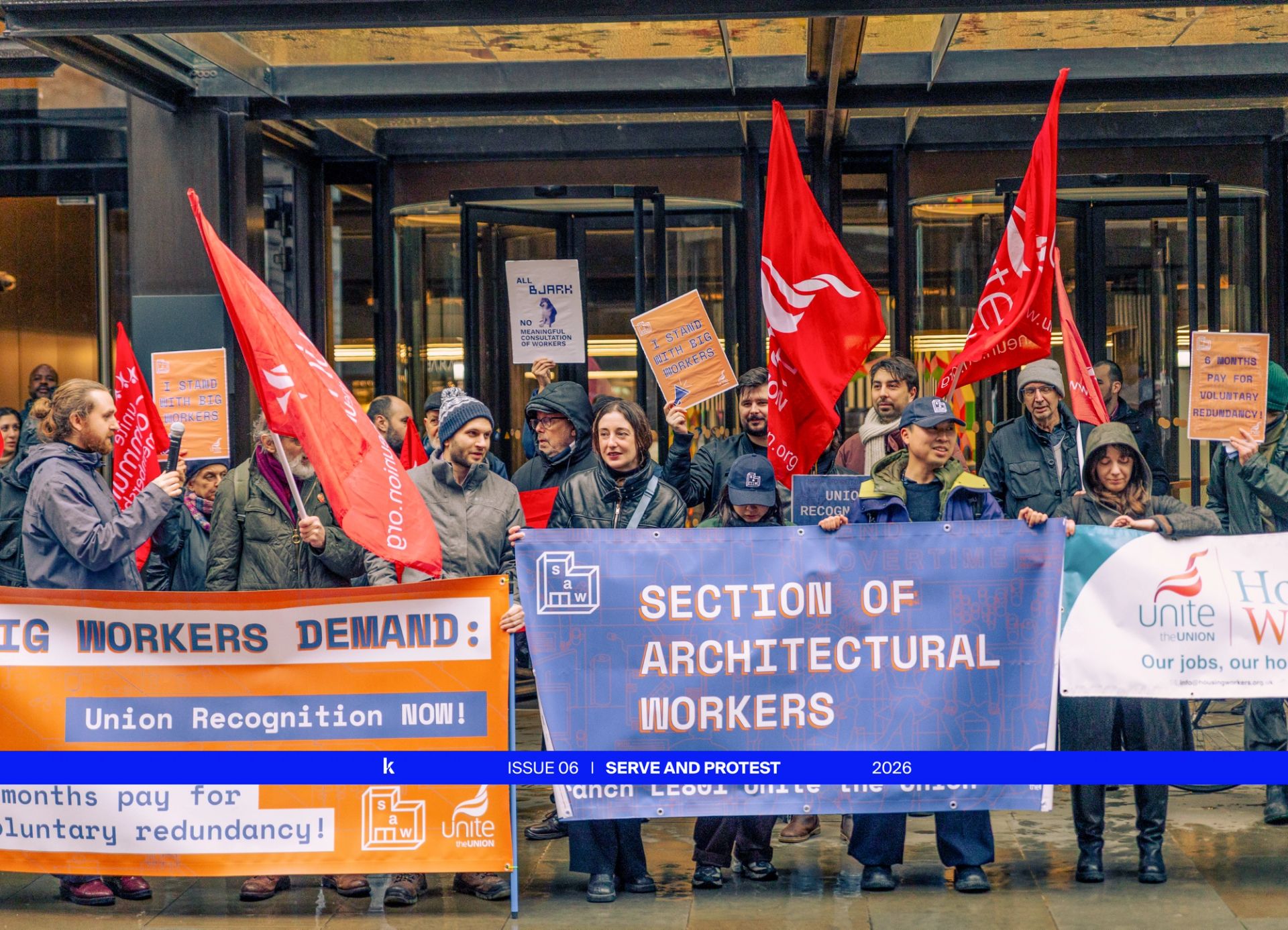
PT The infrastructure of protest takes different forms in specific situations; one methodology doesn't function in a different situation. To understand how protests gain meaning, scale matters: urban, rural, or territorial. For example, an #Occupy protest in an urban space, or like the empty City Plaza Hotel in Athens, which was occupied by activists and refugee families together, standing with refugees. They lived there for three and a half years, building an autonomous infrastructure in the heart of the city. This was meaningful also because it was in a largely racist and right-wing neighbourhood in Athens; at a certain point, the people who were living at City Plaza Hotel decided not to continue with that infrastructure and, through common agreement, they stopped. This is an interesting example in terms of scale, the subject of refugeehood, and the Greek housing and economic crisis—as well as the ethical position. Not only are the activists defending another group together, but they are also creating a new infrastructure, even temporarily. We cannot call it a failure; what enabled shared decision-making is an infrastructure of collective vulnerabilities, which becomes resilient.
"What enabled shared decision-making is an infrastructure of collective vulnerabilities, which becomes resilient."
In the region where I live, most protests are environmental: against mining companies, the negative effects of building the dam, and even against solar energy. There are aggressive companies in collaboration with the state, and also many Kurdish municipalities are forcibly taken over by the current party. This is the undemocratic process that we have right now; on top of that, private companies are trying to extract the landscape. We were trying to fight against a solar panel company in an Ezidi village that would turn all the land into an industrial zone. We met with the solar panel company to explain that this village doesn't want them there, especially on grazing land, which should be protected for local and transhumance communities. We discovered that planting trees on grazing land can provide some legal protection—and so we simply planted a lot of trees. We didn't even need to stage a physical protest on the street, as we had anticipated: the legal protection for trees was hard to change.
The second example, similar to James and Navine’s Vessel project with seagrass, we are starting a Ezidi Female Solidarity Cooperative in the village, specifically, a women's farming cooperative. I was a little unnerved that local people wanted my help building an association—a substantial entity or institutional body. More than ten years ago, the government sued me for certain activities with associations in Istanbul; I spent a whole year in criminal court. I advised the villagers that an association can be very dangerous, as the state can perceive and ascribe aggressive political agendas. Instead, let's build a cooperative. Even thinking about the difference between an association and a cooperative took time; going back to collective decision-making that James is focusing on in his recent book; this emerges as a basic political process in order to fight against protecting your ecology. This is what we are mostly dealing with here and now. Many people are trying to protect land, water, and forests in Diyarbakır and across Turkiye.
Of course, the dam creates not only land-use issues; it also creates highways, tunnels, tolls, and military checkpoints. Together, they partition and segregate the landscape. Nomadic peoples cannot travel on foot across highways or tunnels; they are losing their animals, and traffic accidents are common. Everything in the area has become more rigid, under a strategy of control. This is also how, for me, landscape becomes important as an archive: not only by witnessing people and communities, but also by witnessing through landscapes. How can we archive that witness; going back to the previous question, how can we make it visible?
This connects to the idea of different kinds of protests, as protest can also become institutionalized. But how can we create a threshold infrastructure so that protest becomes continuously empowering, continuously creating material outcomes that affect policy and heritage and thus become visible? In this case, I infer Edouard Glissant’s interpretation of visible opacity, rather than the performative visibility that large institutions like museums, biennales, or governments want to see. This is about finding an operative archive of opacity; I would also reference James' book (Ways of Being, 2022, Penguin p.352) in terms of more-than-human politics and decision-making, which I found very instructive.
JB It's really grim how so much “green infrastructure”, to use a loose term, is being deployed in terrible ways. When I first arrived in Greece, there was a very strong anti wind power movement, but coming from Northern Europe, I naively thought wind power was unequivocally good. It took me a long time to understand the critical ways that wind power is being deployed by large companies causing vast environmental and social damage. As much as we need renewable energy, it's important to think differently about how it is done.
That's what we're attempting with our artist-led and strongly community-based solar project. We're looking at agrivoltaics, which combines solar panels with agriculture. There’s a lot of recent developments coming out of Spain and Portugal about co-locating livestock and solar panels, which apparently works very well. We’ll be growing produce under the panels with partial shade — essentially a climate adaptation, as it’s getting too hot in the summer. All of that is to say that it’s often easy to be overly positive about wind, solar or off-grid practices. But they're not emancipatory ideas in and of themselves; without a political shift that accompanies them, without a basis of community and solidarity. That's why it's really important for us to keep rethinking these ideas.
I didn't spend much time at City Plaza, but I did spend time in other occupied buildings; I arrived in Athens at the height of the movement in 2015, and it was one of the first places that I got involved directly building infrastructure. I was putting Wi-Fi into some of those occupied buildings; these were difficult places, but they had amazing communities, and people came together to build infrastructures around them. I'm very interested in the ways those infrastructural skills get built. I happened to be in New York at the time of Hurricane Sandy in 2012 — the big superstorm that swept in and blacked out Manhattan for three days, causing a huge amount of damage on the Jersey shore and the Rockaways. It happened just after Occupy Wall Street in New York; the major downtown encampment was broken up at the end of 2011. A lot of activists involved in Occupy Wall Street — commonly regarded as a failed protest at this point — learned to build community infrastructure, as part of that process, both physical and in terms of community organisation: how to work together and how to put stuff together.
The amazing thing was that while Hurricane Sandy was ongoing, some of those people got together and put together something called Occupy Sandy, in which former Occupy activists then used the tools that they learned through a direct form of protest to put together a relief effort. In fact it was people from Occupy Sandy who were first on the ground providing really practical support in the Rockaways and Jersey, days before FEMA and the Red Cross turned up — and they were still there months later after FEMA and the Red Cross left. They were doing incredible work that they learned through protests and then applied practically. They were often first on the ground in communities that were not very sympathetic with Occupy. These were not necessarily people who would expect a bunch of hippy-anarchists from that protest to turn up on the ground and help them after a disaster. That's political work as well as practical work — and you don't know where that practical work is going to be useful when you learn it.
I like this term that Pelin just used — threshold infrastructure — which I hadn't heard before. If I understand correctly, it’s about this building of foundations on which infrastructures can be built, and learning the skills with which to build them — because we don't know what we're going to need, we don't know what responses we're going to have. A lot of the things that I'm working on look like off-grid practices; they are a form of training for an uncertain future, where we don't know exactly what we're going to need. The more we practice and learn now, the more flexible and capable we will be when change comes along. In that sense, forms of protest are a really powerful way to develop the skills needed to build counter-infrastructures.
"Forms of protest are a really powerful way to develop the skills needed to build counter-infrastructures."
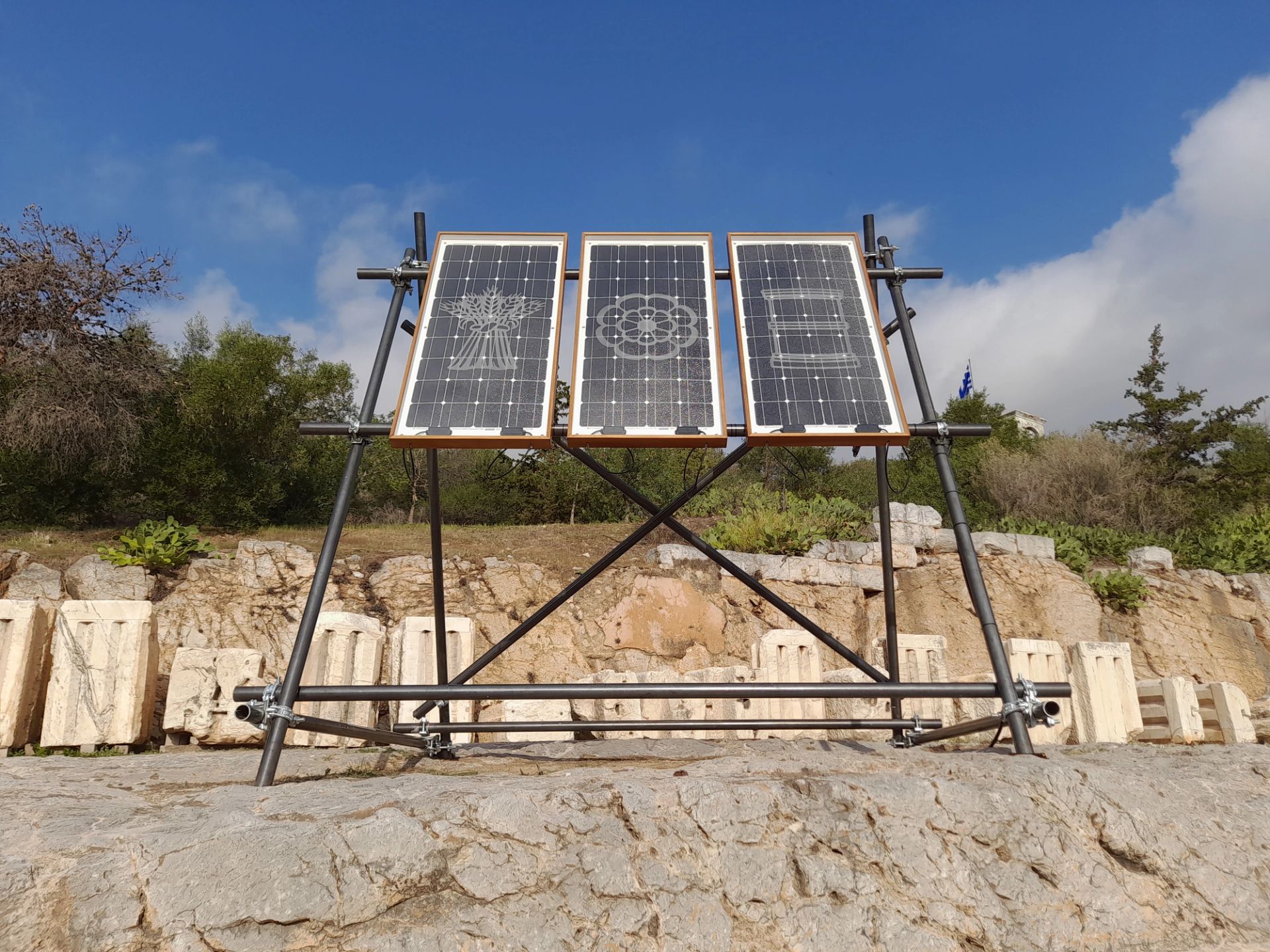
Engraved solar panel installation on the archaeological site of Elefsina, Greece. 'Things Said, Things Seen, and Things Done', James Bridle (2023), courtesy of the artist.
KOOZ Two things I’d like to address: firstly a term that might sit at an angle to ‘serve and protest’, namely the notion of unconditional hospitality. Secondly: how can the more-than-human turn make for a wider politics, and how does the consideration of rivers and forests play into notions of dissent?
JB I’ve thought a lot about more than human decision making, at a complex theoretical level; actually the solar community work comes from trying to implement that meaningfully. I was devising bizarre, Byzantine schemes for how to build a more-than-human decision making community; what we ended up with was a garden, with solar panels in it. But I don't think that's reductive. Done the right way, that's actually just the point. Those are the foundational principles of this community, and doing that thinking has led us here. It is in fact the main outcome of the book and research that Pelin referenced previously. What my more-than-human colleagues teach me is that there's a vast amount to learn; I'm slowly trying to pay attention. The seagrasses, for example, which we use in our buildings and our work, come into our lives in a number of ways; we now have a relationship of solidarity with them. We use their by-products in our architecture, and we're also working to protect them and their habitat. We conduct scientific studies with them and relate that information to the public, working to dissuade people from anchoring their yachts in them. It’s a form of activism tied in with the seagrasses and our relationship with them.
We're also witnessing a period of massive movement among species. I spend a lot of time meeting new arrivals on our island, whether that's lionfish or these huge new sea urchins — both relatively recent arrivals from the Indian Ocean, coming up through the Suez Canal — whose arrival here is made possible by recent rises in temperatures as well as much longer histories of colonialism, imperialism, and the treatment of the land. I swim with them every day and they're a reminder that changes are taking place: we have to find new ways of living together. Actually, I've been trying to think what we can do together with them for a while, and what to do with other more-than-human inhabitants. We have these immense agave succulents all over the island. I wasn't paying much attention to them, though I knew they were not natives to this place. They arrived sometime after the Columbian exchange, over the last two or three hundred years; probably imported to Europe for rope making, and since then they've spread around the Mediterranean. They love it here, although they've had to adapt; in Mexico and South America, they're pollinated by bats, but here it's moths. I thought they were foreigners, and then I met Fernando Laposse, a Mexican designer who suggested that they might be tourists — they don't belong here and they're not doing any useful work.
Laposse works with the agave in Mexico to make textiles, and also to regenerate land that's been destroyed by intensive agriculture. It turns out that the agaves are quite magical, as they take everything they need from the air and absolutely nothing from the soil. They do put a little nitrogen back into it; crucially, they grow very strong root systems that secure the soil where there is usually high aridity and soil loss. They're the first line of defense and can help to restore and regenerate those soils. This is a problem that we have here: we've had intensive agriculture and the abandonment of agriculture; now we have dry soil and soil loss; we need to plant agaves. So these new arrivals are very much here to help us, and they're like workers: they do a job, and they've come here to do it. We need to be very hospitable and adapt to them, so that they can do this absolutely crucial work.
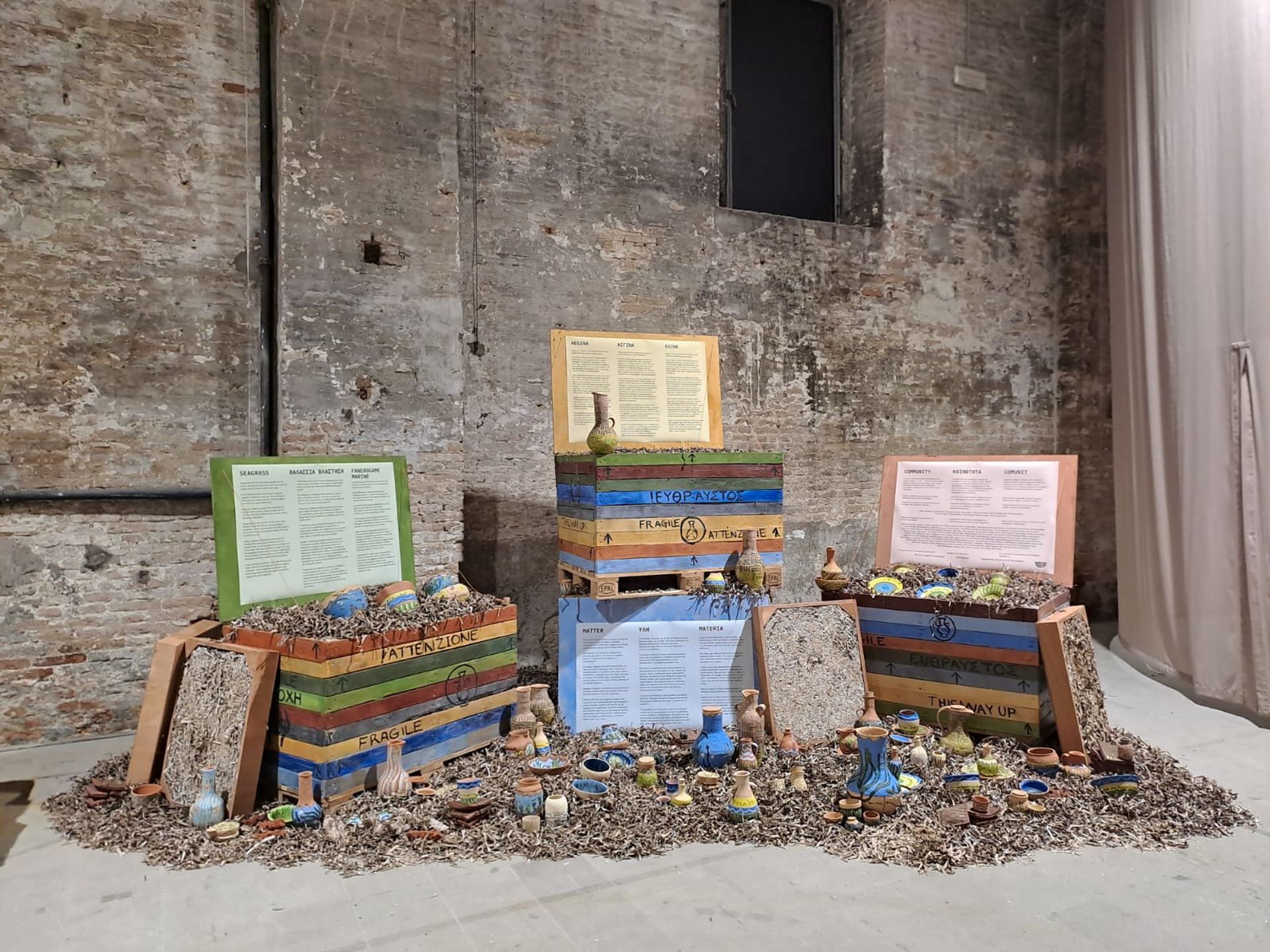
Installation of seagrass packaging and architectural elements with hand-made ceramics, Venice Biennale of Architecture, 2025. 'The only flowering plant in the ocean', Vessel Collective (James Bridle, Navine G Dossos, et al., 2025), courtesy of Vessel.
PT Having worked and taught with Alessandro Petti and Sandy Hilal for more than ten years, I have been very impressed by survival in Palestine’s West Bank. I lived in Beirut, looking at how seeds are archived and what they mean; I visited seed archives in Palestine and in the Bekaa Valley of Lebanon. There's a huge seed archive at Tel Hadya near Aleppo, called ICARDA, which moved operations to Lebanon’s Bekaa Valley when the Syrian war began. Now Lebanon is also being bombed, but it was astonishing to see how they kept going, with limited electricity and infrastructural services, saving seeds for our future. We won't exist in the future, but other generations, as well as non-human generations, might, with those lentils, seeds, wheat, and so on.
For me, seeing this archive was like looking at a futuristic infrastructure. I couldn't believe that under intense bombing and such oppressive and violent conditions, people are trying to keep the seed archive going in the occupied West Bank or in Lebanon. I learned a lot from my Palestinian friends, drawing on experiences from the first and, especially, the second intifada, starting in 2000. It's interesting to witness the threshold infrastructure that connects humans and non-humans, each becoming the other’s means of survival. I created videos, films, documentaries, and an archive of solidarity around caring for these seeds, exploring how we can connect with them and even give them a voice.
"It's interesting to witness the threshold infrastructure that connects humans and non-humans, each becoming the other’s means of survival."
For example, okra seed is a strong ingredient. Wherever I go to a refugee camp — anywhere in the world — they always plant okra, because the plant is so strong; it represents endurance and shares a narrative of solidarity with humans escaping war. The okra seed becomes a strong comrade, which astonished me. I tried to write stories of forced migration through the okra seed, giving it a voice. Can I imagine myself as okra, writing through its perspective? Whenever I see such oppressive conditions, or violence inflicted upon territory — whether that’s my region, Palestine, or Lebanon — it's vital to note that humans don't care for themselves, but for non-humans, thinking of their survival together.
JB Similarly, I've met people living under incredibly harsh conditions in the West Bank, doing exactly the kind of work that Pelin is talking about, and it reassured me deeply. I have a persistent worry that the forms of activism and the work that I believe to be important comes from a very privileged position. I live on a Greek island, I get to build nice things in the sun; I have the freedom and the leisure to do it, at least for now. Yet I've met people who, as Pelin says, do this under extremely difficult conditions.. It remains vital, and it remains possible; as difficult as it is, it's part of what people do to sustain themselves under such conditions. That gives me a lot of hope and the energy that I think we all need.
KOOZ A beautiful note on which to end; thank you both so much.
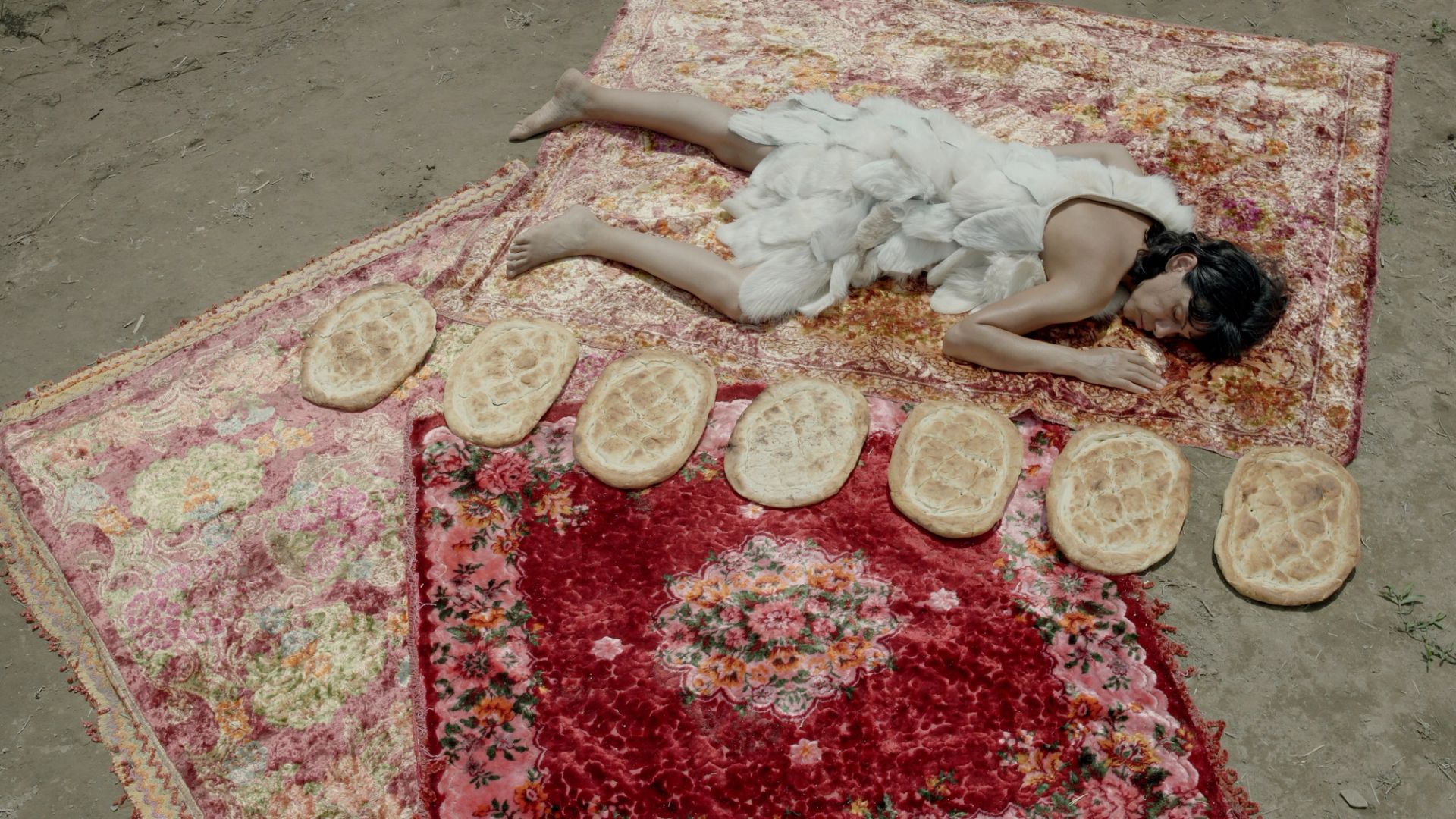
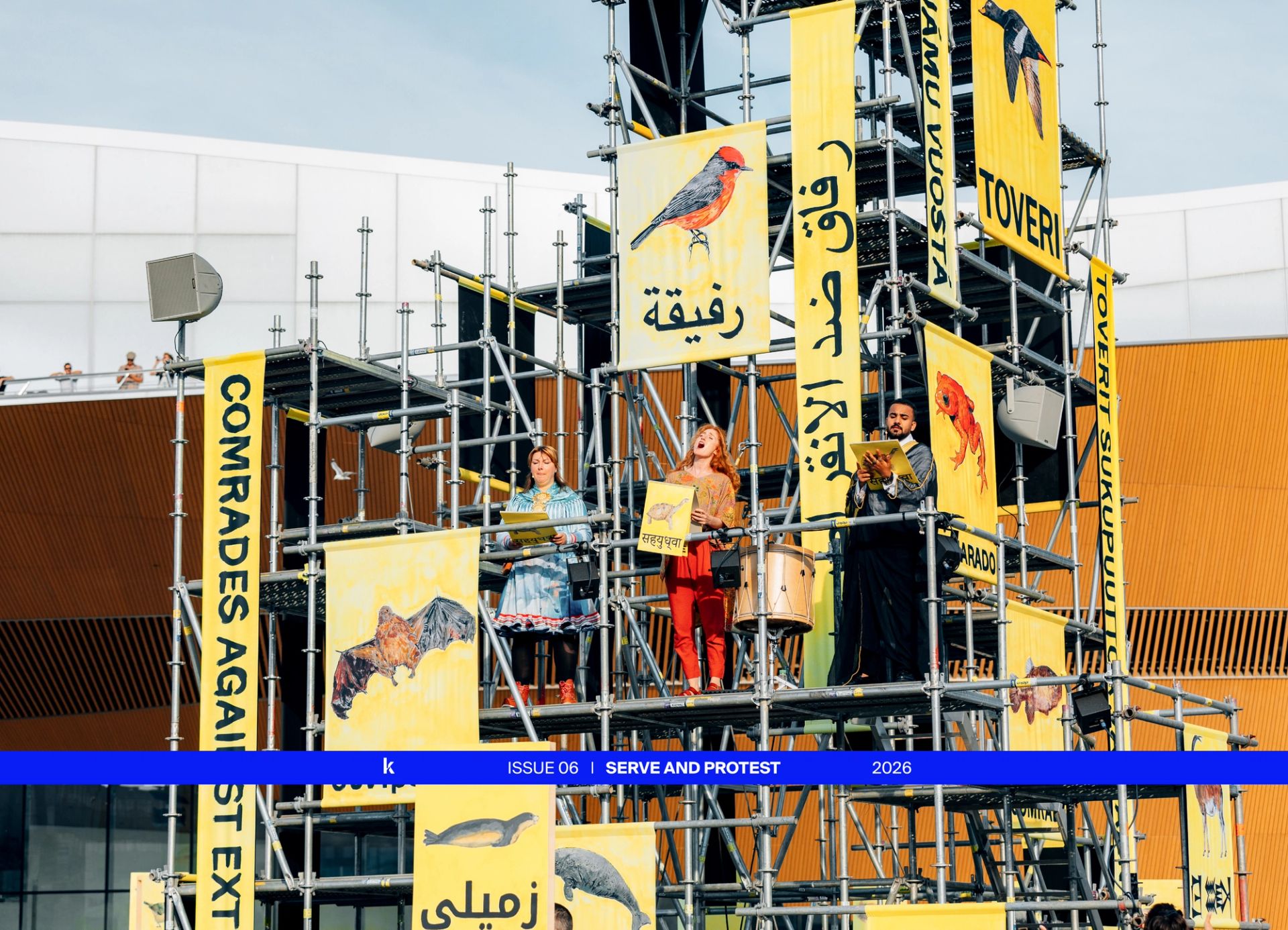
Gilgamesh: She Who Saw the Deep / Gilgamêş: Ew a ku kûrahî dît (2022), Directors&Script: Anton Vidokle & Pelin Tan, 47 min., US - Turkiye.
BIOS
James Bridle is a writer, artist, and carpenter. They are the author of New Dark Age: Technology and the End of the Future (Verso, 2018), on the cultural effects of technology, Ways of Being (Penguin, 2022), on more-than-human intelligence, and a forthcoming book on learning to build in uncertain times. Their artworks are exhibited in cultural institutions around the world, and their writing has appeared in publications including Wired, The Atlantic, The New Statesman, The Guardian, and The Financial Times. These days they live on an island in the Mediterranean and are mostly concerned with self-built housing, community energy, water management, and creative ecological practices.
Pelin Tan is a researcher based in Mardin. Sociologist, Prof./Head of the Cultural Studies graduate program and Cinema Dept. at Batman University. 6th recipient of the Keith Haring Art&Activism fellowship, Bard College Human Rights Project, 2019, NYC. Over the last 15 years, Tan has conducted architectural and territorial research in Turkiye, Kurdistan, Iraq, Lebanon, and China. Tan is a member of the curatorial board of IBA Stuttgart 2027 and the Research Network Steering Committee of the Canadian Center for Architecture, Montreal, 2025–2027, and is co-Curator of Urgent Pedagogies (IASPIS). Tan was a visiting professor at the Hong Kong Polytechnic School of Design (2016), the Architecture Faculty of the University of Cyprus (2018), and the Orient Institute in Beirut, Lebanon. Her recent film with Anton Vidokle: Gılgamesh, She who Saw the Deep, was supported by Sharjah Film Forum, 2021. Books: Forms of Non-Belonging, e-flux books/Sternberg, 2026.
Shumi Bose is chief editor at KoozArch; she is an architectural educator, curator and editor. She is a Senior Lecturer in architectural history at Central Saint Martins; she also teaches at TU Wien and the School of Architecture at Syracuse University in London. She has curated widely, including exhibitions at the Venice Biennale and the Royal Institute of British Architects. She is the founder of Holdspace, a digital platform for extracurricular discussions in architectural education. Shumi is a trustee for Architects for Gaza and a member of the International Committee of Architectural Critics (CICA).