KOOZ/Shumi Bose Thank you both for joining us — and for sharing Maria’s film Can the Unseen Speak? Let’s start with introductions.
Maria PutriSure. I’m Maria, I’m currently on a research fellowship in the Netherlands — which I’ll come back to — to pursue a project that was ‘born’ while I was studying at the Architectural Association, under the supervision of Manijeh Verghese and Inigo Minns. I graduated from the AA in 2024; since then, I've been screening the film that emerged out of that work, titled ‘Can the Unseen Speak?’
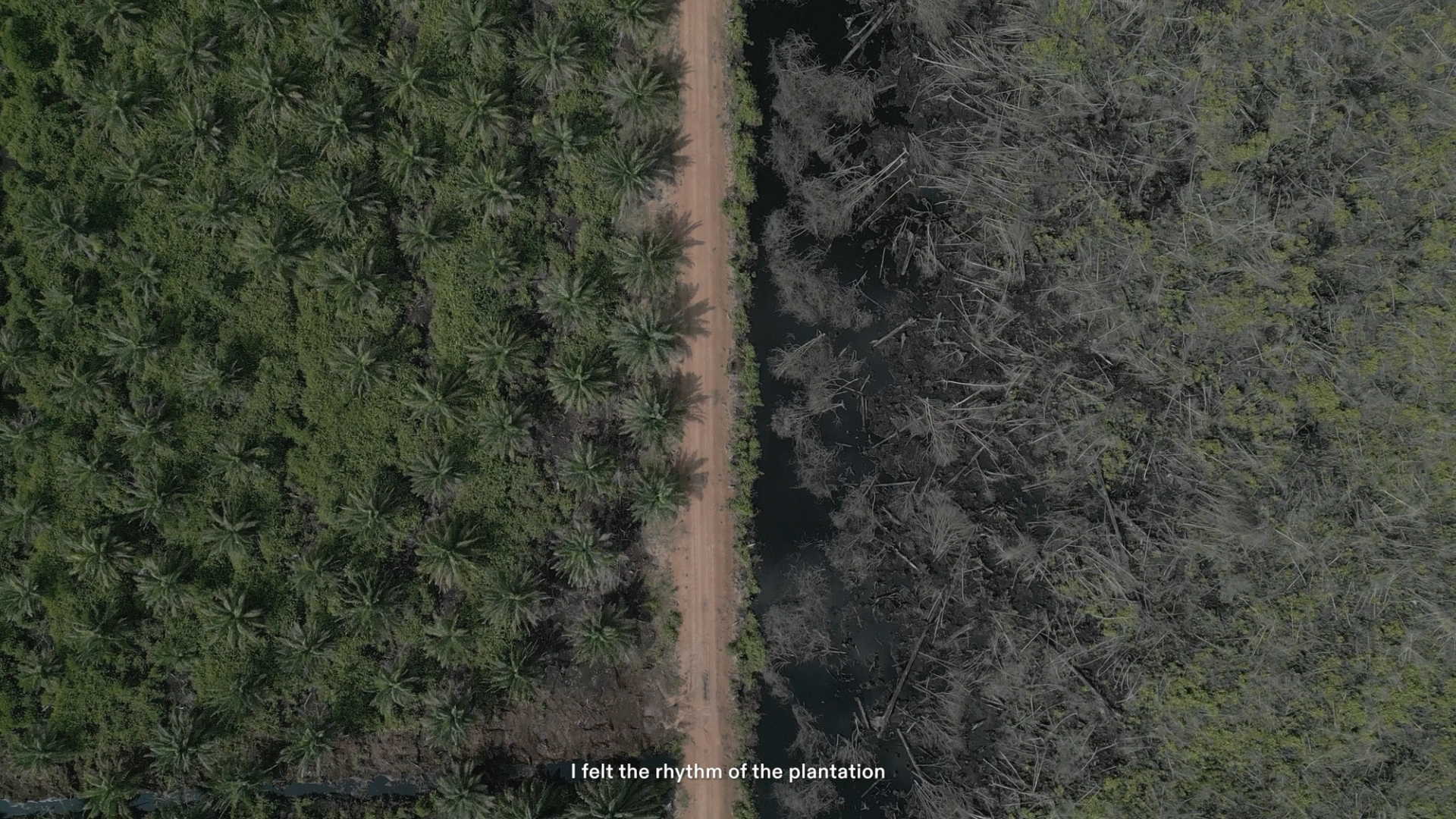
In terms of the project itself, I was already looking at the politics of space in Sumatra, but I was looking at the domestic scale — at the matrilineal houses of the Minangkabau and their models of social and biological reproduction, how this space was contested by local and colonial patriarchal forces through an architectural reading of the house. Which I later on realised had its limitations as a method of analysis. So then I wanted to zoom out into the territorial scale and ended up looking at Dutch colonial plantations, smoke typologies and transboundary haze as the materialisation of land conflict…
Film still from ‘Can the Unseen Speak?’, courtesy the artist.
KOOZ Ali, how about you?
Ali Napier Sure. I'm currently a practicing architect; I also like to write and edit. I've been editing with Failed Architecture for two years, and my own writing usually involves the relationship of everyday culture, nation building, national identity within the post-imperial context. I've written about the British context; being half Indonesian, I've written about that context too. One of the pieces Maria mentioned when we met was an essay I wrote about tropical modernism in West Africa, primarily Ghana. I’m interested in the post-imperial context, and the realities of newly independent “global south” nations trying to forge their own identities after gaining independence. What I found interesting about Maria’s film is not only the identification of some of the impacts of colonialism, but that it shows how difficult it is for these countries to become truly independent even though colonialism has officially ended. The systems put in place have such a stronghold, decades or even centuries later.
KOOZ I'm curious about the point at which it became okay to talk about things like cultural heritage, decolonialism, or indigenous land politics at architecture school. I'm guessing that neither of you started out expecting to do so.
Ali Napier I did my undergraduate degree between 2013 and 2016 — it was certainly a very different landscape then. At Central Saint Martins, where I studied, we were mostly thinking about resilience, social politics, civic networks and local governance — though maybe that was my interest at the time. My postgraduate studies happened between 2018 to 2020 at the Royal College of Art, where some of this was starting to be addressed — then obviously 2020 blew it open. Between the murder of George Floyd and the global COVID lockdown, a lot of this stuff felt even more pertinent and people were reframing histories with intention. There were a lot of great thinkers; it was a very diverse year. That clearly exacerbated the global conversation, and students obviously want to tap into that.
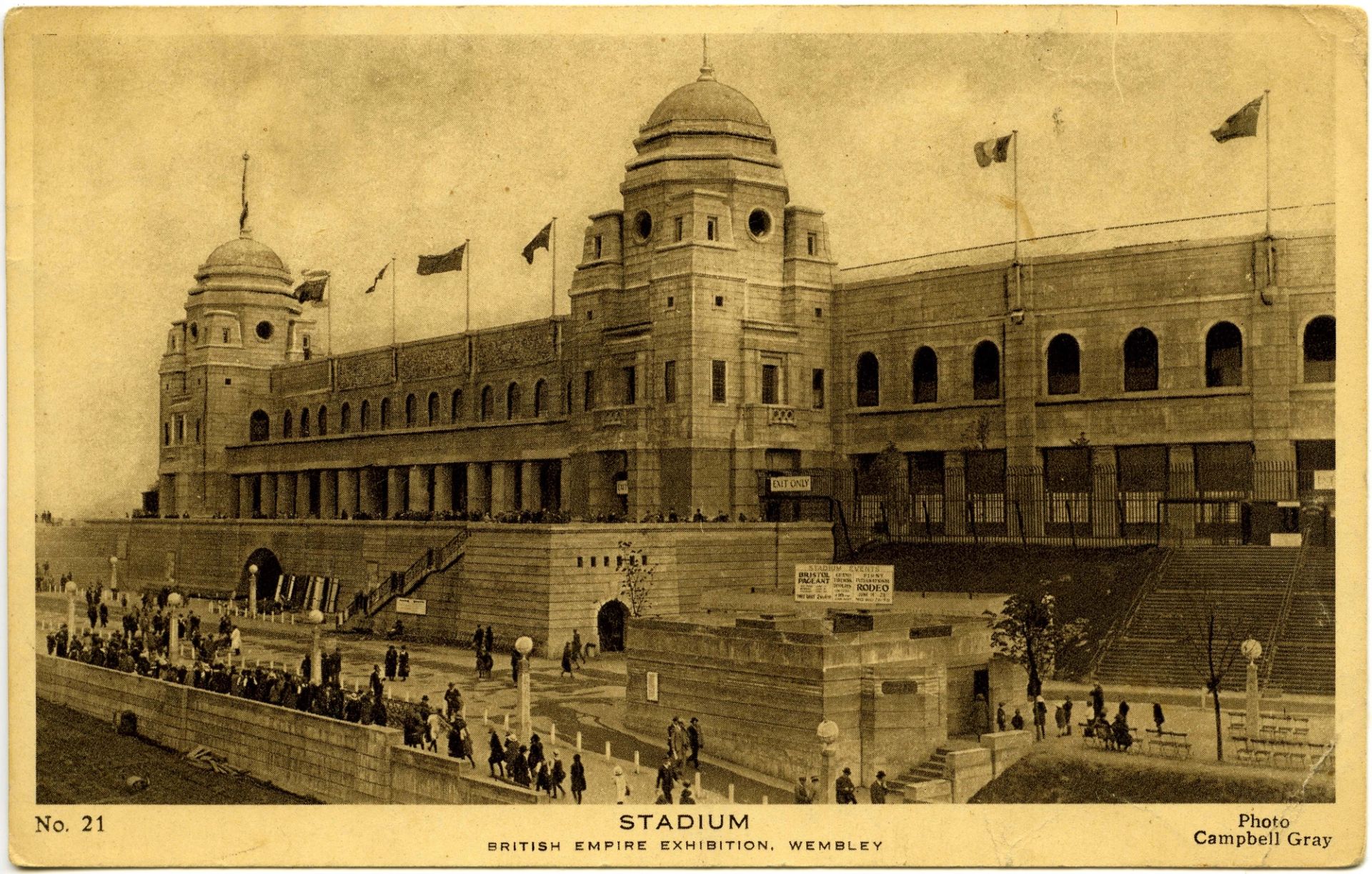
A major piece of work in which I participated looked at the British Empire exhibition at Wembley. Actually, I was interested in the subject because I'm a football fan — but no one really knows that Wembley was built for one of the biggest Imperial exhibitions in the UK. So I was interested in ideas of how Imperial culture was brought to the UK from all over the world, how it represented all these different places with their colonial names, and how that idea of empire became embedded into everyday culture.
Archival postcard of the new stadium at Wembley, on the occasion of the British Empire Exhibition. Photo: Jenny Scott/Flickr
KOOZ Maria, can you set the scene for your film in historical, contemporary, and perhaps even personal terms?
MP I have to be honest; upon actually entering the discipline of architecture, I wasn't really motivated by form-making. I wanted to understand the power relations that govern the built environment and architecture's role in that — how it mediates these relations. Initially, I was more interested in how Jakarta was urbanising, understanding the economic climate, and the liberalisation of the economy that led to massive development projects.
But of course education is not a linear process. Eventually, I came around to form-making and understanding how different design strategies can intervene in this complicated and contested context. That's how I got into studying colonial history in Indonesia. I wanted to understand the colonial processes that led to the making of the urban (the establishment of Jakarta as the center of trade) and the rural. Where did that come about? How did that happen?
In the film and in my ongoing research, I'm looking at the enduring effects of the plantation system — specifically, growing palm oil as a cash crop in Indonesia — that started in the late 19th century. I’m looking at its enduring effects, and how that impact continues to exacerbate the effects of extreme weather changes. In particular, I’m looking at the Sumatran context, as that was the first location where palm oil was cultivated in plantation form since 1911.
KOOZ This is already quite a globalised story; set in Sumatra, now part of Indonesia, colonised by the Dutch who then planted palm oil, which — as your film reminds us — is not a crop native to South East Asia but rather to Africa, right?
MPThat’s right — Both the Dutch and the British took part in the transplanting of oil palms in their colonies. The palm oil crop was transplanted from West Africa, first to Java and then Sumatra. It began with four seedlings that came to Java’s Buitenzorg (Bogor) botanical gardens in 1848, via the Hortus Botanicus in Amsterdam. Similarly the oil palm genealogy in neighbouring regions went through Kew. A Kew gardener went out on a Niger expedition to identify varieties of the palm oil crop, as the British Empire was interested in species that would give higher yields. That botanist returned to Kew, taking his findings through this process of sorting, naming, classifying, and testing which variety would be more lucrative to plant. The Botanic Gardens in Bogor, which acted as a colonial outpost for Kew, became interested in growing this crop — but it wasn't until later, some crooked Belgian businessman Adrien Hallet realised its profit generating possibilities when grown in plantation form. After Java, it was transplanted in Malaysia, using the existing infrastructure of the rubber plantations there. After they found just how profitable it was in Malaysia, this Belgian businessman carried it all the way to Sumatra in 1911.
AN I know what palm oil is used for today, but what made it so profitable at the time? Where was it going?
MP The palm oil was largely exported to Europe, as there was a growing demand for it — first to be used as a lubricant for oiling machinery, and later on for household uses. It started with oiling machinery and later, the production of soap, surfactants and other household products. It started with a few thousand hectares, and between 1916 to 1936, that had grown to 75,000; by the outbreak of the second World War, it was up to 91,000 hectares. The scale of plantations skyrocketed due to this growing global and industrial demand. Right now, palm oil plantations cover an area of some 16.8 million hectares in Indonesia.
ANI'm interested in the role of greenhouses and the lightweight structures used to test the plants, forming microclimates that were foreign in the West. How did they get from testing the oil palm in these small, bespoke glass houses to the capacity of such a profitable plantation crop?
KOOZ Truly, the invention of such a specifically intentioned architecture is fascinating. Can we talk about these somewhat strange incubation cabinets, which were designed to function across scales?
MP It was the practice of botanists to transport plant specimens in objects called Wardian cases, which allowed them to preserve the condition of the plant and receive light during the journey. In the case of Kew, the larger glass houses were a means to showcase the empire and its achievements — a way of taming what was considered wild, in this case plants from the tropics. This was done in a highly controlled, artificial environment. In order to maintain the conditions and to preserve these particular plants, you need to create a microclimate that is incredibly humid and hot — as found today, when you go into the Palm House at Kew. The way in which these species are displayed is extremely manicured and completely detached from their local context. Naming and classification systems are another way of claiming ownership of these plants — of putting them in a particular order, in a very scientific way. These systems obviously excluded indigenous knowledge and processes of handling these plants, as that was considered unscientific, inefficient and again wild.
"These systems obviously excluded indigenous knowledge and processes of handling these plants, as that was considered unscientific, inefficient and again wild."
KOOZ From organising, ordering and controlling nature in greenhouses and gardens, to the appropriation, transformation and taming of the ‘wilderness’ — that takes you from the domestic scale to that of landscape.
MP And taming the land or controlling the landscape requires labour, which makes this both an ecological and a political question. Palm oil plantation and cultivation started in South East Asia in 1911, while colonial rule in Indonesia ended in 1945. During that time, the Dutch coerced a lot of Javanese and Chinese indenture labourers to work on plantations in the worst conditions. Taming the landscape required transforming it into a productive and highly efficient space, Cartesian methods were deployed at varying scales to do this, like the imposition of the Cartesian grid on hilly topographies to rationalise space for its management and the growing of crops in rows — the best way they knew to maximise their yields.
"The Dutch coerced a lot of Javanese and Chinese indenture labourers to work on plantations in the worst conditions. Taming the landscape required transforming it into a productive and highly efficient space, Cartesian methods were deployed at varying scales to do this."
In order to control the whole process — from planting, harvest to and processing into a sellable, exportable commodity, you need labour. Processing facilities were built across the plantation fields of Sumatra and Java, featuring brutal and heavily monitored working conditions; under the 1880 Coolie Ordinance, workers were subjected to really impossible working conditions. This contract prohibited any kind of mobility; workers were poorly paid and tortured for going against the rules.
Through my current fellowship, I’m trying to understand the spatial and carceral logics of the plantation by reconstructing plantation architectures. The spaces were highly organised, with a central platform where the colonial administrator would stand as monitor. Set at the highest elevation of the platform, this overseer would have a 360-degree view of all the workers; below him, the workers were positioned in ordered rows with partitions, transforming them into units of production.
AN In the film, you talk about Cartesian grids in glass houses. We've talked about how the grid was overlaid onto the landscape and effectively, also in the warehouses for workers; that logic forms the basis of colonialism and even global capitalism now. That strongly contrasts with the ways you’ve employed and depicted indigenous culture — for instance, switching to dance or smoke, forms that don't make Cartesian grids. There’s a sense of disobedience, and a clear intention in the film to contrast dance and wildlife with this colonising, Cartesian drive. Can you expand on that strong contrast and why it was such a central theme for you?
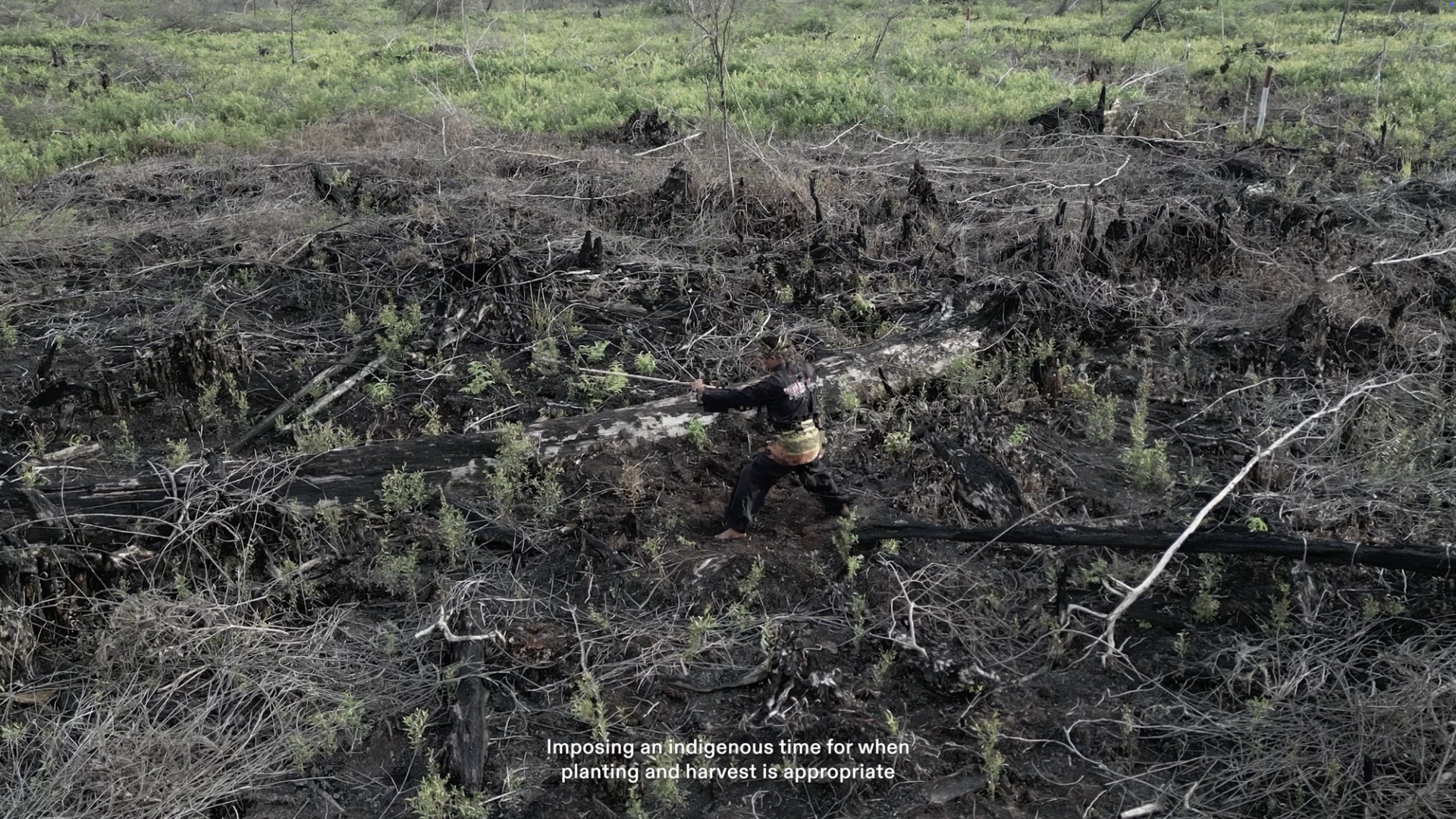
MP I love this question. Well, I saw the haze — which emanates from clearing land for plantations — as subversive potential. I was looking at different smoke typologies and how their movements negate Cartesian rules; I saw that as an opportunity for subversion. The elements of indigenous Silat performance is perhaps a little undercooked in the film. Silat is a historically significant martial art and form of combat, and in the film, the dance can be seen as a choreography of conflict. My plan was to use the haze to symbolise a kind of antidote; a form to counter the colonial processes and Cartesian logics that transform landscapes into plantations. At one point, I was trying to figure out how to extract the particle vectors of smoke, turning that into dance notations for the Silat performers — almost as a form of orientation. The intention was to move beyond that choreography of conflict.
KOOZ It’s impossible to ignore that the smoke from burning peat — which is done to prepare the Sumatran ground for the non-indigenous oil-palm — this haze itself is quite toxic, responsible for the deaths and ill health of countless plantation workers and their communities.
MP Yes, that’s true. In the logic of the film, I was trying to harness the form of that toxicity into something positive — or into disobedience. That led me to choreography. I made small experiments to try and capture the haze as a way of producing an embodied knowledge of wind. This directly contrasts with the Dutch methods, which tried to control the climate and the landscape for the purpose of extraction. My architectural technical studies revolved around the attempt to capture that haze, following the direction of wind and smoke, which led me to produce an embodied knowledge of wind. In strong winds the device was met with a lot of resistance; decelerating my steps as I walked in that landscape, while an absence of wind would cause me to accelerate my steps as the device would deflate. When I describe this as an antidote, it’s not necessarily attempting to solve anything, but simply to express a counteraction — a counter-logic, if you like.
"In the logic of the film, I was trying to harness the form of that toxicity into something positive — or into disobedience."
KOOZ Perhaps we can join some of the dots between land and body. A number of words emerge from the film and your dialogue: the haze, the vessel, the breath, the prayer — and I would add, the dance. Can you tell us a bit more about the breath?
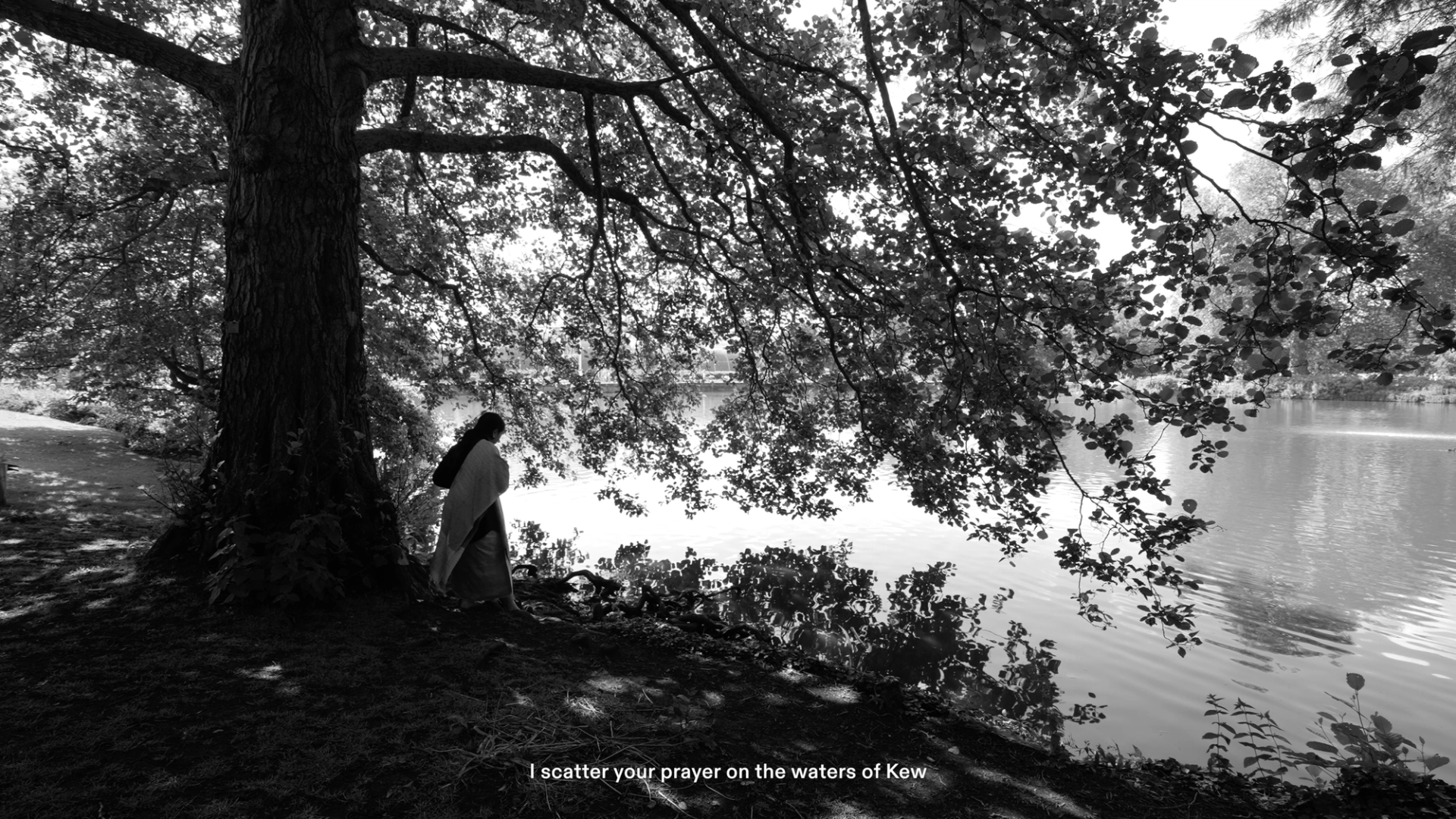
MP The project intuitively led me to glassblowing, along a creative and really nonlinear process. While I was observing and analysing all these different smoke typologies (including plumes from volcanic explosions) at a material level, it led me to glass, which is the product of plumes in different states. Simultaneously I was agitating to make things with my hands and I started glass-blowing as a way to engage with the material. As a process, breath is used literally to form the shape of the glass. It was a way of forming breath, a way of drawing and shaping breath itself. On site, I was trying to collect these multiscalar plumes, in different forms. One sample was burnt peat and polluted air, while another was the prayer of a mother who lost her infant daughter from exposure to the toxic haze. For me, all this felt very connected— how the plantation affects the land, how the smoke haze affects the body, and how the fragile glass is shaped by my breath. I really loved that process; in retrospect, it was an embodiment of that whole process — these experiments felt like an embodied form of cultural resistance. Enacting the ritual collection and release of breath on site was equally emotionally and spiritually rich for me — it also comes from a longing to reconnect with my own Javanese and animist roots, which are very much embedded in material culture and an intimacy with non-human subjects. Our rituals are a crucial part of coexisting with the natural order; for instance, there is an entire system in Javanese building practice that aligns with a complex cosmological order — although we’re so far removed from that now. For me, it was very much a way to reconnect with that knowledge through all of these creative methods, and a means of form-finding that was explicitly not Cartesian.
AN So the elemental breath and prayer intersects with the vessel and the haze, which then become subversive forms. I don't know if it was intentional, but in the film I enjoyed the juxtaposition of the hand-blown glass vessel holding smoke, soil and prayers, and the glass house or Wardian case as a test bed and means of colonial appropriation. It brings together the non Cartesian values against ordered extractions.
MP Yeah, that parallel was actually an afterthought — I wasn't really considering that direct relationship through the glass, between the Wardian case and the blown vessel! I remember that while I was doing this very analytical research, I was simultaneously being very active with my hands, making things. I think the parallel happened at a subconscious level, trying to subvert the tools, methods and ways in which things were being controlled. It proved to be most fruitful for me in my creative process — as opposed to a more traditional or linear manner of responding to a context.
AN I really appreciated that twist on the material realities — it’s not super explicit in the film, but it exists as something for us to dwell on. It’s really quite powerful the more we talk about it and tease it out.
KOOZ It is a really beautiful observation. Happily, there is an increasing spectrum of historically underrepresented histories being revisited and studied today. Yet Can the Unseen Speak? is not primarily a historical story; the conditions it describes are contemporary. Ali, let’s come back to your interest in postcolonial legacies, rather than the heights of empire.
AN Not to add another repetition to the chorus of connections between decolonisation and decarbonation — it’s a fact, but it's worth touching on. What really grabbed me about Maria’s film is this: we know that the Dutch accelerated this system of plantation culture in Sumatra; post 1945, the independent Indonesian government was unable to move beyond this system. It was too profitable to dismantle. Plantations had already decimated a lot of Sumatra's forestry and associated industries; palm oil cultivation therefore became an integral part of first state governments. Today, private companies still continue this practice in Sumatra; new plantations have grown exponentially over the past 30 years; basically, the colonial system is being ramped up.
"Today, private companies still continue this practice in Sumatra; new plantations have grown exponentially over the past 30 years; basically, the colonial system is being ramped up."
Maria, you touch on this in the film: arguably, the Indonesian state is as complicit now as the Dutch was then. The ecological effects — or some of them — result in events like the devastating landslides that happened in Sumatra at the end of last year. There's a very clear effect of deforestation through sustaining an oil palm monoculture, which has clearly exacerbated ecological damage.
Can we talk about the lasting effects of colonisation, and how they impact on the climate crisis today — not only in Sumatra but in many other places in the world, particularly in the Global South?
MP The recent series of deadly floods and landslides in December was not just a warning; it is a clear indication of a systems failure. Four months ago, that same region was affected by forest fires, which occur seasonally. So the same communities who are drowning in now-flooded regions were only recently also breathing in this smoke from the forest and plantation fires. When you burn soilscapes to the point of no return, it becomes hydrophobic — it ruins the soil's ability to retain and absorb water. Together with extreme rainfall, this leads to devastating floods; the rivers were overflowing, destabilising the hilly and mountainous regions which led to landslides at the end of last year: 1141 people were killed, 166,000 homes had been damaged, and 163 people were missing. Despite government policies to confiscate or cut down the land permits for cultivation, they reinstated the same practices by other means — using different legal terms, for example. Large-scale oil palm cultivation and expansion is still happening; actually under the current government, even more forest areas are designated for cultivation.
Film still from ‘Can the Unseen Speak?’, courtesy the artist.
KOOZ The question is whether and where architecture — or indeed creative practitioners, artists, or storytellers — enter the picture. Perhaps we can start with your decision to work in film.
MPWell, I think that it's really important to consider how you narrate these stories. People can learn about things intellectually, but on an emotional level, that knowledge works on a whole different timeline. When you are able to get through to people emotionally, I believe you can make a stronger impact than with a purely factual or informational account of history. That was part of the exercise — to see what other ways could be effective in communicating conflict. I tap into emotions to trigger or provoke people in different ways; as someone who has kind of dealt with various emotionally challenging histories, I harness that into something that can be useful — also tapping into my own unconscious. Additionally, film has the ability to capture the emotions, relations and affective qualities of a site that perhaps a line drawing cannot. The camera is perhaps a more potent drawing tool.
"When you are able to get through to people emotionally, I believe you can make a stronger impact than with a purely factual or informational account of history. That was part of the exercise — to see what other ways could be effective in communicating conflict."
KOOZ Do you intend to return to a more ‘traditional’ design practice — have you made a conscious choice to keep your modes of work separate?
MP I like to think that I'm media agnostic — it really is dependent on the context that I'm looking at, where the right medium will emerge naturally from it. It could be architectural or spatial — although what is spatial if not relational, right? There are other ways of expressing that. For me, impact is really important — I didn't go through five years of architecture school to end up with speculation. So the reason I chose performance and film in this case is because I think it did the job more effectively than a more traditional architectural response could. Reflecting on film in general, it shares the same world-building capacities with architecture. It can be generative and although it also requires capital to execute, it’s maybe not as energy hungry as architecture. But again, going back to my being media agnostic: it really depends on the project and the context.
KOOZ Ali, as a practicing architect, you’re professionally sanctioned to design space; you can even get involved in policy. You choose to write and convene. Are these strands of agency compartmentalised or is there a communion between the two?
AN I think that’s one really great advantage of working in different formats. A lot of my practicing career as an architect involves working for clients that don’t prioritise these topics; a lot of building happens for speculative profit, for instance. So practicing as an architect, there are limits to what you can work with — that's why I think other modes of operating are so interesting, because you can challenge the edges of what architecture can be, how it can affect us spatially and cause us to act. Beyond being a traditional service industry, it gives us agency. Writing is a medium I use because I can be very direct, communicating and relating ideas in a relatively succinct way — it's such an old medium, but still so effective. I do see film as a natural extension of that. Many skills from both architecture and writing can make sense in filmmaking terms, though there is obviously a lot more to it!
There's a possibility that the modes of my own practice could come together, even through seemingly mundane issues. For example, there’s a direct connection between the work I’m doing now on rainwater attenuation in London, and with the floods in Sumatra that have been exacerbated by a monoculture. Effectively, we need those connections to happen at scale. It's only possible if the right people could agree to care about and to fund work in these directions — that's the big challenge.
If we bring it back to Sumatra, the scope and scale of change that's needed is so large, even purely in spatial terms. That is a decades-long political project, so many things need to change. The Indonesian government has no interest; they're actively expanding the industry. The role of the film, then, is more immediate. Obviously making a film is not quick — but it’s much quicker than the work that must happen in Sumatra. So making those choices is about how you can make an impact and get that conversation started, using various processes.
Architecture is such a slow moving industry that to have the conversation, we sometimes need other media to lead the conversation — then more structural actions can follow. The scale of change is so large that it can only happen slowly, to some extent. But the roots of it can come together through different forms of engagement.
"Architecture is such a slow moving industry that to have the conversation, we sometimes need other media to lead the conversation — then more structural actions can follow."
Film still from ‘Can the Unseen Speak?’, courtesy the artist.
KOOZ Super thoughtful answer. Let’s look ahead, to the work you’re engaged in now and going forward —
AN Maria, I wonder if it's worth you talking about your fellowship in Amsterdam, and how it builds on the work for the film —
MP Thank you, yes. I'm lucky that I have the opportunity to push this project further. But I wanted to underline what Ali said about funding, it's really challenging to make work like this. In some ways, this is a very idealistic path, it's not a traditional architectural or professional route. But I'm supporting myself in other ways: currently, I'm on a research fellowship — the Global Slavery History Fellowship — in Amsterdam, which gives me access to Dutch colonial archives related to plantations and indentured labour. Along with other affiliated museums and institutions in Amsterdam, the International Institute for Social History (IISG) have initiated this fellowship to give scholars from formerly colonised countries a platform to share their perspectives and expertise on Dutch colonial slavery so that they can address this past. Which is very important! I'm looking to make a longer documentary, if I can secure the funds for it. This time, I’d like to do a spatial reconstruction and a closer architectural reading of plantation architectures to understand its carceral logics and the actual histories of resistance of indentured labourers on plantation fields in the nineteenth century. Hopefully I’ll be able to collaborate with other scholars to extend this work on Indonesian colonial histories and their aftermaths, but most importantly to be proactively addressing how to move forward and start repairing.
KOOZ It can seem like we consume more and more of each other — and of the world at large — through the circulation of images. Several architects have been motivated to work in film or with filmmakers. To what extent are we being extractive when we enable others to consume these realities as stories?
ANWell, we need to keep talking about issues like decolonisation and restitutions and to some extent anyway, people want to hear it. I’m thinking of students who are often encouraged to talk about things like cultural heritage… It's a lot of pressure on people who are still figuring themselves out; some of these topics are really difficult to deal with. Maybe that's why the academy or the university is the only space where we can have these conversations. We're asking students to figure things out, because there are not many other spaces to explore these ideas.
KOOZ Maria, how do you deal with your own positionality, to avoid performing another extraction on site? I’m thinking of the surreal aspects — the use of performance, choreography and narrative to break up the perception of ‘documentary’. Were there ethical questions you had to confront for Can the Unseen Speak?
MP Definitely, for a film like this, ethical aspects were a big consideration. To some extent, you find your own ethical position through the process, especially in filmmaking and documentary, when you are engaging on site. In my case, that was about being careful and compassionate. I was already brought up with a Javanese sense of ethics — there are already a set of implicit social protocols to follow in a Javanese or Sumatran context. There were surely moments when I was very conflicted. I sometimes felt like I was being invasive, but obviously agreements of consent and participation become really important.
I can answer your question on performance and the more artistic responses to the landscape in the film. Before doing this project, I wasn't aware there was such a thing called situated practice. In retrospect, there were a lot of things that I loved about being completely engaged on site and doing something in real time. There are many more opportunities for dialogue with, for example, the actual custodians of a place, the people who really act upon it. It also detaches you from the assumptions that a diagrammatic analysis might give you, which can be quite reductive.
Performance was also a way of reconnecting directly with the site in a way that architecture doesn’t allow. Obviously, documentary is never objective — you’re always framing and excluding things with your lens. You may find things on site and try to document, but you improvise as well in the process. Working in a difficult context like that is so far from sitting at your computer; I wanted to explore ways to achieve the impact that I aim for through a more situated form of practice.
KOOZ And through the telling of histories, evidently a big part of the film. Thank you for sharing your time, the complex histories and contemporary realities in which you’re working. A pleasure to learn from you both.
BIOS
Alistair Napier is a practicing architect, writer, and editor at the magazine Failed Architecture. His work engages with the relationship of everyday culture, media representation, and collective identity in post-imperial contexts.
Maria Putri is an architectural researcher and designer looking at Dutch colonial legacies in Indonesia across multiple scales. Her work investigates problematic landscapes through colonial archives and spatial analysis combined with performance and filmmaking as a form of creative political practice. Maria holds an M.Arch from the Architectural Association where she graduated with honours. She is currently a Global Slavery History Fellow at the International Institute of Social History in Amsterdam.